Showing posts with label gay. Show all posts

Wednesday, August 28, 2013

British Neo-Pro Soccer Players Much More Accepting of Gay Teammates


In Britain, researchers spoke to 22 young men (age 16-18) on the verge of becoming professional soccer players (footballers). What they found was that all the participants would openly accept one of their colleagues coming out. All of the participants in the study identified as heterosexual and come from the lower to upper working class families.

In the last study to look at this issue (2002), Professor Eric Anderson, of the University of Winchester (who is one of the three co-authors of the new research) found that gay male athletes were tolerated by teammates, "as long as they played the sport well." However, there were no findings of active "support."

This is good to see - British football has traditionally been pretty homophobic, although not quite as much so as U.S. football (not soccer).

This shift seems to speak to the more open and accepting perspectives of the millennial generation, young people who have grown up with gay men and lesbian women in their daily lives. Exposure to people who are "other" reduces the sense of otherness and they become "like me," which is the key to acceptance.

Full Citation:
R. Magrath, E. Anderson, S. Roberts. (2013, Jul 30). On the door-step of equality: Attitudes toward gay athletes among academy-level footballers. International Review for the Sociology of Sport, 48(4), 1-18. DOI: 10.1177/1012690213495747

You can read the whole paper at Academia.edu or at the Sage Publications site. For now, here is the abstract followed by a summary of the press release from Science Daily.
Abstract
In this semi-structured interview research, we investigate the attitudes of 22 academy level association football (soccer) players who are potentially on the verge of becoming professional athletes. We find that, as a result of these men belonging to a generation holding inclusive attitudes towards homosexuality, independent of whether they maintain contact with gay men, they are unanimously supportive of gay men coming out on their team. Thus, this research supports a growing body of literature suggesting that team sport culture is no longer a bastion of homophobia in the UK. Their support includes athletes being unconcerned with sharing rooms with gay players, changing with them in the locker rooms, or relating to them on a social and emotional level. The only apprehension they maintain is that having a gay teammate might somewhat alter homosocial banter, as they would not want to offend that individual.
* * * * *

Generational Shift in Attitudes Among Young Soccer Players Towards Gay Teammates


Aug. 27, 2013 — Young soccer players (footballers) on the verge of becoming professionals are now much more likely to be supportive of gay teammates than a decade ago, according to new research from sociologists at the universities of Kent and Winchester.

Conducted via interviews with 22 Premier League academy footballers aged 16-18, the research found that all the participants would openly accept one of their colleagues coming out.

The research, led by Dr Steven Roberts, of the University of Kent's School of Social Policy, Sociology and Social Research, and Professor Eric Anderson, of the University of Winchester's Faculty of Business, Law and Sport, made use of intermittent interviews over a four-month period between November 2012 and February 2013.

All the participants identified themselves as heterosexual in their interview and all said they were from a lower to upper working class background. The study results showed a marked difference in acceptance of gay teammates compared to the findings of the last such study, carried out a decade ago.

Dr Roberts said: 'The interview results were broadly consistent with other recent research on young British men of their age in that these men showed no overt animosity towards gay men.

'In fact, they were more than tolerant and showed an inclusive attitude toward the hypothetical situation of having a gay teammate, best friend or roommate reveal their sexuality. The results are clear: among the 22 future footballers we interviewed, all were unbothered by the issue of gays in sport.

'This indicated a marked shift in perception from the last study. Although there was some evidence then that attitudes were changing, there has been a generational shift over the last decade. Lads now are saying "we would openly support and accept one of our colleagues coming out." '

The last similar research into the attitudes of young sportsmen was carried out in 2002 by Professor Eric Anderson, of the University of Winchester, one of the three co-authors of the new research. His study found that gay male athletes were tolerated by teammates, 'as long as they played the sport well'. However, there were no findings of active 'support'.

Professor Anderson said: 'Recent comments by Robbie Rogers, the former Leeds United footballer who came out but then left the English game to return to play in the US, suggested he didn't know how easy it would have been to make the transition.

'However, our research does suggest that attitudes in the locker room among young British players would lay the foundation for a player to be able to come out.'

Friday, May 31, 2013

After Careful Deliberation, Baby Goes With Homosexuality

Nice parody of what some people still believe - from The Onion, of course.

After Careful Deliberation, Baby Goes With Homosexuality

ISSUE 49•22 • May 30, 2013


EDMOND, OK—Following weeks of deliberation during which he carefully considered what sort of life he wanted for himself, 4-month-old baby Nathan Reynolds announced Wednesday that he had decided to be homosexual.

“I thought about it for a long time,” said Reynolds, who took into account both how his peers would view him and how he would be treated by society at large before determining his sexual orientation. “I weighed the pros and cons of homosexuality, and ultimately I decided that it was the right thing for me.”

The 16-week-old infant, who admitted that he was fully aware of the negative consequences associated with choosing to be attracted to members of the same sex, claimed that he was now prepared to go through life struggling with rejection, intolerance, and unprovoked hostility.

In addition, Reynolds confirmed that he opted for homosexuality despite very serious concerns about sustaining permanent psychological damage from a lack of acceptance from family members and fearing the stigma of publicly displaying affection for another man.

“Of course, I wasn’t certain of anything at first, but when I finally made up my mind to be gay, I was conscious of the fact that loved ones would repeatedly tell me that I’m not normal,” said the 4-month-old baby who made the decision before reaching the developmental milestone of head control. “Even though I’ll be subjected to ignorant homophobic attitudes and countless anti-gay slurs, the choice of homosexuality really works for me.”

Reynolds, like all infants when they reach the ages between 2 and 10 months old, was intent on determining his sexual orientation, emphasizing that his decision was “just a lifestyle choice and nothing more.” While every baby reportedly makes a commitment to being heterosexual, homosexual, or transgender, Reynolds revealed that each infant has different reasons for their decision, explaining that gay felt like a good fit for his personality and disposition.

“My selection of a sexual preference was the product of a great deal of self-reflection,” said the newly homosexual infant, who added that he reached his decision completely on his own and was not influenced by his genetic makeup or any circumstances beyond his control. “If my sexuality means I get bullied at school, or that I end up feeling unloved and shunned for my entire life, or that I don’t receive equal protection under the law, then obviously that will be my own fault.”

Reynolds reportedly acknowledged that heterosexuality would have had some benefits, such as the universal right to marriage, the ability to adopt children without fear of scrutiny, and the feeling of being validated by his religion. However, the 16-week-old infant said that, in the end, he had decided to identify with a small minority that lacks many basic rights.

“Who knows? Maybe I’ll even change my mind at some point,” said Reynolds, explaining that he can, at any time, freely choose whom he is attracted to. “If I wake up one day and don’t want to be gay anymore, then I can just switch to being heterosexual, easy as that.”

“After all, it’s not like I’m stuck with this decision for the rest of my life,” Reynolds added.

Saturday, May 11, 2013

Straight People Answering A Question Gay People Have Been Asked For Years


Most everyone has seen this video already, but I wanted to make sure it's archived here for posterity - I found it through Upworthy, they found it at Wipe Out Homophobia.

If more straight folk thought about this question and their answer, there might be a whole lot more understanding that being gay (or bi, or straight, or poly) is not a choice or a decision - it's who a person is, at birth, as nature intended.

Watch These Straight People Answer A Question Gay People Have Been Asked For Years


Watching these straight people react to being asked a question that gay people have been asked forever is pretty delightful. If only more people were this empathetic and understanding...

Posted by Rebecca Eisenberg


ORIGINAL: By Travis Nuckolls and Chris Baker (follow Chris on Twitter). Found on Wipe Out Homophobia.

Saturday, December 8, 2012

Layers of Sexual Identity - A Meditation

[The picture is of the gender-pop band, Girlyman.]

For many years there has been an interesting phenomenon in my life wherein my "straight" identified friends believe without hesitation that I am, like them, a straight male, and likewise, my gay friends believe that I am a gay man who simply has not decided yet to fully embrace my true nature. I've always found this amusing.

Generally, I do not much think about it until someone asks me if I am straight or gay. Someone asked me that the other day, someone who does not yet know me very well, and I actually had to think about the answer. Often, if asked if I am gay or straight, I answer, "Yes." This time, however, I answered, "No."

For most of the rest of the day, I thought about the various layers of sexual identity in my life. It seems that interpersonal context, social environment, and a host of other factors all play a role in how I perceive my sexual identity and how others perceive it. The reality is that the two seldom are in sync, except among close friends. What follows are a few reasons why that may be so.

(1) Culturally Straight: As far as the mainstream culture is concerned, I am a straight white male who loves sports, who is in a committed relationship with a woman, and who has none of the style skills often associated with gay men (I like athletic shorts or cargo shorts and a plain solid color tee-shirt, and getting me to dress up is on par with getting the GOP to increase taxes on the wealthy). I like to lift heavy weights, break stuff up with a sledge hammer, and watch Sons of Anarchy and Breaking Bad. Sounds pretty straight.

(2) Culturally Gay: Maybe this is less true now that metrosexuality has been invented, but there was a time when a male who keeps his hair pretty short, stays very physically fit, uses hair care products, uses moisturizer, and prefers to smell like something other than body odor was, by default, gay. Then there is the enjoyment of museums, cooking, poetry, and art films - none of which says straight American male. Oh yeah, AND I am a psychotherapist - a field that is 80% women and involves talking about feelings and holding space for people who are often in severe emotional pain. Sounds pretty gay (and not "gay" in the way kids use the word today).

(3) Not Bisexual: I used to identify as bisexual when I first accepted that I am attracted to men as well as to women. Over the years, however, that label has been inaccurate in a couple of ways.
(A) It feels limiting and it accepts that there are only two sexualities, gay or straight. I reject the notion of binaries in the realm of gender and sexuality (and other areas as well). It's not an either/or choice and it should never be presented as though it is. Sexuality is fluid, as is gender identity (if we allow it to be).
(B) Most of my significant relationships (with a couple of exceptions) have been with women. For a variety of reasons, I find, in general, that I am more compatible with women, probably because I am comfortable with emotions while men (even gay men) often struggle in this realm. I also tend find many more women to be attractive than I do men.
For other men, coming to the point of being able to affirm their bisexuality is a monumental moment in their lives - see this Single Dad Laughing blog post for how difficult this can be. In whatever form people "come out," and in whatever label they choose in the process, revealing a whole other part of ourselves to others is often frightening. When that part of us is still subject to shaming and inequality before the law, it is that much more challenging. Deep bow of respect to Single Dad (Dan) for the courage it took to make his coming out part of his blog.

(4) Gender Fluid: I am clearly and unambiguously a man, biologically. However, I manifest feminine energy as much as masculine energy in my daily life, both of which are context specific. I also experience myself as more gender fluid in my interpersonal relationships, as well as at work (when I am at my psychotherapy job, I sometimes forget I am male unless it becomes part of the conversation [which it does from time to time]).

I am beginning to believe that the masculine/feminine binary is more damaging than helpful. These are poor descriptors of behaviors or traits (all of the psychological or emotional traits assigned to either M or F are essentially human qualities that are available to both sexes).

[By the way: sex is the biological makeup of an individual's reproductive anatomy; gender is an individual's lifestyle, often culturally learned - just so we are clear.]

So What's My Point?


I'm not sure that I have one - but I do think that it's useful to cogitate or meditate on these ideas from time to time. It's also useful to see ourselves and our various identities as objects of awareness rather than being so embedded in them that we are unaware.

My guess is that more and more people have experiences similar to my own these days. Although the mainstream culture is only now warming up to the idea that lesbians, gays, bisexuals, and the transgendered (LGBT) are all real people who deserve equal rights, there are a lot of people on the leading edge of cultural transformation who are beginning to grasp the fluidity of gender and even of sexual identity.

[Another by the way: transgender is not simply transsexual, it's a much broader tent that includes anyone who feels left out by the traditional gender binary (including intersex, the third recognized sex type beside male and female): "The category transgender has no singular, fixed meaning. Rather, it is inclusive of identities and experiences of sex and gender variance, changing, and blending. Although no consensus exists about exactly whom this category includes, nearly all definitions share the use of a metaphorical umbrella, which activists agree is a useful tool for political organizing outside current understandings of binary sex and gender divisions."]

 All of this makes me wonder . . .

I do not believe in the soul or any on-going personal essence that survives death (although I will not go as far as to say there is no such thing - I'm agnostic, so sue me), but I tend to think we all have some form of intangible awareness that is available to us if we seek ways to experience it. Maybe it is a soul, or buddhanature, or higher self, or Atman, or Christ Consciousness - different worldviews have different names for it - but my sense is that it is not gendered.

Okay, this is sounding like dualism, and I reject dualism (I once proposed Singularism back in grad school in the 1990s, before I knew anything about the Singularity hype proposed by Ray Kurzweil and others). So please allow me to clarify: I think we are evolving toward a time when our bodies will be male, female, or intersex, but our identities will not be defined exclusively by our biology (which is largely the case these days for a majority of people). Identity (awareness?) will be influenced or even shaped by our biology, but it will not be defined by it. We will become gender fluid, and with that, sexual identity will be seen as a continuum, not a binary.

I hope . . . . 

Saturday, February 11, 2012

Jill Dolan - Do We Need a More Nuanced View of Sexuality?


Writing for Alternet, Jill Dolan responds to the latest LGBT controversy that arose when Sex in the City actress Cynthia Nixon said in an New York Times Magazine interview that she chose to be a lesbian. Here is a brief summary of the issue:
LGBT, feminist and queer theorists such as UC-Berkeley’s Judith Butler and University of Michigan’s Gayle Rubin propose that gender and sexuality in fact aren’t innate, but are chimeras constructed as indisputable fact by ideology and long-established cultural norms. Nixon’s announcement follows their logic. She had a long-term relationship with a man; now she’s in a committed relationship with a woman. She says jokingly that “gay is better,” but that she chose among sexual practices and relationships is most important. 
Here is what she actually said in the interview and, for the record, I agree with her 100%.
“I gave a speech recently, an empowerment speech to a gay audience, and it included the line ‘I’ve been straight and I’ve been gay, and gay is better.’ And they tried to get me to change it, because they said it implies that homosexuality can be a choice. And for me, it is a choice. I understand that for many people it’s not, but for me it’s a choice, and you don’t get to define my gayness for me. A certain section of our community is very concerned that it not be seen as a choice, because if it’s a choice, then we could opt out. I say it doesn’t matter if we flew here or we swam here, it matters that we are here and we are one group and let us stop trying to make a litmus test for who is considered gay and who is not.” Her face was red and her arms were waving. “As you can tell,” she said, “I am very annoyed about this issue. Why can’t it be a choice? Why is that any less legitimate? It seems we’re just ceding this point to bigots who are demanding it, and I don’t think that they should define the terms of the debate. I also feel like people think I was walking around in a cloud and didn’t realize I was gay, which I find really offensive. I find it offensive to me, but I also find it offensive to all the men I’ve been out with.”
The LGBT community is afraid - and rightfully so - that for Nixon to declare that her sexual relationship is a choice is to allow the conservatives to say, "See, it is a choice, and it's an immoral choice that deserves no recognition under law.

The gay community holds to the biology argument as strongly as the conservatives hold to the immorality argument - both are essentially fundamentalist arguments that hold to the belief that sexual identity is a binary, you're either gay or you're straight, and it's not a choice.

But it's not a binary - as noted in the article from Dilon, there is a large part of our gender identity and sexual preference that is socially constructed. When identity is socially constructed, there is a uniqueness to each person's relational experience, environmental influence, and biology. There are no either/or constructs in this wider perspective.

Dilon's article includes the following passage in support of Nixon:
Nixon’s insistence that she’s making a choice about her sexuality is doubly radical. She’s refusing to submit to conservative constructions of sexuality that make heterosexuality the only appropriate expression of desire and she’s advocating for a rights-based argument that isn’t rooted in biology but in practice and experience. The old models of lifelong, unwavering sexual orientation no longer adequately describe the multiplicity and fluidity of sexual practices and choices.
Exactly. Sexual preference and expression is much more fluid than most people know or - in the case of conservatives - are willing to accept about themselves.

Thursday, February 9, 2012

Slate Reviews Hanne Blank's "Straight: The Surprisingly Short History of Heterosexuality"

120207_BOOKS_straight
I knew that the term homosexual was a relatively recent invention (the word was "coined, in 1868, by a pamphleteer opposed to the laws against "unnatural fornication" being written into the Prussian penal code"), and this book - Straight: The Surprisingly Short History of Heterosexuality - looks in detail at that topic. [This is not to say that the behaviors we identify as homosexual are new - they aren't - only that we did not have specific words to classify them as somehow different than other forms of sexual expression.]

However, she also looks at the way our sexual orientation is created through absorption of social norms - we do not consciously create our heterosexuality as much as we inherit it. True, much of it seems to be biological, which it even more striking that people can override their "indoctrination" to identify for themselves how their sexual preferences are enacted.

This sounds like a very good book.
A happy and man and woman on their wedding day.
How much of sexual orientation is what we've been taught to call ourselves?

You quondam liberal-artists out there—veterans of lit-crit and queer theory, men and womyn formerly fluent in what Said said and all that Lacan cant—may yet remember that we live our lives according to a system of social constructs. The idea of race did not exist until colonialism required it. The notion of the self was thoroughly obscure until the Enlightenment dawned. The teenager didn't exist until the Industrial Revolution told him to get off its lawn.

Now from Hanne Blank comes a chewy piece of scholarship—Straight: The Surprisingly Short History of Heterosexuality (Beacon)—that puts a spin on the hip-hop catchphrase "no homo," explaining that there was no hetero until social science and pseudo-science invented a need in the middle of the 19th century. Anyone who's done time at a British public school or a progressive women's college can tell you that matters of sexual orientation are not strictly either/or. But this book twirls that “/” with panache, spinning a generous handful of yarns about the stories we tell ourselves about sex, love, and identity.

Straight covers an impressive bit of social-historical ground despite being, true to its subtitle, a compact production. It runs 264 pages, including index and footnotes. There are no illustrations, lamentably, so let's start with the author bio. Hanne Blank is "an independent scholar," earlier the author of Virgin: The Untouched History, and her "work has been featured everywhere from Out to Penthouse"—a gamut that would seem to exclude both Oui and Playgirl. She is, on the evidence, a rigorous thinker. Tracing the history of the word heterosexual and homosexual—coined, in 1868, by a pamphleteer opposed to the laws against "unnatural fornication" being written into the Prussian penal code—she is calm and clear. Tracing the way those coinages and the ideas animating them radiated into general discourse—by way of Kraft-Ebbing and Kinsey and Freud—she is deft and nimble. Shuttling back and forth through time to chat about related issues—including matrimony and sodomy, the economics of nonsexual bed-sharing and the history of romantic love—she exhibits the handsome confidence of a popular historian. And dragging herself into it, she uses a light touch to make us question the pronoun she.

In the acknowledgements, Blank thanks her partner for "being such such a good sport about being made into a framing device for a history book." The author is a woman who claims "no deep personal attachment to labeling myself in terms of sexual orientation," and her better half is, in terms of sexual organs, a man. But does the manhood make the man? He is diagnosed with Klinefelter Syndrome, "one of the most common sex-chromosome anomalies," meaning that his DNA reads XXY. His looks are androgynous, and his testicles are no help to the perpetuation of the species, but everything's peachy … until you start wondering whether this couple's love would traditionally be allowed to speak its name.

It would be orthodox to say that he is a man and that their relationship is heterosexual, but Blank is most compelling when talking about doxa. One of her few resorts to jargon, it’s a necessary one. "When anthropologists talk about this 'stuff everyone knows,' " she writes, "they use the term doxa. Doxa comes from the Greek for 'common knowledge,' and that's a pretty good description of what it is: the understanding we absorb from our native culture that we use to make sense of the world. … We all create it, together, mostly unintentionally." The doxa of straightness was created by tribal leaders and trial lawyers, by old wives and Viennese witch doctors, and it is being created by me as I write and you as you read. Blank has some questions for us, and they originated, it seems, with an intimate inquiry she confronts at the health clinic when wondering which box to tick, "gay," "lesbian," "bisexual," "transgender," or "heterosexual."

Hanne Blank.
The book's impetus may be personal but its passions are strictly philosophical. One mission of Straight is to argue with people identified, with a Cornel West flourish, as "our right-wing brothers and sisters"—some of whom, mostly scarily those running for president, assert that heterosexuality is all about procreation. But Black's argument isn't against them. Rather, it's an engagement with the whole system of thought that allows and encourages right and left wings to take flight.

If I fail to convey the book's central point, that is because the book has no center. It's possible that Blank isn't the tenure-track type because her prose style is too good for too many of the departments that go in for her kind of thing—too free of weedy rhetoric to take root in the groves of academe. But also, Blank, though eminently reasonable, is not committed to sustained linear reasoning. The book hops among a useful riddle about "marked categories" (if we say that prude is the opposite of slut, then what are we saying about the person who is neither?), some thoughts on a court case involving the jazz pianist Billy Tipton (a woman who passed as a man, which was news to his widow), and a consideration of the metaphorical "wide stance" of Larry Craig ("he straddled the border of what was permissible for a man in a position of power"). Elsewhere, there are mini-essays on the cultural shift from courting to dating, the Defense of Marriage Act, the advent of no-fault divorce. … It's all smart, and it's all over the place.

And there are wrinkles in the text that would have benefited from the steam-ironing of peer review. Blank, for instance, spends time fruitfully considering degeneration—a perversion of Darwin that lay behind some lethal pseudo-science—but she neglects to mention the famous Max Nordau book of that title. But am I succumbing to the tyranny of doxa in lodging such complaints? Isn't there something perfect in the fact that Straight zigzags in connecting its dots?


Saturday, September 24, 2011

Jezebel - Bullied Teen Who Made "It Gets Better" Video Commits Suicide


Effing awful . . . . Sometimes it really doesn't get better. Dan Savage, who started the It Gets Better Project, says we shouldn't bully the bullies, but hold them accountable:
His tormenters need to be held to account—not bullied themselves, not prosecuted or persecuted, but held to account—for their actions, for their hate, for the harm they've caused. They should be asked if they're "WAY more happier" now, if they're pleased with themselves, and if they have anything to say to the mother of the child they succeeded in bullying to death.
I suspect the kids who bullied Jamey feel pretty bad right about now. I can't imagine what it would feel like to be directly responsible for another human being feeling so horrible about himself and his life that suicide seems to be the best answer. They need to understand the degree of pain required for another person to take his own life at such a young age.

And we need to do more to make sure this does not keep happening in other schools in other towns . . . to other young men.

Jezebel posted his video and the story about his situation - links to their sources are at the bottom of the post.


Bullied Teen Who Made "It Gets Better" Video Commits Suicide

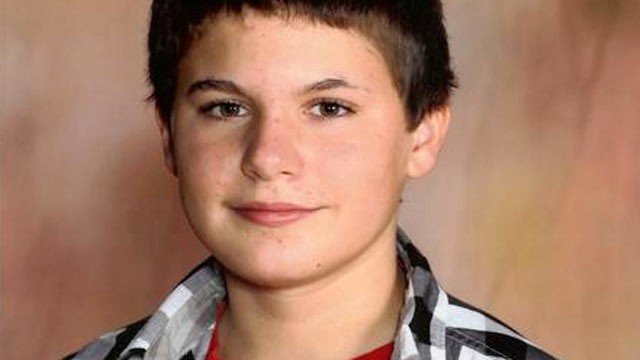
This weekend, just a few months after he filmed a video for the "It Gets Better" project, 14-year-old Jamey Rodemeyer of Buffalo, NY was found dead from an apparent suicide. Earlier this month he blogged, "I always say how bullied I am, but no one listens. What do I have to do so people will listen to me?"
* * * * 
Tracy Rodemeyer says her son, "Has had issues since fifth grade. He had suicidal tendencies back then." Things got particularly bad a year ago when he created a Formspring account and started receiving hateful messages:
"JAMIE IS STUPID, GAY, FAT ANND UGLY. HE MUST DIE!" read one post.
Another read: "I wouldn't care if you died. No one would. So just do it :) It would make everyone WAY more happier!"
The messages were reported to guidance counselors at his middle school, and Jamey was seeing a social worker and therapist.
* * * *
Jamey is the second Williamsville North High School student to commit suicide this year, but school officials say they did all they could. Dale Bauer, a licensed school social worker and clinical social worker at Williamsville, says the school offers some counseling, but isn't a mental health clinic.
 * * * *
In a post responding to news of the Jamey's death, Dan Savage says that those who bullied him, "need to be held to account-not bullied themselves, not prosecuted or persecuted, but held to account-for their actions, for their hate, for the harm they've caused." He adds:
The point of the "It Gets Better" project is to give kids like Jamey Rodemeyer hope for their futures. But sometimes hope isn't enough. Sometimes the damage done by hate and by haters is simply too great. Sometimes the future seems too remote. And those are the times our hearts break.

Friday, June 3, 2011

San Francisco Giants - First Pro Sports Team to Join the It Gets Better Campaign

https://blogger.googleusercontent.com/img/b/R29vZ2xl/AVvXsEjvbjbIXWUGFkR1sWwQY_I0kkW1L1kSI8fFhp9IP62rmSsVgTUW_0PJs0YZ_GJm89fliJl1laJ5vGUXKib-iqF_J7E7zV3Y8h34KhAFkaQyJ09Mlq3mehD0QZ9ILgX-QgSH9zHplWaO8mc/s1600/Matt+Cain.jpg
Matt Cain

Somehow it's not surprising that San Francisco's Giants are the first pro sports team to join the It Gets Better Project. On the other hand, to take this stand in the largely anti-gay world of professional sports is an important and admirable thing to do. Good for them. Male sports remain one of the last places where it is acceptable to be openly homophobic.

So, at least for now, it really doesn't get better if you are gay and you are an athlete. Which really sucks.

Via Rolling Stone:

Major League Baseball to LGBT: "It Gets Better"

The San Francisco Giants have become the first professional sports franchise to join the It Gets Better campaign on behalf of bullied gay youth.

Watch their contribution below:


Professional sports are still rank with homophobia, so major props to pitchers Barry Zito, Matt Cain, Sergio Romo and outfielder Andres Torres for standing up for gay teens.


Monday, May 30, 2011

Authors@Google: Dan Savage and Terry Miller - It Gets Better, the Book

Dan Savage and his husband Terry Miller founded the It Gets Better Project, and it has been wildly successful in bringing in big name celebrity support (from average folks to President Obama) to help convince young men and women that the bullying stops, life changes, and it does get better.

I have heard from therapists, however, that many teens cannot connect with the older adults who wish to support them - the day-to-day hell is still weighing on them like a ton of bricks.

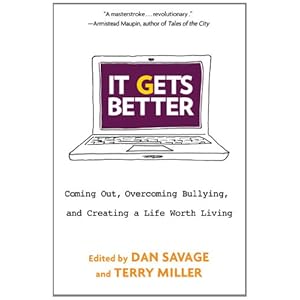
Even so, I think the project is important, and I am glad to hear they have published a book - It Gets Better: Coming Out, Overcoming Bullying, and Creating a Life Worth Living - which Dan and Terry talk about in the Authors@Google segment.
It Gets Better, the Book

Dan Savage and Terry Miller spoke to Googlers in Mountain View in May, 2011 about their book It Gets Better: Coming Out, Overcoming Bullying, and Creating a Life Worth Living and http://www.itgetsbetter.org/.

Dan Savage is the well-known columnist for Seattle's The Stranger, and the founder of the It Gets Better project, which uses videos on YouTube to send positive messages to at-risk LGBT youth.


Tags: , , , , , , , , , , , , , , , , , , , ,

Wednesday, May 18, 2011

The Meaning of Don Lemon's Coming Out

For those who are not aware or did not notice, CNN anchor Don Lemon came out last week - making him the first (as far as I know) openly gay news anchor on a major network (Rachel Maddow is the only lesbian anchor I know about). Good for him - I can't imagine what it must be like to live one's life in fear of being outed. It's sad that it even matters who one loves and that a man can lose his livelihood over it.

My online friend Sage, who blogs at The Whole World Is a Single Flower, feels especially good about this for one reason - Don Lemon is a black, gay man.

Why Don Lemon's Coming Out As Gay Personally Matters to Me

CNN News Anchor Don Lemon

Why does CNN News anchor Don Lemon's coming out mean so much to me personally? In two words--because he's a black man. Yes, that pretty much sums it up.

Each member of alphabet soup we know of as the LGBTQQI (Lesbian, Gay, Bisexual, Trans --sexual and/or transgender--Queer, Questioning, Intersex) community faces both collective and unique challenges. For example, in the area of unique challenges, trans people are still considered personae non gratae to far too many gay and lesbian men and women who would seriously like to see them completely disappear from that alphabet soup. Bisexual men are often viewed as closeted gay men who haven't completely come out and/or who are taking a "safer" route, etc. We humans seem to have never ending ways of splintering ourselves into ever more ridiculous sub-categories, each vying for some illusory sense of cultural privilege and entitlement. We are masters at finding ways to ostracize ourselves from one another.
Read the whole post.


Friday, December 24, 2010

Bullying, Part 2 - Targeting LGBT Youth

http://cci.sfsu.edu/files/images/FAP_logo.preview.JPG

In part one of this two-part post, I offered an article from the Boston Globe on the horrible and lasting effects bullying can have on the child's brain. LGBT youth are easy targets for harassment and bullying by their fellow students, and even by school authorities (LGBT youth are 40 percent more likely than other teens to be punished by school authorities, police and the courts).

On the bright side, support and acceptance by parents can help mitigate the impact of that harassment - when that support and existence exists, that is. There is also, now, the It Gets Better Project, initiated by Dan Savage.

For a variety of reasons, gay youth are the most common targets. Lesbian youth are not as ostracized and transgender youth are far less common (though they may be more troubled if they are identified by peers). This comes from the It Gets Better Project website.

Growing up isn’t easy. Many young people face daily tormenting and bullying, leading them to feel like they have nowhere to turn. This is especially true for LGBT kids and teens, who often hide their sexuality for fear of bullying. Without other openly gay adults and mentors in their lives, they can't imagine what their future may hold. In many instances, gay and lesbian adolescents are taunted — even tortured — simply for being themselves.

Justin Aaberg. Billy Lucas. Cody Barker. Asher Brown. Seth Walsh. Raymond Chase. Tyler Clementi. They were tragic examples of youth who could not believe that it does actually get better.

While many of these teens couldn’t see a positive future for themselves, we can. The It Gets Better Project was created to show young LGBT people the levels of happiness, potential, and positivity their lives will reach – if they can just get through their teen years. The It Gets Better Project wants to remind teenagers in the LGBT community that they are not alone — and it WILL get better.

Fortunately, mental health services can also help - and may be a necessity when parents are not accepting and supportive. This comes from the Center for American Progress.

Idea of the Day: Mental Health Services Can Help LGBT Youth Cope with Harassment

Lesbian, gay, bisexual, and transgender teenagers are some of the most vulnerable of people in the United States today. They face discrimination and harassment from a variety of different sources: bullying and harassment in schools, rejection at home, and condemnation from media and religious organizations. A fear of persecution encourages many LGBT teens to keep their real identities hidden.

Living with the stress of a marginalized identity has clear and negative effects on the mental health of LGBT youth. They are consistently reported as having higher rates of depression and anxiety than their non-LGBT peers. Even more troubling, studies have demonstrated that these young adults are more likely than non-LGBT teenagers to engage in self-harm, have suicidal thoughts, and attempt suicide.

Providing LGBT adolescents with access to mental health services is essential to helping them cope with the extreme pressures that have led many of them to consider suicide. Numerous studies have already demonstrated the benefits of mental health treatment for people suffering from depression and other mood disorders. Mental health counseling and therapy have a high probability of improving the mental health and wellbeing of teens, even when unaccompanied by medication.

For more on this topic please see:

I find it especially disturbing that adults - school officials, law enforcement, and the courts are more likely to punish LGBT youth that other young people. Apparently, lesbian youth are twice as likely to be stopped by police than their peers. My question on that would be: Is this about their sexual preference or is a form of sexual harassment?

Lesbian, gay and bisexual teens singled out for punishment

Posted On: December 6, 2010

Lesbian, gay and bisexual (LGB) adolescents are about 40 percent more likely than other teens to be punished by school authorities, police and the courts, according to a study by Yale University researchers. Published in the January 2011 issue of the journal Pediatrics, the study is the first to document excessive punishment of LGB youth nationwide.

"We found that virtually all types of punishment—including school expulsions, arrests, juvenile convictions, adult convictions and especially police stops—were more frequently meted out to LGB youth," said lead author Kathryn Himmelstein, who initiated the study while she was a Yale undergraduate. The research was supervised by Hannah Brueckner, professor of sociology and co-director of the Center for Research on Inequalities and the Life Course at Yale.

The study was based on the National Longitudinal Study of Adolescent Health (Add Health) and included about 15,000 middle and high school students who were followed for seven years into early adulthood. The study collected details on participants' sexuality, including feelings of sexual attraction, sexual relationships and self-labeling as LGB. Add Health also surveyed participants about how frequently they engaged in a variety of misbehaviors, ranging in severity from lying to parents, to using a weapon.

Add Health included detailed questions about school expulsions and contacts with the criminal justice system.

Himmelstein, who now teaches math at a public high school in New York City, said that adolescents who identified themselves as LGB were about 50 percent more likely to be stopped by police than other teenagers. Teens who reported feelings of attraction to members of the same sex, regardless of their self-identification, were more likely than other teens to be expelled from school or convicted of crimes as adults.

"Girls who labeled themselves as lesbian or bisexual were especially at risk for unequal treatment," said Himmelstein. "They reported experiencing twice as many police stops, arrests and convictions as other girls who had engaged in similar behavior. Although we did not explore the experiences of transgender youth, anecdotal reports suggest that they are similarly at risk for excessive punishment."

The study showed that these disparities in punishments are not explained by differences in the rates of misbehavior. In fact, the study showed that adolescents who identified themselves as LGB actually engaged in less violence than their peers.

"The painful, even lethal bullying that LGB youth suffer at the hands of their peers has been highlighted by recent tragic events," Himmelstein notes. "Our numbers suggest that school officials, police and judges, who should be protecting LGB youth, are instead singling them out for punishment based on their sexual orientation. LGB teens can't thrive if adults single them out for punishment because of their sexual orientation."

Brueckner added, "The study provides the first and only national estimates for over-representation of LGB youth in the criminal justice system. We simply did not have any good numbers on this before. We need more research on the processes that lead to this to help us identify ways to make our institutions more equitable with respect to policing all youth, regardless of race, gender, or sexual orientation."

~ Source: Yale University
Finally, there is this piece that shows how important it is for parents to be supportive. Many parents want to be supportive, but they were raised with values that reject LGBT people as sinful, or a mental illness, or whatever. They struggle to overcome their internalized beliefs - to accept and love their children - but they often do not know how. The Family Acceptance Project can help parents develop the skills they need.

Study finds family acceptance of LGBT youth protects against depression, substance abuse, suicide

Posted On: December 6, 2010

For the first time, researchers have established a clear link between accepting family attitudes and behaviors towards their lesbian, gay, bisexual and transgender (LGBT) children and significantly decreased risk and better overall health in adulthood. The study shows that specific parental and caregiver behaviors -- such as advocating for their children when they are mistreated because of their LGBT identity or supporting their gender expression -- protect against depression, substance abuse, suicidal thoughts and suicide attempts in early adulthood.

In addition, LGBT youth with highly accepting families have significantly higher levels of self-esteem and social support in young adulthood. The study is published in the Journal of Child and Adolescent Psychiatric Nursing, a journal of the International Society of Psychiatric-Mental Health Nurses, in a peer-reviewed article titled "Family Acceptance in Adolescence and the Health of LGBT Young Adults."

Despite all the recent attention to health risks and disparities for lesbian, gay and bisexual youth, prior to this study, little was known about how families express acceptance and support for their LGBT children. Moreover, no prior research had examined the relationship between family acceptance of LGBT adolescents and health and mental health concerns in emerging adulthood.

"At a time when the media and families are becoming acutely aware of the risk that many LGBT youth experience, our findings that family acceptance protects against suicidal thoughts and behaviors, depression and substance abuse offer a gateway to hope for LGBT youth and families that struggle with how to balance deeply held religious and personal values with love for their LGBT children," said Dr. Caitlin Ryan, PhD, Director of the Family Acceptance Project at San Francisco State University. "I have worked on LGBT health and mental health for 35 years and putting our research into practice by developing a new model to help diverse families support their LGBT children is the most hopeful work I've ever done."

Ann P. Haas, Ph.D., Director of Prevention Projects for the American Foundation for Suicide Prevention, noted, "With this new groundbreaking study, Ryan and her colleagues have provided the strongest evidence to date that acceptance and support from parents and caregivers promote well-being among LGBT youth and help protect them from depression and suicidal behavior. These findings open the door to a whole new focus on how families can be helped to more fully engage in the kind of behaviors that reduce suicide risk in LGBT adolescents and young adults."

"Times have changed," said Stephen Russell, PhD, President Elect of the Society for Research on Adolescence and a consultant to the Family Acceptance Project. "More and more families want to be accepting of their children. Yet, many families still struggle when a child comes out as LGBT. It's essential to have research like this to deeply understand the ways that families show their acceptance, so that we can identify how to support families."

The study, authored by Dr. Caitlin Ryan and her team from the Family Acceptance Project, which shows that accepting behaviors of parents and caregivers towards their LGBT children are protective against mental health risks – including suicidal behaviors -- has critical implications for changing how families relate to their LGBT children and how LGBT youth are served by a wide range of providers across disciplines and systems of care, including custodial care systems such as foster care. The study was funded by The California Endowment, a health foundation dedicated to expanding access to affordable, quality health care for underserved individuals and communities.

Major Research Findings:

  • Family accepting behaviors towards LGBT youth during adolescence protect against suicide, depression and substance abuse.
  • LGBT young adults who reported high levels of family acceptance during adolescence had significantly higher levels of self-esteem, social support and general health, compared to peers with low levels of family acceptance.
  • LGBT young adults who reported low levels of family rejection during adolescence were over three times more likely to have suicidal thoughts and to report suicide attempts, compared to those with high levels of family acceptance.
  • High religious involvement in families was strongly associated with low acceptance of LGBT children.

Dr. Ryan and her team at the Family Acceptance Project are currently developing a new evidence-based family model of wellness, prevention and care for LGBT adolescents, with funding from the Robert Wood Johnson Foundation. This model uses a behavioral approach to help ethnically and religiously diverse families decrease rejection and increase support for their LGBT children to reduce risk for suicide, depression, substance abuse, and HIV, to promote well-being and to prevent homelessness and placement in custodial care. This systems-level approach helps communities and providers to engage diverse families as allies in decreasing their LGBT children's risk and increasing their well-being while respecting the family's deeply held values. This work is being conducted in English, Spanish and Chinese with families from all ethnic backgrounds, including immigrant and very low income families, and those whose children are out-of-home in foster care and juvenile justice facilities.

The existing approach to serving LGBT adolescents by pediatricians, nurses, social workers, school counselors and others has focused almost exclusively on serving LGBT youth alone and through peer support, rather than in the context of their families, and does not consider the impact of family reactions on the adolescent's health and well-being.

In addition to providing direct services for families with LGBT children and working with communities in the U.S., the Family Acceptance Project is collaborating with organizations, providers, advocates and families to develop an international movement of family acceptance to promote wellness and healthy futures for LGBT children, youth and young adults.

"Family Acceptance in Adolescence and the Health of LGBT Young Adults" is the third in a series of research papers on outcomes related to family acceptance and rejection of LGBT adolescents, supporting positive LGBT youth development, school experiences and providing family-related care to be released by the Family Acceptance Project.

These studies will be published in peer-reviewed journals designed for providers, caregivers and practitioners from a wide range of disciplines and practice settings.

~ Source: San Francisco State University

Here are a few resources for LGBT youth and their families - if you need some support, these people can help, and connect you with someone who can.

National Sexuality Resource Center

2017 Mission Street, Suite 300
San Francisco, CA 94110
415-437-5121 begin_of_the_skype_highlighting 415-437-5121 end_of_the_skype_highlighting
nsrcinfo@sfsu.edu
nsrc.sfsu.edu

The National Sexuality Resource Center is a sexuality information center affiliated with the Human Sexuality Studies Program at San Francisco State University (SFSU). The Center collects and disseminates the latest information and research on sexual health, education, and rights to advocates, academics, researchers, policy makers, and diverse communities throughout the U.S.

LGBT Family-Related Organizations

PFLAG

(National Federation of Parents and Friends of Lesbian and Gays)
1726 M Street, N.W., Suite 400
Washington, DC, 20036
202-467-8180 begin_of_the_skype_highlighting 202-467-8180 end_of_the_skype_highlighting
www.pflag.org

National organization for education, advocacy and support for families and friends of LGBT persons. Chapters are available in all states – check website for local chapters and educational materials for families.

HRC FamilyNet

Human Rights Campaign
1640 Rhode Island Avenue
Washington, DC 20036
202-628-4160 begin_of_the_skype_highlighting 202-628-4160 end_of_the_skype_highlighting
www.hrc.org

A resource and online information base for LGBT families sponsored by the Human Rights Campaign.

Children of Lesbian and Gays Everywhere (COLAGE)

2300 Market Street, Box 165
San Francisco, CA 94114
415-861-5437 begin_of_the_skype_highlighting 415-861-5437 end_of_the_skype_highlighting
www.colage.org

National organization for children of LGBT parents.

Family Pride Coalition

PO Box 65327
Washington, DC 20035-5327
202-331-5015 begin_of_the_skype_highlighting 202-331-5015 end_of_the_skype_highlighting
www.familypride.org

National organization to provide advocacy and support for LGBT parents and their families.

LGBT Youth Organizations

National Youth Advocacy Coalition

1638 R Street NW, Suite 300
Washington, DC 20009
202.319.7596 begin_of_the_skype_highlighting 202.319.7596 end_of_the_skype_highlighting
Toll-free: 800-541-6922 begin_of_the_skype_highlighting 800-541-6922 end_of_the_skype_highlighting
www.nyacyouth.org

National advocacy organization for LGBT youth. Youth conferences and education.


Monday, October 11, 2010

National Coming Out Day 2010 - Personal Reflections

http://safeplace.mtu.edu/images/manual/safeplace_big.jpg

Today is National Coming Out Day, 2010, a day in which anyone who is living in any kind of "closet" is encouraged to step out into the light and no longer be afraid to be the person you were born to be.

Statistics

  • 9 out of 10 LGBT students have experienced harassment at school.
  • LGBT teens are bullied 2 to 3 times as much as straight teens.
  • More than 1/3 of LGBT kids have attempted to commit suicide.
  • LGBT kids are 4 times as likely to attempt suicide then our straight peers.
  • LGBT youth with “highly rejecting” families are 8 times more likely to attempt suicide than those whose families accept them.
I want to take a quick moment here to promote Dan Savage's It Gets Better Project - and to take the pledge:
THE PLEDGE: We are the kids who have been bullied for being gay, lesbian, bi or trans. We pledge to stay open and strong. We are also the friends, family members, teachers, mentors, and allies of anyone who’s ever felt like they didn’t fit in, gay or straight. We pledge to talk to the kids in our lives to put an end to the hate, violence, and tragedy — and to offer advice on coping, strategies to make it better, and to remind kids that It Gets Better.
Some regular readers of this blog, or my other blog (Integral Options Cafe), know that I believe sexuality is a spectrum, not a binary. Almost no one is either 100% straight or 100% gay in my experience.

I am in a long-term relationship with Jami, a woman, and the majority of my longer relationships have been with women. But I do not identify as straight, nor am I bisexual or gay. In fact, I tend not to identify at all if I can help it.

In my personal experience, love is not gender specific - my emotions do not take the other person's genitals into account when that connection is present. It's about the connection, the chemistry, the sense of safety and intimacy.

Unfortunately, a lot of people, men in particular, do not see this issue in the same way that I do. Maybe it's a religious issue, or homophobia, or simply a fear of that which is "other" - it really doesn't matter, all of them deny another person his/her full rights as a human being, including the right to feel safe from ridicule, harassment, or violence.

Most bullying of and violence against GLBT youth is perpetrated by males - and among young males, the only thing worse than being considered feminine is being seen as a "fag." We use these labels to keep young men trapped in traditional gender roles, to crush their sense of identity, to shame them into the closet.

The problem often starts with men - so the solution begins with men. As parents, as teachers, as coaches, as mentors, it is up to us to teach young people that people are all the same, all deserving of love and acceptance, not shame, not harassment, not bullying.

* * * * *

Paul Katz's article at Huffington Post today represents the experience of a lot of young men who are gay or who experience same-sex attraction (the two are not necessarily the same) - Gay Bullying: How I Know It Does Get Better - he was horribly bullied. Here is a part of his story:

Although I was horribly bullied, my thoughts never turned to suicide. My parents loved and protected me. Neighbors and teachers watched out for me. I joke that watching too many ABC After School Specials about troubled teens helped me to know taking my life was not the answer. Somehow, even then, I knew it was going to be better someday.

Four years later, I came out as gay. I expected the bullying to get worse, but to my near shock, it practically stopped.

Looking back, one reason I think the bullying largely stopped was because of my high school involvement in theater and music departments. The arts absolutely provided me with an outlet for creative expression, and I believe whatever talents people thought I had outweighed any issues with my romantic or sexual preferences.

Only one person ever gave me a problem. He was a football jock a year younger and threatened to kill me all the time. I was constantly in the Dean's office dealing with it. Ironically enough, his last name was Queen.

Within a year of my graduation from high school, the jock had started dabbling in the theater department. In 1989, I was surprised to find him among my castmates in a summer theater production.

During a social event, this bully who continually threatened to kill me came out to me. I asked him how he could possibly explain why he'd given me so much grief. He said, "Look, if you hadn't been "so out" I never would have thought about being gay." So he blamed me.

Because of him, to this day I absolutely believe "those who protest the most" are repressing their own gay desires and fascinations. It continues to be proven over and over again with each "gay scandal" that comes out of a religious sect or the political arena.

The Trevor Project is currently spotlighting a slew of videos from celebrities encouraging gay youth to know that "it does get better." This blog is my way of doing what I can to assist in getting that message out as well.

The bullies come after you because you know who you are. Your comfort in your own skin makes them jealous, afraid, miserable and unhappy. So they want to make you feel the same way they do. Do not let the bullies win. It does get better, especially once you're out of high school. Just hold on. I did and so have millions of others.

A friend of mine sent me the video below created by "The Young and the Restless" actor Thom Bierdz. The theater and music departments I mentioned above, and the adults who ran them, helped me tremendously as a gay teen. Just as I am moved by what The Trevor Project is doing, I am equally moved by Thom's efforts and wanted to bring more attention to his video and AmericanArtAwards.com.

WATCH:


* * * * *

What Paul says at the end of his post is crucial - gay youth know who they are, and for others who do not have this self awareness, those kids are scary and intimidating.

When I was that age, I did not know who I was - I feel as though I was a bully, not necessarily toward gay kids, but toward others who seemed also not to know who they were - each a painful reminder of my own self-doubt and insecurity.

Even now, I am ashamed of who I was as a teen - not for being insecure or lacking self-knowledge, but for anything I did or may have done (or those that I did not stop) that made life harder and less enjoyable for the young people around me. I'm profoundly sorry.

I cannot undo the things I have done in the past, but I can make a difference in the present and in the future. I can work for tolerance and compassion in my community and I can assist people (men in particular) in embracing their identities as men - straight, gay, trans, bi, or however they identify.

No one should ever be afraid to stand in the light and say, with pride, I am . . . . .