My girlfriend is a Certified Sex Addiction Therapist and we both have worked with men (and in her case some women, I believe) who are, beyond a doubt, sex addicts. These people have lost homes, spouses, jobs, and all of their assets because of their addiction. This is a little different than being a womanizer or surfing too much internet porn.
The key factor for sex as an addiction, in my opinion, is that it is a compulsive form of self-medication. Sex addiction is a process addiction (a behavior rather than a substance), and its cycle looks like this:

Patrick Carnes, who Klein rightly acknowledges as the pioneer in sex addiction diagnosis and treatment, identifies four core beliefs held by most sex addicts in one form or another (and if you substitute something else for sex in the fourth one, like cocaine, heroin, or food, these may apply to all addicts).
- I am basically a bad, unworthy person
- No one would love me as I am
- My needs are never going to be met if I have to depend upon others
- Sex is my most important need
The first core belief of the addict is “I am basically a bad, unworthy person.” Abandonment means being unwanted. The child can only conclude that being unwanted means being unworthy and bad.In my experience, the self-medicating aspect is a reply to the inner sense of worthlessness and feeling unlovable. Some kids who have this sense of shame discover alcohol or drugs (for me it was alcohol and marijuana), other kids discover sex or food - either way, what is a normal healthy behavior becomes pathological because it is used to numb, to dissociate, to medicate away the pain of living with shame.
___
A second core belief comes from the first core belief about the child being a bad person. Because of personal unworthiness, the child believes, “No one would love me as I am.” Relationships with others become more tenuous the deeper this belief is. Children grow up believing that no one will accept them unconditionally. People will not be there; they cannot be trusted or depended on. If they do want a relationship, it is because they want something—not because they care. There will always be a price to pay. Minimally, there will be something that must be overlooked, ignored, or denied. To be close will mean to lose reality or integrity somehow. So intimacy is avoided.
___
[I]n the lonely search for something or someone to depend on—which has already excluded parents—a child can start to find those things which always comfort, which always feel good, which always are there, and which always do what they promise. For some, alcohol and drugs are the answer. For others it is food. And there is always sex, which usually costs nothing and nobody else can regulate.
This choice stems from the addict’s third core belief that is about needs: “My needs are never going to be met if I have to depend upon others.” In healthy families, children have a deep sense that their parents care for them as opposed to abandoning them.
Healthy parenting includes touching, loving, affirming, and guiding. The child feels cared for even when struggling with rules and limits. Trust in one’s self, as well as trust of others, emerges in that relationship.
When a child’s exploration of sexuality goes beyond discovery to routine self-comforting because of the lack of human care, there is potential for addiction [emphasis added]. Sex becomes confused with comforting and nurturing. Moreover, the assumption is made that everyone else feels and acts the same. Therefore, to feel secure means to be sexual.
Consequently, the child’s relationships with people have the potential for being replaced with an addictive relationship with sexuality. Addiction is a relationship—a pathological relationship in which sexual obsession replaces people. And it can start very early. The final core belief of the addict emerges clearly: “Sex is my most important need.”
The kinds of childhood situations described here are further complicated when the children are surrounded by negative rules, messages, and judgments about sex. When addicts and their spouses study their families of origin, they are flooded with memories of events where they were told that being sexual was bad or, worse, that they were bad for being sexual.
When children’s primary source of comfort is sex and yet they are told by those whose judgments count the most that to be sexual is perverse, the conclusions they make about themselves are clear. They are unlikable. They need to hide that central part of themselves, which others will despise. Rather than repressing the sexual behaviors, they hide them or keep them secret. Needing to keep that central part of themselves secret adds to the pain and loneliness—which, in turn, creates a need for comfort, making the sexual fix that much more necessary.
The worst part of it is that the addict feels more shame when s/he tries to control or stop the behavior and can't - then they act out to numb that shame, and the cycle spirals downward until the person's life is out of control.
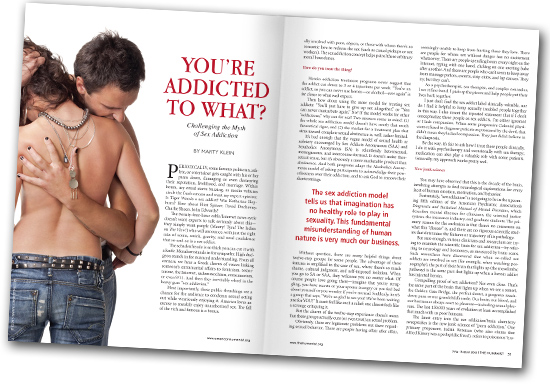
Read the whole article.You’re Addicted to What?
Challenging the Myth of Sex Addiction
by: Marty Klein
Published in the July/August 2012 Humanist
Periodically, some famous politician, athlete, or entertainer gets caught with his or her pants down, damaging or even destroying their reputation, livelihood, and marriage. Within hours, my email starts buzzing, as media vultures circle the fresh carcass and want my expert opinion: Is Tiger Woods a sex addict? Was Katharine Hepburn? How about Eliot Spitzer, David Duchovny, Charlie Sheen, John Edwards?
The twenty-four-hour cable/Internet news cycle doesn’t want experts to talk seriously about this—they simply want people (Maury! Tyra! The ladies on The View!) who will announce, with just the right mix of scorn, smirk, gravity, and total confidence that so-and-so is a sex addict.
The schadenfreude is so thick you can cut it with a knife. Moralism stands in for sympathy. High dudgeon stands in for nuanced understanding. From all corners, we hear a Greek chorus of voices linking someone’s extramarital affairs to feminism, testosterone, the Internet, sadomasochism, consumerism, or even 9/11. And then they inevitably wheel in the heavy gun: “sex addiction.”
Most importantly, these public thrashings are a chance for the audience to condemn sexual acting out while vicariously enjoying it. America loves an excuse to sneakily enjoy unauthorized sex. The fall of the rich and famous is a bonus.
So when USA Today calls about Eliot Spitzer’s high-end escorts, or CNN emails about Anthony Weiner’s sexting, I’m usually pretty slow to respond to the ghoulish invitation.
I don’t diagnose people I haven’t met. More importantly, I don’t use the diagnosis of sex addiction. In thirty-one years as a sex therapist, marriage counselor, and psychotherapist, I’ve never seen sex addiction. I’ve heard about virtually every sexual variation, obsession, fantasy, trauma, and involvement with sex workers, but I’ve never seen sex addiction.
New patients tell me all the time how they can’t keep from doing self-destructive sexual things; still, I see no sex addiction. Instead, I see people regretting the sexual choices they make, often denying that these are decisions. I see people wanting to change, but not wanting to give up what makes them feel alive or young or loved or adequate; wanting the advantages of changing, but not wanting to give up what makes them feel they’re better or sexier or naughtier than other people. Most importantly, I see people wanting to stop doing what makes them feel powerful, attractive, or loved, but since they don’t want to stop feeling powerful, attractive or loved, they can’t seem to stop the repetitive sex clumsily designed to create those feelings.
The conflict over sex addiction is important to humanists for several reasons. “Sex addiction” is a special weapon now used by the religious right to combat perceived liberalism, to ignore science, and to ignite fear. It also helps legitimize anti-sex moralism and bigotry. And psychologists, judges, legislators, and the media are buying it.
When people refer to themselves or others as “sex addicts,” what are they actually talking about? More than anything, simple narcissistic character structure: the familiar “I guess I thought I could get away with it,” “Deep down, I don’t really believe the rules apply to me,” or “When I hurt, I want relief, and I don’t care so much about breaking promises or hurting others.”
If that sounds like normal people—if that sounds like you—it’s not surprising. Narcissism is a common human condition. So here’s my evaluation of almost everyone who is diagnosed as a sex addict—by themselves, their loved ones, or an addictionologist: it’s someone who is unhappy with the consequences of their sexual choices, but who finds it too emotionally painful to make different choices. You know, the way some of us are with cookies, new sweaters, or watching the Kardashians on TV.
Which is to say, it’s not about the sex. It’s about the immature decision-making.
The rest of the people who are in pain about their sexual decision-making are generally struggling with one or more of the following: compulsivity, impulsivity, obsessive-compulsive disorder, bipolar disorder, borderline personality disorder, or post-traumatic stress disorder. An idiosyncratic response to medication can even be a factor.
So when people talk about sex addiction, they’re really talking about all of these, and more. When someone says, “sexually, I’m out of control,” that doesn’t tell us very much. When we know someone has affair after affair; or that someone regularly masturbates to the point of pain; or that someone constantly pressures his wife for sex regardless of how unrealistic it is (she’s post-partum, she has the flu, his parents are in the next room, they had a big fight just a few hours ago); or that someone is pursuing anonymous sex in public parks in a way that’s begging for jail time and loss of career; or that someone watches three hours of porn per night, we simply don’t know very much about the person.
On the other hand, anyone who says “sexually, I’m out of control” is automatically welcomed into the fellowship of sex addicts—without any attempt to evaluate that person’s mental state. Sex therapists generally don’t get distracted by the sexual part of patients’ stories. Those without training in sexuality—like so-called sex addiction counselors—often do.
Let’s examine this cultural phenomenon in more detail.






Mon, Jun 7, 2010