Showing posts with label religion. Show all posts

Friday, December 20, 2013

Jim Palmer - Living with Your Heart Flung Wide Open

This is a nice quote from Jim Palmer's new book, Notes from (Over) the Edge: Unmasking the Truth to End Your Suffering.

Living with your heart flung wide open

December 19, 2013


“Jesus came to awaken our heart. Religion too often makes God about rules and rituals, duties and doctrines. It defines our holiness by our allegiance and compliance to the organization, tradition, and system. Over and against religion, Jesus showed up and calls for an awakening of the heart. Jesus invited all people to allow themselves to be loved by God – to open our hearts and know that we are lovable… ever last single one of us. Jesus said look at me and see what God is like, and then he knelt in the dirt to rescue a woman who had been written off by religion. Jesus taught us that love is not an idea. It’s something you feel in your heart, and then you bring expression to it through your humanity. The truth is not a sterile and indifferent philosophy, or a theological creed. Jesus said, “I am the truth,” and then he lived a life of love. He flung his heart wide open to God and the world.”

- Jim Palmer, Notes from (Over) the Edge: Unmasking the Truth to End Your Suffering

Sunday, October 27, 2013

Jim Palmer - Jesus Was Not a Christian

"Jesus was not a Christian. He is not the founder of Christianity. Christianity is a religion created in the name of Jesus, and is much different from the actual truth that Jesus taught. Were Jesus alive today, I don’t think Jesus would be a Christian. Jesus is still one of best-kept secrets because his truth has been grossly distorted by those who claim to speak for him. There is a religion-free Jesus who belongs to all of humankind. Christianity does not own or have first rights to Jesus. His truth has universal significance. It’s often the case that you have to disentangle Jesus from institutional Christianity in order to uncover his truth." 

- Jim Palmer, Notes from (Over) the Edge - (a new book-in-progress)
Jim Palmer describes himself as a "Religion-Free Jesus Follower."  Here is a recent blog post the offers some insight into his spiritual journey.

Common objections to shedding religion

October 25, 2013


I began sharing my faith journey as an author in 2005, publishing Divine Nobodies: Shedding Religion to Find God (and the unlikely people who help you) (2006). The book struck a nerve, and my Inbox was flooded with emails from others who were trying to untangle their lives and faith from religion. Ordinary people, mainly from a Christian background, they had come to the end of their rope with faith and God, but felt understood and validated through my story, and inspired by the possibility that it could be different.

Seeing that people often got stuck in their disenchantment with religion, my follow-up book, Wide Open Spaces: Beyond Paint-by-Number Christianity (2007), gave a glimpse into what it might look like to live a religion-free relationship with God. I also noticed that many of these people in the throes of spiritual crisis chose to abandon God and Jesus altogether. My third book, Being Jesus in Nashville: Finding the Courage to Live Your Life (whoever and wherever you are) (2012), spoke to this issue as I shared my story of discovering a religion-free Jesus who finally set me free from my religious pathologies and led me forward in my spiritual pilgrimage.

People often take issue with and object to people who are “shedding religion” to know God. I decided to identify and address some of the most common objections I hear.

You don’t go to church anymore


If a person’s involvement in a church feeds and reinforces a message and perspective that hinders their knowing God, then it makes complete sense not to involve yourself there anymore. Many Christians receive their understanding about God through the institution of Church and when they discover this understanding is deeply flawed and they see how this flawed understanding has damaged their lives, they remove themselves from their church. The reason most people object to this is because these confuse leaving one’s church with leaving one’s faith. Research shows that “church leavers” grow stronger in their faith, as opposed to digressing in their faith. The issue is also controversial because people wrongly equate “church” with their specific form of church. There are an endless number of forms of church ranging from highly organized to practically no organization at all. Many people who leave organized church eventually connect in smaller, more informal types of community, which may not comply with the letter of the law when it comes to institutional church but fulfills the true spirit of “church.”


You are reading some really weird books


Many Christians in the “shedding religion” process will read books that: a) looks at their Christian faith with a critical eye, b) promotes spirituality over religion, c) offers a different and fresh view and perspective on faith and God. Shedders will be drawn to authors who offer something beyond institutional Christianity and offer the prospect of knowing God and following Jesus as a way of life as opposed to check-list Churchianity. many of these authors, including myself, get hammered by the Christian establishment. If you mess with city hall, you’re going to pay for it. People criticize such authors as having “bad theology.” In my opinion, many of the criticizers have “bad theology,” and so I’m not sure where that argument ends. People who are “shedding religion” are also drawn to books that promote and speak to spirituality over religion or books that focus on nurturing your inner world. You’d be surprised to know even how many church-going Christians secretly read Eckhart Tolle books but would never admit it. For some people, reading one chapter from The Power of Now was worth more than one year of sermons. This is also the reason why some Christians become interested in Buddhism and Eastern spirituality; these seem to speak more deeply to the root condition of humankind and one’s inner spiritual world as opposed to the focus of a lot of pop-Christian writings. At first, some people are not aware that there is a rich Christian tradition of contemplatives and mystics who lived a very robust Christ-centered spirituality. A few contemporary examples might be Thomas Merton, Ricahrd Rohr, Bede Griffiths, and Flora Wueller.

You are in danger of going off the deep end


Perhaps one of the most annoying things (to those who judge them) about people who are shedding religion is that they begin thinking for themselves. Some Christians have come from churches where the idea is fostered that congregants should only expose themselves to church-approved leaders, teachers, writers, musicians, politicians etc…because doing otherwise would be the equivalent of purchasing a one-way ticket to the flames of hell. Apparently, only a very select few people are capable of discerning truth on their own, the rest of us are ill-equipped for doing so and would be easily lured into all kinds of error if left to our own. I know this may be difficult for some to believe, but people are capable of being exposed to all kinds of differing views of God, and can discern for themselves what truth is present in these views, and what of these views seems inconsistent with truth. I have a Buddhist friend; i have detected truth is things he believes but i did not become a Buddhist. I have an Atheist friend, and I totally agree with this person’s views on all kinds of things, including some of their objections to God, but i did not become an Atheist. I have a N.Y. Yankees friend, i agree that the Yankees have some of the best baseball players but I did not become a Yankees fan. People are truly capable of doing this sort of thing.

When people begin thinking for themselves and base their opinions on firsthand personal experience, they realize that the world doesn’t fit so nicely into all the labels and boxes that religion is sometimes prone toward imposing on things. Religion and politics seems to share a difficulty in disagreeing with others without demonizing them, and wants to slice up the world into the “us” and “them” camp or the “right” and “wrong” camp. I’m not talking about turning a blind eye to evil in the world, or pretending that one’s beliefs doesn’t fuel such evil. All religions, including Christians, have justified evil in the name of God.

You can’t give a straight answer


Lots of questions aren’t so easy to answer anymore for Christians in the “shedding religion” process. For example, questions like: “Are you a Christian?” or “Do you believe in the Bible?” or “Do you go to church?” or “Do you believe in the gospel?” are no longer “yes” or “no” questions for a person who is “shedding religion.” He or she is immediately wondering what is your definition of a “Christian,” and what is your interpretation of the Bible, and how you delineate what “church” is, and how do you understand the “gospel?” By not answering “yes” or “no” it is not a sign that the person is “dodging the issue;” they legitimately cannot answer with a simple “yes” or “no.” It would be better to ask more open-ended questions like, How is Jesus Christ relevant to you?

[My disclaimer: Some people say I am “too hard” on the “Christian establishment.” Let me be the first to say that I know many people who identify themselves as “Christians” who are deeply spiritual, and not guilty of the things I described above. Some of these Christians have had a big influence on my own journey. I also know there are organized forms of church that promote true and authentic Christ-centered spirituality, as well as open, honest, and authentic relationships. I know many Christian churches that are wonderful expressions of love, compassion, and service in the communities where they exist. Since my personal experiences are in some cases related to churches (including my own) and Christians (including myself) that were guilty of the above judgments, I am prone to speak of it. Based on my experience the last several years as an author and spiritual director/coach, I have encountered countless numbers of people who have a similar experiences. I mainly wrote the above post in hopes of encouraging more understanding about many people who are in “shedding religion” mode.]

Saturday, October 26, 2013

Fr. Richard Rohr - Jesus Is Not Loyal to One Religion


Fr. Richard Rohr is a Franciscan priest of the New Mexico Province and founder of the Center for Action and Contemplation (www.cac.org) in Albuquerque, New Mexico. Fr. Richard's teaching is grounded in the Franciscan alternative orthodoxy--practices of contemplation and lived kenosis (self-emptying), expressing itself in radical compassion, particularly for the socially marginalized. As a teacher, he bears witness to the universal awakening within Christian mysticism and the Perennial Tradition.

Among Fr. Rohr's many books are Immortal Diamond: The Search for Our True Self (2013),
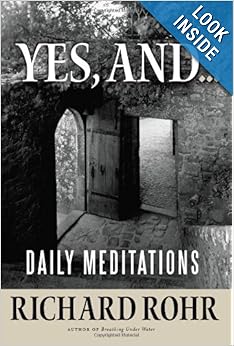
Yes, and...: Daily Meditations (2013), The Naked Now: Learning to See as the Mystics See (2009), and From Wild Man to Wise Man: Reflections on Male Spirituality (2005).

A Central Point!


Meditation 38 of 51 - Seven Themes of an Alternative Orthodoxy
Sixth Theme: The path of descent is the path of transformation. Darkness, failure, relapse, death, and woundedness are our primary teachers, rather than ideas or doctrines (Process).

Why does the Bible, and why does Jesus, tell us to care for the poor and the outsider? It is because we all need to stand in that position for our own conversion. We each need to stand under the mercy of God, the forgiveness of God, and the grace of God—to understand the very nature of reality. When we are too smug and content, then grace and mercy have no meaning—and God has no meaning. Forgiveness is not even desired. When we have pulled ourselves up by our own bootstraps, religion is always corrupted because it doesn’t understand the mystery of how divine life is transferred, how people change, and how life flows. It has been said by others that religion is largely filled with people who are afraid of hell, and spirituality is for people who have gone through hell.

Jesus is always on the side of the crucified ones. He is not loyal to one religion, or this or that group, or the “worthy” ones—Jesus is loyal to suffering itself, wherever it is. He is just as loyal to the suffering of Iraqis or Afghanis as he is to the suffering of Americans. He is just as loyal to an oppressed gay man as he is to an oppressed married woman. We do not like that! He grabs all of our self-created boundaries away from us, and suddenly all we have is a free fall into the arms of God, who is our only and solid security. This seems to be God’s very surprising agenda, if I am to believe the Bible.

Adapted from A Lever and a Place to Stand: The Contemplative Stance, the Active Prayer (CD)

The Daily Meditations for 2013 are now available in Fr. Richard’s new book Yes, And . . .

Wednesday, September 18, 2013

Brent Girouex, Confesses to Having Sex with Four Teenage Boys and Gets NO Days in Jail

This is effed up in more ways than I count. Our system is so screwed up - even the original 17 years this pedophile received was not sufficient, especially considering he is clearly delusional based on his comments.

‘Rape Away The Gay’ Pastor Brent Girouex Gets Sentence Reduced 


Rape Away The Gay Pastor Will Not Serve Time

“Rape away the gay” pastor Brent Girouex, a 31-year-old Iowa man, will not serve jail time for confessing to police that he had sex with at least four youths, according to a recent report from KRMG.

Since that confession, eight additional young men have admitted to being violated by the now-former pastor of Victory Fellowship Church in Council Bluffs, Iowa.

If you don’t want to be appalled, fair warning: you may want to skip over this next section.

Apparently, Girouex thought he could rape away the gay by “praying while he had sexual contact” with his victims in an effort to keep them “sexually pure” for God.

 He then allegedly told police that “when they would ejaculate, they would be getting rid of the evil thoughts in their mind.”

Girouex is a married father of four. Since the disturbing revelations have hit the Internet, his wife Erin has spoken out against him and the reduced sentence that he received after initially getting 17 years in prison.

Instead of upholding to that initial ruling, a judge decided to sentence Girouex to five years probation and mandatory sexual offender treatment.

Provided he doesn’t violate the terms of his probation — in other words, victimize someone else — he will not serve a day in jail.

In comments to KCCI, Erin Girouex had this to say about the idea of sending her husband to prison: “If that’s what it takes to get him away from people, then yes … I don’t want (my children) anywhere near him.”

She added that what she wants is for other victims of sexual misconduct to speak out before it’s too late.

Erin plans to file for divorce, but according to KCCI “the hang-up is that her husband wants to see their children.”

Currently, Brent Girouex has a court-ordered, twice-per-month visitation schedule, where he must be supervised by his own mother.

Here’s a mugshot: 

Rape Away The Gay Pastor Mugshot Brent Girouex


The sentence in this case has many Americans understandably perplexed at the lax attitudes toward sexual violence.

Following on the heels of a Montana judge, who only sentenced a convicted rapist to 30 days in jail after his 14-year-old victim committed suicide, it definitely establishes a horrible precedent.

Do you think the case of the “rape away the gay” pastor is proof the US does not take sexual crimes against minors seriously?


‘Rape Away The Gay’ Pastor Brent Girouex Gets Sentence Reduced Rape Away The Gay Pastor Will Not Serve Time “Rape away the gay” pastor Brent Girouex, a 31-year-old Iowa man, will not serve jail time for confessing to police that he had sex with at least four youths, according to a recent report from KRMG. Since that confession, eight additional young men have admitted to being violated by the now-former pastor of Victory Fellowship Church in Council Bluffs, Iowa. If you don’t want to be appalled, fair warning: you may want to skip over this next section. Apparently, Girouex thought he could rape away the gay by “praying while he had sexual contact” with his victims in an effort to keep them “sexually pure” for God. He then allegedly told police that “when they would ejaculate, they would be getting rid of the evil thoughts in their mind.” Girouex is a married father of four. Since the disturbing revelations have hit the Internet, his wife Erin has spoken out against him and the reduced sentence that he received after initially getting 17 years in prison. Instead of upholding to that initial ruling, a judge decided to sentence Girouex to five years probation and mandatory sexual offender treatment. Provided he doesn’t violate the terms of his probation — in other words, victimize someone else — he will not serve a day in jail. In comments to KCCI, Erin Girouex had this to say about the idea of sending her husband to prison: “If that’s what it takes to get him away from people, then yes … I don’t want (my children) anywhere near him.” She added that what she wants is for other victims of sexual misconduct to speak out before it’s too late. Erin plans to file for divorce, but according to KCCI “the hang-up is that her husband wants to see their children.” Currently, Brent Girouex has a court-ordered, twice-per-month visitation schedule, where he must be supervised by his own mother. Here’s a mugshot: Rape Away The Gay Pastor Mugshot Brent Girouex The sentence in this case has many Americans understandably perplexed at the lax attitudes toward sexual violence. Following on the heels of a Montana judge, who only sentenced a convicted rapist to 30 days in jail after his 14-year-old victim committed suicide, it definitely establishes a horrible precedent. Do you think the case of the “rape away the gay” pastor is proof the US does not take sexual crimes against minors seriously?
Read more at http://www.inquisitr.com/946459/rape-away-the-gay-pastor-brent-girouex-gets-sentence-reduced/#21F3izuySEzIyQTK.99

Saturday, February 2, 2013

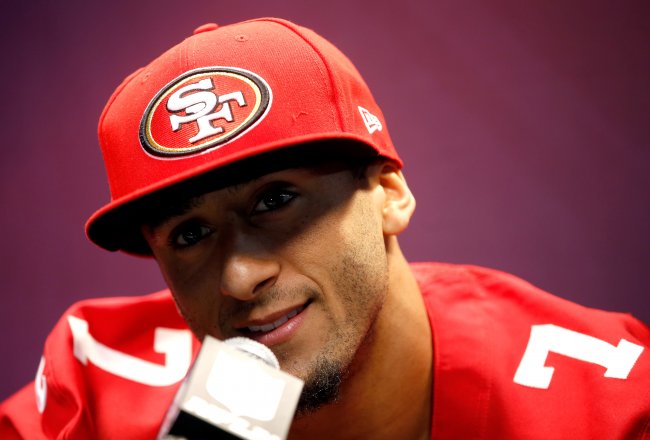
Colin Kaepernick's Tattoos - Breaking Barriers


According to columnist David Whitley, this is how the conversation went down when Cam Newton was interviewed by Panthers owner Jerry Richardson:
Jerry Richardson popped the question.

“Do you have any tattoos?” he asked.

“No, sir,” Newton said. “I don’t have any.”

“We want to keep it that way,” Richardson said.

He was OK with body art on other players, including the human canvas that is Jeremy Shockey. But Newton would be the face, arms and legs of the franchise. The boss didn’t want them covered in ink lines.

“Let’s keep it that way,” he told Newton.
Whitley presented this anecdote to illustrate his argument that Colin Kaepernick's tattoos are inappropriate for an NFL quarterback. Whitley, like Richardson apparently, believes that the quarterback is the "CEO of a high-profile organization, and you don’t want your CEO to look like he just got paroled." Wow, seriously?


Kaepernick looks to me as though he just finished the X-Games BMX Big Air competition, complete with the over-sized baseball cap and whatever the hell the kids are calling that little tuft of a beard on his chin.

More importantly, have you looked at his tattoos? I suspect Whitley just wrote a knee-jerk reaction to something he can't understand. Here is a little bit about the tattoos:
Covering his entire back is a mural of angels fighting demons, which took over 18 hours to complete. 
Across his chest is written: "Against all odds" – a message of defiance against the many scouts and coaches who once dismissed Kaepernick as too skinny to succeed in the sport. On his right arm, Psalm 18:39 conveys a similar message: "You armed me with my strength for battle; you humbled my adversaries before me." 
His right arm is also inked with, "To God the Glory," while his left bicep reads, "My Gift is My Curse." Neither of these, or any of the others, smack of prison ink. This is a man whose faith (which is also tattooed on his right bicep) is so important to him that he has key points enshrined on his body for the rest of his life.

So what if this talented kid has visible ink, and that he is one of the first high-profile quarterbacks to do so (or the first white one, since Michael Vick and Terrelle Pryor are both inked), he is also a quite and humble kid and a fun player to watch, for his ability to throw and to run.

As a side note, he may also be the first mixed race NFL quarterback, too, his birth-mother being white and his birth father black. He was adopted at 6-weeks by the Kaepernicks, and as far as he is concerned, they are his parents.

Again, who cares.

Sunday, December 30, 2012

The Holy or the Broken: Leonard Cohen and the Incantation of "Hallelujah"

Author Alan Light offers a deep and reverential history of Leonard Cohen's most-loved song, "Hallelujah," a song with so many cover versions that some fans do not even know he wrote. Light's book is The Holy or the Broken: Leonard Cohen, Jeff Buckley, and the Unlikely Ascent of 'Hallelujah'.

Here are three different looks at the book and the song it chronicles. We begin with Rolling Stone and an excerpt from the book, then an NPR segment, and finally a CNN Radio segment.

Exclusive Book Excerpt: Leonard Cohen Writes 'Hallelujah' in 'The Holy or the Broken'

The story behind the folk legend's most famous song

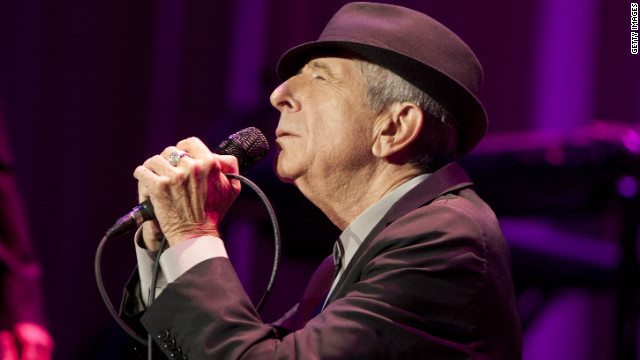
Leonard Cohen
Leonard Cohen
JOEL SAGET/AFP/Getty Images

Leonard Cohen's career had reached a low point when he wrote "Hallelujah." It was 1984, and he had been out of the spotlight for quite a long time. His 1977 LP, Death of a Ladies' Man, a collaboration with Phil Spector, was a commercial and critical disappointment, and his next album Recent Songs fared no better. When Cohen submitted the songs for his subsequent LP, Various Positions, to Columbia, label execs didn't hear "Hallelujah," the opening song of Side Two, as anything special. They didn't even want to release the album, though it eventually came out in Europe in 1984 and America the following year.

Q&A: Leonard Cohen on His New Tour and 'Old Ideas'


It took a few years for "Hallelujah" to emerge as a classic. Bob Dylan was one of the first to recognize its brilliance, playing it at a couple of shows in 1988. The Velvet Underground's John Cale tackled it on the piano for a 1991 Cohen tribute disc, and three years later, Jeff Buckley took inspiration from that rendition and covered it on his 1994 album, Grace. It was that version that eventually created a huge cultaround the song, and it's since been covered by everybody from Bono to Bon Jovi. It's far and away Leonard Cohen's most famous composition, even though many people don't even realize that he wrote it.

Alan Light dove deep into the history of the song for his new book, The Holy or the Broken: Leonard Cohen, Jeff Buckley, and the Unlikely Ascent of 'Hallelujahby Alan Light, copyright 2012 by Alan Light, Published by Atria, an imprint of Simon and Schuste. Here is an excerpt.


* * * *

In June 1984, Cohen and Lissauer recorded the album that would become Various Positions in New York's Quadrasonic Sound studios. In the album's arrangements, for the first time on Cohen's recordings, synthesizers were prominent; they would come to define his sound more and more in the years to come. A group of musicians from Tulsa provided the backbone of the arrangements. Sid McGinnis – who joined the band at Late Night with David Letterman that same year and has remained with the show ever since, in addition to recording with the likes of Bob Dylan, David Bowie, and Dire Straits – provided additional guitar parts.

Jennifer Warnes, who had sung backup with Cohen on previous albums and tours, was brought further into the spotlight as a featured vocalist, a counterpoint to the limited parameters of Cohen's voice. Hawaiian-born Anjani Thomas was one of the backup singers on these sessions; she would go on to become Cohen's longtime companion, and he produced an album of her singing his songs, Blue Alert, in 2006.

Lissauer, a Yale graduate who has gone on to a successful career scoring films, beamed when he spoke of these sessions that took place almost thirty years earlier. Seated in the larger of the two studio rooms he operates from his thirty-five-acre farm about an hour north of Manhattan, he described working on Various Positions as pure pleasure. "I've never had a more rewarding experience," he said. "It was so much fun; we had a great time. Leonard and I got along so well it's almost scary. There were no roadblocks, no disasters; it was great start to finish – it was high art, it was just thrilling."

The songs included several of Cohen's most lasting compositions. The selections that ultimately opened and closed the album, "Dance Me to the End of Love" and "If It Be Your Will," stand among his best-loved work.

Midway through the sessions – Lissauer can't remember the precise sequence, but it wasn't near the beginning or the end – Cohen brought in "Hallelujah" to record. Whatever torment he'd been going through with the song's lyrics over the previous months and years, he showed no sign of confusion or indecision in the studio. "I think it was as it was," said the producer. "There was no 'Should we do this verse?' – I don't think there was even a question of the order of verses, any 'Which should come first?' And had he had a question about it, I think he would've resolved it himself.

 "He's not one to share his struggles," Lissauer continued. "If he wasn't up to recording, if he was still working on something, then we just wouldn't go in. But he'd never go in and act out the tormented, struggling artist."

Leanne Ungar, who engineered Various Positions and has remained part of Cohen's production team ever since, said that there was a pragmatic reason he would not have been experimenting with lyrics during the recording. "He wouldn't bring extra verses to the studio because of time pressure," she said. "The meter is running there." It seems that the breakthrough in Cohen's editing – the vision that allowed him to bring the eighty written verses down to the four that he ultimately recorded – was reaching a decision about how much to foreground the religious element of the song. "It had references to the Bible in it, although these references became more and more remote as the song went from the beginning to the end," he once said. "Finally I understood that it was not necessary to refer to the Bible anymore. And I rewrote this song; this is the 'secular' 'Hallelujah.' "

"Hallelujah" as it exists on Various Positions is both opaque and direct. Each verse ends with the word that gives the song its title, which is then repeated four times, giving the song its signature prayer-like incantation. The word hallelujah has slightly different implications in the Old and New Testaments. In the Hebrew Bible, it is a compound word, from hallelu, meaning "to praise joyously," and yah, a shortened form of the unspoken name of God. So this "hallelujah" is an active imperative, an instruction to the listener or congregation to sing tribute to the Lord.

In the Christian tradition, "hallelujah" is a word of praise rather than a direction to offer praise – which became the more common colloquial use of the word as an expression of joy or relief, a synonym for "Praise the Lord," rather than a prompting to action. The most dramatic use of "hallelujah" in the New Testament is as the keynote of the song sung by the great multitude in heaven in Revelation, celebrating God's triumph over the Whore of Babylon.

Cohen's song begins with an image of the Bible's musically identified King David, recounting the heroic harpist's "secret chord," with its special spiritual power ("And it came to pass, when the evil spirit from God was upon Saul, that David took a harp, and played with his hand: so Saul was refreshed, and was well, and the evil spirit departed from him" – 1 Samuel 16:23). It was his musicianship that first earned David a spot in the royal court, the first step toward his rise to power and uniting the Jewish people.

"As a student of the sound, I understood the resonances of his incantation and invocation of David," said Bono, who added that he immediately responded to the "vaingloriousness and hubris" of the lyric. "I've thought a lot about David in my life. He was a harp player, and the first God heckler – as well as shouting praises to God, he was also shouting admonishment. 'Why hast thou forsaken me?' That's the beginning of the blues."

But this first verse almost instantly undercuts its own solemnity; after offering such an inspiring image in the opening lines, Cohen remembers whom he's speaking to, and reminds his listener that "you don't really care for music, do you?"

"One of the funny things about 'Hallelujah,' " said Bill Flanagan, "is that it's got this profound opening couplet about King David, and then immediately it has this Woody Allen–type line of, 'You don't really care for music, do you?' I remember it striking me the first time I heard the song as being really funny in a Philip Roth, exasperated kind of way – 'I built this beautiful thing, but the girl only cares about the guy with a nice car.' "

Cohen then describes, quite literally, the harmonic progression of the verse: "It goes like this: the fourth, the fifth / the minor fall, the major lift." This is an explanation of the song's structure (the basic chord progression of most pop and blues songs goes from the "one" chord, the root, up three steps to the "four," then up another to the "five," and then resolves back to the "one"), followed by a reference to the conventional contrast between a major (happy) key and a minor (sad) key. He ends the first verse with "the baffled king composing Hallelujah!" – a comment on the unknowable nature of artistic creation, or of romantic love, or both. In the song's earliest moments, he has placed us in a time of ancient legend, and peeled back the spiritual power of music and art to reveal the concrete components, reducing even literal musical royalty to the role of simple craftsman.

The second verse of "Hallelujah" shifts to the second person – "Your faith was strong but you needed proof." Apparently the narrator is now addressing the character who was described in the first verse, since the next lines invoke another incident in the David story, when the king discovers and is tempted by Bathsheba. ("And it came to pass in an eveningtide, that David arose from off his bed, and walked upon the roof of the king's house: and from the roof he saw a woman washing herself; and the woman was very beautiful to look upon" – 2 Samuel 11:2.)

In a July 2011 service at St. Paul's Presbyterian Church in Prince Albert, Saskatchewan, the reading of this story was accompanied by a performance of "Hallelujah." The Reverend Dr. R. M. A. "Sandy" Scott delivered a sermon with his explication of the David story and its usage in the song.

"The story of David and Bathsheba is about the abuse of power in the name of lust, which leads to murder, intrigue, and brokenness," said Reverend Scott. He recounted that until this point, David had been a brave and gifted leader, but that he now "began to believe his own propaganda – he did what critics predicted, he began to take what he wanted."

Reverend Scott calls the choice of the word baffled to describe this David "an obvious understatement on Cohen's part. David is God's chosen one, the righteous king who would rule Israel as God's servant. The great King David becomes no more than a baffled king when he starts to live for himself.

"But even after the drama, the grasping, conniving, sinful King David is still Israel's greatest poet, warrior and hope," Scott continued. "There is so much brokenness in David's life, only God can redeem and reconcile this complicated personality. That is why the baffled and wounded David lifts up to God a painful hallelujah."

Following the David and Bathsheba reference, the sexuality of the lyrics is drawn further forward and then reinforced in an image of torture and lust taken from the story of Samson and Delilah – "She tied you to a kitchen chair / she broke your throne, she cut your hair" – before resolving with a vision of sexual release: "and from your lips she drew the Hallelujah!" Both biblical heroes are brought down to earth, and risk surrendering their authority, because of the allure of forbidden love. Even for larger-than-life figures and leaders of nations, the greatest physical pleasure can lead to disaster.

"The power of David and the strength of Samson are cut away; the two are stripped of their facile certainties, and their promising lives topple into the dust," wrote Reverend Thomas G. Casey, S.J., a professor of philosophy at the Pontifical Gregorian University, of these first two verses. "The man who composed songs of praise with such aplomb and the man whose strength was the envy of all now find themselves in a stark and barren place."

Lisle Dalton, an associate professor of religious studies at Hartwick College, noted the many levels on which Cohen's linking of David and Samson works. "Both are heroes that are undone by misbegotten relationships with women. Both are adulterers. Both are poets – Samson breaks into verse right after smiting the Philistines. Both repent and seek divine favor after their transgressions.

"I don't know a lot about Cohen's personal life," Dalton continued, "but he seems to be blending these two figures together with, we presume, some of his own experiences. There's no 'kitchen chair' in the Bible! There's a biblical irony that highlights the tendency of even the most heroic characters to suffer a reversal of fortunes, even destruction, because they cannot overcome their sinful natures. The related tendency, and the moral message, is for the character to seek some kind of atonement."

In the third verse of "Hallelujah," Cohen's deadpan wit returns, offering a rebuttal to the religious challenge presented in the previous lines. "You say I took the Name in vain," he sings. "I don't even know the name." He then builds to the song's central premise – the value, even the necessity of the song of praise in the face of confusion, doubt, or dread. "There's a blaze of light in every word; / it doesn't matter which you heard, / the holy, or the broken Hallelujah!"

"A blaze of light in every word." That's an amazing line. Every word, holy or broken – this is the fulcrum of the song as Cohen first wrote it. Like our forefathers, and the Bible heroes who formed the foundation of Western ethics and principles, we will be hurt, tested, and challenged. Love will break our hearts, music will offer solace that we may or may not hear, we will be faced with joy and with pain. But Cohen is telling us, without resorting to sentimentality, not to surrender to despair or nihilism. Critics may have fixated on the gloom and doom of his lyrics, but this is his offering of hope and perseverance in the face of a cruel world. Holy or broken, there is still hallelujah.

Finally, the remarkable fourth verse drives this point home, starting with an all-too-human shrug: "I did my best; it wasn't much." Cohen reinforces his fallibility, his limits, but also his good intentions, singing, "I've told the truth, I didn't come to fool you."

And as he brings the song to a conclusion, Cohen shows that for a composition that has often come to be considered a signifier of sorrowful resistance, "Hallelujah" was in fact inspired by a more positive feeling. "It's a rather joyous song," Cohen said when Various Positions was released.  "I like very much the last verse – 'And even though it all went wrong, / I'll stand before the Lord of Song / with nothing on my lips but Hallelujah!' " (While the published lyrics read "nothing on my lips," Cohen has actually almost always sung "nothing on my tongue" in this line.) Though subsequent interpreters didn't always retain this verse, its significance to Cohen has never waned: Decades later, when he was inducted into the Songwriters Hall of Fame, he recited this full last verse as the bulk of his acceptance speech.

"I wanted to push the Hallelujah deep into the secular world, into the ordinary world," he once said. "The Hallelujah, the David's Hallelujah, was still a religious song. So I wanted to indicate that Hallelujah can come out of things that have nothing to do with religion."
Read the rest of the excerpt.

* * * * *

Here is the segment from NPR's Weekend Edition.

Dozens Of Covers Later, 'Hallelujah' Endures

by NPR STAFF


Rufus Wainwright performs in London earlier this year. His cover of "Hallelujah" is among the best-known versions of the oft-interpreted Leonard Cohen song.


There are songs, and then there are anthems.

One of those anthems is the subject of music journalist Alan Light's new book, The Holy Or The Broken.

The anthem itself, Leonard Cohen's "Hallelujah," is one you've probably heard before, but most likely it's been one of the many covers sung by the likes of Rufus Wainwright, Willie Nelson, Susan Boyle, k.d. lang and even Michael Bolton. You may have also heard one of its many appearances in film and television.

As Light tells Weekend Edition Sunday host Rachel Martin, the "bassy and kind of droning" song almost didn't see the light of day.

"Columbia Records, which was Leonard's label then and remains so today, listened to the record and rejected it," Light says.


The label thought the song was "out of step" with where music was at the time, but PVC Records, an independent label, eventually released the song in 1984 in the U.S. to little fanfare.

"Not only was this under the radar, it was completely absent from the radar," Light says. "It was as if this song had never happened."

In 1994, a cover by the late Jeff Buckley helped save "Hallelujah" from musical obscurity. Buckley's version turned one man's lament into another artist's ode to love. Light says the ambiguity of the song's lyrics makes it easy for musicians to make the tune their own.

"There are lyrics that are talking about sex. There are these allusions to stories from the Bible; the King David story and the Samson story," he says. "There's lots and lots of layers."


The song really hit the mainstream when a version by John Cale was in a scene from the hit animated film Shrek. Even since, Light says "Hallelujah" is a go-to emotional trigger in TV shows and movies.

"You know what you're supposed to feel when you hear that song," he says. "You can't even hear it anymore. You just know that's the song that's supposed to make me feel sad now."

Still, Light says at a time when the way we encounter music has become so fragmented, the endurance of this song and its dozens of covers — nearly 30 years after it was first released — is remarkable.

"This is a song that people [now] use at weddings, at funerals and at very deeply personal things ... it's really kind of humbling," he says. "A song like this, you witness just how important it can still be for huge swaths of people."
* * * * *
Finally, here is the segment from CNN, which they also reposted on their Belief Blog.

The rise of 'Hallelujah'
By Edgar Treiguts, CNN
December 25th, 2012


The rise of 'Hallelujah'
Leonard Cohen performs at Madison Square Garden on December 18, 2012.

Editor's Note: Listen to the full story in our player above, and join the conversation in our comments section below.

(CNN) – It's a song that's been recorded by hundreds of artists. It's been a favorite in TV competition shows and been used as a healing anthem in times of tragedy. And just recently, after the tragedy in Newtown, Connecticut, 'Hallelujah' emerged again.

The popularity of 'Hallelujah' was hardly foreshadowed when it was written and first recorded by Leonard Cohen in 1984. The song was on an album Cohen's record company decided not to release.

A decade would pass before it was embraced by another artist, and its true introduction began.

Author Alan Light writes about the song's journey from obscurity to what he calls now a "modern standard".
[1:20] "There are now countless ways that people first encounter this song and so there isn't one fixed version that everything gets compared to because people enter it through all of these many different uses and these many different versions. And it allows it to be a lot more flexible and a lot more malleable then a song where everybody starts from hearing the same version and everything gets compared to that."
Alan Light's new book is The Holy or the Broken: Leonard Cohen, Jeff Buckley, and the Unlikely Ascent of "Hallelujah"

Sunday, December 16, 2012

Radio National Encounter - MEN AND FAITH


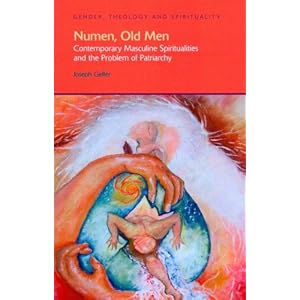
Dr. Joseph Gelfer, who I have featured many times on this blog, is one of the featured guests on this episode of Radio National's Encounter program devoted to men and faith. Gelfer is the editor of the Journal of Men, Masculinities and Spiritualityand he is the author of Numen, Old Men: Contemporary Masculine Spiritualities, and the Problem of Patriarchy, and The Masculinity Conspiracy (which also can be read online for free).

MEN AND FAITH


  • Listen now


  • Download audio


  • Broadcast: Saturday 22 December 2012 

    Over the last few years there’s been a surprising re-emergence of men’s groups, with conservative Christian groups like the Promise Keepers filling sporting stadia in the US, and Catholic men of all ages undergoing initiation ceremonies. So this week on Encounter we’re taking a look at how Christian and Jewish men define masculinity today, and how it affects their relationship to power, women and other men. We’ll also find out about the history of men’s movements and ask about the future for men of faith.

    Publications
    Author: Joseph Gelfer
    Publisher: Equinox Publishing Ltd 2009

    Further Information

    Fr. Richard Rohr

    Spiritual men's group in Brisbane, Qld that runs initiation ceremonies

    Rabbi Ritchie Moss


    Freedom2b assists Lesbian, Gay, Bi-sexual, Transgender and Intersex people from Christian backgrounds on their journey to reconciling their faith, sexuality, and gender identity.

    Friday, November 9, 2012

    Secret Lives of Men - Bond of Brothers with Wes Yoder (Featured Replay)


    This is a replay of a previous episode of the Secret Lives of Men podcast, with Dr. Chris Blazina speaking to Wes Yoder about his 2010 book, Bond of Brothers: Connecting with Other Men Beyond Work, Weather and Sports. Fair warning: this is a Christian book with a "come to Jesus" message for healing men's wounded hearts.

    Here is the book description from Amazon.
    'The perfect conversation for men with little to say can be summed up in eight words: 'Can you believe the weather at that game?'' Author Wes Yoder's words are humorous. Yet, beyond the sports and weather chatter and silence that characterize many male conversations, there is brokenness. Emptiness. Shame. That's not funny. For Yoder, addressing the problem is not about planting the flag for one's manhood by joining a mass movement for men, nor is it necessary for men to 'sire a herd or shoot a moose to authenticate their manhood.' Yoder calls disappointed, disenchanted, and lonely men to authenticity. To rediscover joy. To find satisfaction. In Bond of Brothers, men will discover: Why your career and performance at work are not your identity * How to defeat the fears that come to a man in the 'Tough Years' * What to do when you are too worried to forgive or too power-hungry to smile * Why spiritual friendships are the central, life-giving core of all healthy relationships among men. Being present to comfort, to love, to listen, to take a step toward Jesus together in our brokenness ... that is the essence of friendship, Yoder writes. When we invite Jesus into our shared brokenness, he can do the work of remaking what is left of the mess we have made of ourselves. Begin a journey toward authenticity and your true identity here!
    OK, this sounds a little too 12-Stepford Wives for me, but he is pointing to real issues and real solutions, although I (as an agnostic Buddhist) believe there are other ways men can join in a spiritual journey toward healing.

    Featured Replay: Bond of Brothers with Wes Yoder

    by Secret Lives of Men


    Listen to internet radio with Secret Lives of Men on Blog Talk Radio
    Why are they so afraid to be known? According to Wes Yoder in Bond of Brothers, a whole lot of insecurity, secrets, shame, and silence keep men from growing strong in the broken places.
    For Yoder, addressing the problem is not about planting the flag for one's manhood by joining a mass movement for men, nor is it necessary for men to 'sire a herd or shoot a moose to authenticate their manhood.' Yoder calls disappointed, disenchanted, and lonely men to authenticity. To rediscover joy. To find satisfaction.
    In Bond of Brothers, men will discover:
    • Why your career and performance at work are not your identity 
    • How to defeat the fears that come to a man in the 'Tough Years' 
    • What to do when you are too worried to forgive.

    Tuesday, July 12, 2011

    Cut: Slicing Through the Myths of Circumcision

    Circumcision has been in the news a lot lately - San Francisco is considering a ban and many of the men's rights activists consider it on par with female genital mutilation. This documentary has a bias, but it tries to offer both sides, and it's still interesting.

    Director Eliyahu Ungar-Sargon takes a personal – and local – look at the controversy involving infant male circumcision in his documentary, Cut.

    A graduate of the School of the Art Institute of Chicago, Ungar-Sargon interviews professors from that school and from the University of Chicago as he examines the pros and cons, ethical and physical, of a procedure that, for Jews, has signified the covenant between God and Abraham for centuries.

    It’s a relative newcomer in the United States, routinely performed only since the post-Civil War/Victorian period in the belief it discouraged masturbation and prostitution. On-camera experts debunk more recent health benefit claims.

    Ungar-Sargon queries his Orthodox Jewish father and brother as he wrestles with his own feelings about the procedure, which some consider a human rights violation; he also calls on mohels and rabbis, mothers and fathers who follow the tradition and men who regret their circumcisions (the footage of the foreskin-regenerating Tugger device alone makes this unsuitable for younger audiences).

    Viewers are left with a pretty clear notion of what the Orthodox Ungar-Sargon will do if and when he has a son, but in this informative and thought-provoking film, he gives both sides their say.


    Saturday, May 21, 2011

    In Tennessee You Can't Say Gay, so Say Takei!

    http://img.perezhilton.com/wp-content/uploads/2011/05/dont-say-gay-not-okay__oPt.jpg

    So if you can't say the word "gay," gay people cease to exist in our children's world? Is that the logic of pretending that gay people don't exist (but only until the kids are in 8th grade, then they all suddenly exist again)? Maybe that would work with poverty and ignorance, too?

    What a bunch of dumbasses. Maybe I should be compassionate toward their ignorant and backward thinking, but I can't - they are trying to teach kids, albeit indirectly, that 3-5% of the population does not exist.

    Tenn. Senate OKs ban on teaching of homosexuality

    Critics deride the chamber's passage of the "don't say gay" bill

    Tenn. Senate OKs ban on teaching of homosexuality
    Wikimedia/Kaldari
    Tennessee State Capitol building

    A bill passed Friday by the Tennessee Senate would forbid public school teachers and students in grades kindergarten through eight from discussing the fact that some people are gay.

    Opponents deride the measure as the "don't say gay bill." They say it's unfair to the children of gay parents and could lead to more bullying. Supporters say it is intended to give teachers clear guidance for dealing with younger children on a potentially explosive topic.

    The bill isn't likely to be taken up by the House before lawmakers adjourn this spring, but the sponsor there has said he would push it forward in 2012 when the General Assembly comes back for the second year of the session.

    Passage would make Tennessee the first state to enact such legislation, according to the National Conference of State Legislatures. In 2003, Washington defeated a proposal similar to Tennessee's, as did California in 2005 and 2006. A Louisiana law forbids the use of sexually explicit materials depicting homosexuality in sex education classes.

    Read more - unless is will make your head explode.

    On the lighter side, if you can't say "gay," say Takei - George Takei. This bit of levity comes from The New Civil Rights Movement:

    Post image for George Takei Says, Can't Say Gay? Say Takei! (Video)

    George Takei, star of Star Trek TOS, and a popular LGBT activist and cult hero, has a few words for our friends in Tennessee. The Tennessee state senate this week passed a bill that bans the use of the word “gay,” or any reference to homosexuality. The “don’t-say-gay” bill could be passed in the House next year and if the Governor signs it, it will become law.

    So George Takei has offered his services — and his name — to the state of Tennessee.

    If you can’t say “gay,” say, “Takei!”

    Oh, and if you’re in Tennessee, there’s a rally on Sunday to protest (what must be) the unconstitutional bill.

    Remember, it’s OK to be Takei! (all proceeds go to charity)

    Monday, February 28, 2011

    The Kids Are Alright - Exploring Religion, Youth and Sexuality (in the UK)

    [NOTE: This was cross-posted from Integral Options Cafe - I think it's relevant here as well.]

    multi-faithpr

    This study was done in the UK, but my guess is that young adults there are not much different than they are in the United States. This press release summarizes the findings of Religion, Youth and Sexuality: Selected Key Findings from a Multi-faith Exploration - the link takes you to a full PDF of the study summary.

    I think this is an interesting and highly relevant study - and I like that they allow the young people to speak for themselves - a more open-ended qualitative approach rather than using a pre-written measure that shoe-horns them into fixed categories.

    In my quick reading of the findings, I am heartened to see an emphasis on monogamous sexuality, a desire to see heterosexuality and homosexuality as equally valid forms of sexual relationship, and "(48.2%) of the participants considered themselves ‘liberal’/‘very liberal’," while only "a quarter of them (25.1%) considered themselves ‘conservative’/‘very conservative’."

    Then were the religious views (a mixed bag):
    In terms of religious participation, the majority of the participants (65.1%) were involved in a religious community .... Religious faith was by far the most important source of information for the participants’ sexual values/attitudes and sexual practices. Religious texts, parents/caregivers, friends, the internet and the media also played a role in this respect, but less significantly.
    The entire executive summary is posted at the bottom, after the press release. There is a also a video presentation on the study and its findings:


    And here is the press release summary (just the beginning - follow the link to read the whole thing):

    Exploring religion, youth and sexuality

    28 February 2011 Nottingham, University of

    Sexuality and religion are generally considered uncomfortable bedfellows. Now, for the first time, a team of researchers from Nottingham have carried out a detailed study around these issues and how they affect and influence the lives of British 18 to 25 year olds.

    Led by The University of Nottingham, in collaboration with Nottingham Trent University, experts spent two years investigating the attitudes, values and experiences of sex and religion among young adults.

    The study, which involved nearly 700 young people from six different religious traditions; Buddhism, Christianity, Hinduism, Islam, Judaism and Sikhism as well as young adults of mixed-faith, highlights the challenges they face in reconciling their sexuality and their religion and the concerns they have about the stigmatisation of religion and the increasingly sexualised culture in British society today.

    The project Religion, Youth and Sexuality: a Multi-faith Exploration received funding of nearly £250,000 from the Arts and Humanities Research Council and the Economic and Social Research Council.

    Dr Andrew Kam-Tuck Yip and Dr Sarah-Jane Page, in the School of Sociology and Social Policy at The University of Nottingham and Dr Michael Keenan from Nottingham Trent University’s School of Social Sciences asked all the participants to fill in online questionnaires. Some were also interviewed individually and recorded week-long video diaries.

    Young adults were asked to talk about their sexual and religious values, attitudes, experiences and identities. As well as looking at their family background, social and cultural expectations and participation in religious communities the researchers also examined young people’s experiences of living in British society and how they understood and managed their gender identity in relation to their religious faith.


    http://www.alphagalileo.org/AssetViewer.aspx?AssetId=43679&CultureCode=en

    Executive Summary (from the PDF of the study outcomes and analysis.

    1. This report presents selected key findings from an AHRC/ESRC-funded project entitled Religion, Youth and Sexuality: A Multi-faith Exploration, undertaken between January 2009 and February 2011. The research team are committed to data dissemination within academic and non-academic user communities. This report is written primarily with non-academic users in mind. Academic outputs have been planned for the near future, including a book provisionally titled Religious and Sexual Journeys: A Multi-faith Exploration of Young Believers (Yip, Keenan and Page, Forthcoming). Up-to-date information about the project is available at www.nottingham.ac.uk/sociology/rys.

    2. The research set out to explore the lives and identities of religious young adults, aged between 18 and 25. Specifically, it studied the sexual and religious values, attitudes, experiences and identities of young adults from different religious traditions, namely Buddhism, Christianity, Hinduism, Islam, Judaism and Sikhism. The research also investigated the significant factors (for example family, social and cultural expectations, religious institution) that inform their decision-making in these areas, and the diverse ways they managed their religious faith and sexuality. In addition, the research also aimed to examine these young adults’ experiences of living in British society; and how they understood and managed their gender identity in relation to their religious faith.

    3. The research consisted of three stages: (i) An online questionnaire was completed by 693 participants between May 2009 and June 2010; (ii) 61 participants of diverse religious faiths and sexual orientations were interviewed individually between November 2009 and June 2010; (iii) 24 participants respectively recorded a video diary over a period of approximately seven days between February and November 2010.

    4. 455 (65.7%) participants were female, 237 (34.2%) were male, and one participant was transgendered. Further, 57.1% of participants were Christian, 16.6% Muslim, 7.5% Jewish, 6.8% Hindu, 4.5% Buddhist, 3.8% Sikh and 3.7% identified with more than one religious tradition. In terms of sexuality, 74.3% were heterosexual, 10% were lesbian, gay or homosexual and 7.5% were bisexual.

    5. 64.9% of participants self-identified as white, followed by those who self-defined as Indian (11.3%) and Pakistani (5.8%). 82.4% of participants were British citizens. With reference to participants’ geographic location, 83.8% lived in England, 7.6% in Scotland, 3.2% in Wales and 1.7% in Northern Ireland.

    6. The majority of participants (65.8%) were single; 3.3% were married and 0.3% were in a civil partnership. Further, 25.4% were in an unmarried heterosexual relationship and 4.2% were in an unregistered same-sex relationship. 72.4% of the sample were students, 20.2% were employed and 4.6% were unemployed. In terms of highest academic qualification, the majority of the sample (60.3%) had achieved A-level qualifications, 25.4% had a degree, and 6.3% had a postgraduate qualification.

    7. The participants held different meanings regarding their religious faith. These meanings were not mutually exclusive. Many considered being religious as having a belief in, and a relationship with, a personal God or a divine power. To them, this belief and relationship gave strength and meaning to life. In addition, some participants considered religious faith as a form of personalised spirituality and philosophy for life that promoted self-improvement and enlightenment.

    8. The participants acknowledged the significant social dimension of religious faith which not only illuminated their personal lives, but also helped foster interpersonal and community connections. Some participants also emphasised the sense of ethnic and cultural belonging that their religious identification offered. However, some participants separated personal spirituality from institutional religiosity, considering institutional religion a social control mechanism that excessively regulated gender and sexual behaviour.

    9. Almost half (48.2%) of the participants considered themselves ‘liberal’/‘very liberal’, and a quarter of them (25.1%) considered themselves ‘conservative’/‘very conservative’. In terms of religious participation, the majority of the participants (65.1%) were involved in a religious community in one way or another and just over half of the participants (56.7%) attended a public religious gathering at least once a week.

    10. While the majority of participants used a particular label to identify their sexual orientation, some deliberately questioned the usefulness and accuracy of such labelling. On the whole, the participants were less reflective and articulate about their sexualities compared to their religious faiths, particularly heterosexual participants.

    11. Fewer than half of the participants (43.1%) were sexually active. Further, 12.9% of the participants engaged in casual sex. Just over a quarter of participants who were single (28.7%) were sexually active. Further, 36% of participants in partnered but unmarried heterosexual relationships were not sexually active, perhaps reflecting their commitment to the religious ideal of ‘sex within marriage only’.

    12. Most participants thought that the expression of one’s sexuality was desirable, and 29.9% thought that celibacy was fulfilling. While many participants thought that consenting adults should be allowed to express their sexualities, opinions varied on the ways in which they should do so, with some participants believing that consenting adults should be able to express their sexualities however they wished, while others believed sexual expression should be limited to marriage or a committed relationship.

    13. The participants were almost equally split on the idea that sex should only occur within marriage, suggesting that some religious young adults had moved from ‘sex in marriage’ as the ideal to ‘meaningful or committed sexual expression’ as the ideal (but in diverse relational contexts). In addition, monogamy within a partnered relationship was highly valued.

    14. About one-third of the participants (31.6%) believed that heterosexuality should be the only expression of human sexuality, and a bigger proportion (52.4%) thought that it should be the ideal for human sexuality. 58.1% of the participants were committed to treating heterosexuality and homosexuality on equal terms.

    15. Just over half of the participants (54.8%) thought that their religions were positive towards sexuality issues. However, there was also a significant proportion who viewed fairly negatively the knowledge base of priests or religious leaders in relation to sexuality, particularly matters pertaining to youth sexuality. For lesbian, gay and bisexual participants, while some had successfully reconciled their sexuality to their religious faith, some reported the psychological and social costs of ‘coming out’ and managing their sexual and religious identities.

    16. Religious faith was by far the most important source of information for the participants’ sexual values/attitudes and sexual practices. Religious texts, parents/caregivers, friends, the internet and the media also played a role in this respect, but less significantly. Only around 1% of the participants considered religious leaders the most important source of influence.

    17. Further, in terms of sexual practices in comparison to sexual values/attitudes, the significance of the role of friends and the internet/the media increased, and the role of religious faith, religious texts and parent/caregivers decreased. This is likely due to the fact that friends and the internet/media were perceived to be the safer and more supportive sources to address the specific issues of how to practise one’s sexuality.

    18. The participants’ experiences in connecting their religious faith and sexuality were diverse. There are three primary manifestations: (i) tension and conflict due to difficulty in managing these two dimensions; (ii) compartmentalisation of these two dimensions in order to minimise tension and conflict; and (iii) accommodation and harmonious acceptance of these two dimensions.

    19. The participants identified a variety of challenges for them as young religious adults in secular society. These included: stigmatisation of religion, sexualised culture, drinking culture and consumer society. However the majority (67.4%) did not believe that being religious made their everyday life more difficult.

    20. The majority of participants (68.5%) believed that religious people were stigmatised in Britain. 35.3% thought that it was difficult to talk about their religious faith with non-believers. Further, some felt that references to religion in society often took the form of jokes or gross generalisations.

    21. The majority of participants (76.1%) believed there was too much focus on sex in mainstream society. Particularly, they considered sexualised culture and the prevalence of sexual promiscuity significant issues for religious young adults.

    22. The majority of participants (63.4%) believed that their religions upheld gender equality in principle. However, some expressed concern that this was not the case in reality, with, for example, perceived gender inequality being evidenced at places of worship.

    23. A high number of participants (73.2%) agreed with women being involved in religious leadership. This was particularly important for young women who saw women in leadership as role models.

    24. Religious faith was considered the main factor influencing how the participants lived their lives as women or men. Some participants acknowledged that there were discrepant expectations for women and men particularly in the context of relationships and raising children. However, 65.6% of women and 68.1% of men disagreed that women should have primary responsibility for raising children. To them, it should be a shared responsibility.

    25. Religious young adults can benefit from hearing the stories of their contemporaries to understand the wide range of experiences and negotiations in their religious and sexual lives. This knowledge could offer help in integrating religious faith and sexuality more successfully. Engagement with mainstream society may also encourage understanding and respect between non-religious and religious young adults.

    26. Young religious adults desire an increased openness to discussions of faith and sexuality within their religions. Religious leaders and professionals should be open to such discussions, willing to reflect on young adults’ interactions with secular culture and to engage with secular youth workers and health professionals to find ways of providing support for religious young adults.

    27.Training of practitioners working with young adults in secular contexts needs to recognise the role and importance of religious faith in some young adults’ lives. More collaboration is also needed between religious leaders and professionals who work with young adults in secular contexts, in order to formulate policy and practice that provides consistent advice and guidance.


    Tags: , , , , , , , , , , , , , , , , , , , , , , , , , , , , , , , , ,