Showing posts with label faith. Show all posts

Sunday, October 27, 2013

Jim Palmer - Jesus Was Not a Christian

"Jesus was not a Christian. He is not the founder of Christianity. Christianity is a religion created in the name of Jesus, and is much different from the actual truth that Jesus taught. Were Jesus alive today, I don’t think Jesus would be a Christian. Jesus is still one of best-kept secrets because his truth has been grossly distorted by those who claim to speak for him. There is a religion-free Jesus who belongs to all of humankind. Christianity does not own or have first rights to Jesus. His truth has universal significance. It’s often the case that you have to disentangle Jesus from institutional Christianity in order to uncover his truth." 

- Jim Palmer, Notes from (Over) the Edge - (a new book-in-progress)
Jim Palmer describes himself as a "Religion-Free Jesus Follower."  Here is a recent blog post the offers some insight into his spiritual journey.

Common objections to shedding religion

October 25, 2013


I began sharing my faith journey as an author in 2005, publishing Divine Nobodies: Shedding Religion to Find God (and the unlikely people who help you) (2006). The book struck a nerve, and my Inbox was flooded with emails from others who were trying to untangle their lives and faith from religion. Ordinary people, mainly from a Christian background, they had come to the end of their rope with faith and God, but felt understood and validated through my story, and inspired by the possibility that it could be different.

Seeing that people often got stuck in their disenchantment with religion, my follow-up book, Wide Open Spaces: Beyond Paint-by-Number Christianity (2007), gave a glimpse into what it might look like to live a religion-free relationship with God. I also noticed that many of these people in the throes of spiritual crisis chose to abandon God and Jesus altogether. My third book, Being Jesus in Nashville: Finding the Courage to Live Your Life (whoever and wherever you are) (2012), spoke to this issue as I shared my story of discovering a religion-free Jesus who finally set me free from my religious pathologies and led me forward in my spiritual pilgrimage.

People often take issue with and object to people who are “shedding religion” to know God. I decided to identify and address some of the most common objections I hear.

You don’t go to church anymore


If a person’s involvement in a church feeds and reinforces a message and perspective that hinders their knowing God, then it makes complete sense not to involve yourself there anymore. Many Christians receive their understanding about God through the institution of Church and when they discover this understanding is deeply flawed and they see how this flawed understanding has damaged their lives, they remove themselves from their church. The reason most people object to this is because these confuse leaving one’s church with leaving one’s faith. Research shows that “church leavers” grow stronger in their faith, as opposed to digressing in their faith. The issue is also controversial because people wrongly equate “church” with their specific form of church. There are an endless number of forms of church ranging from highly organized to practically no organization at all. Many people who leave organized church eventually connect in smaller, more informal types of community, which may not comply with the letter of the law when it comes to institutional church but fulfills the true spirit of “church.”


You are reading some really weird books


Many Christians in the “shedding religion” process will read books that: a) looks at their Christian faith with a critical eye, b) promotes spirituality over religion, c) offers a different and fresh view and perspective on faith and God. Shedders will be drawn to authors who offer something beyond institutional Christianity and offer the prospect of knowing God and following Jesus as a way of life as opposed to check-list Churchianity. many of these authors, including myself, get hammered by the Christian establishment. If you mess with city hall, you’re going to pay for it. People criticize such authors as having “bad theology.” In my opinion, many of the criticizers have “bad theology,” and so I’m not sure where that argument ends. People who are “shedding religion” are also drawn to books that promote and speak to spirituality over religion or books that focus on nurturing your inner world. You’d be surprised to know even how many church-going Christians secretly read Eckhart Tolle books but would never admit it. For some people, reading one chapter from The Power of Now was worth more than one year of sermons. This is also the reason why some Christians become interested in Buddhism and Eastern spirituality; these seem to speak more deeply to the root condition of humankind and one’s inner spiritual world as opposed to the focus of a lot of pop-Christian writings. At first, some people are not aware that there is a rich Christian tradition of contemplatives and mystics who lived a very robust Christ-centered spirituality. A few contemporary examples might be Thomas Merton, Ricahrd Rohr, Bede Griffiths, and Flora Wueller.

You are in danger of going off the deep end


Perhaps one of the most annoying things (to those who judge them) about people who are shedding religion is that they begin thinking for themselves. Some Christians have come from churches where the idea is fostered that congregants should only expose themselves to church-approved leaders, teachers, writers, musicians, politicians etc…because doing otherwise would be the equivalent of purchasing a one-way ticket to the flames of hell. Apparently, only a very select few people are capable of discerning truth on their own, the rest of us are ill-equipped for doing so and would be easily lured into all kinds of error if left to our own. I know this may be difficult for some to believe, but people are capable of being exposed to all kinds of differing views of God, and can discern for themselves what truth is present in these views, and what of these views seems inconsistent with truth. I have a Buddhist friend; i have detected truth is things he believes but i did not become a Buddhist. I have an Atheist friend, and I totally agree with this person’s views on all kinds of things, including some of their objections to God, but i did not become an Atheist. I have a N.Y. Yankees friend, i agree that the Yankees have some of the best baseball players but I did not become a Yankees fan. People are truly capable of doing this sort of thing.

When people begin thinking for themselves and base their opinions on firsthand personal experience, they realize that the world doesn’t fit so nicely into all the labels and boxes that religion is sometimes prone toward imposing on things. Religion and politics seems to share a difficulty in disagreeing with others without demonizing them, and wants to slice up the world into the “us” and “them” camp or the “right” and “wrong” camp. I’m not talking about turning a blind eye to evil in the world, or pretending that one’s beliefs doesn’t fuel such evil. All religions, including Christians, have justified evil in the name of God.

You can’t give a straight answer


Lots of questions aren’t so easy to answer anymore for Christians in the “shedding religion” process. For example, questions like: “Are you a Christian?” or “Do you believe in the Bible?” or “Do you go to church?” or “Do you believe in the gospel?” are no longer “yes” or “no” questions for a person who is “shedding religion.” He or she is immediately wondering what is your definition of a “Christian,” and what is your interpretation of the Bible, and how you delineate what “church” is, and how do you understand the “gospel?” By not answering “yes” or “no” it is not a sign that the person is “dodging the issue;” they legitimately cannot answer with a simple “yes” or “no.” It would be better to ask more open-ended questions like, How is Jesus Christ relevant to you?

[My disclaimer: Some people say I am “too hard” on the “Christian establishment.” Let me be the first to say that I know many people who identify themselves as “Christians” who are deeply spiritual, and not guilty of the things I described above. Some of these Christians have had a big influence on my own journey. I also know there are organized forms of church that promote true and authentic Christ-centered spirituality, as well as open, honest, and authentic relationships. I know many Christian churches that are wonderful expressions of love, compassion, and service in the communities where they exist. Since my personal experiences are in some cases related to churches (including my own) and Christians (including myself) that were guilty of the above judgments, I am prone to speak of it. Based on my experience the last several years as an author and spiritual director/coach, I have encountered countless numbers of people who have a similar experiences. I mainly wrote the above post in hopes of encouraging more understanding about many people who are in “shedding religion” mode.]

Saturday, February 2, 2013

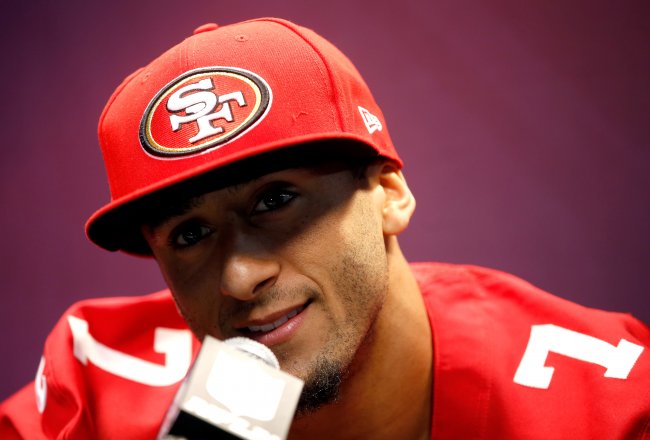
Colin Kaepernick's Tattoos - Breaking Barriers


According to columnist David Whitley, this is how the conversation went down when Cam Newton was interviewed by Panthers owner Jerry Richardson:
Jerry Richardson popped the question.

“Do you have any tattoos?” he asked.

“No, sir,” Newton said. “I don’t have any.”

“We want to keep it that way,” Richardson said.

He was OK with body art on other players, including the human canvas that is Jeremy Shockey. But Newton would be the face, arms and legs of the franchise. The boss didn’t want them covered in ink lines.

“Let’s keep it that way,” he told Newton.
Whitley presented this anecdote to illustrate his argument that Colin Kaepernick's tattoos are inappropriate for an NFL quarterback. Whitley, like Richardson apparently, believes that the quarterback is the "CEO of a high-profile organization, and you don’t want your CEO to look like he just got paroled." Wow, seriously?


Kaepernick looks to me as though he just finished the X-Games BMX Big Air competition, complete with the over-sized baseball cap and whatever the hell the kids are calling that little tuft of a beard on his chin.

More importantly, have you looked at his tattoos? I suspect Whitley just wrote a knee-jerk reaction to something he can't understand. Here is a little bit about the tattoos:
Covering his entire back is a mural of angels fighting demons, which took over 18 hours to complete. 
Across his chest is written: "Against all odds" – a message of defiance against the many scouts and coaches who once dismissed Kaepernick as too skinny to succeed in the sport. On his right arm, Psalm 18:39 conveys a similar message: "You armed me with my strength for battle; you humbled my adversaries before me." 
His right arm is also inked with, "To God the Glory," while his left bicep reads, "My Gift is My Curse." Neither of these, or any of the others, smack of prison ink. This is a man whose faith (which is also tattooed on his right bicep) is so important to him that he has key points enshrined on his body for the rest of his life.

So what if this talented kid has visible ink, and that he is one of the first high-profile quarterbacks to do so (or the first white one, since Michael Vick and Terrelle Pryor are both inked), he is also a quite and humble kid and a fun player to watch, for his ability to throw and to run.

As a side note, he may also be the first mixed race NFL quarterback, too, his birth-mother being white and his birth father black. He was adopted at 6-weeks by the Kaepernicks, and as far as he is concerned, they are his parents.

Again, who cares.

Saturday, January 5, 2013

Cindy Wigglesworth - Building Spiritual Intelligence in the New Year


Cindy Wiggleworth is the author of SQ 21: The Twenty-One Skills of Spiritual Intelligence and in this article from Huffington Post, she offers suggestions and support for setting and achieving a spiritual intelligence goal for 2013. For reference, I have included her chart of the 21 spiritual competencies.


A Spiritual Intelligence Goal for the New Year
Posted: 01/04/2013

Cindy Wigglesworth - Author of SQ21, Leadership Coach and Corporate Consultant

"Spirit," by whatever name, is not measurable. But skills like spiritual intelligence (SQ) skills can be measured. And measurement is useful -- it points to where we can grow and improve.

My belief in the value of measuring SQ was confirmed when I recently heard from a woman named Jane who had scored a "0" on one of the skills in my SQ21 spiritual intelligence assessment.

"It really got my attention in a way I would not have expected," Jane said. "I was shocked. Good grades and test scores have always been important to me." Initially it was a bit hard to take. But as Jane began to read the report that came with her scores, she saw a list of some possible reasons for her score. A moment of recognition occurred. She had deep wounds she was still carrying from the church she attended as a child. She left this church with anger in her heart. The report and coaching suggested she might want to heal the wounds from her past by trying to forgive and seeing what was good in her earlier church experience.

She prayed about it and opened herself up to the guidance of spirit. Eventually she took the steps to reconnect with the choir director and then the minister and his wife. She was astonished by what she experienced. "I had forgotten the love because I had focused for so long on my anger and pain," she said. "It was that 'zero' that opened the door to my readiness to listen to spirit and to find the courage to commit to opening up to a part of my past I was afraid to be with. I did need to go back, in some way, and allow healing to begin. I didn't even know this love was still in me."

I have heard a great many such stories over the years. There is nothing quite like the stark reality of a number to propel us into reflection and possibly into action.

As we look to another new year, I am planning my own focus area for personal growth. Perhaps you are doing the same? Here are some ideas if you want to plan for some SQ growth:

1. List the areas where you would like to improve. Some common areas: letting go of the past, forgiveness; focusing on what is good, gratitude; having patience with others; developing humility. Make your own list. Then pick the one idea which is most important and focus on that.

2. Measure your current status. This is like knowing your current weight before you start a diet. Consider if there is an assessment you might want to use to see where you are today so you can plan next steps and chart improvements. If there isn't one you can write out a paragraph about why you want to improve in this area. What do you want to stop doing? Or what are you trying to change?

3. What are your desired outcomes? Be as clear and specific as possible. For example: "I will know I am successful when I can go to my parents' house for dinner and not feel triggered." How will you feel when you successfully develop this skill? Use emotions words like "I will feel calm," or "I will feel joyful."

4. Find good tools or practices to help you achieve your goal. Is there a meditation, forgiveness or other practice you would like to learn or recommit to practicing? A book to buy? A workshop or retreat to attend?

5. Think about tangible ways to track your progress. Could you journal at the end of each day? Consider who could give you feedback about your progress; for example, could a loved one give you positive feedback when you show more patience than usual? Be clear about what kind of feedback you want -- if you find corrective feedback helpful, ask for it. If not, ask for positive feedback only.

6. Buddy-up. Find a friend who wants to grow too and provide cheerleading support for each other! Agree to a regular check-in for mutual support. Perhaps you can take the same class together?

Let me know in the comments what areas you are focusing on, and what tools work for you. Who will be supporting you?

Measurement is our friend. Let's set clear goals, measure fearlessly and grow abundantly in 2013!

For more by Cindy Wigglesworth, click here.
For more the spirit, click here.

Sunday, December 16, 2012

Radio National Encounter - MEN AND FAITH


Dr. Joseph Gelfer, who I have featured many times on this blog, is one of the featured guests on this episode of Radio National's Encounter program devoted to men and faith. Gelfer is the editor of the Journal of Men, Masculinities and Spiritualityand he is the author of Numen, Old Men: Contemporary Masculine Spiritualities, and the Problem of Patriarchy, and The Masculinity Conspiracy (which also can be read online for free).

MEN AND FAITH


  • Listen now


  • Download audio


  • Broadcast: Saturday 22 December 2012 

    Over the last few years there’s been a surprising re-emergence of men’s groups, with conservative Christian groups like the Promise Keepers filling sporting stadia in the US, and Catholic men of all ages undergoing initiation ceremonies. So this week on Encounter we’re taking a look at how Christian and Jewish men define masculinity today, and how it affects their relationship to power, women and other men. We’ll also find out about the history of men’s movements and ask about the future for men of faith.

    Publications
    Author: Joseph Gelfer
    Publisher: Equinox Publishing Ltd 2009

    Further Information

    Fr. Richard Rohr

    Spiritual men's group in Brisbane, Qld that runs initiation ceremonies

    Rabbi Ritchie Moss


    Freedom2b assists Lesbian, Gay, Bi-sexual, Transgender and Intersex people from Christian backgrounds on their journey to reconciling their faith, sexuality, and gender identity.

    Thursday, February 17, 2011

    TED Talks - Krista Tippett: Reconnecting with Compassion

    Nice talk and a great message. Via TED: The term "compassion" -- typically reserved for the saintly or the sappy -- has fallen out of touch with reality. At a special TEDPrize@UN, journalist Krista Tippett deconstructs the meaning of compassion through several moving stories, and proposes a new, more attainable definition for the word.

    Why you should listen to her:

    Krista Tippett grew up in Oklahoma, the granddaughter of a Southern Baptist preacher. She studied history at Brown University and went to Bonn, West Germany in 1983 on a Fulbright Scholarship to study politics in Cold War Europe. In her 20s, she ended up in divided Berlin for most of the 1980s, first as The New York Times stringer and a freelance correspondent for Newsweek, The International Herald Tribune, the BBC, and Die Zeit. She later became a special assistant to the U.S. Ambassador to West Germany.

    When Tippett graduated with a M.Div. from Yale, she saw a black hole where intelligent coverage of religion should be. As she conducted a far-flung oral history project for the Benedictines of St. John's Abbey, she began to imagine radio conversations about the spiritual and intellectual content of faith that could open minds and enrich public life. These imagined conversations became reality when she created "Speaking of Faith" (now "Being"), which is broadcast on over 200 US pubic radio stations and globally by NPR. From ecology to autism to torture, Tippett and her guests reach beyond the headlines to explore meaning, faith and ethics amidst the political, economic, cultural and technological shifts that define 21st century life. Tippett is the author of "Speaking of Faith" and "Einstein's God."