Showing posts with label porn. Show all posts

Sunday, August 31, 2014

Tracy Moore - Meet the Spornosexuals: Muscled Men Who Embrace Equal Opportunity Objectification

http://www.soyhomosensual.com/wp-content/uploads/2014/06/485618_10151613117724857_68070654_n-279x300.jpg

About 20 years ago, a new word entered the cultural lexicon, and quickly became both pervasive and pointless - Mark Simpson's metrosexual. [Even now, the spell-checker in Blogger thinks its not a word.]

So Simpson thinks he has identified a new subculture in varied world of masculinities, the spornosexual, a second generation metrosexual where obsession with clothes is replaced by obsession with sports and fitness, and the added, seemingly ubiquitous porn addiction (or desire to be a porn star).

Oh, and they love to post selfies of their buffness on social media sites. Honestly, this makes them little different than all of the females who post pictures of themselves in their underwear or showing off their ass-sets. It all feels a bit homoerotic to me, which is also interesting. While certainly a lot of these guys identify as straight, there is also the element in this trend of wanting to be desired by both sexes, whether it's to be sexually desired (by women) or to instill jealousy (in other men) for their physiques (who will desire their buffness).

Besides, this type of selfie has long been an element in the gay male community - a kind of marketing tactic.

So, do we really need this word? Tracy Moore, writing for Jezebel, thinks not.


Meet the Muscled Men Who Embrace Equal Opportunity Objectification

by Tracy Moore | 6/23/14

What's with dudes getting buffer, y'all? Should we call it something? Other than, you know, buff dudes? What ever happened to beefcake? How about we ask that guy who came up with metrosexual. Oh, he already came up with something. Spornosexual. [dies]

Let's all say it once and then never say it again because this bullshit is never going to happen. Sporno-barf-ual. Sporno-vomitron. Sporno-dude-icus. Spornoshitcicle. In fairness, if I coined a term like metrosexual that actually caught on so thoroughly that it was used even by terribly unhip people in near-forgotten states where trends hit two years late even with the Internet, I'd probably enter the ring with lady luck again and try to coin another thing every six months.

Mark Simpson, term coiner, waited 20 years. That is something. But this spornosexual business just won't do. It is a new thing out this month already added to Urban Dick that's supposed to be a term describing a second-generation metrosexual, only + sports + porn, a portmanteau of sportsman and porn star. It's all thanks to the rise of selfies, social media, and a pornified culture, what Simpson describes as "the major vectors of the male desire to be desired."

One, it sounds too much like spore or spawn and therefore it is gross and dumb, the double-whammy of bad things you can do to concepts. At least metrosexual gave you a better sense of the intersections: Urban + sexuality. It was dumb, too, but had a kind of clarity we could all dread together while also comprehending.

Two, it's way too general and all encompassing of all dudes who are beefy and nice to look at on some level without really isolating any particular distinction. According to Simpson, the tools of these eye-burning bathing suits would qualify BUT ALSO this totally acceptable beefiness found in Daniel Osborne from The Only Way Its Essex. And, we can only presume, beefcakes such as Gosling, and Efron, and Tatum, etc.

I'm spornoconfused. Wait, what is a spornosexual supposed to be, again?

Says Simpson:

With their painstakingly pumped and chiselled bodies, muscle-enhancing tattoos, piercings, adorable beards and plunging necklines it's eye-catchingly clear that second-generation metrosexuality is less about clothes than it was for the first. Eagerly self-objectifying, second generation metrosexuality is totally tarty. Their own bodies (more than clobber and product) have become the ultimate accessories, fashioning them at the gym into a hot commodity – one that they share and compare in an online marketplace.

This new wave puts the "sexual" into metrosexuality. In fact, a new term is needed to describe them, these pumped-up offspring of those Ronaldo and Beckham lunch-box ads, where sport got into bed with porn while Mr Armani took pictures.

Let's call them "spornosexuals".
Second thought: Let's not. While it's worth looking at the way selfies and porn have intersected to give rise to the indulgence of our vainer tendencies, we've no doubt all moved a little closer to the light. The term spornosexual goes beyond that to generalize beyond comprehension and make extreme assumptions about the intelligence and sleaze of anyone who looks the part (whatever that part is/still don't get it).

Says Simpson: They want to be wanted for their bodies, not their wardrobe. And certainly not their minds.

Look, if you re-read his paragraphs and pretend they're about women it sounds like every dumb thing ever said about a woman who cares a lot about her appearance. Additionally, in the various coverage of the term, you get a good sense of the unease of writers (male and female) about men who boldly seek attention for their physique or have bodies that are considered sexually appealing.

Here's one:

The term encapsulates the new breed of male who thinks nothing of using (and abusing) products, practises and pleasures previously only the domain of women and gay men. Practises including wearing half-thongs to the beach.
Ugh, men showing their bodies? And thinking nothing of it?!

Another, which calls spornosexuality an "evolutionary step backward":

Spornosexual. It sounds like something Japanese businessmen might watch (featuring naked girls and fish), but actually it's the latest fad in male beauty.
Is it really a fad? Is men caring about their bodies and appearance and clothes — even to what we might think of as "extreme" by virtue of the cultural pressure on them not to care — a fad, or simply inevitable and quite human?

And

Women have had to endure this commercialisation for years, but for men the "fun" started in the 1990s with the rise of the metrosexuals – fellas who seemed to imagine that wearing a necklace made them feminists or even a little bit gay. But, in defence of metrosexuality, at least that trend was all about remaking yourself to be attractive to others. It was innately social. By contrast, the spornosexual is really only interested in how they look to themselves – it is narcissistic. By toning and perfuming and recording every ripple with Facebook selfies, they've converted their bodies into their own masturbatory aids.
He's right that women have had to endure this for years: Narcissism is usually aimed as a pejorative at women who spend a bajillion hours getting ready as a result of an insidious blend of liking to do it and being told since birth it's their first duty to mankind. But the answer to men increasingly getting on this vain train is not to mock men who give in to the pleasures of being desired, it's to eventually regard the desire to look good — whatever your definition of that is — as acceptable for the people who are into it, not spend another round of centuries now aiming the tired criticism of shallow frivolity at men.

He goes onto say there's nothing wrong with wanting to look good, but that prioritizing looking good above having brains (for men) is not a sign of gender equality or social progress. Again, the larger point is missed: Looking good without being viewed as intelligent is hardly considered problematic in women, much less viewed as a tragic development. But men being all brawn and no brain? A step back.

But back to those men: Certainly, the increasing focus on everyone feeling the pressure to look camera ready is a phenomenon well worth documenting, but not everyone feels that pressure, and it's certainly not summed up by spornosexual. Certainly it'd be nice if everyone could feel less pressure to look perfect, but this is capitalism, and equal opportunity objectification is probably the best we can hope for.

Simpson writes that spornosexuals have "photoshopped themselves in real life" which we know is a lot like a line out of Crazy, Stupid Love uttered by Emma Stone describing the body of none other than ultimate beefcake Ryan Gosling. This. But this is a long time coming and true of women too. In a piece about the rise of Hollywood hotties, Dodai tracked the trend that for men in the industry, it's no longer about acting; it's about abs.

The fact is, it's possible to discuss and critique the fact that men's bodies can be sexualized too, for better or for worse, and celebrate that choice when it is in fact a choice. Men's bodies are no less appealing or lust-inspiring than women's, and such determinations are a matter of opinion anyway. Still, it's hard to imagine a time when, no matter how much men "eagerly objectify" themselves, that such pressures will ever be a mandate. The decision to be extra-maniacal about your bod as a dude on earth is probably only going to help you, and even if it makes a lot of people invested in more rigid gender roles uncomfortable, for the time being, it's still optional.

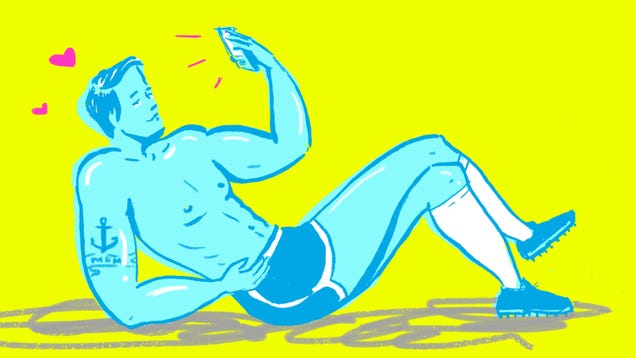
Illustration by Tara Jacoby.
Tuesday, August 26, 2014

We Are All Sexters Now: America’s Favorite Amateur Porn


"All" is such an inclusive word. I suspect many of us are not part of this "all." But the numbers of people now sexting, and not just teens and young adults, has sky-rocketed.

To me, as an apparent middle aged man, this phenomenon feels like a sad commentary on our increasing isolation from each other as a result of technology. Although, to be fair, I am sure some people do this in responsible and safe ways.

We are all sexters now: America’s favorite amateur porn

Sexting nation, 78 million strong! How the scolds and moralists lost, and sexting became an all-American pastime


David Rosen
Saturday, Aug 16, 2014


(Credit: Ammentorp Photography via Shutterstock)

It was only a few years ago when scolds and the media made “sexting” a national concern. Congressmen were being outed for exposing themselves in revealing sexts; states across the country were passing laws making it a crime; hundreds of kids were being busted for doing it; and talk-show talking heads, along with religious leaders and other social worthies, were bemoaning the fate of American youth. Sexting was scary.

Today, sexting has all but disappeared from public discourse. Sure, occasional teen busts are reported, but they capture far less media attention. Why? What’s happened to make the hottest media story of a couple of years ago pretty much disappear from the public stage?

With rare exception, the popular media are driven by the crisis du jour: the latest body count report, natural disaster or political sex scandal. So, yesterday’s news is so yesterday.

But sexting is more than a media story; it is the first original form of pornography to emerge in the 21st century. Sexting may have disappeared from the public spotlight, but it has not disappeared from public life.

Sexting is an original form of do-it-yourself (DIY) or user-generated-content (UGC) media, amateur porn. It began as a subversive art, with young people taking, sending and receiving explicit nude, semi-nude and provocative still images, video clips and/or text messages of themselves and others via a smartphone or another mobile communication device.

Sexting is not child porn, or sexual bullying; for the most part, sexting is not a form of sexual exploitation, of violation. Rather, it is a postmodern aesthetic with roots reaching back to pre-modern forms of female representation, from the original 17th century “posture girl.” Between 10 and 20 percent of teens engage in sexting, but they are only the tip of an increasingly popular social phenomenon.

The outings of Congressmen Anthony Weiner, D-N.Y., and Chris Lee, R-N.Y., in 2011 shifted the sexting storyline. It went from a tabloid tale of out-of-control teens, a 21st-century version of 1950s kids into obscene comic books or Marlon Brando’s “The Wild One,” to pathetic tales of male exhibitionists. Perhaps most alarming: recent disclosures about the UK spy program, “Optic Nerve,” which scooped up an untold number of sexually explicit images, proves again that sexting is widespread among American adults.

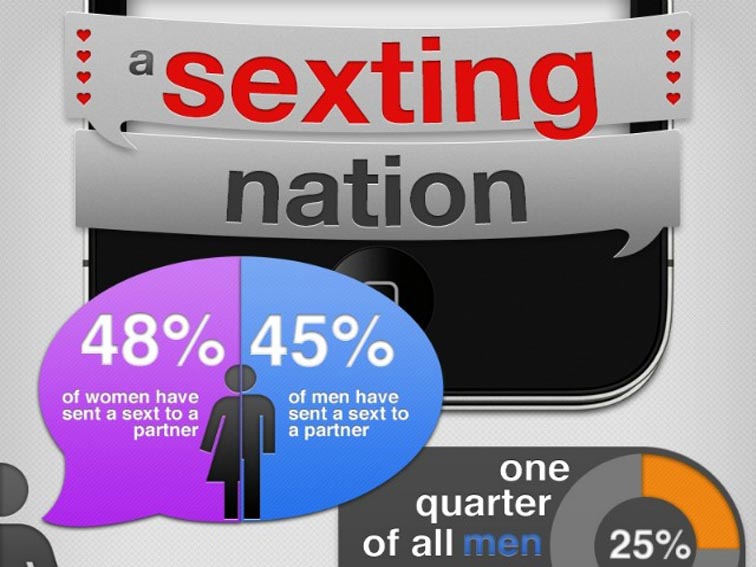
Sexting is going suburban and vanilla. Like “adult” pornography, it is being accepted as just one more of the “50 shades” of sexual titillation. Sexting scandals involving adults are regular occurrences and there’s even a website featuring the latest celebrity sexting scandal. Retina-X Studios, a company that sells online tracking tools, recently conducted a study of 4,800 respondents and found that the most sexting takes place on Tuesday morning, between 10 a.m. and noon – time when most teens are in school. It also found that iPhone users engaged in sexting almost twice as frequently as Android users.

The most revealing testimony to the mainstreaming of sexting was a recent Washington Post piece, “A guide to safe sexting: How to send nude photos without ruining your life, career and reputation.” Its warning to readers was simple: “Repeat after me: If you can’t prevent people from spreading your nudes, the next-best thing you can do is prevent them from ever knowing said nudes belong to you.”

The Post instructed readers to follow two essential rules for online posts. First: “Never include your face in the photo. Make the background nondescript. Cover or omit distinguishing features, like birthmarks and tattoos.” Second: “Anonymize the photo file itself. All photos, even ones taken on a smartphone or tablet, are embedded with information about how, when and where the photo was taken. This is called EXIF data, and you want to strip it from any photos you may need to deny ownership of in the future.” One can only wonder how many inside-the-Beltway players saved the article. Sexting has become an all-American form of self-expression.


*

No one knows how many Americans engage in sexting. However, recent surveys by McAfee and Pew suggest how sexting is going mainstream.

McAfee, the cyber security firm, released a study earlier this year of “more than 1,500 consumers” and found that more than half (54%) “send or receive intimate content including video, photos, emails and messages.” It found that one in three American adults have filmed sexual content on their mobile devices.

Digging deeper, McAfee reported that 70 percent of 18- to 24-year-olds receive sexually suggestive content and that (among those using mobile devices) more males than females do so (61% vs. 48%). It also found that 45 percent of adults stored the sexts they received while 40 percent stored the ones they sent. Among those who sent “intimate or racy content,” three-fourths (77%) sent it to their significant other, while only 1 in 10 sent such content to a total stranger.

Pew Research reported that “sexting … is practiced by couples and singles alike” and has nearly doubled since its last survey in 2012. The most active adults engaged in sexting were between 25 and 34 years of age. “Married and partnered adults are just as likely as those not in a relationship to say they have sent sexts,” the report noted, adding, “single adults are more likely to report receiving and forwarding such images or videos.” Pew’s research also found the following among adults: 20 percent of “cellphone” owners have received a sext of someone they know; 9 percent have sent a message of themselves to someone else; and 3 percent have forwarded a sext to someone else.

Approximately 145 million Americans own a “smartphone,” a 3G or 4G mobile device capable of image-based sexting. Extrapolating from this estimate, the McAfee report suggests that upwards of 78 million users have engaged in sexting. The Pew report suggests that some 30 million Americans have received a sext and about 13 million have sent one. The scope of sexting among Americans likely resides somewhere between the two estimates. Clearly, sexting is no longer simply a teen titillation.


*

Sexting emerged as a form of DIY or amateur pornography about a decade ago and originally subverted the dominant porn conventions in (for the most part) three ways. First, it involved teen makers and viewers, not adults (e.g., sex predators); second, it involved erotic display and not explicit sex acts (e.g., fellatio, intercourse); and third, it was a non-commercial form of enticements (i.e., not a product for sale). Sexting continues as a form of teen flirting, something essentially by and for young people and freely exchanged, a gift.

However, sexting seems to be increasingly adopted as part of the postmodern adult sex scene, and as it goes mainstream it is losing its critical edge. In the U.S., “noncommercial” sexual relations between consenting adults are not illegal. One can easily imagine sexts becoming the next intimate Valentine’s card or seductive private message, the latest personal turn-on. Who needs chocolates when one can send a sext?

Will sexting be integrated into the commercial sex industry? Sex is big business in the U.S., estimated at $50 billion in annual revenue. Prostitution, illegal in all but a handful of Nevada counties, pulls in an estimated $18 billion; the sex toy or “sexual wellness” sector is pegged at $15 billion; the 3,000 or so gentlemen’s clubs are reported to serve some 1.2 million (mostly male) customers a day and generate an estimated $3.1 billion to $7.5 billion in revenues. And this does not include the private “safe sex” clubs for gays and straights as well as specialized fetish clubs (e.g., BDSM) often hosted by a professional dominatrix, the gay bathhouses or other illicit “noncommercial” hookups easily arranged via voice calls, Internet sites and wireless app services.

The U.S. porn business is estimated at $10 billion-plus annually. According to one source, there are nearly 25 million porn sites worldwide, making up 12 percent of all websites. Sebastian Anthony, writing for ExtremeTech, reports that Xvideos is the biggest porn site on the Web, receiving 4.4 billion page views and 350 million unique visits per month. He claims porn accounts for 30 percent of all Web traffic. (In comparison, Wikipedia gets about 8 billion page views.) Anthony estimates the average length of time spent on Xvideo at 15 minutes. From an aesthetic perspective, he notes that, alas, most people receive their digital video feeds using low-resolution streaming.

Sex saturates the marketplace, whether promoting personal satisfaction or glamorizing a product, be it a new car or a mouthwash. Sexting illustrates the power of technological innovation and, sadly, of how a once-radical, DIY form of self-expression is being recuperated, integrated into the commercial economy. The marketplace has perfected the art of turning the most intimate human exchange into a commodity. The only unanswered question is what intimacy remains to be plundered?

More David Rosen.

Monday, July 21, 2014

Peg Streep - What Porn Does to Intimacy

http://www.epiclol.com/cdn/pictures/2012/01/pornography-logistic_1326452670_epiclolcom.jpg

Disclaimer - Not all porn is evil, but frequent use of porn can pose serious issues.

This post from Peg Streep's Psychology Today blog, Tech Support, looks at three recent studies on how pornography impacts intimacy in relationships.

What Porn Does to Intimacy

3 studies find that explicit material can do more harm than most people think.

Published on July 16, 2014 by Peg Streep in Tech Support
The rapid proliferation of pornography is one of the digital age’s legacies; some 40 million people in the United States visit porn websites regularly, many of them emerging or young adults. Popular media have capitalized on cautionary tales about porn addiction and stories of boyfriends objectifying their girlfriends and wanting them to behave like porn stars. But studies confirm that the preponderance of young men—and slightly less than half of women—thinks that watching sexually explicit material is okay.


That’s what Spencer B. Olmstead and his colleagues found when they asked college students about the use of pornography in future romantic relationships: 70.8 percent of men and 45.5 percent of women thought they would watch. In contrast, only 22.3 percent of men and 26.3 percent of women thought pornography had no role in a romantic partnership. Men and women tend to disagree on two issues: How porn is watched (alone, in groups, with a sexual partner); and how often it is watched. As Michael Kimmel reported in his 2008 book Guyland, young men often watch porn with their peers and for different reasons than older men. Kimmel writes that “guys tend to like the extreme stuff, the double penetrations and humiliating scenes. They watch it together with guys and they make fun of the women in the scene.” In contrast, older men with more experience either watch by themselves or with a partner, and with what Kimmel calls “wistfulness” about their younger selves; they tend to prefer material “where the women look like they are filled with desire and experience pleasure.”

The Olmstead study found that women’s concerns had more to do with whether consumption of porn was limited than whom it was watched with. Men tend to think that watching porn has only positive consequences.

As reported by Nathaniel Lambert and others in a review of studies, women whose partners watched porn regularly thought less of those partners and saw porn as more of a threat to the stability of their relationship. On the other hand, other studies have shown that young men and women alike think that sexually explicit material can help them explore their sexuality and adds “spice” to what they do in bed.

Is watching pornography really as benign as people think? The following three studies reveal that it has a greater effect on relationships than those we usually discuss.

1. Porn-free relationships are stronger, with a lower rate of infidelity.

That’s what Amanda Maddox and her colleagues found in a study of men and women, ages 18 to 34, who were in romantic relationships. The researchers measured the levels of negative communication, relationship adjustment, dedication or interpersonal commitment, sexual satisfaction, and infidelity. In their study, 76.8 percent of men and 34.6 percent of women looked at sexually explicit material alone; 44.8 percent reported viewing it with partners. They found that people who didn’t view any porn had lower levels of negative communication, were more committed to the relationship, and had higher sexual satisfaction and relationship adjustment. Their rate of infidelity was at least half of those who had watched sexual material alone and with their partners. But people who only watched porn with their partners were more dedicated to the relationship and more sexually satisfied than those who watched alone.

2. Watching porn diminishes relationship commitment.

What these researchers discovered is that watching porn reminds you of all the potential sexual partners out there, which in turn lowers your dedication to the person you’re actually involved with. It also leads you to swap out the person who’s actually lying in bed with you for some fantasy person you’ve never met (and probably never will).

Does that sound healthy?

Nathaniel Lambert, Sesen Negash and others conducted five separate experiments to find out. In the first, they asked participants, age 17 to 26, who were in relationships (as long as three years and as brief as two months) about their porn consumption and measured levels of commitment. They found that porn consumption lowered commitment in both men and women, but with a stronger effect on men.

In their second study, they had independent observers watch videos of couples performing an interactive task—one partner was blind-folded and had to draw something while the other gave instructions. Among the observers, lower commitment was observed among porn users.

The third study only tested participants who had consumed porn. They had half the group give up porn for three weeks. The other half was asked to give up their favorite food, but were allowed to watch porn. The result? Those who had abstained from sexually explicit material showed increased commitment to the relationship at the end of the three weeks.

The last two studies focused on the effect of greater attentiveness to alternatives on potential infidelity and infidelity itself. And yes, people who watched porn were more likely to engage in flirting (and more) outside their relationships in one experiment; and more likely to cheat and hook-up in the other.

3. The fantasy alternative leads to real-world cheating.

In another study, Andrea Mariea Gwinn, Nathaniel Lambert, and others further explored the nature of the other alternatives imaginatively offered up by pornography. They suggested two possibilities: First, that seeing physically attractive and sexually available partners on screen may heighten a person’s perceptions of his own possible partners. And second, that porn may make the idea of multiple sexual partners more appealing—another wound to a committed relationship.

And that’s exactly what they found.

In one study, the researchers found that people who thought about porn they’d watched reported having better alternatives to their current relationship than those who didn’t. A second study showed that, over time, exposure to porn was a robust predictor of infidelity.

More strikingly, the team found that both thinking about possible partners and acting on the impulse to find those alternatives operated separately from dissatisfaction with one's current relationship and partner. In other words, even though one's own pasture may be plenty green enough, just the thought of a greener one can be enough to send one roving.

You might want to keep that in mind if you’ve been watching the hard stuff or if you've become inured to seeing your partner just flip open his laptop "just for fun.”

Pornography is not as benign as you think, especially when it comes to romantic relationships.

1. Olmstead,Spenser B., Sesen N Negash, Kay Pasley, and Frank D. Fincham, “Emerging Adults’ Expectations for Pornography Use in the Context of Future Committed Relationships: A Qualitative Study,” Archives of Sexual Behavior (2013), 42, 625-635.
2. Kimmel, Michael. Guyland: The Perilous World Where Boys Become Men. New York: HarperCollins Publishers, 2008.
3. Maddox, Amanda, Galena K, Rhoades, and Howard J.Markman,” Viewing Sexually-Explicit Materials Alone and Together: Associations with Relationship Quality,” Archives of Sexual Behavior (April 2011), 40, no. 2, 441-448.
4. Lambert, Nathaniel M. and Sesen Negash, Tyler F.Stillman, Spencer B. Olmstead, and Frank M. Fincham, “A Love That Doesn’t Last: Pornography Consumption and Weakened Commitment to One’s Romantic Partner,” Journal of Social and Clinical Psychology (2012), vol.31, no.4, 410-438.
5. Gwinn, Andrea Mariea, Nathaniel M. Lambert, Frank D. Fincham, and Jon K,Maner, “Pornography, Relationship Alternatives, and Intimate Extradyadic Behavior,” Social Psychological and Personality Science, (2013), vol.4, no. 6, 699-704.
Copyright© Peg Streep 2014
VISIT ME ON FACEBOOK: www.Facebook.com/PegStreepAuthor
READ MY NEW BOOK: Mastering the Art of Quitting: Why It Matters in Life, Love, and Work
READ Mean Mothers: Overcoming the Legacy of Hurt

Saturday, May 31, 2014

Men Who Watch Porn Have Less Grey Matter in Brain Regions Associated with Motivation and Executive Function


Watch porn and your brain may suffer from the intense stimulation of the reward system. One of the results of this can be a lower top-down modulation of prefrontal cortical areas (i.e., a loss of executive function and the ability to associate behaviors with outcomes). Another outcome is that exposure to porn imagery produced reduced activation in parts of brain associated with motivation - suggesting that porn (like other drugs) reduces the desire to do anything other than look at porn.

The researchers point out, rightly, that they cannot say that porn reduces grey matter - only that those who watch more porn has less grey matter. It may be the later that leads to the former.

By the way, the average porn consumption for the 64 men was 4 hours a week.

Below is a summary of the research from Science Alert, followed by the abstract of the full article (which is sequestered behind a pay wall).

Men who watch porn have less brain grey matter

Porn consumption has been linked to differences in the structure and function of male brains


Felicity Nelson | Saturday, 31 May 2014 

Image: PornHub

Men who watch porn have significantly less grey matter in their brains, a new study shows. MRI brain scans of 64 men between 21 and 45 years of age were taken while participants were shown images of porn and people exercising.

The participants were later requested to provide information about weekly porn consumption via a phone interview. Every person in the study volunteered to answer these questions, even though they were not told that this information would be needed before commencing. The men had a wide range of porn consumption averaging 4 hours a week.

Men with higher porn consumption had lower grey matter volumes. Interestingly, when men were shown sexually explicit material during the MRI scan, the region of the brain associated with motivation showed reduced activity.

"Our findings indicated that grey matter volume of the right caudate of the striatum is smaller with higher pornography use," researchers at the Max Planck Institute for Human Development in Berlin, Germany told ABC Science.

The study could not show that porn caused men's brains to lose grey matter. "Future studies should investigate the effects of pornography longitudinally or expose naive participants to pornography and investigate the causal effects over time", researchers told ABC Science.

This research was published this week in the journal JAMA Psychiatry.

Full Citation:
Kühn, S; Gallinat, J. (2014, May 28). Brain Structure and Functional Connectivity Associated With Pornography Consumption. JAMA Psychiatry. Online First. doi:10.1001/jamapsychiatry.2014.93


Brain Structure and Functional Connectivity Associated With Pornography Consumption

The Brain on Porn ONLINE FIRST

Simone Kühn, PhD; Jürgen Gallinat, PhD

ABSTRACT

Importance Since pornography appeared on the Internet, the accessibility, affordability, and anonymity of consuming visual sexual stimuli have increased and attracted millions of users. Based on the assumption that pornography consumption bears resemblance with reward-seeking behavior, novelty-seeking behavior, and addictive behavior, we hypothesized alterations of the frontostriatal network in frequent users.

Objective To determine whether frequent pornography consumption is associated with the frontostriatal network.

Design, Setting, and Participants Sixty-four healthy male adults with a broad range of pornography consumption at the Max Planck Institute for Human Development in Berlin, Germany, reported hours of pornography consumption per week. Pornography consumption was associated with neural structure, task-related activation, and functional resting-state connectivity.

Main Outcomes and Measures Gray matter volume of the brain was measured by voxel-based morphometry and resting state functional connectivity was measured on 3-T magnetic resonance imaging scans.

Results We found a significant negative association between reported pornography hours per week and gray matter volume in the right caudate (P < .001, corrected for multiple comparisons) as well as with functional activity during a sexual cue–reactivity paradigm in the left putamen (P< .001). Functional connectivity of the right caudate to the left dorsolateral prefrontal cortex was negatively associated with hours of pornography consumption.

Conclusions and Relevance The negative association of self-reported pornography consumption with the right striatum (caudate) volume, left striatum (putamen) activation during cue reactivity, and lower functional connectivity of the right caudate to the left dorsolateral prefrontal cortex could reflect change in neural plasticity as a consequence of an intense stimulation of the reward system, together with a lower top-down modulation of prefrontal cortical areas. Alternatively, it could be a precondition that makes pornography consumption more rewarding.

Tuesday, January 21, 2014

Anna Pulley - 10 Things Porn Gets Horribly Wrong About Men

From Role/Reboot, Anna Pulley exposes 10 things about men that porn gets "horribly wrong." And my first thought was, "Only 10?"

This is a good article - with a little humor to lighten things up. The only one I really did not know was that gay male porn stars make 3x as much as straight porn guys. Good for them.


10 Things Porn Gets Horribly Wrong About Men 

By Anna Pulley
January 07, 2014


This originally appeared on Alternet.org. Republished here with permission.

Here are the biggest male myths we find hardest to swallow.

We recently told you our biggest grievances involving women in mainstream porn. Making a comparable list for men, however, proved to be harder (sorry) than it initially seemed. Partially because, in mainstream straight porn, which is produced, funded, run, and directed by men, the focus is almost entirely on the porn actresses. Rarely do we get sweeping slow pans of pectoral physiques, zoomed in facial grimaces, or the come-hither eyes that women make at the camera. While we do often glimpse extreme penetration closeups, with its accompanying, and at times mesmerizing, ball pendulums, little attention is paid to much else.

Further complicating our attempts is that very few scientific studies on porn have been done (except in the realm of addiction and why no one will think of the children). But! A peer-reviewed Porn Studies Journal is slated to come (sorry again) in 2014, so perhaps this will change soon. In the meantime, some of our stats come from self-proclaimed “idea detective” Jon Millward, who crunched numbers from the Internet Adult Film Database (like IMDB, but for smut) which boasts data on 151,946 titles and 129,831 performers/directors, but as is to be expected, much of Millward’s data focuses on the ladeez.

Despite these obstacles, when it comes to the topic of men, porn still gets a lot wrong. Here are the 10 biggest male myths we find hardest to swallow (not sorry about that one, actually).

1. Only one erogenous zone exists.

In mainstream and especially hardcore porn, men are often reduced to little more than walking, grunting penises who experience no other pleasure except from their deep-V diver. Like RoboCop, but for sexual purposes only. Again, since the onus is on the women in porn, some disregard of male bodies is to be expected. While we don’t expect to be regaled with the pleasures of their watercolors hobby or anything, a little attention could be paid to other erogenous zones, like nipples, necks, thighs, asses, and even balls, which are largely ignored, in porn as in life.

2. Size is subjective.

While no hard or even soft data exists on the average penis size of porn stars versus the average Tom’s Harry Dick, the porn-star-penis-as-huge trope is certainly prevalent and used to sell a variety of pumps, pills, and other penis-enlargement doodads, banking on men’s insecurity and Photoshop to hawk their wang wares. But just as technology can make Smurfs three-dimensional, porn cinematography can make a penis appear larger than it is, with lighting, camera angles, makeup, and even the placement of one’s penis next to, say, a diminutive porn actress. Everything looks big when you stand next to a girl who weighs 80 pounds.

3. The everlasting boner.

In typical porn scenes, men are required to bang longer than the Salvation Army drum on the Easter Day parade, i.e. for 30-60 minutes or more. Despite what you may have heard in Boyz II Men songs, non-porn intercourse typically lasts between 3-7 minutes. As Seymore Butts told Forbes: “The most difficult part about being a male porn star is the hard-on. They have to get it up and off on cue essentially and all the while in between maintain [it] for two to three hours. This must be done under the most difficult of circumstances, including not being attracted to their female co-star, having sex in the most uncomfortable settings, i.e. on hard surfaces, cold/hot weather, etc., and/or having to stop frequently for direction or shot setups.” Male porn performers also use Caverject—a drug injected directly into their penis to maintain those impossible erections, bringing new meaning to the phrase “working stiffs.”

4. Mo’ money shots, mo’ problems.

If sex acts in porn were relative, then we’d all be giving and getting a lot more facials. According to Millward’s porn study, 87 percent of porn actresses will “take a facial” at least once in their careers. For comparison, 62 percent will do anal, 31 percent swallow, and a mere 6 percent will be fisted. The money shot is the most common way to end a porn scene. As with all things, of course, there are probably some men and women who enjoy capping off their night with a little sperm in the eye, but it’s also safe to say that the vast majority do not.

5. The jackhammer.

Porn would have us believe that the only tried and true way to fuck a woman is to pound her so hard that the cervical force and momentum spontaneously cause her to travel back to the Triassic period to bring back a tooth from a Therapsid with which to conquer our reptilian overlords in 2057. Really hard, in other words. Of course, a good deep-dicking can be enjoyable (and even preferred!) from time to time, but every time? And for an hour? And no breaks to drink Gatorade laced with speed to keep up the fervent drilling to China? Also, no one ever sweats. Maybe that’s why they keep all the dry ice around.

6. Very little variety of roles for men.
While women can be a wide variety of stereotypes (the randy MILF, the randy sorority girl, the randy babysitter, etc.) the profiles of men in the International Adult Movie Database are sadly bland. They either do boy/girl scenes or they don’t. Even when they do get to play an actual role, it is often the uninspiring pizza delivery guy (“I ordered extra sausage!”), or some kind of repair man. “You know what this sink needs? Twelve inches of reinforced steel pipe. C’mere ladies.”

7. Neither here, nor hair.

Like women in porn, the standard for male porn stars is to partake in bushwhacking (as well as scrotum-shearing, chest-clipping, and rectal-region hair removal). This manscaping, and other body hair removal, is for aesthetic reasons: to make one’s penis appear larger, smoother, and cleaner. While non-porn male deforestation has certainly seen a rise (there are a bevy of articles on the topic, major razor brands have launched all-body shavers for men, salons are offering more male services, etc.), there isn’t much research on its overall prevalence. But, a 2008 study from Australia found that 82 percent of gay men and 66 percent of straight men removed their pubic hair at least once, although the largest percentage of both groups said they did it “rarely.”

8. It pays to be gay.

While there are few cultural rewards for bisexual men, except perhaps in the realm of increased hair products, in porn at least, there are definite financial benefits. Gay porn pays about three times as much as straight porn. For this reason, many straight male porn performers have done gay porn, enough to spawn the term gay-for-pay. We can’t say the same for non-porn dude experimentation, as much as we wanted Brokeback Mountain to become a phenomenon.

9. Porn stars weigh less and have more piercings.

The average male porn star weighs 167.5 lbs, 27 pounds less than the national average for men. It makes sense that porn stars would be in better shape than many, considering the physical demands of say, the Standing 69 or the Lawnmower. Aside from weight, however, attractiveness of male porn stars seems more often than not based largely on...how to put it...the quality of the wood. One time we watched a near-elderly man, who looked like a penis with eyes, nail his hot secretary and the sight was so ghastly it almost turned us off porn indefinitely. Speaking of appearances, male porn stars also are more likely to have at least one tattoo (9.5 percent more than average), and a body piercing (13 percent more than average).

10. Male porn stars really get around.


Male porn stars are far more prolific than your average dude (duh), but also considerably more than female porn stars, when it comes to number of partners. Millward again: “The 10 most prolific male performers, on average, have slept onscreen with 1,013 different women each (45 a year for an average career length of 22.4 years). Whereas the 10 most prolific women on average have slept with 148 different men (eight a year for an average career length of 17.7 years). The most prolific of them all, Tom Byron, has slept with 1,127 different women. According to the National Center for Health Statistics, non-porn men have an average of seven sex partners."

Follow @annapulley on Twitter.

Wednesday, August 7, 2013

The New Man 141: Pelmas and Bollt – How to Admire Women Without Being Creepy

Tripp Lanier's newest The New Man podcast features Christiane Pelmas and David Bollt discussing "sexual attraction, beauty, your relationship, porn, art, and most importantly — how this all impacts your power and fire for living."

This is an interesting topic for a lot of men - and the discussion is not only about how to admire women in a non-creepy manner. It's also about living a life that does not cut off your sexual energy, how to be in balance with that, and what women are looking for in men.

TNM 141: Pelmas and Bollt – How to Admire Women Without Being Creepy

06 AUGUST 2013


Podcast: Download

When you’re with your woman, are you afraid to get caught checking out other women?

Is it confusing that a woman makes an effort to look beautiful but you’re a jerk if you get caught looking at her?

And how can you admire a woman’s beauty in a cafe without being creepy?

Christiane Pelmas and David Bollt are hear to continue the conversation on sexual attraction, beauty, your relationship, porn, art, and most importantly — how this all impacts your power and fire for living.

In this interview:
  • If you’re in a relationship, is it wrong to check out other women?
  • How to be with your woman and admire other women, too
  • How cutting off your sexual energy is killing your mojo for everything
  • Why many guys live a split life sexually (think Don Draper or Carlos Danger)
  • How does looking at certain images of women kill your power and freedom?
From a woman’s perspective:
  • As a woman, what is it like to be admired by men?
  • What makes a man’s attention creepy?
  • Do women only want rich or good looking guys to check them out?
  • Is there a mixed message when women make an effort to appear beautiful but men feel like a jerk if they look?

Wednesday, April 17, 2013

Masturbation as a Failure of Masculinity?

This is an interesting article, and in general I agree with the premise that frequent porn use and/or masturbation (they go hand in hand, so to speak) is detrimental to healthy intimate relationships for most men. But some of these guys - the new (to me) term is NoFappers - seem to take it to an extreme, for example the title of this post is a quote from the article describing how some of these guys view maturbation - I added the question mark.

But is maturbation really a failure of masculinity? Or is it a basic animal drive (many animal species, or mammals at least, also masturbate)? Is it okay to masturbate when one is single, but not in a relationship?

In my experience in working with porn addicts (and I think this is the REAL issue here), if they can give up porn for 30 days, but are still allowed to masturbate, they discover a rich fantasy life they did not know they possessed - and most find that much more rewarding than porn.

The best part of using fantasy rather than porn is that when a guy does get into a relationship, the fantasy life can potentially generate a lot more creativity in his love-making.

Hands Off

Why are a bunch of men quitting masturbation? So they can be better men.

By Emily Witt
Published Apr 14, 2013

(Photo: Bobby Doherty/New York Magazine)

Traditionally, people undergo a bit of self-examination when faced with a ­potentially fatal rupture in their long-term relationship. Thirty-two-year-old Henry* admits that what he did was a little more extreme. “If you’d told me that I wasn’t going to masturbate for 54 days, I would have told you to fuck off,” he says.

Masturbation had been part of Henry’s daily routine since childhood. Although he remembered a scandalized babysitter who “found me trying to have sex with a chair” at age 5, Henry says he never felt shame about his habit. While he was of the opinion that a man who has a committed sexual relationship with porn was probably not going to have as successful a relationship with a woman, he had no qualms about watching it. Which he did most days.

Then, early last year and shortly before his girlfriend of two years moved to Los Angeles, Henry happened to watch a TED talk by the psychologist Philip Zimbardo called “The Demise of Guys.” It described males who “prefer the asynchronistic Internet world to the spontaneous interactions in social relationships” and therefore fail to succeed in school, work, and with women. When his girlfriend left, Henry went on to watch a TEDX talk by Gary Wilson, an anatomist and physiologist, whose lecture series, “Your Brain on Porn,” claims, among other things, that porn conditions men to want constant variety—an endless set of images and fantasies—and requires them to experience increasingly heightened stimuli to feel aroused. A related link led Henry to a community of people engaged in attempts to quit masturbation on the social news site Reddit. After reading the ­enthusiastic posts claiming improved virility, Henry began frequenting the site.

“The main thing was seeing people who said, ‘I feel awesome,’ ” he says. Henry did not feel awesome. He felt burned out from work and physically exhausted, and his girlfriend had just moved across the country. He had a few sexual concerns, too, though nothing serious, he insists. In his twenties, he sometimes had difficulty ejaculating during one-night stands if he had been drinking. On two separate occasions, he had not been able to get an erection. He wasn’t sure that forswearing masturbation would solve any of this, but stopping for a while seemed like “a not-difficult experiment”—far easier than giving up other things people try to quit, like caffeine or alcohol.

He also felt some responsibility for what had happened to his relationship. “When a guy feels like he’s failed with respect to a woman, that’s one of the things that causes you to examine yourself.” If he had been a better boyfriend or even a better man, he thought, perhaps his girlfriend wouldn’t have left New York.

So a month after his girlfriend moved away, and a few weeks before taking a trip to visit her, Henry went to the gym a lot. He had meditated for years, but he began to do so with more discipline and intention. He researched strategies to relieve insomnia, to avoid procrastination, and to be more conscious of his daily habits. These changes were not only for his girlfriend. “It was about cultivating a masculine energy that I wanted to apply in other parts of my life and with her,” he says.

And to help cultivate that masculine energy, he decided to quit masturbating. He erased a corner of the white board in his home office and started a tally of days, always using Roman numerals. “That way,” he says, “it would mean more.”

For those who seek fulfillment in the renunciation of benign habits, masturbation isn’t usually high on the list. It’s variously a privilege, a right, an act of political assertion, or one of the purest and most inconsequential pleasures that exist. Doctors assert that it’s healthy. Therapists recommend it. (Henry once talked to his therapist after a bad sexual encounter; she told him to masturbate. “Love yourself,” she said.)

And despite a century passing since Freud declared auto­eroticism a healthy phase of childhood sexual development and Egon Schiele drew pictures of people touching themselves, masturbation has become the latest frontier in the school of self-improvement. Today’s anti-masturbation advocates deviate from anti-onanists past—that superannuated medley of Catholic ascetics, boxers, Jean-Jacques Rousseau, and Norman Mailer. Instead, the members of the current generation tend to be young, self-aware, and secular. They bolster their convictions online by quoting studies indicating that ejaculation leads to decreased testosterone and vitamin levels (a drop in zinc, specifically). They cull evidence implying that excessive porn-viewing can reduce the number of dopamine receptors. Even the occasional woman can be found quitting (although some women partake of a culture of encouragement around masturbation, everything from a direct-sales sex-toy party at a friend’s house to classes with sex educator Betty Dodson, author of Sex for One).

(Photo: Bobby Doherty/New York Magazine)

One of the unintentional pioneers of the current wave of anti-masturbators is Alexander Rhodes, a 23-year-old college student and actor who lives in Pittsburgh. On June 20, 2011, after coming across a study conducted by Hangzhou Normal University in China that found that testosterone levels peak after seven days without ejaculation, Rhodes started a “NoFap” forum on Reddit, where he announced various challenges for those who wanted to abstain. (Fap is onomatopoeic Internet slang for masturbation.)

When it first launched, the forum received 20,000 visitors a month. There was no shortage of mutual encouragement, with badges awarded for milestones like going a week, a month, or a year without fapping, and a counter tracking exactly how many days a person has abstained. NoFap’s popularity has now ballooned to nearly 400,000 unique visitors per month, and posts have grown in diversity. Some threads tout the perceived benefits of no-fapping (“found my first girlfriend”). Others recommend self-­improvement books or revel in a newfound sense of perspective (“I was able to notice birds chirping, which I haven’t done in years”), or engage in what can best be described as penis monologues (“Today I was sitting on the toilet and I looked down and I saw my penis and I kinda just stared at it, then I asked him ‘What is your purpose penis?’ To which he replied ‘I dunno lol’”).

But perhaps the most noticeable shift within the forum is how NoFappers have begun to characterize their short-term challenges as long-term lifestyle ­choices—one discussion is literally titled “NoFap isn’t a challenge. It’s a way of life.” In the thread, ­Aterazideme posted: “I desire to be a person in control of his desires. Each day of NoFap brings me close to that ideal.”

And that “ideal” is defined pretty consistently, at least to ­“fapstronauts,” as they call themselves. In short, it means being more masculine, which in turn leads to success in other aspects of life. Take the example of 19-year-old Redditor Ojdidit123. After 70 days without masturbating, he wrote, he went from being a virgin to meeting a woman on his flight, getting a “raging boner,” and having sex with her in both the plane and an airport hotel. The confidence he got from that encounter, he said, not only helped him perform well at a job interview later, and secure a job at a hedge fund for the summer, but also enabled him to call a long-simmering crush and ask her out. “All that shit happened in the span of 48 hours,” he posted. “It was pretty fucking crazy.”

The vehemence with which some users espouse the benefits of anti-masturbation surprises Rhodes, who says that he never intended the forum as a self-help initiative. “I saw it as a fun challenge to test your willpower, to put yourself against your instincts and see if you could do it,” he says. Rhodes is also quick to clarify that he thinks masturbation is a normal and healthy human activity.

“I’m less extremist than a lot of NoFap members,” he says. “There are a lot who blame every problem they have on masturbation,” echoing a disclaimer on the NoFap board: “Please do not look to fapstinence to cure all your social and physical ills. If you have other problems that have nothing to do with your sexual habits, they’re still going to be there when you’re done with a NoFap challenge.” I ask if his counter, which reads 40 days, is accurate. He laughs and says no. “My girlfriend’s away in a different state for a few more days. I might have even masturbated before you called me.”

Last August, comedian Greg Barris began talking about his ­masturbation hiatus in his stand-up routines. He started with a regime not unlike that of a pregnant woman, giving up booze, weed, and caffeine. He also gave up porn. A year later, when a woman he was seeing left town, “like gone, forever,” he decided he would give up sex. “But not trying to have sex, you know?” he says. “Not accidental celibacy.” Masturbation came next. He set a goal of 60 days. As the days passed, he made jokes about his progress online:

“30 days celibate. Hot on Tesla’s tracks. Have created wireless energy out of my humidifier and now my whole apt is off the grid.”

“43 days totally celibate. If you see me and hug me don’t squeeze me too hard.”

“60 celibate today. 60 days no masturbation today. Anyone else?”

Halfway through his experiment, he felt more energy and mental clarity. Throughout the process, “I kept saying, ‘I’m resetting my dick and my brain,’ ” he says. “If you’re on sex mode, then your brain is probably running like a couple of hundred programs, where it’s like looking for sex somehow.”

Comparing the body to a computer is a common analogy among those in the anti-masturbation community, a subset of which includes the self-proclaimed “biohackers” and “quantified self” enthusiasts who collect data regarding the input and output of their bodies. If the body is a series of systems, the thinking seems to be, then whatever problems exist can be repaired like a piece of hardware. Wilson, the guru of “Your Brain on Porn,” suggests that dopamine receptors will regenerate and dopamine levels increase after a withdrawal period of “flatlining”—total uninterest in sex. Some anti-masturbators even use video-gamespeak when they talk about abstaining on “hard mode,” which means declining sex with a partner as well as with oneself.

There’s also the particularly poignant demographic whose sexual lives are so inextricable from their computers that giving up masturbation is a way of unplugging and reentering the world. “I never really had to get out there,” says a 24-year-old law student in California whose longest streak of not masturbating was 105 days (he did have sex with his girlfriend during this time). Though he started limiting masturbation because it fixed the erectile problems he experienced during sex with his partner, it was also about trying to more actively engage with life. “I was not a troll who lived in my room and played World of ­Warcraft all the time, but I didn’t really develop fully socially,” he says.

The goals for all these men, regardless of their personal lives or relationship statuses, seemed to be similar: to return to a more charged, natural self. It’s a throwback notion—virility as integral to manhood—but many of these anti-masturbators regard it as truth. “I feel like a man again” is a common refrain. One NoFapper referred to his 90 days without masturbation as “a passage into manhood.” They see masturbation as a failure of masculinity—not because it’s shameful or forever associated with adolescence, but because, on a fundamental, even chemical level, it’s draining their true potential.

The medical profession isn’t convinced. Every doctor and psychologist I spoke with informed me that “there’s no evidence” to link masturbation to sexual performance, and that it’s an over­simplification to think that frequent masturbation is the cause of delayed ejaculation. According to ­Stephen Snyder, a sex therapist in Manhattan, it’s “most often not the case.” Darius Paduch, a professor of urology and reproductive medicine at Weill ­Cornell Medical College, went so far as to say that ejaculation leads to greater fertility. “In our practice, we pretty much make men achieve an erection at least three to four times a week,” he says. Paduch also cited studies that found that men who ejaculated multiple times a week faced less risk of erectile dysfunction later in life. There’s also the body’s natural process of elimination: Many anti-masturbators start having wet dreams.

But none of that matters to the abstainers, including Matt, whose longest stretch without masturbation was 280 days. He has also encouraged a friend to join the experiment (and is keeping a spreadsheet to chart their ­progress). “Maybe part of it’s placebo,” he says. “But I’ve become more articulate and more confident. People can even understand what I’m saying better. I’ve become a very different person in a lot of ways.”

Henry went out to California. For two months, he lived with his girlfriend. Their relationship felt strong, the sex was great, and everything seemed to be on track. Then work and family compelled him to return to New York. They remained a couple, and Henry maintained his efforts. He says that his abstention, along with daily meditation and no porn, made him feel confident and grounded. He recorded his voice on his iPhone and claims it had deepened. Perhaps it was all in his mind, but he noticed other benefits, “like when you walk down the street and you make eye contact with a woman, and she smiles. And there’s no darting with the eyes, or no staring creepily, just a more natural exchange.”

He compares the feeling to being on antidepressants: “It was like a buffer, little things didn’t bother me.” He also began feeling more alert. And younger. And he found himself far more attracted to women—not in a furtive or uncomfortable way, but in the sense that the world around him felt more charged. Something totally banal—the before and after pictures of a Weight Watchers commercial, for example—suddenly had meaning.

“It felt like it did when you were in puberty or in college,” he says. “Women became more salient.” For 54 days, he did not masturbate. Then, over the phone, the relationship ended, and so did Henry’s campaign. “I didn’t have any desire,” he says. “I could totally not have done it, but I was like, ‘Fuck it.’ ”

Friday, March 15, 2013

America Is Addicted to Porn

This graphic comes from Buzz Feed - it was shared by some friends on Facebook. Since 72% of the visitors to porn sites are men, this is a male issue.

I don't go so far as to say that all porn is horrible and it must be banned - that's too slippery of a slope for me. And the reality is, as is true in all addictions, that a lot of people can view porn from time to time and it causes no problems in their lives or relationships - and some couples like to view porn together.

But the average age of first exposure now is 11 years old - and again, these are mostly boys. My exposure to Playboy as a young teen resulted in objectification of women, so I can't imagine what hardcore pornography is doing to these young men.


Wednesday, February 20, 2013

Elana Millman - Interviews with Men on Sex and Sexuality


Interesting . . . this comes from the Good Men Project.

Elana Millman - Interviews with Men on Sex and Sexuality


What would the average man on the street when asked “Where did you learn about sex?” or “Do you think porn has changed men’s relationship to sex?” 
Elana Millman took to the streets to interview real guys to find out what they really think about sex in our society. 
Do you agree? Disagree? 
What would you tell Elana if she stopped you?

Sunday, February 10, 2013

Linda Hatch, PhD - Good Porn, Bad Porn


I am sure that there can be good porn, or at the very least that porn can be educational as well as titillating, but among the several sex addicts I have seen as a coach or therapist, porn is more addictive than most chemicals, and it's free. And if you have ever seen much porn, it's hard to believe any of it can be good.

My greater concern, however, is for the young men who are growing up watching online porn and learning porn-style sex as "normal sex." Porn-style sex is all about the orgasm, especially the man's, but none of it is about emotional intimacy and caring.

It's hard enough to learn about healthy, intimate sexuality as a young man, throwing porn into the mix is a recipe for disaster. Not only will these young men be ignorant of how female sexuality actually works, but they will have been conditioned to quick and easy pay-off of masturbating to porn, which might make the whole process of seduction, foreplay, and mutually pleasurable sexual sharing seem like too much work (I have heard this from sex addicts).

This article was posted in November of 2012 at the Psych Central blog, The Impact of Sex Addiction by Dr. Linda Hatch.


Is there good porn?

Take a look at this statement from an article called The Impact of Internet Pornography on Adolescents: A Review of the Research. 

“Increased access to the Internet by adolescents has created unprecedented opportunities for sexual education, learning and growth.”

(Owens, E. W., Behun, R. J., Manning, J.D. and Reid, R.C. (2012). Journal of Sexual Addiction and Compulsiviy, 19, 99-122)
Writers and researchers seem to feel obligated to acknowledge the potential benefits of pornography when in fact their own research as well as the vast majority of everyone else’s shows no such thing.

The above authors go on to document the damaging effects of internet pornography on adolescents.  For example that youth who view porn develop unrealistic sexual values and beliefs, and that viewing violent porn is related to higher levels of sexually aggressive behavior. Also that viewing porn leads to body image problems with girls and performance fears in boys and so on.

Certainly research on the negative effects of porn is important. But there is always an opposing view out there that porn serves the useful functions of freeing men and women, reducing shame around sex, aiding couples, and educating the young.

The reporting of scientific evidence often seems to be an attempt to escape the good vs. bad debate about porn so as to avoid being seen as moralistic. Just the facts. And indeed that is what science does.

But proving that porn can be a harmful, addictive drug fails to address a larger issue that I think is given less attention.


The two sides of the porn debate

The conservative/religious anti-porn movement is pitted against pro-porn ideology. Supporters of porn can range from freedom of speech advocates to those who argue that porn is liberating and any opposition to porn is a moralistic attempt to impose rigid, outdated norms on everyone.

The pro-porn folks (or at least the porn industry) appear to be winning.  The amount of porn consumed is increasing and the imagery is becoming more extreme in terms of erotic depictions of dominance/submission, degradation and violence against women.

Although women are starting to watch internet porn in increasing numbers, the majority of viewers are men (about 70%) and porn videos are typically depictions of male dominance.

The porn narrative

Professor Robert Jensen of the Austin School of Journalism says that porn typically tells a story.  That story, he says, is that “all women are there for the sexual pleasure of men.

Further, Jensen argues that porn conveys the message that there are no “good” girls, that all women are “whores,” and that women like pain.  And he believes that part of the porn ideology is that when women play out these roles they will “become fully realized as sexual beings.”

Other writers have tabulated the frequency of the various sex acts  in porn depicting a couple, the relative frequency of receiving oral sex, of male vs. female orgasm etc. and has found that it favors men.

Professor Jensen maintains that this pattern in the stories and the increasing extremity of porn, particularly so-called “gonzo” porn infiltrates the mainstream of visual media. This is referred to as the “pornifying of pop culture.”

The human values question

When the two sides face off in the porn debate it often comes down to values.  So the scientists can prove that porn has any number of bad effects like addiction, erectile dysfunction, and divorce, but that will not convince someone whose sexuality has become fused with sexual objectification.  They will feel attacked at a deep level.

The larger question that I feel is neglected is not whether your porn viewing is consistent with my values, but whether your porn viewing is consistent with your own values.

As Professor Jensen points out, porn as a whole is built around ideas like gender inequality and the comodification of a class of people (women).  Subordinating and dominating any segment of humanity is inconsistent with most people’s value systems.

Along with the scientific data we need to remind ourselves as clinicians and researchers to bring the discussion back around to the values that we and our clients share, like the capacity for empathy and a sense of our common humanity.

~ Linda Hatch is a psychologist and certified sex addiction therapist specializing in the treatment of sex addicts and the partners and families of sex addicts. Linda also blogs on her own website at Sexaddictionscounseling.com