Showing posts with label metrosexuals. Show all posts

Sunday, August 31, 2014

Tracy Moore - Meet the Spornosexuals: Muscled Men Who Embrace Equal Opportunity Objectification

http://www.soyhomosensual.com/wp-content/uploads/2014/06/485618_10151613117724857_68070654_n-279x300.jpg

About 20 years ago, a new word entered the cultural lexicon, and quickly became both pervasive and pointless - Mark Simpson's metrosexual. [Even now, the spell-checker in Blogger thinks its not a word.]

So Simpson thinks he has identified a new subculture in varied world of masculinities, the spornosexual, a second generation metrosexual where obsession with clothes is replaced by obsession with sports and fitness, and the added, seemingly ubiquitous porn addiction (or desire to be a porn star).

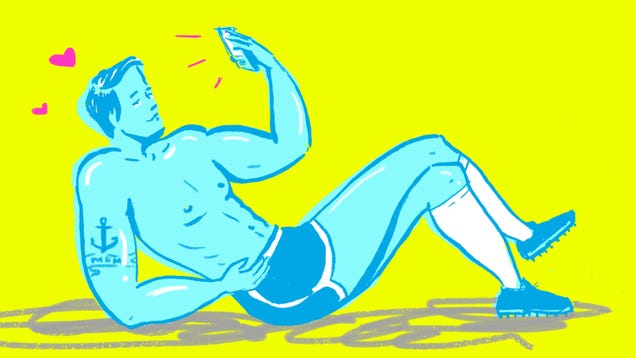
Oh, and they love to post selfies of their buffness on social media sites. Honestly, this makes them little different than all of the females who post pictures of themselves in their underwear or showing off their ass-sets. It all feels a bit homoerotic to me, which is also interesting. While certainly a lot of these guys identify as straight, there is also the element in this trend of wanting to be desired by both sexes, whether it's to be sexually desired (by women) or to instill jealousy (in other men) for their physiques (who will desire their buffness).

Besides, this type of selfie has long been an element in the gay male community - a kind of marketing tactic.

So, do we really need this word? Tracy Moore, writing for Jezebel, thinks not.


Meet the Muscled Men Who Embrace Equal Opportunity Objectification

by Tracy Moore | 6/23/14

What's with dudes getting buffer, y'all? Should we call it something? Other than, you know, buff dudes? What ever happened to beefcake? How about we ask that guy who came up with metrosexual. Oh, he already came up with something. Spornosexual. [dies]

Let's all say it once and then never say it again because this bullshit is never going to happen. Sporno-barf-ual. Sporno-vomitron. Sporno-dude-icus. Spornoshitcicle. In fairness, if I coined a term like metrosexual that actually caught on so thoroughly that it was used even by terribly unhip people in near-forgotten states where trends hit two years late even with the Internet, I'd probably enter the ring with lady luck again and try to coin another thing every six months.

Mark Simpson, term coiner, waited 20 years. That is something. But this spornosexual business just won't do. It is a new thing out this month already added to Urban Dick that's supposed to be a term describing a second-generation metrosexual, only + sports + porn, a portmanteau of sportsman and porn star. It's all thanks to the rise of selfies, social media, and a pornified culture, what Simpson describes as "the major vectors of the male desire to be desired."

One, it sounds too much like spore or spawn and therefore it is gross and dumb, the double-whammy of bad things you can do to concepts. At least metrosexual gave you a better sense of the intersections: Urban + sexuality. It was dumb, too, but had a kind of clarity we could all dread together while also comprehending.

Two, it's way too general and all encompassing of all dudes who are beefy and nice to look at on some level without really isolating any particular distinction. According to Simpson, the tools of these eye-burning bathing suits would qualify BUT ALSO this totally acceptable beefiness found in Daniel Osborne from The Only Way Its Essex. And, we can only presume, beefcakes such as Gosling, and Efron, and Tatum, etc.

I'm spornoconfused. Wait, what is a spornosexual supposed to be, again?

Says Simpson:

With their painstakingly pumped and chiselled bodies, muscle-enhancing tattoos, piercings, adorable beards and plunging necklines it's eye-catchingly clear that second-generation metrosexuality is less about clothes than it was for the first. Eagerly self-objectifying, second generation metrosexuality is totally tarty. Their own bodies (more than clobber and product) have become the ultimate accessories, fashioning them at the gym into a hot commodity – one that they share and compare in an online marketplace.

This new wave puts the "sexual" into metrosexuality. In fact, a new term is needed to describe them, these pumped-up offspring of those Ronaldo and Beckham lunch-box ads, where sport got into bed with porn while Mr Armani took pictures.

Let's call them "spornosexuals".
Second thought: Let's not. While it's worth looking at the way selfies and porn have intersected to give rise to the indulgence of our vainer tendencies, we've no doubt all moved a little closer to the light. The term spornosexual goes beyond that to generalize beyond comprehension and make extreme assumptions about the intelligence and sleaze of anyone who looks the part (whatever that part is/still don't get it).

Says Simpson: They want to be wanted for their bodies, not their wardrobe. And certainly not their minds.

Look, if you re-read his paragraphs and pretend they're about women it sounds like every dumb thing ever said about a woman who cares a lot about her appearance. Additionally, in the various coverage of the term, you get a good sense of the unease of writers (male and female) about men who boldly seek attention for their physique or have bodies that are considered sexually appealing.

Here's one:

The term encapsulates the new breed of male who thinks nothing of using (and abusing) products, practises and pleasures previously only the domain of women and gay men. Practises including wearing half-thongs to the beach.
Ugh, men showing their bodies? And thinking nothing of it?!

Another, which calls spornosexuality an "evolutionary step backward":

Spornosexual. It sounds like something Japanese businessmen might watch (featuring naked girls and fish), but actually it's the latest fad in male beauty.
Is it really a fad? Is men caring about their bodies and appearance and clothes — even to what we might think of as "extreme" by virtue of the cultural pressure on them not to care — a fad, or simply inevitable and quite human?

And

Women have had to endure this commercialisation for years, but for men the "fun" started in the 1990s with the rise of the metrosexuals – fellas who seemed to imagine that wearing a necklace made them feminists or even a little bit gay. But, in defence of metrosexuality, at least that trend was all about remaking yourself to be attractive to others. It was innately social. By contrast, the spornosexual is really only interested in how they look to themselves – it is narcissistic. By toning and perfuming and recording every ripple with Facebook selfies, they've converted their bodies into their own masturbatory aids.
He's right that women have had to endure this for years: Narcissism is usually aimed as a pejorative at women who spend a bajillion hours getting ready as a result of an insidious blend of liking to do it and being told since birth it's their first duty to mankind. But the answer to men increasingly getting on this vain train is not to mock men who give in to the pleasures of being desired, it's to eventually regard the desire to look good — whatever your definition of that is — as acceptable for the people who are into it, not spend another round of centuries now aiming the tired criticism of shallow frivolity at men.

He goes onto say there's nothing wrong with wanting to look good, but that prioritizing looking good above having brains (for men) is not a sign of gender equality or social progress. Again, the larger point is missed: Looking good without being viewed as intelligent is hardly considered problematic in women, much less viewed as a tragic development. But men being all brawn and no brain? A step back.

But back to those men: Certainly, the increasing focus on everyone feeling the pressure to look camera ready is a phenomenon well worth documenting, but not everyone feels that pressure, and it's certainly not summed up by spornosexual. Certainly it'd be nice if everyone could feel less pressure to look perfect, but this is capitalism, and equal opportunity objectification is probably the best we can hope for.

Simpson writes that spornosexuals have "photoshopped themselves in real life" which we know is a lot like a line out of Crazy, Stupid Love uttered by Emma Stone describing the body of none other than ultimate beefcake Ryan Gosling. This. But this is a long time coming and true of women too. In a piece about the rise of Hollywood hotties, Dodai tracked the trend that for men in the industry, it's no longer about acting; it's about abs.

The fact is, it's possible to discuss and critique the fact that men's bodies can be sexualized too, for better or for worse, and celebrate that choice when it is in fact a choice. Men's bodies are no less appealing or lust-inspiring than women's, and such determinations are a matter of opinion anyway. Still, it's hard to imagine a time when, no matter how much men "eagerly objectify" themselves, that such pressures will ever be a mandate. The decision to be extra-maniacal about your bod as a dude on earth is probably only going to help you, and even if it makes a lot of people invested in more rigid gender roles uncomfortable, for the time being, it's still optional.

Illustration by Tara Jacoby.
Friday, November 16, 2012

Extinct, Passé? Did 'Metrosexual' Become the New Normal? Do You Care?


Stereotypes suck. Any time we can get rid of another label, another way to define people - men in this case - so that they cease to be fully complex human beings, it's a good day. It seems that the term metrosexual is falling out of use, in part because more men fit that category than don't, or so it appears. Good riddance.

Erynn Masi de Casanova, of the University of Cincinnati, presented her new research (although it is a very small sample) at the recent American Anthropological Association conference in San Francisco.

Extinct or Passé? New Research Examines the Term, 'Metrosexual'

November 13, 2012

Did the "metrosexual" male come into being and die out with the last decade, or has he become the new normal? Erynn Masi de Casanova, a UC assistant professor of sociology, presented truly irrelevant research about the label at the 111th annual meeting of the American Anthropological Association in San Francisco.

Casanova's research consisted of interviews with men in three major metropolitan cities and the interviews led to the belief that men in general were taking more interest in a well-groomed appearance and that they felt the term, "metrosexual," was a stereotype that had run its course. Some men who were interviewed indicated that they preferred dressing up and looking sharp – especially on weekends – even though many American businesses now promote workplace casual dress codes. This was prominently reported in New York.

So was ZZ Top's "Sharp Dressed Man" sung by metrosexuals? Was Fred Astaire a metrosexual?

Casanova based her presentation, "Is the Metrosexual Extinct? Men, Dress and Looking Good in Corporate America," on interviews with 22 men in which the word, "metrosexual," came up in the conversation. The men were white-collar workers in three major U.S. cities: New York, San Francisco and Cincinnati - a midwestern liberal city bookended by coastal liberal cities.

"I was really interested in finding out how individual men think about social categories, such as metrosexual," says Casanova. "It's a word that's out there, but do men really think about it – does it mean anything to them?"

Probably not, it was just a marketing designation. Casanova rightly notes the label was coined by British journalist Mark Simpson to describe a single, young, heterosexual man with a high disposable income, who worked in the city.

"I found out that people had contradictory opinions about what being metrosexual was. Sometimes one person would reveal both negative and positive connotations about the word," says Casanova. She says the majority of the men referred to the aesthetic aspect of the stereotype – men who were well-dressed and well-groomed.

Most Americans think of metrosexuals as wearing black suits one size too small, though. Incredibly, the men in the surveys had heard the term despite it having its 15 minutes of fame in 2004, mostly to insult Presidential candidate John Kerry when he spoke French. The men also said that the term was being used less and less – that it was likely a buzz-word that was fizzling out, or that now it has just become a label, as more men pay more attention to their appearance. "One of the interviewees said it's just a new word for who used to be called a 'pretty boy,'" Casanova says.

Casanova's interviews also found that the metrosexual moniker opened up a way for heterosexual men to enjoy fashion without being stereotyped as gay, although others considered the term a more polite way of calling someone gay. Some men, says Casanova, saw the interest in fashion as a possible way to bridge gaps between gay and straight men. Some of the heterosexual men interviewed admitted taking fashion advice from gay men.

"As many men confirmed, this bridge seems to be a relatively new – and still somewhat tenuous – development," Casanova says.

Of the 22 men interviewed, half were from New York, 41 percent were from Cincinnati and nine percent were from San Francisco. The majority of the interviewees identified as white; three identified as African American; one as Indian and one as "Afro-Caribbean."

The men held a variety of positions in the corporate world, from sales/marketing to finance, recruitment and architecture/design. The average age of the men interviewed was 36. The youngest was 24 and the oldest was 58.

Funding for the current research project was provided by the University of Cincinnati Taft Research Center and Casanova says the research is part of a larger study that she plans to publish as a book.

Thursday, May 24, 2012

Morgan Spurlock, Male Grooming and ‘Mansome’

 
For decades, women have been targeted by the personal products industry with everything from hair removal devices and creams to "odor" removing feminine hygiene products to make up and hair coloring. If you watch the commercials and look at the magazine ads, nearly everything that is natural about being female needs to be prettied up and sanitized. And aside from small enclaves around the world (most noticeably Boulder, Seattle, San Francisco, Flagstaff, and a few East Coast towns with women-only colleges in the U.S.), a LOT of women have bought into this marketing of the shaved, painted, and sanitized woman.

Now men are being targeted - a trend that seemed to begin with the metrosexual phenomenon in the 1990s and 2000s. But as Morgan Spurlock documents (and ridicules) in his new film, Mansome, the trend is also moving into the mainstream of masculine culture. The focus for men seems to be some of the traditionally masculine qualities - strength and muscle (but it often requires shaving one's whole body to highlight the muscle, as in bodybuilding and guido culture), six pack abs (again, super lean and muscular, with a strict attention to diet that used to be something only women worried about), nice hair (well-groomed and god forbid you should go gray or bald), and impeccable clothing (more guys seem to be getting things tailored than in the past), and so on. Those last two are where things cross-over into the realm of the metrosexual, withthe use of personal care products becoming much more acceptable.

My take: I use hair product, shower gel, cologne, go to the gym as often as I can, have six-pack abs, watch what I eat, like to wear nice clothes, and am strong and mildly muscular - but I do not think of myself as metrosexual, nor do I do any of those things because I feel some pressure to conform to an image (and I have examined this, thoroughly, since I do have a vanity part). I do it because it's who I am. If men want to get prettied up, or be rough and bearish, or live somewhere in between, who the hell cares? Whatever makes them happy.

I watch these trends in the media because they say something, no matter how trivial, about the evolution or transformation of masculine ideals in the culture. I think we're seeing some men beginning to take better care of their health and their appearance, but a trip to Walmart or Home Depot will show us just how small a minority of men are doing so at this point.

From the New York Times, an interview with Spurlock about the film.

Morgan Spurlock, Male Grooming and ‘Mansome’

Morgan Spurlock shaving his handlebar mustache in "Mansome." 
Morgan Spurlock shaving his handlebar mustache in “Mansome.”

After tackling fanboy culture (“Comic-Con Episode IV: A Fan’s Hope”) and product placement (“Pom Wonderful Presents: The Greatest Movie Ever Sold”), the documentary filmmaker Morgan Spurlock has now turned his focus to men’s grooming habits with “Mansome.” The movie, which had its premiere last month at the Tribeca Film Festival, opens in theaters Friday.

In the film, Mr. Spurlock interviews many men, from celebrities like Jason Bateman and Zach Galifianakis, to the award-winning beardsman Jack Passion, in a quest to understand how men’s grooming habits have evolved in the 21st century and how male identity has changed in the process. Mr. Spurlock’s own handlebar facial hair factors into the mix.

The beardsman Jack Passion in "Mansome." 
The beardsman Jack Passion in “Mansome.”

In a recent interview at his SoHo production offices, Mr. Spurlock spoke about the film. Below are edited excerpts from that conversation.

Q. How did you want to structure the film?
 
A. We wanted to use characters as the best place to jump off from, to find people who had interesting and compelling stories. Jack Passion is an amazing character. Here’s a guy who is the European beard champion and the U.S. beard champion. He represents you and the rest of us Americans as the finest in “beard building,” as he calls it. Once I met Jack, I thought this is someone we should use as a model.

We wanted to find the people who represented the fringes of this idea. Only by understanding the extremes of certain people can you start to understand what the middle represents. I find myself more in the middle with the exception of this ridiculous mustache that I’ve been shaving around for eight years.

 
Q. You did a little bit of life imitating doc with your own mustache at the film premiere at Tribeca, correct?
 
Mr. Spurlock without his mustache at the Tribeca Film Festival. 
Mr. Spurlock without his mustache at the Tribeca Film Festival.
 
A. Yes, in the movie, I talk about how I came across Adam Garone, [a co-founder of] Movember, a charity fund-raiser for prostate cancer research where they get guys to grow mustaches. I called him and said I’ve had this mustache for a long time, so we came up with the idea of me shaving off my mustache during Movember to raise money for charity.

And then my little boy, who’s never seen me without a mustache, sees this weird man in his house and kind of loses it.

So for the premiere, I had my mustache, and while the movie showed, I shaved it off. After the movie, everybody’s looking at me like, “You kind of look like somebody I should know.” People couldn’t tell who I was. It was great.
 
Q. How did you determine which celebrities you were going to use?
 
A. Well, first you go to ZZ Top. You have these guys with these iconic rock ‘n’ roll man beards that they’ve had for years. It’s their identity. Then John Waters, with his pencil-thin mustache, was good. Zach Galifianakis is one of those guys who has always made fun of how he’s a bit of a schlub. Yet he’s incredibly successful with this dirty-mountaineer look to him. So I thought he’d be interesting.
 
Q. Beyond facial hair, what were you interested in exploring?
 
A. The film does look at this world of male body dysmorphia, where men are supposed to look and be a certain way. Shawn Daivari is an example of this. As a professional wrestler, there’s a certain way he’s supposed to look, which is completely ripped and cleanshaven without a hair on his body. He has to shave his whole body every single day before he goes to work. He has this mental image of what he has to live up to every single day. So there are some serious questions that are raised and some serious conversations that come up in the middle of a lot of funny parts.
 
Q. What ways have you found that male identity has most changed over the years?
 
A. Men now are made to feel as insecure as we’ve made women feel for decades. Magazines cater to this insecurity. You’re too fat, you’re too ugly. Get that girl! So you think: “I don’t have six-pack abs. What’s wrong with me?” I think that men have lost the confidence of self. We’ve lost this confidence of our own identity.
 
This brief article is from the LA Times, the land of bronze skin and botox - where youth is worshipped almost as much as celebrity.

Is the post-metrosexual manscape landscape the 'mansome era'?

Mansome Movie Stills

When it comes to answering the big questions about masculine identity and the male grooming ritual, Morgan Spurlock's latest movie, "Mansome" may barely scratch the surface (in spa terms that would make it more of an exfoliation than an extraction), but since the topic is being tackled on the silver screen at the same the makers of men's lotions, potions, salves, tonics and shaving implements are seeing increased sales, I decided to have a chat with Spurlock during his recent West Coast press junket. The result appears in Sunday's Image section.

Over the course of the interview, Spurlock shared some of the surprises and regrets from getting the documentary from idea to screen. One high point was finding Ricky Manchanda, a New Yorker who, at first glance, appears to be nothing more than a preening peacock of a narcissist.

"What I love about Ricky’s story is that he's a guy who has dealt with something we’ve all dealt with on some level -- peer pressure and being ridiculed by friends .... [A]nd Ricky’s saying: 'I’m not going to be that guy, I’m going to fit in by society’s standards.' That was a real 'aha' moment for me. "

Although there are a lot of voices (and I mean a lot; the press notes list 28 commentators by name -- from famous comedians to bloggers -- which doesn't include a slew of random men- and women-on-the-street interviews) there was some insight Spurlock wishes he'd been able to include.

"I would have loved more magazine editors and more people like that to chime in on their role in what’s happened," Spurlock said. "But it’s hard to get a lot of people to talk about how they've contributed to it. ... And we tried to get people from the modeling business to talk about it from the male modeling side  and we couldn’t get people to go on camera to talk about that."

Most discussions about male grooming and societal expectations eventually touch on the dreaded M-word -- metrosexual -- and when the topic finally came up Spurlock sounded ready to kick it to the curb once and for all.

"What’s the word for the post post-metrosexual era? I don’t know what it is," Spurlock said. "But I do know that we're beyond metrosexual. That was a term that came out to describe these men -- was almost a slag against them -- because they were engaging in something that had been quintessentially associated with gay culture [and] it was a negative connotation."

"We're at a place where [men taking care of their appearance] is being seen as normal, and it's becoming more accepted in society. So maybe we're living in 'mansome' era."
 

Saturday, April 28, 2012

The Daily Beast - Morgan Spurlock Takes On Modern Masculinity


Jessica Bennett (senior writer and editor at Newsweek and The Daily Beast) takes a look at the new film from Morgan Spurlock, Mansome, an examination of what it means to be a 21st-century man through an unlikely lens—male grooming.

In ‘Mansome,’ Morgan Spurlock Takes On Modern Masculinity


In an age of manscaping, metrosexuals, and high-end grooming, what does it mean to be a man? Jessica Bennett on the latest tale of confused male identity, Morgan Spurlock’s Mansome.


There are probably a few ways to get people to watch a pseudo-documentary about male grooming. One is to put Jason Bateman and Will Arnett in a bathtub together, with fluffy white facial masks and cucumber eye coolers.

“What do you think makes a man?” Arnett ponders, candlelight flickering in the background.


“Well,” Bateman says, “I wish I had your manly voice.”

Two men. One bathtub. A $200 facial scrub. Competing for who has the deepest voice. It’s perhaps the perfect example of the modern male contradiction.


And so begins Mansome, the latest film from Oscar-nominated director Morgan Spurlock (Supersize Me), which premiered at the Tribeca Film Festival this week, and will be released in theaters on May 18. (Full disclosure: I was interviewed for it. I did not make the cut.) Produced by Arnett and Bateman, the film aims to tackle what it means to be a 21st-century man through an unlikely lens—male grooming. That means everything from the philosophy behind the mustache to mandatory manscaping to the rise of the man spa, where dudes can watch ESPN while getting their nails buffed (it’s a manicure, right?).


As Spurlock describes it, male primping has reached a tipping point, of sorts—and indeed, The Wall Street Journal proclaimed it in a story just this week: “Men’s grooming has gone mainstream.” If you bother to compile the data, you’ll find that men spent $84 million on high-end skincare products last year; they make up an estimated third of spa-goers; and 900,000 of them underwent cosmetic surgery procedures last year, according to the American Society for Aesthetic Plastic Surgery. (Brotox, anyone?) And in tough economic times, some men are willing to go to even greater lengths: in a Newsweek survey, 12 percent of men said they’d consider cosmetic surgery if it upped their chances of getting a job.


“There’s been a real commodification of manliness in the last few years, and I think, over time, there’s been a kind of softening of men,” says Spurlock, who shaved his mustache during his film’s New York premiere. “And I’m sure there are still men who chop down trees and hunt things, but I think those people are few and far between.”


Mansome

Shawn Daivari in scene from Mansome., Courtesy of Tribeca Film Festival


Spurlock, it appears, has suddenly discovered the metrosexual—albeit a few years late. Or perhaps it’s the more retro version: you know, guys who buy designer hunting gear, and cologne that’s scented like the woods. So while Spurlock insists he’s a “bar soap and water” kind of guy—save for his $50 La Roche-Posay facial cream—he set out to learn the ins and outs of male grooming habits across the country, with testosterone as his guide.


The male identity part gets lost along the way, but we do learn some interesting facts. For one, did you know that the world-champion beard grower is a dude from Walnut Creek, California? His red mane reaches to his belly button, and he will threaten to kill anyone who touches it (yes, really). Also: who would have known that male Mexican Molly fish have actual mustaches? Apparently it makes them more attractive to the lady Molly fish—or so explains science.


“When you wear a [mustache], you project a totally different energy and purpose,” the cofounder of Movember (the month formerly known as November) explains. “Deep down, every man wants to know what he looks like with a mustache.”

It’s hard for Spurlock to go wrong when he’s got Arnett and Bateman in a tub. Add ZZ Top, Adam Carolla,  and man-movie maven Judd Apatow to the Mansome mix, and you’ve got the frat boy’s documentary dream. Zach Galifianakis, seated in a forest, in a lumber-man’s jacket, tells us that his father smelled like “garlic and diesel fuel.” Judd Apatow makes sure we know that men “try to look good to meet a woman—or so that the woman doesn’t run away.” Which is pretty much what Spurlock’s 5-year-old son does, when he sees that his dad has shaved his beard. (Dad emerges from bathroom clean-shaven. Kid breaks down into hysterics.)


But Spurlock also introduces us to “regular” people, like the founder and CEO of “Fresh Balls” —it is what it sounds like—who explains simply, “I woke up one night, I had a problem, and I fixed it.” Or Mr. Carmine, a Yonkers toupee-maker with a thick Italian accent and a (very) full head of gray hair. We meet an extremely hairy pro wrestler who has his buddy help him shave his back—because hairlessness comes with the job.


And then there’s Ricky, a young New Yorker with what seems like a case of body dysmorphia—and the most artificially sculpted eyebrows known to man. He uses two separate razors to shave his face every day, so his skin is baby smooth. He tans, moisturizes, exfoliates, and buffs, and then gels his hair back, with a crisp white button-up. You can basically smell his cologne through the screen. “When I look good, I feel fearless,” the man tells the camera, taking one last look in the mirror before he heads out for the night.


Spurlock doesn’t bother to provide much context for such grooming habits—you know, the economy, men’s place in the world, the rise of plastic surgery, and all those stories about how men are in “crisis.” Nor does he give a reason for the sudden vanity. (Men’s magazines? Queer Eye?  Photoshop?) What’s clear is that as women rise up in the world, they’re allowed to be selective—and let’s be honest, who wants a man who doesn’t groom? “Women can now afford to be picky; and men probably sense this,” says Helen Fisher, the biological anthropologist.


But what Spurlock will say is that men are facing what women have long endured: mass marketing, and constant pressure. “We’ve started to do to men what’s happened to women for years—which is to say, ‘you’re fat,’ ‘you’re ugly,’ ‘you need to fix this and that,’” Spurlock says. “And now suddenly all these guys who were incredibly confident just because we were men are saying, ‘Maybe I’m not good enough.’”


In other words: welcome to the club.

Sunday, March 11, 2012

Maureen Dowd Muses on Guylons, Guylashes, and Make-up for Men


"It's the end of the world as we know it, and I feel fine."

Michael Stipe was a few years early, and it's not the WHOLE world, just the macho masculine world. And watching the end of the traditional masculine world is both an honor and a privilege, so I really do feel fine. In fact, I'm trying to help it along.

Granted, as long as there are Wrangler jeans and tractor pulls at the country fairgrounds, there will be men who think a woman's place is barefoot and pregnant, preferably in the kitchen. But they will one day be the minority among men, and the days of redneck bullies beating up emo kids will be history.

One of the signs that the macho apocalypse is nigh would have to be the invention of guylashes, manscara, mantyhose (also known as brosiery and guylons), manskirts, and guyliner. Wait no longer - that day is here.

The old joke is to name some place you hate (Montana, Wyoming, Texas, North Carolina, and Wisconsin seem to be common locations), followed by, "Where the men are men and the women are too."

Now I can just hear some Nebraskan or Missourian saying, after someone has read out loud for him this Maureen Dowd column (see what I did there?), "Well, I'll be danged, those big cities sound like places where the women are women and the men are too."

Okay, I'm just messing around with stereotypes (I have to say that because some people who don't know me might take me seriously and get offended). But seriously, if a guy wants to wear guyliner and guylons, who the hell cares? It might give Rush Limbaugh something new to get his nuts in a vice about.

Hell, back when I wanted to Robert Smith or Peter Murphy, I used to wear a bit of eye-liner now and then (in my day, we didn't have guyliner, so we just had to make do). I turned out okay, sort of, in a non-hetero-normative kind of way.

Dowd is making a little fun here, too, although she does report what appear to be facts and quotes and all that journalism stuff. And WTF, Putin cried about winning an "election" that was as sure a thing as Ohio going to Bush in 2004? Yeah, it had to be the cold wind.

Manlashes, Manscara and Mantyhose

By MAUREEN DOWD
Published: March 10, 2012


USUALLY I’m the one musing about the end of men.

But this time it was my friend John, who sent me an alarmed e-mail: “Crying Putin, manscara and now mantyhose. We are over.” 

Not to mention the new romantic comedy, “Friends With Kids,” starring Jennifer Westfeldt (who also wrote and directed), along with her boyfriend, Jon Hamm, and other “Bridesmaids” stars. The movie, as the Times reviewer Jeannette Catsoulis noted, depicts a New York world “where men now knowledgeably discuss Kegel exercises and uterine droop.” 

Russia was stunned by the tears in the eyes of Vladimir Putin, the rugged and steely former K.G.B. chief, on the night he grabbed a third term as president. His critics mocked him for crying in gratitude over an election they charged was stolen.

“That wasn’t tears,” said Garry Kasparov, the Russian chess champion who is now a liberal politician. “That was Botox flowing out.” (No wonder Pootie-Poot, as W. called him, doesn’t wince when he’s accused of voter fraud.)

Putin claimed the tears were caused by the icy Moscow wind. But his spokesman, Dmitri Peskov, demurred on state television: “Well, at least that was his explanation for what happened.”

Manskirts, manscara, guyliner and guylashes have all had their spurts, especially in Britain. (Yes, that’s you, Russell Brand and Capt. Jack Sparrow.) A British brand called Eylure started selling false eyelashes for men last fall, promising to create a “Hollywood gaze.” Next up: eyelash extensions, already a trend for Japanese men, who tend to have short lashes.

On a recent episode of “The Office,” Jim (played by John Krasinski) had to sub for Ryan, the small-town temp who thinks he’s an Apple-worthy tech marketer, at the launch of an Internet gadget called the Pyramid. Jim did the presentation in the dark wearing a Nehru jacket and guyliner.

“Time, space, gender,” Jim intoned. “There are no rules anymore. All boundaries are breaking down in the wake of the infinite future.” 

During New York’s Fashion Week last month, Alexandre Plokhov, the Russian-born menswear designer, sent out male models walking awkwardly in long skirts and hair extensions; they were greeted with gasps from the audience. Paul Marlow, the designer for Loden Dager, put eyeliner on his male models. 

“They hated it at first and were joking with each other how pretty everyone was,” Marlow recalled. “Then they went out for a smoke, came back and were totally into it.” 

Franceso Cavallini, the vice president of the Florence-based upscale legwear company Emilio Cavallini, told Women’s Wear Daily last week that there is “a cult following for mantyhose,” also known as “brosiery” and “guylons.” 

The company introduced a unisex tights collection in 2009, a knitted blend of cotton and nylon that has more “breathability” for men, who perspire more. Purchases by men now make up 2 to 3 percent of the company’s annual production of one million tights. 

Cavallini told Women’s Wear Daily that men in Europe wear tights with shorts and “for warmth under pants during cold weather months and also at home to lounge around in.” Prints for the tights include skulls, stars, stripes and a checkerboard pattern. 

“The unisex tights are mainly black and white,” said Lisa Cavallini, a company executive and Francesco’s sister, “but I believe the men buying these tights want to make a fashion statement.” Their mantyhose are most popular with customers from Germany, France, Scandinavia, Canada and the United States. 

Can tights be manly? As the “Robin Hood: Men in Tights” song goes, “We’re men, we’re men in tights; we roam around the forest looking for fights.” 

A Web site dedicated entirely to men’s hosiery, e-MANcipate.net, offers an illustrated guide on how to put on pantyhose, starting with Step 1: “Take a seat. Be sure that the nails on your hands are at least in fine condition.” 

I asked pretty 41-year-old Sara Blakely, who started Spanx with her $5,000 savings and just made the Forbes billionaires list as the youngest female self-made billionaire in the world, whether mantyhose were on her agenda. 

“I never say never,” she said. “Men are starting to become more and more vocal about what they need. We’ve been getting calls from stylists who tell us that A-list actors and top musicians are squeezing into our Spanx bodysuits for women for movies and music videos. And women are telling us to please do something for their husbands and boyfriends, who are squeezing into large and extra-large women’s sizes.” 

She already sells men’s undershirts, made of cotton and spandex, and underpants for men featuring “a better designed pouch.” 

Perhaps men are emboldened now that the Y chromosome, which has been shedding genes willy-nilly and shrinking for millions of years, has steadied itself. The Y has reached, as the Times science writer Nicholas Wade put it, “a plateau of miniaturized perfection.”

Miniaturized perfection in skull tights. What could be better?

Thursday, June 30, 2011

Perspectives on Male Sexuality

These two posts have been hanging around in my tabs for a while, but I found them interesting and wanted to share them - I'd be curious to hear what any of you think about these. One post (the first one) features men talking about male sexuality, the second one is a female perspective on male sexuality.

This first one was posted a month ago at the Good Men Project site by Rachel Rabbit White - then there is a follow-up from her own website. This is part of her "The Man Project," an effort to explore male experience.

As an aside, this post was part of the Sex Week series at the GMP, I'll link to the other articles below this post.

What’s Missing From the Discussion About Male Sexuality?

May 31, 2011 By Rachel Rabbit White

Rachel Rabbit White started The Man Project to hear about the aspects of male sexuality that don’t get discussed.

Never ask a guy to braid your hair. A study just came out that suggests men feel angry when made to perform a “traditional feminine task” like, apparently, hair braiding. The researcher suggests this is because men are expected to gender perform in ways that women don’t have an equivalent; they must constantly “prove” their masculinity. While it’s not easy equating the ways that sexism effects men and women, rigid gender roles don’t help anyone.
But I am writing about this male phenomenon as a woman. And most of my sex positive blogging peers are also female. It almost seems there is some silent rule: men aren’t allowed to write about sexuality, as though a guy with a sex blog is the intellectual version of a flasher. It’s another way sexism harms men.
In these sex positive discussions, there is so much I want to hear from the male side, so much about masculinity that needs exploring. And this is how The Man Project was born. I asked men who are vocal about sex and asked them what was missing from the discussion about male sexuality. After talking with a handful of men from varying backgrounds—literature, art, porn, television—here’s a sampling of what I found. Feel free to weigh in and continue the discussion in the comments section below.
♦◊♦
How do you feel about your masculinity? Is this important to you?
David J: I think there’s an interesting cultural struggle around masculinity going on. At least judging by the advertising that’s targeting my demographic, like the Old Spice commercials. There’s this sense that masculinity, as it’s traditionally articulated, is problematic. So, masculinity isn’t something we seriously address. Also, it’s not something that’s presented to us in a serious way, it’s presented to us comically.
So, my friends and I, when we act traditionally masculine, we are both performing and making fun of masculinity–but we aren’t examining it. And we end up expressing our gender that way. It’s not, “I’ve thought a lot of masculinity and other forms of gender expression.” Instead, it’s, “The way I relate to my masculinity is by making fun of masculinity. And other than that, I don’t really know how to deal with it.”
Michael: The one thing that absolutely bugs me in the gay world is the question of, “Are you a top or a bottom?” It’s really, “How masculine are you?” If you want to see how masculinity and femininity are played out in the straight world, you only have to see how it is played out in the gay world. Top and bottom is really nothing but masculine and feminine. In ancient Greece and in Rome, homosexuality was accepted—but only if you were the top. The proscription against homosexuality was not about men having sex with men. It was about men not acting like women.
♦◊♦
Why is the sex writing, sex positive sphere dominated by women?
Michael: When I was selected to be the co-host of Sex Inspectors, they didn’t come out and say, “We want someone who is gay,” but they did more or less. I think the idea was if a [straight] guy talks about sex to a woman, there’s a sense that there is a hidden agenda. Which is a nice way of saying, “He is predator-like.”
Grant: We think there’s something gross about reading about a straight guy and his sexual experiences. Women are given great sexual latitude to do a number of different things—bondage, kinks, even lots of different vanilla sex. Men are really sort of reduced to just wanting to fuck something, and that’s it. Sexually, we are forced into a box and not allowed to express ourselves in many more ways than society allows.
David S: I think the critique and developing analysis of women’s sexuality came out of the feminist movement to a large extent. So, that would explain the critique of traditional thinking about women’s sexuality in general. It’s too bad because I think traditional gender roles in sexuality are just as limiting and damaging for men.
♦◊♦

There is this idea that male sexuality is different, simpler than female sexuality. It’s just a button to push. Thoughts?
David S: I used to run a workshop on male sexuality for women. One of the most common things that women would ask is, “So I’m with this guy, we have amazing sex and then in the morning, he is like gone.” I think guys think they are just gonna have a fun time. Because sex is as powerful as it is, sometimes a big door opens up inside you. Suddenly, your emotional guts are all over the table. Sex, touch, it is powerful in that way. Suddenly, you are dealing with the fact that you never got touched as a child, suddenly you are dealing with the time something happened and you were embarrassed. Suddenly, all sorts of larger issues, even existential ones leap up, and there you are in the middle of them.
I think women are more prepared for this, less frightened. For some guys, in this deeply intimate exposed place with a person they hardly know, they wake up in the morning and start putting a wall up, really fast. One of the sad things about sex, particularly for men, is that the culture shoves a version of sex down your throat that is just a poor, pale version of what is really possible.
Buck: I think and act and interact totally different from how I did when I was female and had little testosterone in my body. Even though I was a very masculine female. But I was much more sensitive, I cried easier. I looked at things differently, my sexuality. My sex drive was intense for a woman. But I would say it is much more intense now.
♦◊♦
What about male stereotypes like guys being “less in touch with their emotions”?
Eon: In a breakup, for example, I think women have a lot more coping mechanisms that society supports. Men are expected to not care and move on. I don’t know what’s going on at the Moose Lodge and I’m sure that some of those brothers are helping each other out. But in general, it’s hard to help another man emotionally. It’s a pride thing and a societal pressure not to.
Danny: There has been so much discussion over how women are treated, or how women feel when they perform in pornographic scenes. But heterosexual men seem to have been left out of this discussion. Maybe even gay men too. “How do male performers feel about performing in sex scenes?” It’s not a question often asked. I think it’s just assumed we want to fuck anything that’s put in front of us. I assure you that’s not the case.
♦◊♦
What about the one, guys are just “thinking with their dicks”?
Zak: So, guys can be extraordinarily smart in order to get their dick to have what they want. Like, right now we’re talking on a telephone. You’ve got Skype. My guess is that both of those things were invented by guys who thought that if they could invent something cool, it would make them rich and famous and get them laid. So Alexander Graham Bell wasn’t maybe thinking with his dick but thinking really helped his dick out.
Women are a complicated target. You have to really do all kinds of crazy shit in order to impress them or to get them to know you. And so, you know, men invent computers and airplanes and socks and healthcare because, like, you can’t have sex with women when they’re dead! We’ve really got to keep them all alive.
Eon: In my youth, the idea was that no girl would want to look at a dick—the dick is just lucky to be here. But I think both men and women want to be ambitious and explore the world in a similar way. [What’s missing for men is] the inability to make the one partner both of these things, wife and sexual adventurer.
♦◊♦
What is missing from the discussion around male sexuality?
Grant: I want to suck a dick. I don’t want to conform to a lifestyle or necessarily move to Chelsea. I just want to suck a big one. If women [want to experiment], it’s cool, but for guys it’s, “Oh, so you’re gay?”
Also, here is what I want to see changed: the way men use language. They talk about banging girls, finger-banging or fucking. It’s something mechanical that sort of gets done. I hope for them it’s actually a little more complex than that, a little more considered. But anything other than some sort of Anglo-Saxon term for what you do to a woman as a man is viewed as somehow weird, or creepy, or it makes you a sensualist.
David J: The message we are getting today is that our sexuality is problematic and destructive. I think that culturally there aren’t enough symbols of non-destructive sexuality for men to really adopt.
♦◊♦
Rachel Rabbit White is a “sex journalist.” Follow her on Twitter for more conversations about masculinity, sexuality and sex positivity. And to see more from these interviews, visit her blog.

More from Sex Week at the Good Men Project:

Benoit Denizet-Lewis: The Dan Savage Interview

Amanda Marcotte: What Women Don’t Tell You

Ed Fell: 10 Secrets to Satisfying Sex

Andrew Ladd: A Billion Wicked Assumptions

Charles Allen: Why I Hate My Giant Dong

Emily Heist Moss: Does Size Matter?

John DeVore: Multiple Inches of Love

Joshua Matacotta: Do Gay Men Fear Intimacy?

Bhatia and MacKinnon: The Psychology of Erectile Dysfunction

Wilson & Robinson: Can’t She See I Need It?

Robert Levithan: Sex at 60

* * * * * * *

This is a follow-up post, of sorts, to the above article - it is a guest article by Elly of Quiet Riot Girl that was posted at Rachel Rabbit White's blog.

Metro or Bi? Digging Deeper into Modern Masculinity

3rd Jun. × ’11
This is a guest post by the cheeky, entertaining and always whip-smart Elly of Quiet Riot Girl. Photo by Mona Kuhn
“Contrary to what you have been told, metrosexuality is not about flip-flops and facials, ‘man-bags’ or ‘manscara’. Or about men becoming ‘girlie’ or ‘gay’” says Mark Simpson, the man who coined the word “metrosexual”. “It’s about men becoming everything. Quite simply, metrosexuality is men’s “desire to be desired”. Men in contemporary society are now able to admit to wanting to be beautiful and to be appreciated as “objects of desire” in a way that was previously reserved for women.”
One of the things I love about Rabbit’s blog is this is a place where men and expressions of masculinity are taken seriously. That sounds strange, when we are forever told (mainly by feminists) that it is women who are not considered adequately in our culture–as people, as sexual beings.
But I find that wherever I look there are discussions about ‘‘the objectification of women’s bodies” or “sexual violence against women and girls” or “pornography and women”. It has reached a point where I have to ask, without irony, “what about the men?” Simpson, an English author and journalist, has spent his entire career asking that very question.
Simpson coined “metrosexual” back in 1994, but it really became a media-fuelled phenomenon in 2003 when “metromania” hit the USA. From Barack Obama to David Beckham to Giorgio Armani to Eminem to The Situation, the metro man is everyman. As Simpson explains, “metrosexuality is the male desire to be desired by everyone, including and sometimes especially by other men. This was once regarded as pathological, perverted and definitely something to keep to yourself. Now it is so commonplace it’s almost ‘normal’. Perhaps even – eek! – ordinary.”
But, it’s not as though men just became narcissistic. Simpson says it’s clear that men had a capacity for sensuality and vanity – a desire to be desired – but for most of history it has been closeted. Men were to be warriors or laborers or empire builders. They weren’t meant to be beautiful. The Victorians codified a sexual division that decreed women were beauty and men were action. But now that men have been encouraged to get in touch with their vanity and sensuality it seems there’s no stopping it!
Metrosexuality differs from other incarnations of male self-love, in that it’s reliant on consumer capitalism. In other words, if you want to look hot: buy more stuff. But that narcissism, ever-apparent for the metro-man who needs mirrors like Narcissus needs the pool, is not necessarily a negative, argues Simpson.
“The rise of male behaviors, practices and tastes characterised as metrosexual are made possible in large part by the decline of stigma attached to male homosexuality. While this stigma made life difficult for homosexual men, it also had an instructive, not to say repressive, effect on all men.” In contrast metrosexuality means masculinity is no longer black and white, “no longer always heterosexual and never homosexual or always active never passive, always desiring never desired, always looking never looked at,” says Simpson.
Nicole Lesser, photo
Back in the 90s, Simpson identified “lesbian chic” — you know, those women celebrities snogging each other on magazine covers and at film premieres-as an example of increasing acceptability of female “bi-curiousness”. It is this blurring of sexual orientation amongst men that some people have found hardest to swallow. I asked Simpson if metrosexuality blurs the boundaries between gay and straight, and enables men to express bi-curiousness, why is it still not acceptable for men to be openly bi?
“It’s still early days, remember. And we’re only just beginning to move away from the commonly held nostrum of the last thirty years or so that all women are bi, but any man who touches another man’s ‘pee pee’ is gay” says Simpson. “ Metrosexuality is definitely a form of bi-responsiveness. But a lot of people want masculinity to remain repressed. Some men are scared stiff of having those options. They don’t trust themselves. This is crucial in understanding how metrosexuality has impacted men’s sense of self, and also why it is still a controversial concept, especially in conservative corners of the globe.”
In the end, it all comes down to one plain fact, Simpson explains, “Frankly, everyone knows that men love cock. Though we’re not meant to mention it. And as a result of this secretiveness there is an unconscious idea that if men taste cock then they won’t want pussy. It’s untrue of course, in most cases – Professor Bailey and his kinky sex-lie detector tests notwithstanding – men love cock AND pussy. Just look at straight porn! It’s salient that this fear doesn’t generally manifest itself with female bi-curiousness. Because, the assumption seems to be ‘she’s always gonna want cock’.”
But despite this homo-anxiety he triggers in many men, the metrosexual won’t stop shoving his pretty sexually-undefined ass in our faces. He symbolizes men gaining pleasure from looking at themselves and each other, you just can’t be 100% straight and metro. In the metrosexual noughties, some male stars have come out as bisexual. James Franco, Duncan James from the UK Boy-band Blue, and Tom Hardy for example. Simpson says about Hardy, “There is something quite inspiring about this married Hollywood star’s ownership of his bi-curious past and his ambi-sexual persona. It’s a good advert for metrosexiness: ‘Don’t be afraid to dream a little bigger, darling’.”
Some recent research backs up Simpson’s theories. A 2010 report by academics at The University of Bath suggests that “the majority of male students in the UK think nothing of giving one another a big wet one on each other’s lips in all sorts of social situations”. The researchers found that 89% of white undergraduate men at two UK universities and one sixth from college said they were happy to kiss another man on the lips through friendship. Doctor Eric Anderson, the lead researcher, claimed that heterosexual men kissing is a result of the decline of homophobia.
The young men interviewed came out with some lovely quotes which illustrate how comfortable they are with expressing their “metro-love” for one another. Matt, telling a story about breaking up with his girlfriend, “I was really lonely…So one night I asked my housemate who is one of my best friends if I could sleep in the bed with him. He looked at me, smiled, and said, ‘Come on,’ opening the covers to invite me in.” Matt continued, “He kissed me, and then held me. It was nice. I sent him a text the next day saying, ‘I’ve got the best friend in the world’.”
Sam, comparing university with more conservative approaches in his home town, “I never kiss any of my friends back home,” he said. “And I can’t imagine it going down too well.” When asked about how his friends showed him affection back home, he said, “Punching and rubbing their knuckles into my head.”
Pete stressing that when he kisses a mate, it is not because he is drunk: “Alcohol might make it easier for some guys, I guess. But I don’t think that’s why guys kiss.” He added, “I can tell you why I kiss my friends. I kiss them because I love them.”
“I kiss them because I love them” is a little bit different, a little deeper, than the stereotype of the metrosexual, preening and plucking and prancing in front of a mirror. The achievement of Metrosexy and its potentially subversive power lies in the way Simpson manages to take all these aspects of metrosexuality and make whole, a rounded picture of how contemporary masculinities are being formed and changed, made less heteronormative, through our consumer culture.
Quoting that early metro icon, James Dean, who famously denied being homosexual, Simpson characterizes metrosexuality as a man’s way of saying, “I don’t want to go through life with one hand tied behind my back.” And why should he?
Editors Note: “No-Homo”.


Tags: , , , , , , , , , , , , , , , , , , ,

Monday, August 9, 2010

Humor - Masculinity In Crisis! By Bryan Safi

Hilarious . . . and spot on.
Masculinity In Crisis!

By Bryan Safi
Posted: August 5, 2010

After a brief love affair with metrosexualism, the pendulum of American culture has shifted back to the straight side. And who wouldn't want to be a real man? Look at the rad Old Spice guy! Real men do awesome things like ride horses, grow mustaches, lift weights, seduce girls, own motorcycles - they are, in other words, the total opposite of feminine.

The new ethos seems to be... Bring back the real guys and smear those queers.


Friday, July 2, 2010

STUDY: Men Are No Longer ‘Metrosexual’

Really? We buy more "product" than ever and spend only 7 minutes less than women getting groomed in the morning - but the term "metrosexual" has been rejected. That's cool, I guess - it's now mainstream for men to care about their grooming.

STUDY: Men Are No Longer ‘Metrosexual’

For years, men who take care of themselves the world over have been plagued by the moniker “metrosexual,” a word which offensively suggested that a distaste for dry patches of skin or uncontrolled scruffiness had more to do with who one slept with than with, well, simple distaste for dry patches of skin or uncontrolled scruffiness.

But StyleList reports that according to a new study conducted by GQ and Allure magazines, the average man now spends only seven minutes less getting ready than the average woman. Congrats on finally hogging the bathroom the way you deserve to, bros.

What accounts for the change? The study found that 63 percent of men surveyed say they like their morning grooming routine, and 72 percent say they feel more pressure to care about what they look like.

Accordingly, men are spending more money on their grooming products because they’re using more of them (an average of 11 to a woman’s 16) and they’re getting more expensive versions of the products they need. The modern man forks over $121 for his various lotions and sprays, while women spend $194.

And because it’s finally OK to care about what we look like, the overwhelming majority of us have dismissed the term metrosexual — 93 percent of those in the study said that it was “offensive, dated, and doesn’t describe me.”

Damn right, dudes. Damn right.

Wednesday, March 31, 2010

Art of Manliness - The Menaissance: The Death of the Metrosexual and the Rise of the Retrosexual

http://photos.thefirstpost.co.uk/life/2005/07/images/0720sghi_6.jpg

Hmmmm . . . thoughts? I think there is some good stuff here - men need to redefine themselves within the context of the postmodern world. We are not going to be happy with the John Wayne role, or the Grey Flannel Suit role - both of which were beginning to break down for our fathers.

But in order to redefine our societal roles, we need to grow up as individuals. Being a slacker, video game playing, beer guzzling, skirt chasing man is not manliness - it's being an overgrown kid. Each of those three behaviors (and so many others) can be redefined in healthier, more mature ways.

Game playing is a form of escape and relaxation, but we can do that in healthier ways, and not make it a lifestyle. Beer drinking is one way some men socialize, but it need not be over beers, it could be thoughtful conversation over coffee, or a pick-up game of basketball, or a workout at the gym. And chasing women is biological, but rather than seeking variety, we do much better to seek depth with a single women, one with whom we can grow and express our more tender emotions.

When women express their displeasure with us, I suspect these are some of the things they wish we would change - and it goes so much deeper than just these three thoughts. We have some real work to do.

The Menaissance: The Death of the Metrosexual and the Rise of the Retrosexual

by Brett on March 29, 2010

Back in February I gave an Ignite Talk in Tulsa called “The Menaissance: The Death of the Metrosexual and the Rise of the Retrosexual.” If you’re not familiar with Ignite Talks, here’s the jist of the concept from the Ignite Tulsa website:

A dozen or so speakers present on a variety of topics, but they only get 5 minutes and 20 slides. Oh, and their required 20 slides automatically advance every 15 seconds.

I decided to talk about manliness. I discuss the lame stereotypes of manliness that have taken hold in our culture, but then switch gears and talk about some of the signs that indicate a “Menaissance” is taking place in which men are holding themselves to a higher standard.

It was tough to cram all I wanted to say into five minutes. Consequently, I ended up rushing a bit which you notice in the video. But overall, it was a fun experience, and it stretched me a bit personally. And I thought you all might enjoy it as well.

So, without further ado…


This is a related post from a while back (March of 2008) in which Brett calls for a Menaissance.

It’s Time For a “Menaissance”

by Brett & Kate McKay on March 27, 2008

theman.jpg

Men are no longer needed. For the past 40 years, the role of men in Western society has diminished immensely. Before men were seen as providers and protectors. It seems the only thing men are good for is providing sperm for species propagation. But even that’s been taken away from them. Knowing their irrelevancy, many men are reporting feeling lost, depressed, and undervalued.

Solve one problem, create another

Men’s irrelevancy is due in a large part to the feminist movement. I think society owes a great deal to feminism. I don’t think any of us would want to live in a world where the only aspiration a woman has is becoming a wife and a mother. Thanks to feminism, women have more choices and men and women are seen as equals. I like feminism so much, I married a feminist and I unequivocally believe in the equality of the sexes.

In the midst of solving one problem, however, we’ve created another. While the feminist movement focused on the role of women in society, little discussion was given to what men’s role in this new world would be. As a result, we’re left with men who are confused and lost about their purpose as a man.

A survey featured this week in the Telegraph UK sheds some light on how men feel about their role today:

  • 52% said they had to live according to women’s rules
  • 58% said they would prefer to be the main breadwinner, with 34% preferring their wife to be a full-time mother/homemaker, and 24% preferring their wife to work part-time.
  • only 33% felt they could speak freely what they thought
  • 67% felt it safer to conceal their opinion
  • more than half thought society was turning them into “waxed and coifed metrosexuals”

The Call for a Menaissance

One of the reasons I started The Art of Manliness was because I noticed this sense of disorientation in myself and in my peers. It seems as though as women became more successful men were content to fade in the background and become slackers. The only idea of manliness I saw in popular culture was the crude caricature of it found in Maxim Magazine or on Spike TV.

In response to this vacuum of true manliness, the Telegraph article reports that some American scholars are calling for a “menaissance”- a return to embracing instead of shunning real manliness.

The fact that men and women are equal doesn’t have to mean they are exactly the same. True manliness sees women as equals in every way, but at the same time recognizes and appreciates our differences. Traditional manliness was characterized by ideas of honor, strength, virtue, sacrifice, responsibility, leadership, and integrity. Women rightly argue that their sex embraces these same values. But is it possible that these values and characteristics might manifest themselves differently in each sex?

This is what I think is at the heart of the menaissance-exploring how the way men live out these values gives them a unique identity as men.

I hope the Art of Manliness can play a role in bringing back manliness and ringing in the menaissance. I started the blog with the hopes of discovering what manliness means today. I still don’t have all the answers, but I am enjoying delving into the questions. And I hope you all come along for the ride.