Saturday, August 9, 2014

A Couple's Therapist on the Reality of What Men Think About Sex

From Samantha Rodman PhD, Dr. Psych Mom, writing at Huffington Post, this is an informative and entertaining article on what a couple's therapist has learned about male ideas about sex through talking to people in relationships.

In discussing the impact of porn on relationships, she mentions the film Don Jon, a movie recommended to me by a friend. At first it was just annoying its faux masculinity and objectification of women. But that is the point - the main character (Joseph Gordon-Levitt, who wrote and directed the film) prefers porn to women, even when he hooks up with a "ten" (Scarlett Johansson). It's not a great film, but I think it presents a reality that many men are unwilling to speak about openly, so I recommend it.

What Men Think About Sex vs. Reality

By Samantha Rodman PhD, Dr. Psych Mom
Posted: 08/09/2014


As a couples therapist, I see quite a great deal of miscommunication about sex between partners. And this is in the rare scenario where there is any communication at all. Generally, each partner thinks that the way they think about sex is obvious to the other, and nothing could be further from the truth. Here I come, like a psychology-wielding superhero, to vanquish common misunderstandings about sex for once and for all. Really. Also, I create world peace. But seriously, this post may at least function as something to email to your husband to show him how normal you are, and/or to start an honest and open discussion about your sex life.

Here are the most common incorrect assumptions that men make about sex, with my rebuttals after each.

1. Frequent and strong sexual desire and thoughts should be natural and normal for all people in long-term relationships.

Frequent and strong sexual desire and sexual thoughts are natural for normal for SOME PEOPLE in long-term relationships. These people are usually either men, or they are women who feel close, relaxed and attractive, or who are in a new and exciting relationship. Note the lack of qualifiers after the subset "men." Note all the qualifiers after the subset "women." I am not saying women don't want to have sex. However, all the recent research shows that sex drive in women tanks in monogamous relationships (see What Do Women Want?), unlike what was previously thought, which was that men grow tired of women after a while but women never get sexually bored by their partners. So basically, it is entirely normal and natural for your wife NOT to want to have sex with you, unfortunately.

The facts of the matter are that if your wife is experiencing decreased sexual desire, it is entirely normal. She is likely hitting the trifecta of libido-killers for women: long-term monogamy, exhaustion and body image issues (the latter two particularly apply after having kids).

Furthermore, any resentful feelings she has about you or the relationship in general, or anything that makes her feel insecure, will also kill her sex drive. If any or many of these issues apply, she will have to apply some real effort to get into a sexual mood, and this is completely normal. See Mating in Captivity for a more in-depth discussion of why your wife is normal in not wanting to have sex more. (Sorry, buddy.)

2. Most married couples are having sex at least three times a week, if not more.

Check out this chart. Almost half of married couples with husbands aged 25-49 fall into the "a few times a month to once a week" category. And only 5.8% of married men in their 30's are having sex four or more times per week. And who knows about these guys, anyway, because this chart doesn't distinguish between how long couples have been married for, whether they have kids, whether their wives are pregnant or nursing or whether one or both suffers from depression, anxiety or any other condition that would dampen sexual desire. From my clinical experience and Moms Night Out confidences, married fathers of small children are having sex a bit less than once a week on average. Pretty much, they aim for one to two times a week and then life and small kids get in the way of that aspiration. (Co-sleep much?)

3. Women go into sex expecting and wanting the focus to be on their pleasure.

Au contraire, women generally do not want the primary focus of the sexual encounter to be on their pleasure. Instead, I hear female clients share frequent fantasies of being with men who are overpowered by lust and desire. If a woman feels like her partner has the sole goal of giving her an orgasm, it is quite a lot of pressure and can make her feel self-conscious and awkward. This does not mean that women do not want to enjoy sex; but, they have to feel that their partner is enjoying it at least primarily because he finds her so attractive sexually that he feels urgent desire for her. Women do not respond well to a man who is trying to use various "techniques" in order to be a better lover. This makes us feel like a sudoku puzzle you are trying to solve.

4. Men who focus on a woman's pleasure (read: enjoy giving oral sex) are few and far between, but I myself happen to be one of these rare ones (note how every male client I have met thinks this).

Dispelling this myth can be my great contribution to humanity. If I had a nickel for every time I heard a man say that "unlike most guys," he "really likes" to go down on women, I would have enough nickels to build a life size statue of a man going down on a woman. And then I would auction it off on eBay, because I have children, for God's sake. Anyway, men, listen up, I would wager from clinical experience that about 80% of you say that you really like to do this. You are not the minority.

Meanwhile, back on Earth, very, very few women in long-term monogamous relationships want frequent oral sex. Really. Even the hot girls you dated in college that were all about it. Do you know why they were all about it? A few reasons: a) they were young and hormonal. Women and men are fairly similar in terms of their sexual peak; it's a myth that men peak at 18 and women at 40. Doesn't this make evolutionary sense? (This myth got propagated probably because women are too shy when young to speak up about what they want in bed, but older women are more confident so may seem more sexual.) Then, b) you were new and exciting. As I said before, women's libido decreases greatly with monogamy. Even a few years of college dating is nothing like the monogamy that comes with living with you and your underwear on the floor.

Many women find oral sex to be overwhelming (too much physical sensation in one place), it may make them feel distant from you (physically and emotionally) and not to mention, you try it at the wrong time. Many women are likelier to want oral sex when they are already aroused; trying it too early in the encounter may physically hurt and make women feel self-conscious. When their inhibitions are lowered is a better time to try, but even then, many women do not enjoy it.

5. I must last as long as I can and be in full control of myself at all times.

In my clinical experience, women do not want a man to last forever. This is consistent with what I said before, that women like when men urgently desire them. If you last forever, how urgent is your desire? Not very. Of course, if premature ejaculation (within a minute or less) is an issue, this can be helped with sex therapy or techniques you can practice yourself.

6. Also, I should engage in a lot of foreplay, all the time, because women want this.

Some do, and others prefer to just start having sex pretty soon into the encounter. For many women, having sex is what gets them into the mood to have more sex. Additionally, if your wife thinks you'll be disrupted in the middle of sex (e.g. by young kids waking up, etc), often a long elaborate sexual episode can make her anxious. Moral of the story: Don't assume your wife wants a long, drawn out sexual experience every time. Ask her, or see how she responds to something more, say, to the point.

7. Women orgasm from intercourse alone pretty frequently.

About 75% of women don't orgasm from intercourse alone. If you didn't know this already, this statistic will change your worldview. So your wife is not weird or not in touch with her sexual side. She's just your run-of-the-mill non-intercourse-orgasming woman. Phew.

8. The women I dated in high school/college/my 20's who I had lots of crazy sex with are still doing that with the men they married.

I call BS on that one, friend. I just told you about the whole monogamy and age and babies leads to decreased libido in the majority of females. If you had married that hot young thing, she would be a less hot, less young thing who wants to sit around and watch TV at night too. You know it's true if you think about it rationally.

9. My wife makes up excuses not to have sex, and other women just go with the flow and are happy to feel desired.

See above.

10. After the baby, most women get their sex drive back reasonably quickly.

If by reasonably quickly, you mean, after the last baby is 5 years old and sleeps through the night. And also if by that point they've gotten back to working out, eating right, sleeping well and feeling good about who they are as a person and not just as a mommy. In that case, yes, pretty quickly.

11. Watching porn does nothing to hurt our sex life or relationship.
I beg to differ. Yes, it's normal to masturbate and so on and so forth, BUT people have only a limited amount of energy -- mental, physical and sexual. If you're giving the best of yourself to an Internet person, it's not going to your wife. I am further willing to bet that it makes your wife feel pretty crappy to know that you're looking at other naked women, many of whom are going to look more conventionally "hot" than she looks (or feels that she looks). And the more porn men watch, the less likely they are to be satisfied with the physical appearance and sexual appetites and behaviors of their real life partner. See #7 above -- did you ever see a porn movie where the woman didn't get off from intercourse? Of course not, yet this is how the majority of women function. Anyway, watching porn is the male equivalent of when your wife sees a movie like The Notebook and then she hates you for a couple of days.

On top of this, porn can be addictive. So try and limit it. For more on this topic, see the movie "Don Jon."

Now, I am in no way saying that women cannot work on being more open to sex and get more in touch with their sexuality within their marriage (and alone, for themselves). However, the purpose of this post was to discuss the vast differences between what many (not all!) men assume about sex, and the reality of what the majority of women think and feel about it. Discussing this post with your spouse is a great way to see whether you two are on the same or different pages about sex. If you'd like some more reading on this topic, try the excellent book Wanting Sex Again: How to Rediscover Your Desire and Heal a Sexless Marriage by Laurie Watson.

And don't worry, next I'll tackle all the ways many women are wrong about sex.

Friday, August 8, 2014

Fitness Friday - Fitness News You Can Use

It's Friday, so it must be time for some fitness information. This week we have Chad Waterbury with a protocol to add strength in your training program; Christian Thibaudeau with a new training program; Charles Staley with a good post on sets, reps, and goals; Tony Gentilcore with a post of using kettlebells to improve your deadlift; and finally, Bret Contreras with 10 things people new to training should know.

Add Strength to Your Program

Chad Waterbury | August 6, 2014
Most of us want to get bigger and stronger at the same time. But most guys or gals that follow a bodybuilding-style program aren’t building much strength.

So today I’m going to outline a workout you can put in your current bodybuilding program that will fill in the much-needed gaps.

That’s important because if you increase your full-body strength you’ll be able to lift heavier loads in your bodybuilding workouts. This, in turn, will make it easier to build muscle in your other workouts.

Maximal Strength


There are many types of strength, so when I talk about strength-training I always make it clear to my audience what type of strength I’m talking about. In most cases, I’m referring to maximal strength: your ability to lift the heaviest load possible for 1-3 reps.

The master of maximal strength, Pavel Tsatsouline, and I have had many discussions on the best way to build it. Russian weightlifters – known as Olympic lifters to us in the states – spend most of their training cycle in the 80-85% of one-rep max (1RM) training zone. That fact will be surprising to many since it’s typically best to train with heavier loads than 85% of 1RM if you’re far from your maximal strength potential.

* * * * *

The 915 Workout Program

by Christian Thibaudeau | 08/06/14


Here's what you need to know...
  • This program is designed to make you at least 15% stronger while adding 7 pounds of muscle on your body – distributed in such a way that it will not only make you look a lot larger, but more powerful.
  • The 915 program uses the three powerlifts (squat, bench press, deadlift) and the snatch-grip high pull or power clean as the foundation lifts.
  • You'll use two assistance exercises for each main lift. These assistance exercises will allow you to correct any weaknesses holding you back on your main lift.
If you want to build muscle at a fast rate, you don't have to include an exercise for every single angle of every single muscle in your body. You don't have to use all the most advanced methods at the same time. Growing is all about working hard on exercises that will deliver results 10 out of 10 times. It's also about finding your personal weakness and hammering it hard.

The system I present below is very simple, but if you apply some elbow grease the results are guaranteed. So stop over thinking! Get on the system, work hard, and you will grow and get stronger. It's as simple as that. And for those who need further assurance, I've been using this system with several clients and they're all progressing faster than I expected; gains of at least 15% on the big lifts in 9 weeks is normal!

* * * * *

How Many Reps Should I Do?

by Charles Staley | 08/04/14


Here's what you need to know...

  • It's not what you can do in a set, it's what you can do in a workout. It's not what you can do in a workout, it's what you can do in a training cycle.
  • If you're interested in maximal strength, tension is the name of the game. That can mean lifting a very heavy weight as fast as you can, lifting a moderately heavy weight as fast as you can, or ideally, both.
  • If your main goal is strength, you should terminate any given set just short of technical breakdown, or for stable lifters, always leave one solid rep in the tank for any given set.
  • If your main goal is hypertrophy, you should use a wide range of reps, from as few as 1 to as many of 30. This can be done by pyramiding up to a few heavy sets, followed by a few higher-rep "back off" sets with lighter weights.
  • Most trainees need to address both strength and hypertrophy in their training, regardless of what they consider their primary goal to be. The "sweet spot" between these two adaptations seems to be 5-8 reps per set.
  • Training to failure is only advisable for technically stable athletes on their last set. Blowing your wad on your first set will limit the overall amount of volume you'd otherwise be able to rack up.
Whenever you're doing a set, there are only two real decisions you need to make:
1. How many reps should I do?
2. How close to failure should I go?
Aside from exercise selection and training frequency, these are possibly the two most important decisions you'll need to make in order to obtain optimal results from your training. To answer these questions, you'll in turn need to ask two additional questions:
1. What's my goal?
2. How many total sets am I going to do for that exercise?

* * * * *

How the Kettlebell Can Improve Your Deadlift

Tony Gentilcore | August 2, 2014


I had an interesting conversation with my good friend and fellow strength coach, Ben Bruno, not too long ago.

He and I like to catch up every now and then to 1) discuss our mutual affinity for JP Licks ice-cream and 2) talk some training and fitness shop.

He’s originally from New England and worked as a coach at Mike Boyle Strength and Conditioning for a handful of years before moving out to LA last fall for a change of pace and to pursue some other opportunities.

His typical clientele now out in LA resembles a litany of Hollywood A-listers and a “who’s who” of gossip magazine covers, as well as those people who have a bit more of an aesthetic bias towards training.

While he loves LA and the people he works with, a small percentage of his heart is still back in Boston, working with athletes and helping people get strong.

In one of our last conversations he made the comment that there’s a stark contrast in training mentality between the west and east coast. But a little context comes into play.

Whereas at Cressey Sports Performance, someone nails a 400+ lbs deadlift and no one bats an eye, out in LA someone hits that same lift in a commercial gym and it’s assumed they’re on steroids. And then given their own reality tv show!

Similarly, with regards to female training, and especially with regards to female celebrities and the “Hollywood” mentality as a whole (my apologies with the gross generalization here), barbell training is almost considered taboo.


Ben noted that whenever he’s tried to get some (not all) of his female clients to train with free-weights they were a tad skittish and reticent to place any appreciable load on the barbell.

Truth be told, while the tide is slowly turning for the better (more and more women are reaping the benefits of strength training. See: CrossFit), there’s still a “barbells are scary” vibe that pervades the female psyche. It’s slight, but it’s still there.

Ben noticed a funny thing, however. He noted that whenever he had his female clients use kettlebells they were more than eager to “get after it.” It was almost as if they didn’t think kettlebells counted as strength training.

* * * * *

10 Things All Beginning Lifters Should Know

Brett Contreras | August 5, 2014

Every experienced lifter out there can remember the first time they moseyed into the weightroom, full of fear, confusion, and insecurity. Though most of us make it past these initial stages, some lifters never do. Some lifters quit training, mostly because they don’t understand it. If only there was a seasoned lifter at every gym who could talk to beginners and educate them on what things are important and what things aren’t very important. Below are the more common sources of confusion and misunderstanding that newcomers to resistance training share.

Thursday, August 7, 2014

John Oliver Shames Americans for Public Apathy Toward Prison Rape


America's prisons are broken. Just ask John Oliver and several puppets. I'm not sure of the actual air date for this, but it was posted to YouTube on July 20, 2014.

With an estimated 2.2 million people in prison in America, 90% of whom are male, it's likely that the reported numbers on prison rape are significantly low compared to the actual occurrence rate.

No Escape: Male Rape in U.S. Prisons
is the title of an influential, book-length, 2001 report by Human Rights Watch on prison rape in the United States. The report is credited with playing a major role in the 2003 passage of the Prison Rape Elimination Act.

From Wikipedia:
The book-length "No Escape: Male Rape in U.S. Prisons" was released on April 19, 2001.[6] The report documented that prison rape was commonplace during a time when half of U.S. states compiled no statistics on the subject.[2] Brent Staples described the report, which was based partly on the testimony of over 200 inmate victims, as "grisly".[7]

"No Escape" surveyed 34 states' prison systems.[8][9] The report documented lurid accounts of prison rape, wherein inmates were being sold to other inmates as sex slaves. Men, instead of being beaten into submission, were coerced into sexual activity, sometimes while prison officials stood by.[7] In the report a group of six Texas inmates told HRW that sexual slavery "is commonplace in the system's most dangerous prison units."[10] "No Escape" identified prisons run by the Texas Department of Criminal Justice as the worst for incidents of prison rape;[11] this assertion was confirmed by later reports.[12][13] The report also collated similar testimony from inmates in Arkansas, Illinois, Michigan, and California.[10]
The reality is that reporting prison rape is likely to get you hurt even worse - the "no snitch" code is incredibly powerful. Like so many other forms of rape, this is an issue of toxic masculinity.


John Oliver Shames Americans for Public Apathy Toward Prison Rape

No one deserves to be the victim of a sexual crime.

August 1, 2014 | By Jelani Hayes


Photo Credit: Ljupco Smokovski / Shutterstock.com

Recently on Last Week Tonight, John Oliver delivered a great segment on the American prison system. One of the issues he addressed was the public’s apathy toward and alarming amusement by the occurrence of rape in prisons. “It’s so easy not to care about prisoners,” he said. “They are, by definition, convicted criminals. In fact, it’s so easy not to care that we are really comfortable making jokes about one of the most horrifying things that can potentially happen to them.” Rape.

Sexual assault is prevalent in our prisons and jails—a fact most Americans have probably gathered from popular media wherein prison rape jokes are common. According to the 2011-2012 National Inmate Survey, 4.0 percent of federal and state incarcerated persons and 3.2 percent of those in jails reported being sexually assaulted—from unwanted touching to rape—in the last twelve months. A prison or jail staff member was said to be responsible for more than half of these incidents. These numbers are open to question, of course. Other studies have suggested higher percentages, and sexual assaults are traditionally under reported.

Sexual violence should not occur in any space, yet its appearance in correctional facilities is especially troubling—prisons and jails are, in theory, controlled environments. Realistically, they cannot be completely controlled, but the rape of an inmate is a far greater oversight than the entry of contraband. Because the majority of these incidences occur at the hands of staff members, the crime is an even worse insult to our criminal justice system and our humanity.

The United States incarcerates more people than any other nation—largely a result of its militant and racist drug war—and thus its criminal justice system is subjecting a highly unusual number of people to violence in a confined space where they are unable to adequately protect themselves. The sexual victimization of imprisoned persons defeats one of the theoretical purposes of incarceration: rehabilitation. Upon their release, formerly incarcerated persons not only have to try to obtain housing, jobs, and educational opportunities with a criminal record attached to their names but they must also aim to cope with the emotional scars of being subjected or witness to sexual violence. The average incarcerated woman, for instance, has been a victim of physical or sexual abuse prior to being imprisoned. Incarceration may only continue the violence she is forced to confront.

Despite common knowledge of prison rape culture, the victims’ stories have largely gone untold and their pain has been cheapened into humor. Recently, select incidents of rape have received substantial media attention with the help of social networking and student activism. From college campuses to high school parties, the public is taking part in an ongoing conversation about rape culture—outside of prison walls. The victims whose lives are disrupted and thrown into the media spotlight are generally young, educated women who themselves pose no real or imagined threat to society. Justifiably, sympathy and support pours in from feminists and, quite frankly, anyone who is appalled by their cases and how the media, educational institutions, and the criminal justice system handle them. These stories are important. They remind us that rape culture deeply permeates American culture, and as a society, we have an obligation to combat and protect one another from its consequences. That obligation—as it is expressed in our mainstream conscience—currently does not extend in a meaningful way to our most vulnerable population: incarcerated children, men, and woman.

Incarcerated persons are forced to relinquish their bodies to the power of the state and render their humanity to public opinion. The government and the private prison industry have done very little to prevent sexual violence in jails and prisons. The media has presented sexual assault as a normal component of the punishment dealt to lawbreakers. Prison rape has been the subject of jokes (don’t drop the soap), used jokingly as a deterrent to crime (if you get caught, you know what will happen to someone like you in jail), and as an interrogation method (Law and Order: Special Victims Unit detectives have, on a number of occasions, threatened suspected sex offenders with the prospect of eye-for-an-eye justice at the hands of other inmates). Taken together, society has stripped incarcerated children, men, and women of their humanity. Their dehumanization is possible in part because of the uneducated popular notion that criminals stem from a culture not our own and that the conditions of their punishment are generally well deserved. With nearly one out of every 100 adults in the United States in jail or prison, the message society is currently sending is that sexual assault is tragic—99 percent of the time.

No one deserves to be the victim of a sexual crime—not even those society values so little that we store them away from public sight and sympathy. In the name of universal human dignity, the outrage surrounding rape culture must extend to the 2.2 million people behind American bars.

This piece first appeared on the Drug Policy Alliance Blog.

~ Jelani Hayes is an intern in the media department at the Drug Policy Alliance and a senior at the University of Pennsylvania.

Wednesday, August 6, 2014

Who's The Man? Hollywood Heroes Defined Masculinity For Millions

This brief story from NPR details the shift in Hollywood from leading men who embody traditional forms of masculinity (tough, sure, quiet) to men who are more real and more reflective of the varied masculinities men can embody. Even our superheroes are flawed men (Iron Man, The Dark Knight [Batman], Superman) who have doubts about themselves and who many not always act like heroes.

Who's The Man? Hollywood Heroes Defined Masculinity For Millions

by Bob Mondello
All Things Considered
July 30, 2014
John Wayne — seen here in 1956's The Searchers — was an icon of traditional Hollywood manliness.
John Wayne — seen here in 1956's The Searchers — was an icon of traditional Hollywood manliness. AP/Warner Bros.
Tony Curtis used to say that he'd learned how to kiss a girl by watching Cary Grant at the movies. Let's give him the benefit of the doubt and assume he wasn't just sitting behind Grant at the theater — while also noting that he's hardly alone in taking instruction from films.

Movies have always offered a window through which audiences, sitting in the dark, can observe human nature without being observed. A movie theater is where many a boy learned how to make things right, the way John Wayne did in so many pictures, with fists or a gun. Movies taught about sacrificing for the greater good, as Humphrey Bogart did when he sent Ingrid Bergman off with a "here's lookin' at you, kid" in Casablanca. They're a place to learn about standing firm against injustice (with Spencer Tracy in Inherit the Wind), and about standing up for yourself (with Sidney Poitier in A Raisin in the Sun).

All of which was useful for a nation that thought of itself as a melting pot. For generations, newly arrived immigrants had emerged slowly from their ethnic enclaves in big cities, where things were comfortingly just like the old country. Assimilating was hard.

But film — even back when it was silent — was like an instruction manual for the American experience. For a nickel at the nickelodeon, a foreign fellow fresh off the boat could see exactly how American men dressed, how they greeted each other (with a handshake, not with European kisses on each cheek), and, more generally, how people in his newly adopted country behaved. Admittedly, silent films used a kind of shorthand for American behavior — stereotypes, to allow directors to brush in characters quickly without dialogue: women were almost always domestic, delicate and passive, while men were outgoing, strong and active.

Film's power of suggestion quickly became so influential — so overwhelming in fact — that some argued it should be curbed. In the 1930s, the film industry created a production code that laid out a set of strict rules for filmmakers, banning drunkenness, sex, revenge plots, all forms of immorality and stating explicitly that no movie should throw audience sympathy to the side of wrongdoing.

You couldn't do most of Shakespeare under those rules, but you could have strong, manly, family-friendly heroes. Which meant, as the bluenoses intended, that Hollywood, having been told what it could show, was in effect telling audiences what they should be — portraying human behavior (especially male behavior) in idealized, heroic terms that mere mortals might have trouble living up to.

After World War II, the code started fraying around the edges as competition from television cut into Hollywood's bottom line. What could film offer that TV couldn't? Well, foreign films had nudity; indie films offered rebellion. The studios wanted a piece of that action, so they stopped restricting filmmakers with the Production Code and started alerting audiences through the ratings we know today.

And as soon as the restrictions were gone, leading men in movies became more like men in real life — not always strong or good or forceful. Dustin Hoffman became a huge star, playing a total slacker in The Graduate. Peter Fonda easy-rode his way across America; Paul Newman and Steve McQueen played antiheroes and got labeled the "Kings of Cool." John Travolta was that era's Fred Astaire — all of them recognizable as people, not icons.

All were nuanced, and vulnerable and incapable of being like the men of old Hollywood, because the world had changed too much. Woody Allen demonstrated the change in comically literal terms by conjuring up Bogie to help him man up in Play It Again, Sam.

In a world of modern, nuanced, flawed screen men, superheroes like Robert Downey Jr.'s Iron Man have taken up the mantle of traditional movie masculinity, says critic Bob Mondello. Industrial Light & Magic
Testosterone was in full retreat by the 1980s. Movies made for teenagers had teen heroes, not adult males. James Bond started poking fun at the kind of "suave" his predecessors had played straight, and romance devolved from Cary Grant to Hugh Grant — stammering, hesitant, charming in a manner that was utterly without eloquence or confidence.

This led over time to the adult male as overgrown child in Judd Apatow comedies, to dads who turned themselves into Mrs. Doubtfires to rule the roost, to sensitive bad guys, earnest good guys, gay guys who wished they could quit each other, and action heroes like Jason Bourne who literally don't know who they are. Men, in short, became varied, and human, and unambiguously authentic on-screen.

But audiences still want heroes — and more important, audiences are eager to pay to see heroes. Which means Hollywood needed to find a way for males to be heroic again.

The solution, which turned out to be a multibillion-dollar solution: Make them superheroic. Men of Steel, Men of Iron, men with the webslinging power of spiders and with the claws of wolverines — but more important, each and every one a man who cares.

From John Wayne to Iron Man ... not such a stretch, really. They're icons both, standing tall, fighting for the greater good. And yes, they're manly in a way that may not be entirely human, or even something most people would want to live up to. But it sure looks great in Cinemascope.

Tuesday, August 5, 2014

Sarah Nicholson - The Evolutionary Journey of Woman: From the Goddess to Integral Feminism

[NOTE: This post also appears at Integral Options Cafe this morning. While the main topic is integral feminism, it feels particularly useful for men to be acquainted with this book, too.]


The following is my review of Sarah Nicholson's recent book, The Evolutionary Journey of Woman: From the Goddess to Integral Feminism (Integral Publishers, 2013). Sass was kind enough to send me a PDF review copy of the book.

* * * * *

When I was 20 years old or so, I began reading the Collected Works of C.G. Jung on the recommendation of an art history professor who correctly intuited my affinity for Jung's approach to psycho-spirituality. As an adjunct, I also discovered (again) the work of Joesph Campbell, who was the editor of The Portable Jung, one of the better introductions to the writings of Jung, grouped thematically. I was previously familiar with Campbell's work from his PBS series with Bill Moyers (based on his, The Power of Myth) in the 1980s.

The parallels between Jung's model of psychological individuation and Campbell's model of the monomyth took me back to Campbell's work, especially The Hero with a Thousand Faces (Bollingen Series, No. 17), which then took me back to the work of Arnold van Gennep and Victor Turner.

In essence, the hero's myth, which Campbell called the monomyth, is a symbolic narrative of initiation, a process that can be broken down into three stages - separation (from family, community, previous identity), [crossing the threshold in answer to "the call"], initiation (physical and psychological trials, often involving a confrontation with the divine feminine and a need to find atonement with the father), [decision to take the gifts acquired back to the world or not], and return (bringing the "boon" bestowed or earned back to the world, sharing the gift with others, no longer fearing death).

Within those three larger movements, Campbell identified 17 individual stages for the whole process - stages that are common to many (if not most) of the world's best known hero's quests.

One thing you may have noticed, however, is that this model is distinctly masculine. While Campbell occasionally made reference to the monomyth applying to women as well, there is little evidence of this in his work.

The question is this: What does the evolutionary journey (individuation) of woman look like?  Can her story be framed within this same structure, or is there a unique path that women follow in their own trasnformational process?

These are the questions Nicholson addresses in her book.

* * * * *

From the Introduction:
"In the midst of a period of internal and external exploration, fueled by the desire to understand the significant disparity between my socio-cultural context and my inner calling - which insisted that life was deeper, wider and wilder than social norms and material goals suggested - I found the work of Joseph Campbell. This meeting was deeply affective. His exploration of the hero beautifully articulated the core purpose of human life as attunement to the path of awakening, and this spoke to me directly."
As she explored the areas of mythology, religion, and spirituality, she discovered the "deeply androcentric nature of these worlds." In her book, Nicholson seeks to find and follow the heroine, to discover and share her story and to "explore woman's evolving relationship with what it is to be human."

To outline the broader project of book, here is the table of contents (personally, I find the table of contents, the references, and the index to be good indicators of whether or not I want to read a given book):
ONE: HEARING THE CALL: THE HEROINE’S JOURNEY    1
Joseph Campbell and the hero’s journey
Mysticism and mythic symbol
The hero’s journey as perennial philosophy
The hero as ‘everyman’
Feminist critique of the hero
TWO: CROSSING THE THRESHOLD: CONFRONTING THE QUESTION OF WOMAN    17
Feminist approaches to the question of Woman
The First wave of feminism
The Second wave
Sex versus gender
Psychoanalytic and poststructural feminism
Woman, mythology and the religious symbolic
Feminist theology
Mary Daly: Reweaving the journey
Carol Christ: Thealogy
Goddess spirituality and the Great Mother
The God problem
Jungian archetypes
The archetype of the self for women
Towards the third wave and beyond
THREE: WHO IS WOMAN? THE THIRD WAVE AND BEYOND     43
Time and the evolution of feminist thought
The discourses of the Third wave
Subjectivities of inter-relation: corporeal feminism
Process philosophy and the Nomadic Feminist subject
Third wave religion: Buddhism’s nondual philosophy
Non-dual philosophy: Transontolog
Definition: The Name of Woman
Integral theory: New tools
Towards an Integral feminism
Woman - through the quadrants
Evolutionary consciousness
FOUR: THE ROAD OF TRIALS: EVOLUTIONARY PATHWAYS    65
The limits of evolutionary theory
Wilber’s evolutionary theory
Holonic theory
Developmental eras of consciousness
From Origin to Integral: The work of Gebser
Wilber’s Integral Theory of development
The Archaic Stage
The Magical Stage
Habermas: Social Labor and the father
Bacofen: Mother right – Father right
Pre-modern Gender: Wilber’s suppositions
Man the hunter
Foraging: woman the gatherer
Evolutionary continuity: sociobiology and sharing
Sexual dimorphism
The collective hunt
The sedentary woman
The father and the question of work
Feminist archaeology: Re-capitulating the evidence
FIVE: MEETING THE GODDESS: THE MYTHIC PLAINS   97
The Question of Venus
Symbolism of the Magical stage
The Mythic stage
Stages of consciousness: From Magic to Mythic
Gimbutas and the Great Goddess
Critique of the Goddess hypothesis
Remembering and inventing the Goddess
Re-reading the Mythic evidence
Epochal mutation: From Mythic to Mythic-Agrarian
The Metamorphosis of Myth: The Tales of Inanna
Inanna: The Great Death
Mythic-Imperial Stage
The Hero and the Warrior
Mythic-Agrarian: The Iron Age
SIX: THE RISE OF THE RATIONAL     123
The Mental Rational Stage
Formal Operational Cognition
From Monotheism to Globalism
Feminism: Emergence vs. Oppression
Gender Stratification: Coercion and Voluntarism
A rebuttal to Co-creative theory
Capacity Development
Woman and the cultural symbolic
From mythos to religion
The separative self
Pathological dominance
The rise of feminist consciousness
Integral answers
Towards the horizon
SEVEN: DIVINE HORIZONS: THE HEROINE’S PATH TO THE UNITIVE   151
Self abnegation: Women’s estrangement from the divine
Women’s divine horizons
Adult development theory
Critique of developmental theory
The first stages of development
Women in the conventional
Critique of gendered theories of development
Girls development and adolescence
The developmental journey of the hero/ine
A developmental junction: Achiever or Affliate
Differentiation and the separative self
The Post-conventional tier
Integrated vs. Construct Aware
The Post-Postconventional tier
The transcendent stage
The Unitive stage
Practising the sensible transcendental
Horizontal and vertical, terrestrial and heavenly
To be incarnated? Archi-ancient and forever future
EIGHT: CONCLUSION     175
Returning from the Journey with Gift Giving
Hands – the Discourse of Integral Feminism
Next Steps: Sacred Marriage
Her chapters (2 and 3) on the history of feminism are very instructive for readers who are not familiar with this material - and few of us outside of academic feminism read most of the authors she references. They also provide a solid foundation for her later explorations of a uniquely heroine-oriented myth and a critical framework for her deconstruction of gender in Ken Wilber's integral theory.

Inanna and the Descent to the Underworld

The myth she feels drawn toward is one of the oldest human myths, the Sumerian myth of Inanna, Queen of Heaven and goddess of lust, love, fertility, and warfare. However, it's important to note that she is not the goddess of marriage. Her domain is lust and she is associated with extramarital sex and affairs, and she can often be found in taverns seeking the adventure of new sexual partners. The Babylonian epic of Gilgamesh also makes reference to Inanna's well-known disregard for her lovers (after the act).

Nicholson understand's Inanna's narrative as a classic hero's tale, or heroine in this case. Her story was the genesis for her book, and even though she chose to expand the study beyond Inanna's myth, she felt pulled back to the myth.
For two years her story was the topic of this book, but the need to establish an Integral feminist philosophical and methodological position that could adequately contextualize her story in terms of stages of consciousness, the evolution of gender dynamics, and changing representations of the female divine, became increasingly clear to me. Thus this book is focused on the greater schema. Yet, no matter how much I put Inanna’s story aside it continued to return to the text. 
One of her best known myths is "Inanna's Descent to the Underworld." Staying true to her nature, when Inanna is rescued from the Underworld, she must choose someone to replace her there. The first few people they come upon are all mourning servants, but then they come upon her husband, Dumuzi, who is not mourning at all (far from it), and she chooses him to go with the demons and take her place in the Underworld.

Any effort to analyze the goddess figure in history requires discussing and critiquing the work of the archeologist Marija Gimbutas. Despite her popularity among lay readers (especially in New Age goddess movements), archeologists and anthropologists have offered harsh and thorough criticism of her Goddess Hypothesis. Gimbutas' main idea is that all of the world's variety of goddess figures can be traced back to a single neolithic goddess or divine feminine figure. Further, she contends that this period of "peaceful, matrilineal, agricultural and primarily sedentary culture of Mythic Old Europe" ended with the invasion of nomadic herders who brought with them domesticated horses and lethal weapons. According to Gimbutas, these invaders brought to Europe "myths of conquering warrior hero gods" (p. 105).

Aside from the vast criticism of her model in archeological and interpretive grounds (which Nicholson spends a couple of pages outlining), there is also the issue of the pre/trans fallacy (an idea developed by Ken Wilber) in assigning trans-rational capacities to a pre-rational culture. An additional issue is that many anthropologists and archeologists believe that it was agriculture that ushered in the patriarchal dominance from which modern goddess movements seek to extricate themselves [see references: 1, 2, 3], not nomadic herders.

Here is the stance Nicholson takes on Gimbutas' work:
While not absolutely explicit, it is clear that, in keeping with feminist methodology, Gimbutas’ archaeo-mythology is a liberally intuitive and creatively interpretive method. She moves her subject matter out of the realm of archaeology and into the realm of mythopoesis and in doing so blurs boundaries and distinctions, utilising but going beyond the scope of the material evidence. Yet despite these methodological problems, there is much rich material in Gimbutas’ extensive research that should not go unutilised.... (p. 107) 
* * * 

Integral Feminism

Nicholson uses Ken Wilber's model of integral theory to underpin her larger project in this book. For this reader, the time spent on Wilber is the weakest part of the book (but I suspect this is less about the book and more about the seeming need for every book using integral theory to spend a couple of chapters explaining Wilber's AQAL model, as if homage must be paid).

To be fair, Nicholson is perfectly willing to criticize the weaknesses in Wilber's theory, and when it comes to sex and gender, there is a lot of room for criticism. 
It is my intention, utilizing the philosophy and methodology of Integral feminism, to follow woman’s journey through the broad waves of human development, as Wilber presents them , to her arrival in feminist consciousness. Along the way I examine how Wilber positions woman and I make feminist incursions into this history where necessary. (p. 63)
Jean Gebser and Jurgen Habermas, primary sources for Wilber's integral model, also get their due from Nicholson. In chapter four, the author offers a thorough and cogent critique of Wilber's (via Habermas) views on the division of work and gender roles in the "Magical" stage of human evolution.

The evidence seems relatively clear that early horticultural societies were not terribly divided in work roles according to gender (as Wilber would have it). Wilber espouses somewhat of an essentialist position on gender and gender roles, and while there are essential differences in some respects, gender roles are (or were) more egalitarian and less rigidly divided.
Studies of contemporary horticultural societies show an equal distribution of productive work between men and women. Both women and men “plant, weed, harvest, and transport crops” after new areas of land have been cleared and prepared for cultivation, mostly by men (Huber 2006, 71). This is likely to have been the case in the Neolithic period also. (p. 109)
 

While moving towards the socially conventional ‘roles and rules’ of concrete operations and conventional morality, the early Mythic [13] period would not yet have the reified differentiations of gender roles and status divisions that are demonstrated in later stages. (p. 109)
 As horticulture became agriculture with the invention of metal tools, especially the hoe and later the sword, humanity moved from a early mythic worldview to a mythic-agrarian worldview. Kinship loyalties now played a lesser role in culture than did political/power loyalties. Dependence on and subservience to a king was now central in daily life.

By tracking these societal changes alongside changes in the Inanna story, the myth becomes reflective of the lives of its tellers.
The Sumerian mythologies of the goddess Inanna straddle the divide between the early Mythic and Mythic-Agrarian stages. Inanna is a particularly important case study. Encapsulated in the very first written mythic narratives, she is both a unique representation of the heroine and of the divine in female form. In this guise she represents the archetype of the Self as envisaged through the Mythic stage. The significant changes that occur in the manner of her representation as the Mythic stage transitions to Mythic-Agrarian demonstrate the shifts in consciousness that occur during this period. (p, 112)
Nicholson details some of the changes that occur in Inanna's myth over that period of time (roughly 2,000-3,000 BCE). This is how the author characterizes her subject:
 The Mythic Inanna embodied the values of adventure, curiosity, knowledge, sensuality and deeper self-knowledge through mysticism. As a spiritual hero she is both agentic and communal, transcendent and yet deeply immanent. As a goddess, Inanna fully represents the burgeoning consciousness of the Mythic Age. Fundamentally different to the mother Goddess espoused by Gimbutas [16], Inanna is a goddess of exploration and knowledge. (p. 113-114)
From here, Nicholson continues to trace the evolution of the archetypal feminine Self, the development of a heroine's myth, through Wilber's psycho-social stages of development.

Final Thoughts

This is a book I found to be educational, enlightening, thought-provoking, and with which I sometimes found myself arguing. Isn't that what good books should do? Being as familiar as I am with both Campbell and Wilber, however, it was easy to let Nicholson lead me on the "evolutionary journey of woman."

As a man who works with other men on issues around gender roles, this feels like an important book for men to read, at least as much so as it is for women. Perhaps nowhere is this so true as in the integral community, with its reliance on Warren Farrell and David Deida as essential leaders in masculinity.

The integral community, in particular, with so many of the primary authors being male and holding essentialist positions, dictated in part by Wilber, has alienated a lot of women. For example, here is a passage from the "Integral Operating System," based on the writings of Carol Gilligan:
Male logic, or a man’s voice, tends to be based on terms of autonomy, justice, and rights; whereas women’s logic or voice tends to be based on terms of relationship, care, and responsibility. Men tend toward agency; women tend toward communion. Men follow rules; women follow connections. Men look; women touch. Men tend toward individualism, women toward relationship. (Wilber, 2012)
Seriously? To define the feminine as communal, caring, and immanent and the masculine as agentic, rights-oriented, and transcendent is so painfully reductionist that both men and women should be turned off by this androcentric nonsense.

Now, we have Sarah Nicholson's book and voice to add some justice, autonomy, and individualism to the heroic journey of the integral feminine.

References:
  1. Hughes, SS & Hughes, B. (2001). "Women in Ancient Civilizations". In Adas, Michael. Agricultural and pastoral societies in ancient and classical history. Temple University Press. pp. 118–119.
  2. Eagly, AH, & Wood, W. (June 1999). "The Origins of Sex Differences in Human Behavior: Evolved Dispositions Versus Social Roles". American Psychologist; 54 (6): 408–423.
  3. Erdal, D. & Whiten, A. (1996). "Egalitarianism and Machiavellian Intelligence in Human Evolution" in Mellars, P. & Gibson, K. (eds) Modelling the Early Human Mind. Cambridge Macdonald Monograph Series.
  4. Wilber, K. (2012, Mar 11). The Integral Operating System. Part IV: What Type Are You? Retrieved on August, 4, 2014, from https://www.integrallife.com/member/ken-wilber/blog/integral-operating-system-part-iv-what-type-are-you

Monday, August 4, 2014

The Thinking Behind Gender Stereotypes

This is an interesting article - here is a good summary of the findings:
The researchers found that male participants tended to partake in more essentialist thinking than their female counterparts, regardless of the group to which they were assigned. They also found that all participants, regardless of condition or their own gender, held stronger stereotypes about males than about females. "People," Eidson explained, "are less willing to accept violations of the male gender role than of the female gender role."
This is why I keep doing this blog - men are much more locked into strict gender roles than are females, and it's both sexes who enforce these expectations.

That's an important finding - if women really want men to change, they have to support those changes.

The thinking behind gender stereotypes

by Angela Herring | Medical Xpress

Associate professor of psychology John Coley, right, and R. Coley Eidson, a doctoral candidate in Coley’s lab, recently released a paper overturning a body of research on the way we think about gender roles. Credit: Brooks Canaday
If you ask a kid what it means to be male or female, you'll likely get a pretty stereotypical response. Boys, kids tend to think, are inherently interested in boy-like things—trucks, baseball, and construction work—while girls are inherently interested in dolls, dress-up, and tea parties. Boys like to build things and go fishing and want to be football players when they grow up. Girls like to sew, wear makeup, and want to be ballerinas. For the young examinee, the behavioral tendencies of boys and girls are just as fundamental as their physical attributes.

Most research has found that this stereotypical, or "essentialist," thinking tends to fade as we get older. According to associate professor of psychology John Coley, the academic literature has suggested that by the time we're in elementary school we start to see environment as playing a large role in the manifestation of gender roles. We learn that girls aren't inherently more inclined to be teachers and nurses, but that our environment and our experiences urge us into such gender-normal behaviors.

But new research from Coley and R. Cole Eidson, a doctoral candidate in his Categorization and Reasoning Lab at Northeastern, suggests that we retain some of our childlike, essentialist-thinking into adulthood. In a paper published earlier this year in the Journal of Cognition and Development, the duo repeated earlier studies of children using a group of undergraduate students, but they added a twist.

Eidson explained that if you could strip away an adult's years of cultural learning—in which they collect a better understanding of people's individuality and how they think and behave—"then you might still find essentialist thinking lurking beneath the surface." To accomplish this, they gave the study's participants a time constraint.

First, they presented the 36 male and 33 female participants with four characters: a girl raised by only women, a girl raised by only men, a boy raised by only women, and a boy raised by only men. Then, just as with the earlier studies on children, they asked the participants how the individual would behave in a particular situation or what kinds of physical attributes the person would have as an adult. But unlike the earlier studies, Eidson and Coley split their participants into two groups with two different directives. Half of them had to wait 10 seconds before making their decision about the character while the other half had to make a snap judgment, answering the question in less than two seconds.

The constraint made a significant difference. Those who had to reply quickly tended to respond with more stereotypical answers, just as a pre-elementary-school child might do. The participants who had more time to consider their replies tended to respond with more socially-acceptable answers.

"This work shows that essentialist thinking is automatic and deeply-rooted, but that people can overcome this bias given time and cognitive resources," Coley said.

The researchers found that male participants tended to partake in more essentialist thinking than their female counterparts, regardless of the group to which they were assigned. They also found that all participants, regardless of condition or their own gender, held stronger stereotypes about males than about females. "People," Eidson explained, "are less willing to accept violations of the male gender role than of the female gender role."

Coley and Eidson can only speculate on why this might be the case, but perhaps, Coley said, it has something to do with the fact that female gender roles have undergone a determined shift over the past century.

This research continues the work being done in Coley's lab examining the way humans categorize their world. But this study is among the first to look at the cognitive processes underlying the way we categorize our fellow humans based on gender.

The work, Eidson said, has implications for dealing with social phenomena such as prejudice and stereotyping. If we believe that different groups have different inherent properties and we start assigning values to those properties, "then really quickly you can move into a place where one group is less desirable than another," he said. "Even adults are still doing this, it's just under the surface. Understanding that may give you some kind of inroad to dealing with those kinds of issues."

Explore further: The brain's reaction to male odor shifts at puberty in children with gender dysphoria

More information: 
Eidsona, RC & Coleya, JD. (2014). Not So Fast: Reassessing Gender Essentialism in Young Adults. Journal of Cognition and Development; 15(2). DOI: 10.1080/15248372.2013.763810

Provided by Northeastern University

Saturday, August 2, 2014

'Masters of Sex' Artfully Exposes a Myth of Masculinity

A recent episode (July 27) of Masters of Sex (Showtime) has received a lot of attention for its depiction of main character William Masters' revelation of childhood physical abuse by his father. This revelation was quickly buried again.

The impetus for the revelation was Masters' experience delivering a baby with ambiguous genitalia, and then feeling outraged by the harsh reaction from the newborn's father. Because of this series of events, Masters found himself reflecting on his own struggles with masculinity to research partner Virginia Johnson (Lizzy Caplan) during a secret hotel rendezvous.

This is a show I have not gotten into yet, but I plan to do so. It is currently one of the most highly praised shows on television.

'Masters of Sex' artfully exposes a myth of masculinity

By Yvonne Villarreal


Michael Sheen has wowed critics by playing one of TV’s most unlikable characters in Showtime’s highly praised “Masters of Sex.” (Jay L. Clendenin / Los Angeles Times)

Highlights:
  • Michael Sheen propels 'Masters of Sex' by exposing a troubled childhood and then quickly shutting it away
  • 'Masters of Sex' has delivered a masterful episode that artfully exposes a myth of masculinity
It turns out that the pioneering sex researcher William Masters in "Masters of Sex" is most exposed when cloaked in a plush white bathrobe.

The July 27 episode of the highly praised Showtime drama had viewers more on edge than the moments before a physician delivers test results. The episode pivoted on Michael Sheen's stellar performance as the famous sex researcher who slowly peeled back the Band-Aid on a very troubled childhood and then quickly re-applied it.

After delivering a baby with ambiguous genitalia, and later becoming incensed by the harsh reaction from the newborn's father, Masters found himself reflecting on his own struggles with masculinity to research partner Virginia Johnson (Lizzy Caplan) during a secret hotel rendezvous. With nothing but a bathrobe as his armor, Masters became the patient.

"He did me a favor," Sheen said in the scene where he tells of suffering a broken nose at the hands of his father at age 14. "He made me the man I am today."

It was a commanding point in the slow-burn of the icy character as the modest-performing show settles into its second season. For the man who has thrived in Hollywood's world of historical fiction — playing real-life characters in film such as David Frost in "Frost/Nixon" and former British Prime Minister Tony Blair in "The Queen" — the Welsh native has established himself as one of television's premiere actors. His depiction of the sex researcher as one of TV's least sympathetic anti-heroes has been revered by critics — many took issue with his omission from this year's Emmy race.

Over a recent breakfast, Sheen reviewed the intricacies of the confounding character whose work help set the stage for the sexual revolution. As he cut into two poached eggs, the 45-year-old actor motioned to the oozing yolk with his eyes.

"That will never be Bill," he said. "You won't see his feelings spill out, but he gave us a little something in that episode."

After a pause, he elaborated.


Lizzy Caplan and Michael Sheen star in "Masters of Sex." (Craig Blankenhorn / Showtime)

"The road to happiness can often be a road of awfulness in getting there," he added. "Bill has become the person he's become and he's adapted to life and dealt with things the ways he's dealt with them because of stuff that happened to him when he was younger, but it's not really working for him. What it's created is kind of a prison. And, yeah, he'd like to be free from that prison, but there's a part of him that made that prison for a reason, and he doesn't want to leave it. It's too scary. And I find that so damn interesting, I have to say. It's like he's the Walter White journey in reverse."

When viewers met Masters, he was a prominent but uptight OB-GYN physician at Washington University School of Medicine who was also a detached husband to a doting wife (Caitlin FitzGerald). He soon became fixated on the study of sex, a taboo subject particularly for an academic in the 1950s. Eventually, to pursue his passion, he enlisted Johnson to help conduct research — the two eventually began a sexual relationship.

The near constant in Masters' character is that he's a jerk much of the time. It's a boldly honest approach to a character that dares to buck TV's hang-ups with likability, Sheen said. And like Masters, Sheen isn't here to play nice and make friends.

Michelle Ashford, who developed the series from Thomas Maier's biography of the same name, initially gave consideration to making Masters slightly warmer and more palatable for viewers. The decision was being weighed during a time when audiences were actually rooting for "Breaking Bad's" meth-dealing Walter White.

But Sheen fought against softening his character to please viewers.

"There's a scene in Oliver Stone's film 'Nixon' where [Richard] Nixon points to a painting of JFK, and he says, 'When they look at you, they see what they want to be. When they look at me, they see what they are,'" he said in his best Anthony Hopkins-as-Nixon impersonation. "Most TV characters are who people want to be, even if it's Walter White.

"Sure, Don Draper isn't a pleasant character, but he looks gorgeous, and everyone wants to sleep with him. I don't look like that! And I want to make that a strength. At the same time, I have an absolute responsibility to be totally rigorous in making sure that he's a real person. Why shouldn't the audience have a character that's about all their worst qualities?"

The role was presented to Sheen during his run as Hamlet in a controversial production in London in late 2011. The call was Ashford's first glimpse of Sheen's intensity.

"He was really listening more than he was asking a ton of questions," Ashford said. "Since then, the back and forth between the two of us as to who Bill is and what makes him tick and what makes him weak is a true collaboration. You can't even say he's been invaluable to the process. He just is the process. We talk on the phone, by email, in his trailer — we talk all the time about this character. The way we're able to follow this character for a long time really stirs something in Michael."

Over breakfast, Sheen displays an equal curiosity over the medium's state of metamorphosis — the way it's consumed; its multi-platformness. The fascination has spurred him to begin developing his own projects for television. In doing research, he's read over some TV outlines — among them was the original series overview of HBO's "True Detective."

"In the very opening line, it's described as a 'literary,'" Sheen said. "It hit me like a bullet because I've been thinking about that. I feel like that is what this new version of TV is kind of becoming. It's a cross between a novel and a film. The way you can layer and reveal characters in this space is just so fascinating to me.

"It's why I'm OK with being the [jerk] in your living room. At least I'm not a [jerk] trying to cover it up."

Twitter: @villarrealy

'Masters of Sex'
Where: Showtime
When: 10 p.m. Sunday
Rating: TV-MA-LSV (may be unsuitable for children under the age of 17 with advisories for coarse language, sex and violence)

Friday, August 1, 2014

Fitness Friday - Fitness News You Can Use

I missed last week, so there are a few extra articles here this week to give you something to read while you should be working. There's a lot of good stuff, so enjoy!

* * * * *

From the Cressey Performance blog, a guest post from Andrew Zomberg.

7 Strategies for Strength Training with the Minimum

Written on June 20, 2014, by Eric Cressey

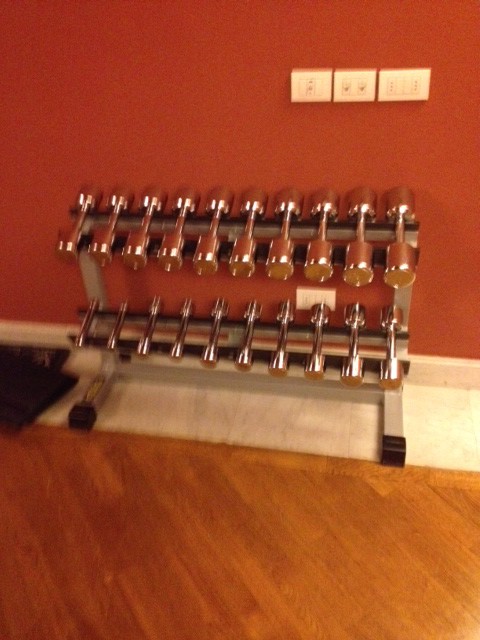
Recently, my wife and I vacationed in Italy, and fitness nuts that we are, we frequented several hotel gyms - none of which were particularly well equipped. Here's the one from hotel in Florence; yes, it was just dumbbells up to 10kg.


Immediately upon leaving, I sent an email to Cressey Performance coach Andrew Zomberg (@AndrewZomberg), who I knew was the guy to write up a post on having a great training effect without much equipment. This is what he pulled together; enjoy! -EC


Greater equipment availability generally yields greater efficiency because in order to induce structural or functional adaptations, you have to “force” the body to do so. Unfortunately, getting to a gym is not always feasible. The good news? Resistance training does not always have to depend on cable machines, power racks, and barbells.

Inaccessibility to gym equipment can be discouraging. The good news is that by creating structured programs and discovering new ways to challenge yourself with progressions, you can easily elicit a comparable training effect, just as if you were in a gym. Here are some options...
* * * * *

From Brett Contreras (the glute guy, as the picture below attests) - a collection of cool links in his "Random Thoughts" post - there is a TON of stuff there, so be sure to check it out.

Random Thoughts


How’s it going fitness peeps? I’ve got some great articles, videos, rants, and before/after pictures for you to check out. Just keeping you in the know!

Good Articles


Here are some great recent articles to read, written by various colleagues.

Scientific Articles


Chris Beardsley

Chris has written some great scientific articles in the past month. Several months ago he focused on hypertrophy, then he moved on to strength, and now he’s examining power. Here are the last six blogposts:
  1. Resistance Training and Power
  2. Ballistics and Power
  3. Injury Rates in Strength Sports
  4. Range of Motion on Strength Gains
  5. Rest Periods on Strength Gains
  6. Training to Failure on Strength Gains

Other Scientific Articles
  • We’re getting fatter due to less exercise, not more calories. See HERE.
  • Are you tired of pseudoscience? HERE are 10 claims that the authors would like to see go away forever.
  • Nick Tumminello teaches you some B.S. detection strategies HERE.
* * * * *

A few articles from T-Nation.

Total Body Strength

Loaded Isometrics for Size and Strength

by Nate Palmer | 07/24/14


Here's what you need to know...

  • Loaded isometrics teach irradiated tension, which increases strength gains in almost every exercise.
  • These moves can be done to increase either muscle size or strength, depending on the load used and the time under tension.
  • These exercises will teach you to use your entire body as one unit, test your mettle, and build strength in several key areas. Perform these after your main lift for the day, as a finisher, or just to test your willpower and see how strong you really are.
  • Keep the entire body tight to build total body strength. Keep your mental focus on the muscle you're working. Build your mental focus and you will get stronger!
Loaded isometrics can teach you a great number of things. The lesson I always learn is that I'm not as strong or as tough as I think I am. It's always a humbling experience to feel a whole new level of pain from a familiar exercise and it's a good check to see if you're actually working on your weak areas or just on the exercises you like.

Loaded isometrics are also fantastic for teaching the concept of irradiated tension, which, when properly performed, can increase strength gains in almost every exercise. The basic premise of irradiated tension is the idea that the body does not function in single units, but that the entire structure is important for even the smallest isolation move. In other words, when you create tension through your whole body, a dumbbell curl is more than just a dumbbell curl.

To create this next-level type of tension through your whole body, assume an athletic stance, feet shoulder-width apart, knees slightly bent, and starting with your core, begin to tighten your abs and then your glutes to create a foundation. Then squeeze the quads, pull the shoulder blades down and back, engage the lats, and lastly, tighten both fists.

Make sure you're taking small shallow breaths and then take inventory of your body. You should feel like an immovable object. If you need more proof that this technique will allow you to lift more, do a single arm dumbbell press with your weaker arm. Try it once without the tension, and try it once with it. Make up your own mind.

* * * * *

8 Rules for Fat Loss Training

by Andrew Heming | 07/29/14 
Here's what you need to know...
  • If you're serious about stripping off body fat, you must make time for proper nutrition. If you don't have time for this, make time.
  • Too often people trying to lose body fat just use intense metabolic resistance training and HITT (high intensity interval training). With fat loss programs, you need to switch as needed to different strategies such as metabolic resistance training, strength training, bodybuilding, and strength plus conditioning.
  • When designing a weekly plan for your training, consider how different styles of training affect different systems and thus affect recovery. You need to allow for some "space" between different kinds of stressors such as nervous system stressors, joint stressors, spinal compression, and metabolic stressors.
  • When trying to burn fat, you should rotate between different types of alactate (without lactic acid) conditioning that consists of short, intense work and lactate (produces lactic acid as a byproduct) conditioning that consists of longer duration work.
Want to lose body fat quickly and keep it off? Stop following those mainstream fitness workouts designed for your granny. Real fat loss training should build calluses on your hands. Here are eight rules for effective fat loss training, plus a sample workout plan that puts them all into action.

* * * * *

Bodybuilder Goes CrossFit

by Christian Thibaudeau | 07/25/14 
Here's what you need to know...
  • While the thinking used to be that CrossFit made guys weak, the average competitor in the CrossFit Games is very impressive.
  • Quite a few CrossFit girls have better physiques than some figure competitors, even without dieting.
  • There's something magical about being able to perform an explosive lift when you're metabolically fatigued and your heart rate is skyrocketing.
  • Doing submaximal lifting that focuses more on speed and density of work, like you do in CrossFit, is a great way to build muscle.
  • CrossFit can also get you lean fast, even with zero emphasis on nutrition.
I have a secret. I did CrossFit almost exclusively last summer. I've competed in Olympic lifting, powerlifting, and I've been a competitive bodybuilder... and now I can say I've been a CrossFitter too. I went to CrossFit Levis three times a week and then trained on my own to work on strength and my Olympic lifts. I actually kept a kind of CrossFit journal back then. So, one year later, here it is: my CrossFit diary, along with some current-day observations.
* * * * *

Here is a little science for you this week:

After resistance exercise, muscle repair and strengthening aided by stem cells


Thursday, 24 July 2014
A new study in mice reveals that mesenchymal (mezz-EN-chem-uhl) stem cells (MSCs) help rejuvenate skeletal muscle after resistance exercise.

By injecting MSCs into mouse leg muscles prior to several bouts of eccentric exercise (similar to the lengthening contractions performed during resistance training in humans that result in mild muscle damage), researchers were able to increase the rate of repair and enhance the growth and strength of those muscles in the exercising mice.

The findings, described in the journal Medicine and Science in Sports and Exercise, may one day lead to new interventions to combat age-related declines in muscle structure and function, said University of Illinois kinesiology and community health professor Marni Boppart, who led the research.
 * * * * *

This comes from Ergo-Log.com, a site that posts some interesting research summaries related to supplements, nutrition, and strength.

The joint effect of strength training and ginger supplementation

Supplementation with ginger combined with strength training reduces the damage wreaked by aggressive molecules in fat people, but the combination doesn't work better than either supplementation or training alone. Sports scientists from Iran state this in the Journal of Exercise Science & Fitness. The results of their study also suggest that ginger supplementation boosts the number of kgs muscle mass you build with strength training, and the number of kgs fat you lose as a result.

Strength training and ginger

Overweight is unhealthy for a number of reasons, and one of these is that the extra kgs of fat multiply the activity of aggressive molecules – free radicals – in the body. Physical exercise – so strength training too – reduces this, and supplementation with ginger does the same. But what does combining the two do? That's the question the researchers wanted to answer in their experiment.