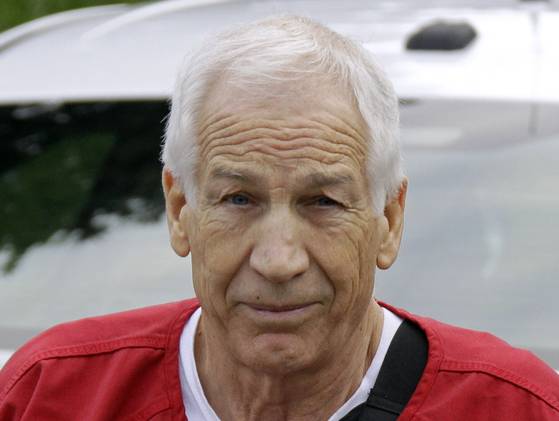
The once-beloved coach,
whose abuse triggered a scandal for one of the nation's most storied
college football teams, was given credit for 112 days served.
He will also have to cover costs of the prosecution, Cleland said. The amount was not immediately known.
"All the qualities that make you successful concealed your vices," Cleland said. "This, in my view, makes you dangerous."
He noted the long-term
damage Sandusky inflicted on victims: "This crime is not only what you
did to their bodies but their psyche and souls."
Despite the mountain of
testimony that convicted him and a plea from a victim Tuesday that
Sandusky finally admit his guilt, Sandusky remained stalwart. "I did not
do these disgusting acts," he said repeatedly.
His attorneys have 10
days to appeal the judge's decision. They have already vowed to appeal
his conviction. After the sentencing, defense attorney Joe Amendola
insisted that if the team had had more time to prepare for the trial,
Sandusky would have been acquitted.
Cleland designated
Sandusky as a sexually violent offender, which will partially determine
where he will be housed in prison and which programs he will be required
to participate in, according to Jean Casarez of HLN's "InSession."
Sandusky told the judge he did not oppose the status but maintained his
innocence.
One of his attorneys
said before the hearing that Sandusky's legal team would not contest the
classification but would stipulate that they disagree with it.
Across the country, victims of sexual abuse and organizations that represent them hailed the downfall of the notorious abuser.
"Now that Sandusky will
be locked up and unable to harm more children, our hope is that even
more survivors will take their first steps towards recovery -- with the
confidence that their family, friends and community will believe them
and support them," said Scott Berkowitz, president of the Rape, Abuse
& Incest National Network.
But the most emotional
words of the day came from Sandusky's victims. Some spoke at the
hearing, pushing for a harsh sentence, while one and the mother of
another offered written impact statements read by the prosecution.
"The pain is real, and it will be inside me forever," said a man identified as Victim No. 5.
He added that he will never forget the image of Sandusky "forcing himself on me and forcing my hand on him."
"He took away my childhood the day he assaulted me, and he should be sentenced accordingly."
Another victim, No. 6, described the "deep wounds" that left him praying for help.
"As I put the 1998
incident in the shower into focus, I think about how you manipulated
me," he said, adding that Sandusky "called yourself the tickle monster
so you could touch me."
Victim No. 4 assailed
Sandusky's refusal to acknowledge what he had done. "Rather than take
responsibility for your actions, you attacked us," he said.
"My only regret is that I didn't come forward earlier."
In her written statement, the mother of Victim No. 9 said, "Words cannot describe the pain and impact on my son and family."
"Because of you, we had to move four times," she said.
"I had to endure two attempts from my son trying to take his life. ... You caused him a lifetime of sorrow and suffering.
"I question every decision I made as a parent," she added.
"Shame on you, Mr. Sandusky, for your narcissistic and selfish acts.
"Whatever comes to you I hope it is tenfold for what you did to my son and others."
Victim No. 1, in his statement, said of Sandusky, "There is no remorse ... just evil."
Lead prosecutor Joseph McGettigan said Sandusky is among "the most insidious and depraved of criminals."
Sandusky founded his charity for young people, Second Mile, to help children but used it to identify victims, McGettigan said.
"He inserted himself into the lives of children, deceiving their mothers."
A touch became a grope and "too often a penetration," McGettigan said.
"No deceit was too
shameful for him," the prosecutor added. "He relied on shame to silence
his victims. ... He treated his victims like sexual property, which he
used as he saw fit."
McGettigan also slammed Sandusky for whining about "his own pain" in an audio statement Monday night.
Sandusky, speaking for about 13 minutes at the hearing, called his situation "the worst loss of my life."
"I will cherish the
opportunity to be a candle for others," he said, adding that "somehow,
some way, something good will come out of this."
His wife, Dottie, had tears in her eyes.
Cleland addressed the
victims: "The fact that you were assaulted is no cause for shame. ... It
is for your courage that you will be remembered." And, he said, they
will heal.
Sandusky entered the
courthouse Tuesday wearing a red jumpsuit with a bullet-resistant vest
underneath. Though he was handcuffed, he clutched a manila envelope and
smiled briefly as he got out of a police vehicle. His wife arrived in
the parking lot moments earlier.
In his audio statement
Monday, Sandusky said, "They could take away my life, they could make me
out as a monster, they could treat me as a monster, but they can't take
away my heart."
He accused the judge of
bringing the case to trial too quickly, the victims of conspiring
together and the attorneys of trying to make money in future civil suits
-- which an attorney for Victim No. 5 called "preposterous."
It has been nearly a
year since the Penn State scandal erupted, leading to the firing of
iconic head football coach Joe Paterno and the ouster of the
university's longtime president, Graham Spanier.
Jurors determined in
June that Sandusky, who retired from Penn State in 1999, used his access
to university facilities and his foundation for underprivileged youth
to sexually abuse the boys.
On June 22, Sandusky was
convicted on 45 counts of child sex abuse, ranging from corruption of
minors to involuntary deviate sexual intercourse, which were laid out in
graphic testimony by his accusers over the course of the
less-than-two-week trial.
During the trial, which
garnered national attention and cast a shadow on Penn State's heralded
football program, the 23-year-old Victim No. 4 testified that he was
only 13 when Sandusky sexually abused him in a university shower.
That account is separate
from a 2001 incident that Mike McQueary, a former Penn State assistant
football coach, testified about, saying he saw the former coach pressed
up against the back of a boy in the shower room of the Lasch Football
Building.
McQueary filed a
whistle-blower lawsuit last week against the university, according to a
court document from Centre County, Pennsylvania.
Less than a month after
Sandusky's conviction, former FBI Director Louis Freeh released his
university-funded report that blamed Paterno, Spanier, suspended
Athletic Director Tim Curley and ex-Vice President Gary Schultz for
taking part in a cover-up to avoid bad publicity.
Freeh also said Paterno
could have stopped the attacks had he done more, though neither
McQueary, Sandusky nor Paterno -- who died in January -- were
interviewed by his investigators.
Attorneys for Spanier
blasted the review, calling it a "blundering, indefensible indictment"
and "a flat-out distortion of facts" that was "infused with bias and
innuendo."
In July, the NCAA
imposed sanctions against Penn State, including a $60 million fine,
scholarship reductions, the vacating of 112 wins of the football team,
five years' probation and a bowl ban for four years.
After the sentencing decision was announced, the university's president released a statement.