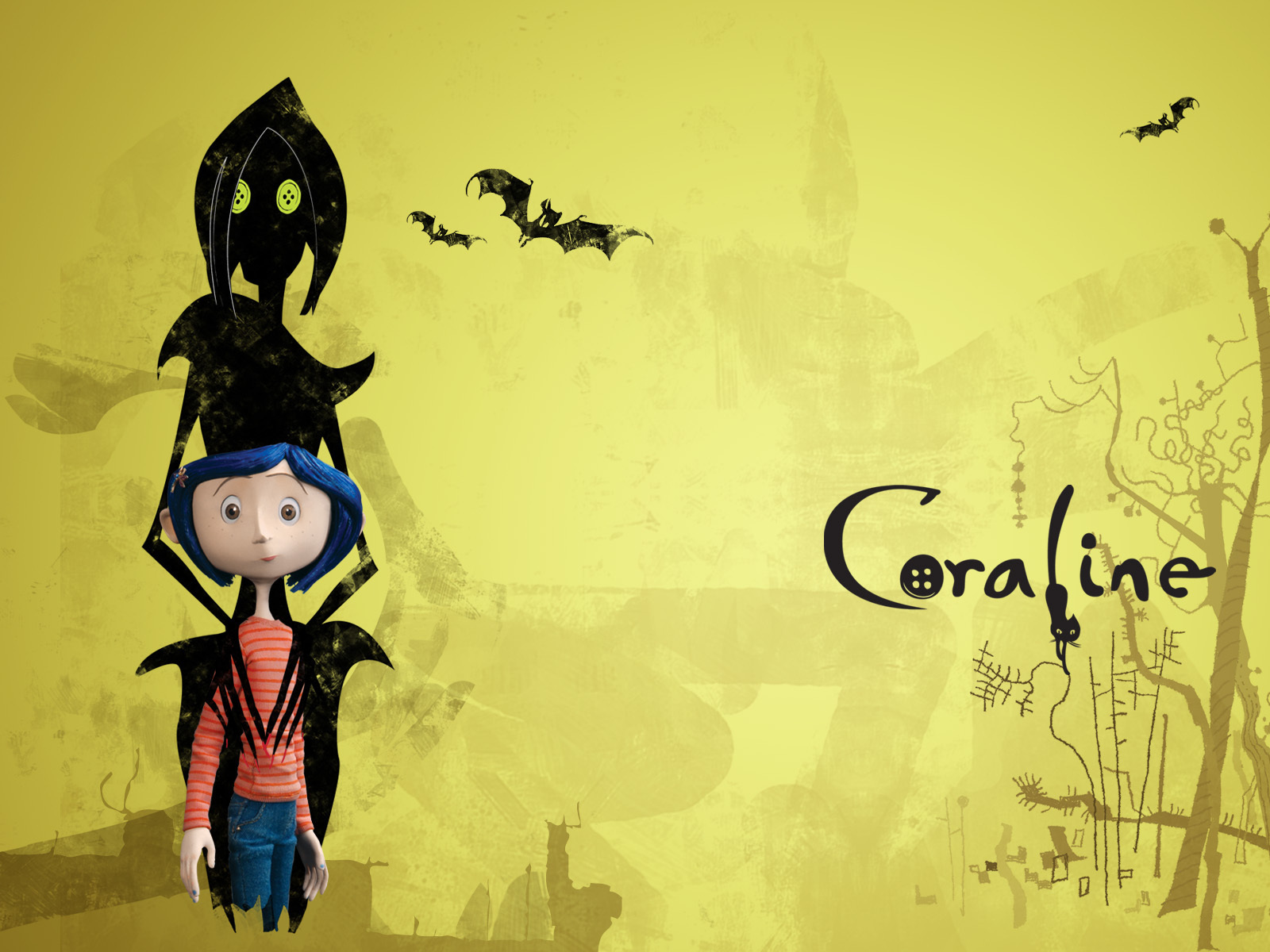
I liked Coraline the movie (2009), but I had never read Coraline (2002), the Neil Gaiman novel on which is was supposed to be based. After reading this article about the two different (very different) Coralines, now I feel compelled to go back and read the book to see what Gaiman really intended for this young heroine.
If you haven't read the novel, maybe this will convince you, too, to go back to the original - and thanks must go out to Brit Mandelo for exposing the heteronormative narrative the director of the film, Henry Selick, imposed on the original text. [And thanks to Arthur for pointing me toward this article.]
Doing Damage to the Text: Gender in Neil Gaiman’s Coraline(s)
Brit Mandelo

Neil Gaiman’s Coraline is a remarkable book. Naturally, given its appeal to children and adults as well as its handsomely creepy narrative, somebody was going to make a movie out of it—and that movie was Henry Selick’s Coraline (2009). I went to see that film in theaters, and though I initially loved it—it was gorgeous, certainly—after a little while something began to itch at me. Something didn’t seem right. There had been quite a lot of revision in the adaptation, but that’s par for the course in making a movie. The text has to be adapted to fit the screen, sure. But then the real problem occurred to me, and it wasn’t that Selick’s version had made changes. I don’t much care about that on principle.
It was that those revisions had turned the initial text into its opposite, retaining the general shape of the plot but gutting the thematic content.
Neil Gaiman’s novel Coraline is a coming of age story; it’s participating in the tradition of stories in which a youth overcomes a trial to develop their identity. The book is about independence, identity, and development. The significant thing is that it is really very much concerned with having a girl as the protagonist, a girl who is fully rounded and develops on her own as a stable, coherent individual subject.
Henry Selick’s adaptation is firmly not. In fact, in his film all of the interesting potentially-feminist freight of Gaiman’s novel disappears, edited away and replaced with a heterosexist couple-narrative. Selick drastically alters and lessens the narrative of female competency and independence contained in the original.
While the basic adventure plot remains in both book and film—Coraline rescuing her parents by challenging the beldam, exploring the frighteningly transformed “other” world to find the souls of the trapped children, and tricking her way through the door back to her own world—the thematic shape changes distinctly, altered by those aforementioned additions (of an entire character and new scenes), as well as serious alterations to other scenes. Exploring and comparing those scenes reveals the problematic shift in theme and tone between the two Coralines—something that matters to me, as a person who would like there to be more authentic, wholly realized stories about young women as protagonists and adventurers, as full subjects of their own stories.
Because it’s not just academic, and it’s not just about having something to argue, this whole thing about the Selick film. Texts are important to shaping culture—to shaping how people see themselves, the roles they’re allowed to step into, and the way they understand the world. Having coming of age stories for girls that are about danger and bravery, trouble and problem-solving, matters. Having a heroine like the Coraline of the novel matters, and having her taken apart and reshaped into a trope matters, too.
So, without further ado, let’s dig in to the argument I’m making about potentially-feminist, certainly-important content in the novel and the opposite of that in the film of the same name.
First off, contrast the opening chapter of the novel and the first ten minutes of the film. The novel’s Coraline, we find, is independently motivated and curious; she does a lot of exploring, all alone, and does not seem to really know fear. The opening of the book is all about her solitary adventures. Tellingly, her response to being told to avoid an old well is to “explore for it, so that she knew where it was, to keep away from it properly” (5). (And pay attention to that well, too; it comes up a few times.)
However, in the film, Coraline simply wanders from her new house onto the grounds out of boredom rather than a desire to explore. Once outside she is alarmed by noises and runs down a hill terrified; there’s some screaming. She’s then nearly run over by a person on a bike, who looms threateningly over her while she sits in the dirt. That person on the bike is a young man named Wybie: Selick’s addition to the screenplay and his film.
Their initial meeting has already presented Coraline as a girl who is easily frightened and subdued by the young man, Wybie. Therefore we have shifted already from a young woman alone exploring to a girl and a boy together, in which the boy has taken a dominant position in the pair. This trend of Wybie as a masculine figure, a source of authority, continues; the well, for instance, is introduced by Wybie. Coraline doesn’t discover it on her own. (Having knocked her over, he warns her that she’s standing on the planks covering the old well.)
In addition, he later informs Coraline that his grandmother lost a sister in the house she now rents out and has warned him and all children away from it. He delivers these warnings as a figure of authority on the house—he knows, Coraline doesn’t, and he tells her. His information, delivered to her from a protective position, entirely removes her potential to discover the danger on her own. Again, this Coraline does not achieve things independently: the introduced male character does them for her.
The narrative of “Wybie as male companion and protector” extends to the Wybie created by the beldam in the other-world, too. Other Wybie is provided to Coraline as equal parts entertainment and companion for her at-first pleasant explorations in the magical, supernatural other-world. He offers her cotton candy at the mouse-circus, sits with her during the burlesque performance at Other Miss Spink & Other Miss Forcible’s, walks with her around the grounds. Conversely, in the novel Coraline braves the eerie circuses and not-quite-right displays entirely on her own.
The independent young woman of the novel is, in the adaptation, sublimated into one half of a heterosexual couple. Her individuality is made a duality, with the young man as a necessity to her exploration. The adventures cannot be had alone, as they must be in the novel; therefore, the element of girlhood exploration and coming-of-age is weakened. There is a shift from explicit concern with the identities of young girls as themselves in the novel to the identities of young girls as they relate to boys in the film. The film is not Coraline: it is Coraline and Wybie.
And it gets worse. That stuff, maybe, could be brushed off—it’s irritating but minor, and possibly works to move the plot along sometimes by offering exposition (though I don’t buy that for a second). The problem is that in the end it’s more than just reducing the danger/bravery element by taking the lone girl explorer protagonist and turning her into half of a couple. It’s more than having the male half of the couple be the deliverer of information and guidance. Because then Wybie has to start rescuing Coraline, and things go way further off of the rails of Gaiman’s novel in a way that renders its whole thematic point—the girl, her subjectivity, her competence—moot.
In both versions the beldam uses a mirror as a prison for her abandoned children, into which she throws Coraline, and in both versions she does so with similar dialogue: “You may come out when you’ve learned some manners […] and when you’re ready to be a loving daughter” (79) in the novel and “You may come out when you’ve learned to be a loving daughter!” in the film. But that’s where the similarity stops.
In the novel, the beldam simply abandons Coraline in the mirror-closet and eventually takes her out when she feels she’s been punished enough—it’s a helpless imprisonment. The point, though, is that Coraline has lasted her out—she doesn’t break, and she even manages not to cry despite the urge to. The mirror-imprisonment is one of the more intense, emotional scenes of the novel. In the film, the scene is translated similarly throughout; the beldam’s speech is the same, the three ghost children are similar, et cetera. It is the ending which has been drastically altered.
Instead of Coraline waiting out the beldam, Other Wybie bursts through into the mirror and rescues her; he then shoves her down the hall and through the door back to her world with the beldam on their heels. As she reaches out to offer to rescue him, he slams the door in her face to force her to go on without him. Other Wybie, not Coraline, is the winner. He has rescued the girl he likes, physically hustled her to safety as if she were incapable of escaping on her own, and slammed a door between them to heroically sacrifice himself.
Coraline, however, is now simply the rescued girl. Faceless and nameless as most of the rescued girls in coming-of-age narratives are, at this point her strength and independence are nonexistent. Again: a boy has to not only rescue her from the mirror-prison but physically force her to safety. It is a rescue she never needs in the novel. Her speech on bravery (“Because, when you’re scared and you still do it anyway, that’s brave” (59)) is also not translated from the book to the film, and this scene makes the reason why particularly obvious: because this translation of Coraline to the screen may be spunky and fun to watch having an adventure, but her story is not about her individual bravery and competence. She may go on to save her own parents, but this rescue comes first, and another rescue follows at the end.
Because in both versions, after Coraline has escaped through the door with the key, the children’s souls, and her parents’ snow-globe—locking the beldam safely behind it again—there is still one threat left: the beldam’s severed hand, which has followed Coraline back to her world. The resolution of this last plot point in the two endings is so completely different that even a viewer not particularly queued into to the gender dynamics otherwise would notice.
In Gaiman’s novel, Coraline notices the hand on her own after it attacks the downstairs neighbor’s dog, frightens the mouse-circus upstairs, and begins scratching gouges in her windows. There’s still one problem left to solve, then, and Coraline sets herself to completing it. She talks her way into getting a tablecloth from her mother for a tea-party with her old dolls and tricks the hand—by talking loudly to the actresses downstairs about the key and her plans to go have a tea-party by herself—into following her. In advance, she had pulled all the boards from the well, even though they were too big for her, and laid the tablecloth over it as camouflage. She lures the hand down to the well, “and then, as carefully as she could, she leaned over and, gently, placed the key on the tablecloth. […] She held her breath, hoping that the cups of water at the edge of the well would weigh the cloth down, letting it take the weight of the key without collapsing into the well” (157). She then moves away to the other side of the well, pretending to serve cake to her dolls, and the hand scrabbles for the key as she watches. “Time slowed for Coraline. The white fingers closer around the black key… And then the weight and the momentum of the hand sent the plastic dolls’ cups flying, and the paper tablecloth, the key, and the other mother’s right hand went tumbling down into the darkness of the well” (158-159).
Once this is done, she hauls the planks back over the well and weighs them down again. To reiterate: she figures out the hand is following her on her own, she makes a plot to get rid of it on her own, she executes the—very physically and emotionally taxing—plan on her own, and she wins on her own. Throughout the course of the novel Coraline has been independent, challenged by horror, by death, and by fates worse than death—and she comes out on the other side of the trial a braver, happier, more centered young woman. It is a coming-of-age scary story for girls, about girls, and concerned with the identities of girls—their power as themselves, by themselves. Hoorah, yes, thank you, etc.
And then, there’s Selick’s film rewrite of the ending. Coraline does not realize the hand is after her; instead, she misses all the clues, and decides she wants to throw away the key for her own peace of mind. She goes to the well, intending to throw the key down it for real—this is not an ingeniously plotted trap—and is attacked by the severed hand. It grabs her and she shrieks, falling. She is about to lose the key to the hand when Wybie appears as rescuer, one last time. He charges down the hill on his bike, knocks the hand away from her, wrestles with it, and is nearly knocked down the well himself—risking his life as the protective man is expected, narratively, to do. He climbs out, finds the hand about to hurt Coraline, and smashes it with a rock. Coraline, so very grateful for her rescue, gives him her hand and gets up off the ground.
The stripping out of the feminist freight about independent young women having adventures, being smart, and saving themselves is finally and irrevocably completed, leaving a story about a heterosexual couple where the man, in the end, rescues the (silly, incompetent) woman from the big bad evil. A story we’ve all seen quite enough.
That’s uncool.
Gaiman’s novel Coraline is a sharply creepy, edge-of-your-seat read starring a young girl who does make mistakes but who also solves problems. She is a power unto herself, and her adventures show readers—other young girls, often—the possibilities of their own subjectivity. They can be brave, they can be competent, and they can win. That’s the argument about gender I’d rather take away from the dual Coraline texts—and that’s why the movie doesn’t sit well with me. I want more coming of age stories about girls who are whole subjects in themselves, rather than stories where the role of the girl is to be rescued. I’ve had about enough of that, thanks.
~ Brit Mandelo is a writer, critic, and editor whose primary fields of interest are speculative fiction and queer literature, especially when the two coincide. She can be found on Twitter or her website.


