Showing posts with label injuries. Show all posts

Saturday, April 6, 2013

The Power of Friendship - Kevin Ware on Louisville Teammate Who 'Touched My Heart'

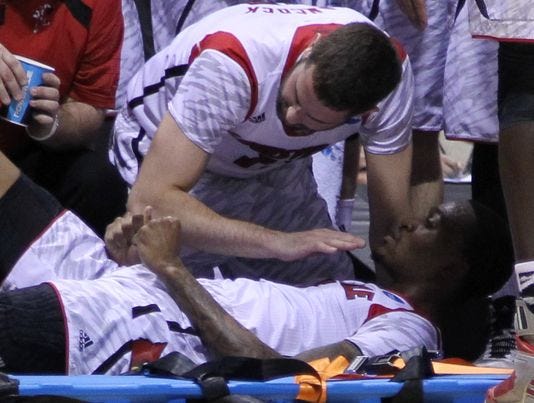
When Louisville player Kevin Ware went down last weekend with one of the worst sports injuries most of us will ever see, only one player, a teammate, was able to set aside his own fears and sadness and be the friend who helped Kevin through the trauma. This is that story, from USA Today.

Kevin Ware on Louisville teammate that 'touched my heart'

Adam Himmelsbach, USA TODAY Sports
April 4, 2013

(Photo: Brian Spurlock, USA TODAY Sports)

When Louisville forward Luke Hancock saw Kevin Ware lying near the sideline with a shattered right leg, he initially recoiled like his teammates. Some Cardinals were vomiting, others were crying and inconsolable.

But then Hancock thought back to last summer, when he suffered a gruesome shoulder injury in a pickup game. He remembered how others were aghast. He remembered how former Louisville guard Andre McGee was the only one to rush to his side, to rush him to the hospital. He remembered how much that had meant.

So as Ware lay there in the first half of the Cardinals' NCAA tournament victory over Duke on Sunday, scared and alone and stunned, Hancock ran to him. He held Ware's hand and told him they would get through this together. He told Ware he would say a prayer for him.

Ware didn't respond at first, because he was in shock. Hancock took a deep breath, closed his eyes, clenched Ware's hand and started the prayer.

"Lord, watch over us and let Kevin be OK during this tough time," he began. "The Lord does everything for a reason, and He will get us through this."

Hancock said he did all he could to keep from breaking down, to keep tears from falling onto his fallen teammate. He found out later that Ware also was trying not to cry, trying to stay strong for him.

Hancock gently patted Ware's chest several times, the two of them together in front of 34,657 fans in Lucas Oil Stadium and millions of horrified TV viewers.

"I wouldn't want to be alone in that situation, and I don't think he wanted to be alone," Hancock said, sitting in a small office at the team's training facility Wednesday as Ware held a news conference upstairs. "I just thought if I could talk to him and tell him he'll be all right, it might help."

Luke Hancock on Kevin Ware: "I just thought he needed someone by his side." 
It helped more than Hancock realized, more than he could imagine. Ware said that before Hancock arrived, he was scared. After Hancock touched him and calmed him, he knew he would be fine. 
Before long the other Cardinals were there and Ware was enveloped in a sea of support. His teammates clenched his forearms and held him tight. But that first moment was the most important moment. 
"Seeing Luke there," Ware said, "really just touched my heart." 
He said Hancock's presence allowed him to refocus and regain his strength. It allowed him to start thinking about the team — or, as he told me, "to go into Kevin mode." 
He began telling his teammates to win the game, to win it for him. He said it over and over, until he was taken away on a stretcher before heading to a hospital for surgery. 
You never know how you'll react to danger or disaster or trauma. You like to think you'll be strong and courageous, but sometimes it's just not that easy. 
You can't fault the other players for their initial reaction to such a macabre moment. But you can praise Hancock, and you should. 
"I think it just galvanized everybody," Louisville athletic director Tom Jurich said. "It was the very first thing I noticed. To see Luke right there was just incredible." 
On Tuesday afternoon, Hancock arrived at the team training facility wanting to know when Ware would return home. Told that he already was in the locker room, Hancock rushed in. 
"You could see on my face and on his face that we were just so happy to see each other," Hancock said. "He gave me a hug and said he was so thankful I was there for him. I told him I knew he'd do the same for me. That's my friend."

Sunday, February 3, 2013

Alva Noë - Poetry In Motion: Why I'll Be Watching The Super Bowl


The other day I posted a lengthy article from Esquire on the crisis mentality that has emerged in the NFL around head injuries and the violence of the game. There have been similar articles over the last week or two as everyone gears up for today's Super Bowl game between the San Francisco 49ers and the Baltimore Ravens, the first time ever that brothers have faced each other in the Big Game as opposing head coaches.

I have to admit a long-time love affair with football - I loved to play it when I was a wee lad (before soccer became my year-around sport) and I have loved watching it for as long as I can remember, all the way back to the first Pittsburgh Steelers Super Bowl win.

But I am also concerned about the increasing recognition of brain damage in these men, the public awareness of which grew substantially following the autopsy on Junior Seau that revealed repeated brain traumas that most likely led to his suicide. These men are bigger, stronger, and faster than ever, and the level violence created when bodies like theirs collide can be catastrophic both in the short term (concussions) and the long-term (brain damage).

Philosopher Alva Noë recognizes the dangers inherent in a sport that revolves around hitting the opposing player has hard and as fast as possible, often with the goal of dislodging the ball if at all possible. Still, he is watching the Big Game and he recommends you watch, as well.

For an opposing view, see Stop Ignoring Head Trauma: Turn Off The Super Bowl by Barbara J. King.

Poetry In Motion: Why I'll Be Watching The Super Bowl

by ALVA NOË
February 01, 2013

Randy Moss of the 49ers glides down the field, under an arcing football, on his way to a touchdown against the Patriots on December 16, 2012.Jared Wickerham/Getty Images

I don't blame professional footballers for suing the NFL for supposedly having failed adequately to protect them from head injury.

That's the way we do things in our society. We see a problem and start suing; it's our way of trying to figure out what changes need to be made and whose insurance companies are going to pay for them.

What I don't buy, not for a second, is that we didn't all already know that playing football, the way they play it in the NFL, is very dangerous. (Although we have surely learned a good deal about the far-reaching consequences of head injury! See this technical article; it was cited in Barbara King's provocative discussion here at 13.7 on Thursday.)

A great many sports are dangerous, to one degree or another.

Athletes get hurt. Badly. They're like gladiators. They get beat up, knocked around, and they live with pain. Surgery, to repair damage done and to extend a career, is normal.

They say taking steroids and other performance enhancing drugs is bad for your health. One reason to ban PEDs, it is said, is to protect athletes from these dangers.

That reasoning reminds me of a joke: a man stands before the firing squad; he is offered a last cigarette. "No thank you," he says. "I'm trying to quit."

If you want safety and good health, steroids are not the problem. It's sports themselves.

But my aim today is to praise sport, though, not to bury it.

I will be watching the Super Bowl this weekend. And I recommend it to you.

Forget the dangers. Forget the use of banned drugs. Forget the commercialism.

The value of sports — the value of spectator sports — outstrips all that.

Sports is a field of love.

We love sports. We love these athletes.

And we value being spectators because it gives us an opportunity to love and adore them.

We admire them, in the original sense of this word: we feel wonder in the face of all that these athletes accomplish. We are awed by their strength and speed, extraordinary skill, drive and determination, their fight.

But above all, we value the physical courage that enables these players to play to win. We applaud them for their willingness to leap and jump and twist and slam and take the hit.

I won't allow my boys to play tackle football in high school. That's not the life I want for them.

But I will be watching the Super Bowl this weekend to celebrate and adore these most unusually accomplished and beautiful people!

We may forget that poetry in Europe begins with the celebration of athletic achievment in theOdes of Pindar. The spectacle of sports carries on and it remains a fitting subject for celebration.

~ You can keep up with more of what Alva Noë is thinking on Facebook and on Twitter:@alvanoe
Thursday, January 31, 2013

Are We Witnessing the End of Professional Football?

After reading this article from Esquire, it's hard not to believe that football as we know it now will cease to exist in the not-to-distant future.

I'd be curious to see reader opinions on the article and on the likely end of football, a sport I played growing up and have enjoyed watching as an adult.

Theater of Pain

This NFL season has been defined by people talking about "the injury issue" — pundits, columnists, league officials. The one voice you haven't heard — until now — belongs to the players.

By Tom Junod

Crushed Skull, Phil Toledano

Published in the February 2013 issue, on sale any day now

My left knee has been aching this entire week. I don't know why. I didn't get hit directly on it in the last game. My right knee has started the week so sore the side where the nerve got hit. When I wear the brace, my knees feel like total crap. When I start moving around, the muscles and tendons in my leg feel so stressed, sometimes I feel they might rupture. My lower back is so sore, painful and stiff; my right shoulder has lost some mobility for some reason. My right ankle is constantly being twisted; my left feels very weak. It's hard for me to react to movement, or even drive off of it. I used the word "hard" but the real word is "next to impossible." I don't sleep much, I feel super stressed, and on game day I take tons of drugs... 
—An entry from a journal kept by an NFL player for the purpose of preserving, for his children, a record of his pain
In 2009, Willis McGahee, then a running back for the Baltimore Ravens, caught a pass in a playoff game — a championship game — against the Pittsburgh Steelers. The pass, from his quarterback Joe Flacco, was perfect. McGahee, known since his days at the University of Miami for his ability to catch the ball, had come out of the backfield and was heading straight upfield, ten yards beyond the line of scrimmage. He did not have to slow down. He caught the ball over his inside shoulder at full tilt. Ryan Clark, a safety for the Steelers, was waiting for him.

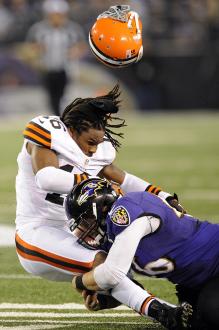
It was a big play in a big game, and it turned out to be decisive. The Steelers had just gone ahead, 23 — 14, on a Troy Polamalu interception return. Now the Ravens had the ball on their own twenty-six-yard line, second and six, late in the fourth quarter. McGahee caught the pass just beyond the thirty-five; with two steps, he was just short of the forty. He never got there. Clark gathered himself, then uncoiled. He simultaneously turned and lowered his shoulder, and from a kinetic crouch he extended himself into McGahee, straightening out while leaning forward, leaving his feet after discharging all his energy, his legs helicoptering off to the side. It was a high but legal hit, and the thunderclap it released was definitive, high and low at the same time, a deep pneumatic clang, the sound of a cymbal turned by force into a gong. Clark fell to his side, holding his helmet in his hands as if to stop the ringing in his ears. McGahee fell loosely on his back, where he stayed, his cleats in Boot Hill position, toes to the sky.

"Oh, what a hit! Ball's out, recovered by Timmons. Ryan Clark is still down, so too is Willis McGahee. And they say fumble recovery, Pittsburgh..."

It was not a posture to which McGahee was unaccustomed. Six years earlier, in his last game at the U., he blew up his knee, an injury that was routinely called "gruesome" and "grotesque" and that still enjoys an Internet afterlife as one of the "Top Ten Worst Sports Injuries of All Time." Now he was on the receiving end of one of the signature collisions of the NFL's head-injury era — an era ushered in by a combination of athleticism unfolding at the edge of human capability, the expanding authority of neuroscience, and the horror stories of middle-aged football heroes descending into depression, dementia, and derangement. "When there's a savage hit, you try to get out there quickly," says Dr. Anthony Yates, who for the last thirty years has been the Steelers' team doctor and who currently serves as president of the NFL Physicians Society. "You presume it's a concussion and hope it's not more than that. And when there's two men down, you wonder about the logistics. Are we going to need two trucks, two evacuations...?"

He needed only one. After the familiar spectacle — the familiar American ritual — of two teams heretofore locked in violent struggle crowding the field in solidarity; of solitary players bent in desperate prayer; of television announcers peering through the wicket of medical personnel in order to parse the fallen for "encouraging" signs of movement; of Creedence's "Down on the Corner" playing on stadium loudspeakers for the rowdy and restive crowd: After all this, Ryan Clark walked off the field with a concussion. Only Willis McGahee was immobilized, strapped to a board, and evacuated from the stadium, after which the Pittsburgh Steelers took possession of the ball and the game, on their way to an eventual win in Super Bowl XLIII.

I called McGahee recently. He now plays for the Denver Broncos and was recovering from a torn medial collateral ligament. With the playoffs approaching, and with NFL injuries becoming ever more of "an issue" — the global warming of American sports fans, something to be fretted over and put aside — I wanted to talk to someone whose career has been defined by very public injuries and whose very public injuries have defined the state of football over the last ten years. But he didn't see it that way. "Injury has not been part of my career," he said. "I've only gotten hurt twice. I got hurt once in college and once in the pros."

Right, but that second injury, against the Steelers...

"No. I mean now. The MCL."

"So you don't consider the concussion an injury?"

"That's what they consider it. But getting a concussion and hurting your knee are two different things. You get back up from a concussion."

Willis McGahee was knocked out cold against the Steelers. He went out on the board. He didn't consider himself injured, though, because like all NFL players he considers himself an expert in what qualifies as an injury and what doesn't. The loss of consciousness he suffered in Pittsburgh didn't qualify because it didn't require rehabilitation. It didn't put his career in jeopardy. It didn't exile him from his teammates.

And most of all, it didn't hurt.

McGahee And Clark Collision - Rob Carr/AP Photo

"Fans basically know nothing," Ryan Clark says when asked to talk about his experience of injury. "They know what they see on the field and that's about it. They don't know the work, the rehab, the getting out of bed on Monday morning. A lot of injuries are the ones that don't get reported, the ones that don't take you off the field. People always ask me, 'Are you feeling good?' No. You never feel good. Once the season starts, you never feel good. But it becomes your way of life. It becomes the norm. It's different from a guy going to work at a bank. If he felt like I did, he wouldn't get out of bed. He'd call in."

"Our perspective is our own pain," says the veteran who keeps the pain journal, who we'll call PJ from now on. "What other perspective do we have? We've been beaten down since we were kids that you're never too injured to play. And so when normal people — people who are not associated with football — ask 'How do you feel?' for many years it was hard for me to answer that question. It was hard for me to say exactly how I feel, because it would show a sign of weakness or softness. And at the professional level, you better not say how you feel, or the next man will get your job."

The perspective of pain is what this story is about. For fans, injuries are like commercials, the price of watching the game as well as harrowing advertisements for the humanity of the armored giants who play it. For gamblers and fantasy-football enthusiasts, they are data, a reason to vet the arcane shorthand (knee, doubtful) of the injury report the NFL issues every week; for sportswriters they are kernels of reliable narrative. For players, though, injuries are a day-to-day reality, indeed both the central reality of their lives and an alternate reality that turns life into a theater of pain. Experienced in public and endured almost entirely in private, injuries are what players think about and try to put out of their minds; what they talk about to one another and what they make a point to suffer without complaint; what they're proud of and what they're ashamed by; what they are never able to count and always able to remember.