
Funny....
If Guy Best Friends Acted Like Girl Best Friends
The Buddy System: A single close friendship can ease a boy’s passage through middle school - But what if your son can’t find a pal?
By Joshua Glenn and Elizabeth Foy Larsen | Posted Thursday, March 15, 2012
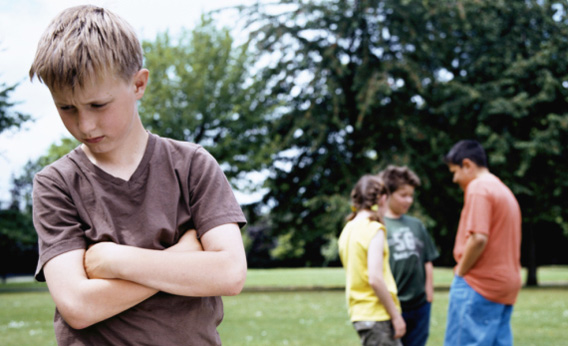 Research has shown that kids with close friendships are healthier, do better in school, and get don’t get bullied as often. Photograph by Digital Vision.
Recently both of our oldest sons switched schools for junior high. While in many ways each of their transitions were smooth, both of us were surprised that these two terrific, well-adjusted, handsome (natch) boys seemed at first—at least to their parents—to have no friends.
We reacted to this information in manners befitting our personalities. Josh gently encouraged his son to pick up the phone and call his elementary-school pals; his son resisted, saying he wanted to move on. Elizabeth, on the other hand, went full-on helicopter. After a call to her son’s adviser revealed the not-encouraging fact that he’d been eating lunch with that same adviser, she phoned the school counselor, who assured her that her son wasn’t roaming the halls by himself and that this temporary friendlessness was in the range of normal, especially for introverted boys like her son. “He’s still most likely putting all his energy into getting to the right classroom for each class, not to mention finding the bathroom,” she said. Needless to say, soon Elizabeth was asking her son for the names of everyone he ate lunch with, much to her son’s disgust.
We remember from our own treacherous passages through junior high how strong friendships can ease the pain of those change-filled years. Josh and his best friend from childhood, Dooley, lived on the same street and attended the same middle school. Though they both made other friends, the two were joined at the shoulder most days from breakfast, which Josh often ate at Dooley's house (where Carnation Breakfast Drinks were an accepted alternative to oatmeal), through dinner, which Dooley often ate at Josh's father's house (where reading a Tintin book at the table was by no means considered rude).
In fact, decades of research have shown that kids with close friendships are healthier, do better in school, and don’t get bullied as often. Friendships also can minimize the negative impacts of family problems and, according to Dr. William M. Bukowski, a psychologist who researches friendships at Concordia University in Montreal, make kids less anxious about trying new things. In one University of Virginia study, researchers placed students wearing heavy backpacks at the base of a hill and asked them to estimate its steepness. The participants who stood next to a friend gave lower estimates than those who were alone.
Perhaps most important, friendships can validate kids in a way that sticks more than their parents’ You rock! praise. “Kids know that parents are supposed to love their children,” says Bukowski. “But when someone shows you affection who doesn’t have to, it has a stronger effect.”
Given these benefits, it makes sense that we parents of boys should see the middle school years as an opportunity to encourage a life-long appreciation for friendship. Unfortunately, for boys growing up today, maturity is mostly defined as being cool and independent. You’re not supposed to need a relationship with anyone. In fact, the very idea of having a “relationship” with a guy friend, much less talking about it, seems icky to many boys.
“You have to shift the whole game and say that maturity should be defined as having quality, mutually supportive healthy relationships,” says Niobe Way, an NYU psychology professor. Way’s recent book, Deep Secrets: Boys’ Friendships and the Crisis of Connection, shreds the assumption many parents make that boys can take or leave their pals. Instead, her research shows that boys actually love their guy friends, and have the instinctive intelligence to be able to talk about those attachments. “We think boys are emotional clods who don’t know how to express their feelings,” says Way. “What I hear from listening to boys for almost 20 years is that they have an incredible astuteness about the emotional world. It’s not just that they can say they love a friend, but they can say things with more nuance, like ‘I can act like I’m mad but I’m really hurt.’ ”
Unfortunately, according to Way and other researchers, intimacy between boys vanishes as they progress through high school, in part because many boys this age are afraid of acting in a way that makes them seem girlish or gay. (Jocks, on the other hand, can openly show affection with their guy friends—especially on the playing field—because their popularity and status as manly men insulates them from being harassed.) It’s a loss that the boys Way interviewed mourn intensely and still grieve as adults. Since publishing her book, Way says she’s been surprised by all the letters she’s received from grown men telling her how much they missed their own boyhood chums.
The loss of close-knit guy friendships in middle school may lead to more than loneliness. “If you live in a culture in which the definition of manhood is independence and autonomy and where we aren’t valuing our social and emotional sides,” asks Way, “is it so surprising that we have this culture of bullying and cyberbullying and people being so brutal to each other?”
We agree. But encouraging authentic relationships at a time of life when kids just want to fit in is no small challenge. Here are a few friendship-encouraging strategies recommended by experts—and that would possibly be recommended by our sons, if they were ever willing to talk about this.
Don’t confuse popularity with friendship. If your son has one friend in whom he can confide, and who he trusts won’t talk behind his back, that’s all he needs. Research shows that to get all the benefits of friendship, one is the magic number. Don’t crusade for him to acquire friends the way he used to collect Pokémon cards.
Don’t freak out if your son doesn’t have friends from time to time. In his study of 350 kids, Bukowksi found that every single one went through a period when he had no friends. “There is going to be turnover in friendships,” says Bukowski. “These downtimes are a chance for parents to encourage the importance of relationships and take stock.” And so …
Talk about friendship. Even though most boys don’t want to have a heavy sit-down about their buddies, you can still talk about the importance of friendship in a way that will get your point across. Bukowski and Way both suggest talking about your own friendships: how much they mean to you; what disappoints you. Just don’t overshare! A simple, “I really care about my friendship with Mike and it bums me out when he doesn’t return my emails” will do. Elizabeth had great success recently when she told her sons that a friend is someone who can keep your secrets and doesn’t treat you well one day and then turn on you the next. Both of her sons told her which boys they knew who fit this description. And then they also were able to say which kids didn’t and how it makes them feel when that happens.
Give him a chance to bond over things he loves. You can’t stage-manage a middle schooler’s friendships they way you could when he was in elementary school. But you can provide boys with opportunities to do things with kids who share their interests—filmmaking classes, batting practice, hip-hop. But don’t think that just because your kid has met another LEGO robotics nut that your work is done. “One of the challenges for middle school boys is to change their friendship relationships from being activity based into experiences that are more relational,” says Bukowski. “If a 7th grade boy is playing basketball together with his friends, he should be aware that he shouldn’t gloat about it if he’s better than his friend. Boys who are friends compete with each other, but they can manage that competition.” If your son has a hard time not lording his greatness over others, Bukowski recommends watching the ESPN TV show Pardon the Interruption, which pits two sports reporters against each other to hash out the issues of the day. “They fight about everything,” he says. “But it never becomes personal. You always have the sense that they love each other.”
***And how, over a year later, have our boys fared? Elizabeth’s son did make friends at his new school while also staying close to a few guys he’s known since he was little. He’s bugging her about seeing The Hunger Games with his pals on the day it’s released, is excited about being on the middle school tennis team, and is going to camp with four classmates this summer. Josh’s son took up the electric bass and made friends through his school’s jazz band. He and his friends have co-ed parties, go ice skating together, and never stop IMing. Proving, as is always the case with parenting, that solving one concern just begets another.

Listen to the Story
Fresh Air from WHYY
[20 min 17 sec]
Add to Playlist
Download
Dogs today evolved from wolves who first developed a relationship with humans on the hunting trail.November 8, 2011Dogs have aided humans for thousands of years. Man's best friend has provided protection, companionship and hunting assistance since the days of the earliest human settlements.But how and when dogs evolved from wolves is a matter of debate. Naturalist Mark Derr says there are two main schools of thought: Some researchers believe that humans domesticated wolves who were scrounging around their villages for trash. Others think that humans were taking care of wolves from the time they were puppies — until enough puppies were tamed and they somehow then evolved into dogs."Neither explanation seems satisfactory," writes Derr in How the Dog Became the Dog — From Wolves to Our Best Friends. "That is why there's no consensus."In his book, Derr explores how the relationship between humans and wolves developed, and how that relationship then influenced the physical evolution of wolves into dogs. He tells Fresh Air's Dave Davies that he believes humans and wolves developed a close relationship after recognizing themselves in each other while hunting on the trail of big game. by Mark DerrHardcover, 287 pages"[That's when] they started traveling together, and they've been at it ever since," he says. "The dog is a creation of wolves and humans — of two equal beings that came together at a certain point in history and have been together ever since."Derr says our ancestors likely followed behind wolves as they hunted for game on the trail. Wolves, in turn, learned to wait for scraps from bipedal hunters — who were far more accurate with their rudimentary weapons than the wolves were with their teeth."The wolf could say, 'These people are far more profligate hunters than we are. When they go out, they always leave a surplus. It's easier for us to take the scraps that they have than to hunt,'" says Derr. "Hunting is a highly energetic activity. And they could learn from each other, just by observing each other."As humans and wolves began to work and live together, physical features on the wolf began to change: Its skeletal frame grew smaller, and its jaw shortened. Wolves that socialized well with humans began to travel with them, and then were able to pass on their genes."You had populations of dog-wolves that became isolated, and in doing so, they began to inbreed," says Derr. "And when you inbreed, you get genetic peculiarities that arise, and then those peculiarities become part of the population. If they work or become popular or have some function of beauty or utility, then they were kept by the humans — and that population then spreads those through other populations through breeding."Fossils of wolves and dogs have been found in early hunting camps. In China, researchers have found evidence that some hunters were raising millet to feed to their hunting companions."This kept the dogs alive during times of thin meat," says Derr. "When they weren't getting as much meat as they wanted, they would feed [the dogs] millet. That would indicate that the early dog was being used as a hunter, but also that it was highly valued."Interview HighlightsOn puppies"There's something about them that makes us friends with them. There are people who dislike dogs for sure. But dogs also have an uncanny ability ... to walk in a room and pick out the one or two who seem to dislike dogs the most and make friends with them. It's happened to me with some of my dogs on numerous occasions. I think there's a deep — some people call it love, I call it a 'deep empathy' between these two species that resonates with each other in a way that makes them comprehensible to each other, even though they don't speak the same language."On small dogs"There are some people who suggest that the small dog, because of its size, was a curiosity, an easier dog to have as a companion. In much of American history and even today, you'll find people who have two dogs: a large dog, who is in the yard, and a small dog, whose job is to kill rats and make a noise if somebody comes near, be a companion or playmate for the children, or a guardian."On the cultural evolution of dogs"This is one of the reasons why people like to speak of the dog as a separate species than the wolf, even though they're so closely related. The dog lives with us in a way that wolves don't. It is created by us in different ways."On breeding"I'll say it bluntly, and it has to be said: Some of these breeds are incapable of giving birth without C-section. ... I think that it certainly is wrong to produce animals that aren't healthy. It's bad for the animal and bad for the people who take them into their homes and find out that this dog they love is going to die at a very young age because of an inheritable disease. ... We really should ask ourselves whether it is fair to the animal to do that. I am of the opinion that it's not."

