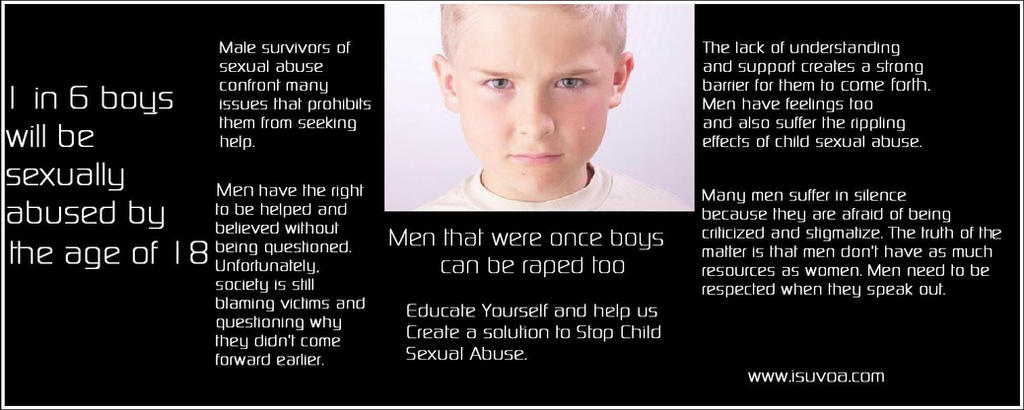
In one study from 2010, 46% of men who reported being raped also reported that they were raped by a female. Under the new definition for rape being used by the Centers for Disease Control, there is a category of sexual violence called “being made to penetrate.”
This definition includes victims who were forced to penetrate someone else with their own body parts, either by physical force or coercion, or when the victim was drunk or high or otherwise unable to consent.When cases of male rape were assessed using this new definition, the rates of non-consensual sexual contact evened out -- 1.270 million women and 1.267 million men reported being victims of sexual violence.
This has long been the hidden and never-discussed reality in sexual assault treatment. There is not a single shelter in the United States for men who are battered in domestic violence. Many rape crisis centers do not see men at all. In fact, when the Tucson Rape Crisis Center began to see men (before that organization became the Southern Arizona Center Against Sexual Assault), there was a LOT of dissent from female staff and a powerful reluctance to allow male clients into the programs.
As one of the trauma therapists at SACASA, I see a lot of men, maybe a third of my caseload. We also have a group for male survivors, and one of the local military bases, Fort Huachuca, has invited me to present to their staff on male survivors of sexual assault.
Because men are reluctant to report, especially if the perpetrator is female, we still don't know the full extent of male survivors. But it's a strong move in the right direction for the CDC to expand their definition of rape in such a way as to include men.
This article is from Hanna Rosin at Slate - it's a welcome contribution to the national conversation on sexual violence and rape culture.
When Men Are Raped
A new study reveals that men are often the victims of sexual assault, and women are often the perpetrators.
By Hanna Rosin
Hanna Rosin is the founder of DoubleX and a writer for The Atlantic. She is also the author of The End of Men: And the Rise of Women. Follow her on Twitter.
For some kinds of sexual victimization, men and women have roughly equal experiences. Photo by Thomas Northcut/Thinkstock
Last year the National Crime Victimization Survey turned up a remarkable statistic. In asking 40,000 households about rape and sexual violence, the survey uncovered that 38 percent of incidents were against men. The number seemed so high that it prompted researcher Lara Stemple to call the Bureau of Justice Statistics to see if it maybe it had made a mistake, or changed its terminology. After all, in years past men had accounted for somewhere between 5 and 14 percent of rape and sexual violence victims. But no, it wasn’t a mistake, officials told her, although they couldn’t explain the rise beyond guessing that maybe it had something to do with the publicity surrounding former football coach Jerry Sandusky and the Penn State sex abuse scandal.
Stemple, who works with the Health and Human Rights Project at UCLA, had often wondered whether incidents of sexual violence against men were under-reported. She had once worked on prison reform and knew that jail is a place where sexual violence against men is routine but not counted in the general national statistics. Stemple began digging through existing surveys and discovered that her hunch was correct. The experience of men and women is “a lot closer than any of us would expect,” she says. For some kinds of victimization, men and women have roughly equal experiences. Stemple concluded that we need to “completely rethink our assumptions about sexual victimization,” and especially our fallback model that men are always the perpetrators and women the victims.
Sexual assault is a term that gets refracted through the culture wars, as Slate’s own Emily Bazelon explained in a story about the terminology of rape. Feminists claimed the more legalistic term of sexual assault to put it squarely in the camp of violent crime. Bazelon argues in her story for reclaiming the term rape because of its harsh unflinching sound and its nonlegalistic shock value. But she also allows that rape does not help us grasp crimes outside our limited imagination, particularly crimes against men. She quotes a painful passage from screenwriter and novelist Rafael Yglesias, which is precisely the kind of crime Stemple worries is too foreign and uncomfortable to contemplate.
I used to say, when some part of me was still ashamed of what had been done to me, that I was “molested” because the man who played skillfully with my 8-year-old penis, who put it in his mouth, who put his lips on mine and tried to push his tongue in as deep as it would go, did not anally rape me. … Instead of delineating what he had done, I chose “molestation” hoping that would convey what had happened to me.For years, the FBI defined forcible rape, for data collecting purposes, as “the carnal knowledge of a female forcibly and against her will.” Eventually localities began to rebel against that limited gender-bound definition; in 2010 Chicago reported 86,767 cases of rape but used its own broader definition, so the FBI left out the Chicago stats. Finally, in 2012, the FBI revised its definition and focused on penetration, with no mention of female (or force).
Of course it doesn’t. For listeners to appreciate and understand what I had endured, I needed to risk that they will gag or rush out of the room. I needed to be particular and clear as to the details so that when I say I was raped people will understand what I truly mean.
Data hasn’t been calculated under the new FBI definition yet, but Stemple parses several other national surveys in her new paper, “The Sexual Victimization of Men in America: New Data Challenge Old Assumptions,” co-written with Ilan Meyer and published in the April 17 edition of the American Journal of Public Health. One of those surveys is the 2010 National Intimate Partner and Sexual Violence Survey, for which the Centers for Disease Control invented a category of sexual violence called “being made to penetrate.” This definition includes victims who were forced to penetrate someone else with their own body parts, either by physical force or coercion, or when the victim was drunk or high or otherwise unable to consent. When those cases were taken into account, the rates of nonconsensual sexual contact basically equalized, with 1.270 million women and 1.267 million men claiming to be victims of sexual violence.
“Made to penetrate” is an awkward phrase that hasn’t gotten any traction. It’s also something we instinctively don’t associate with sexual assault. But is it possible our instincts are all wrong here? We might assume, for example, that if a man has an erection he must want sex, especially because we assume men are sexually insatiable. But imagine if the same were said about women. The mere presence of physiological symptoms associated with arousal does not in fact indicate actual arousal, much less willing participation. And the high degree of depression and dysfunction among male victims of sexual abuse backs this up. At the very least, the phrase remedies an obvious injustice. Under the old FBI definition, what happened to Rafael Yglesias would only have counted as rape if he’d been an 8-year-old girl. Accepting the term “made to penetrate” helps us understand that trauma comes in all forms.
So why are men suddenly showing up as victims? Every comedian has a prison rape joke and prosecutions of sexual crimes against men are still rare. But gender norms are shaking loose in a way that allows men to identify themselves—if the survey is sensitive and specific enough—as vulnerable. A recent analysis of BJS data, for example, turned up that 46 percent of male victims reported a female perpetrator.
The final outrage in Stemple and Meyer’s paper involves inmates, who aren’t counted in the general statistics at all. In the last few years, the BJS did two studies in adult prisons, jails, and juvenile facilities. The surveys were excellent because they afforded lots of privacy and asked questions using very specific, informal, and graphic language. (“Did another inmate use physical force to make you give or receive a blow job?”) Those surveys turned up the opposite of what we generally think is true. Women were more likely to be abused by fellow female inmates, and men by guards, and many of those guards were female. For example, of juveniles reporting staff sexual misconduct, 89 percent were boys reporting abuse by a female staff member. In total, inmates reported an astronomical 900,000 incidents of sexual abuse.
Now the question is, in a climate when politicians and the media are finally paying attention to military and campus sexual assault, should these new findings alter our national conversation about rape? Stemple is a longtime feminist who fully understands that men have historically used sexual violence to subjugate women and that in most countries they still do. As she sees it, feminism has fought long and hard to fight rape myths—that if a woman gets raped it’s somehow her fault, that she welcomed it in some way. But the same conversation needs to happen for men. By portraying sexual violence against men as aberrant, we prevent justice and compound the shame. And the conversation about men doesn’t need to shut down the one about women. “Compassion,” she says, “is not a finite resource.”