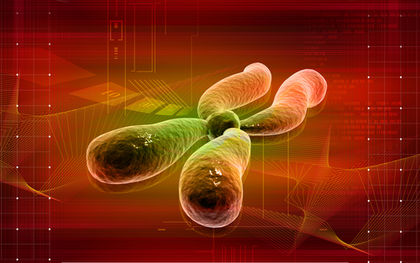
Michael Weiss and his colleagues at the Case Western Reserve University School of Medicine have been for several years exploring at the micro level what it is that makes us perceive our bodies as being either one sex or another, only male or only female.
In this new study they look at the chromosomal structures that determine biological sex - and it turns out there are many variations other than our culturally accepted sex/gender binary.
Full Citation:Near the Edge of Sexual Ambiguity
September 5, 2013
By Cory Silverberg
My Bio
It's rare to find poetry in a press release.
But I pulled the above phrase, which is so evocative and rich, describing as it does, not our bodies but a moment during fetal development before sex assignment; I mean just think about it: What does that edge look like? What happens when you peer over it? Who is teetering there? Are they worried about falling off, are they waiting to jump, or are they happy living on the edge? This is clearly the stuff of poetry and humanity) from a Case Western Reserve University press release a few days ago.
The release describes a study conducted by Michael Weiss and his colleagues at the School of Medicine, who have for several years been exploring in the most micro way imaginable what it is that makes us think about bodies as being either one sex or another, only male or only female.
A bit of background is required:
Despite rich and varied histories that demonstrate it isn't so, most societies function on the premise that all humans are easily classifiable as male or female, and that we can identify who is who by looking at genitals, hormones, and chromosomes. Usually human experience (one of the things we call "culture") is juxtaposed with science in this regard. The science, we're told is more cut and dry. Only it isn't. Medicine and science has for some time documented that humans are not easily categorizable into one of two sexes. If you look carefully at the research, sexual diversity, on the level of genital appearance, hormones and chromosomes, is present and predictable in humans. To use the language of normativity, the fact that some of us don't fit into one of two boxes is as normal as the fact that some of us do.
As Prof. Weiss explains in the poetic release, developmental biology has stuck with the two category model based on the understanding that human bodies develop in a consistent or reliable way because "evolution favors reliability. Robust switches ensure that our genetic programs give rise to a consistent body plan to ensure that babies have one heart, two arms, ten fingers, and so forth."
The switches Weiss is referring to are a way that researchers like him conceptualize gene expression and sexual development. Essentially, it is thought, that all fetuses begin with "female tissues." At some point in fetal development a "switch" turns on and as a result the fetus begins to develop "male tissues." Eventually testes develop, which produce testosterone, which in turn informs the development of male genitalia.
You may have heard someone say that we all start off female. That's what they were referring to.
So the theory is that in order to have bodies that can reliably survive and reproduce, we have evolved "robust switches." In other words, our fetal development is more or less sturdy and fixed, not a lot of diversity.
But we know that there is more diversity than society advertises. Thinking only of chromosomal sex, there are far more than two options. Instead of the popular XY "male" and XX "female" options we hear so much about, some of us have cells with XXX, XXY, XXYY, XYY, XO chromosomes, and the list continues. These "other" options are usually referred to as chromosomal abnormalities. Of course they aren't "other" or abnormal, they are chromosomes in bodies, they are us.
For simplicity sake I'm not going to get deeper into gender here, but it's hard not to point out that there are many more of us whose bodies have XY chromosomes and who are women, whose bodies have XX chromosomes and are men, whose bodies have one combination or another but identify somewhere in between or completely outside of the popular models that we're offered by society. You can read this glossary entry for more about the difference between sex and gender.
Back to genes and sex and switches.
In an effort to understand all this confusion between fixity and diversity, Weiss has been looking for many years at a particular switch, the SRY gene "master switch," that sets into motion the process of fetal tissue changing in a way that is described as male sex development.
In this paper he and his colleagues decided to look at the SRY genes that are shared by a father and his daughter. In this case the daughter has XY "male" chromosomes, but the SRY genes didn't trigger the switch in the predictable way so instead she developed internal female genitalia (ovaries, fallopian tubes, and uterus).
The researchers assumed that something significant must happen to make the SRY switch function in this unexpected way (in their language they expected that a "severe insult to the Y-encoded switch" was necessary and would be in the neighborhood of a factor of 100 or more). What they found was the threshold at which the SRY functions in this unexpected way was only a factor of two. From the release:
"Therefore, human males actually develop near the edge of sexual ambiguity. This means that, unlike the robust genetic programs which develop other essential processes like heart function, the SRY gene master switch is particularly vulnerable to change. It only takes a slight deviation from the normal process to dramatically alter fetal sexual development.Weiss hypothesizes that, rather than predictability, diversity in sex development and expression is itself an evolutionary advantage:
Given the importance of sexual reproduction to the survival of a species, why do human SRY genes function so close to the boundary of infertility? The idea of an unreliable master switch might appear paradoxical, but a growing body of research suggests that it might be an evolutionary necessity."
"We have this tenuous switch on the Y chromosome, and we anticipate that its gift to humanity is variability in the pathway of male development from its earliest stages. The essential idea is that our evolution has favored a broad range of social competencies. In prehistory, this range would have given a survival advantage to communities enriched by a diversity of gender styles."Weiss is focusing on a very narrow part of our bodies, one group of genes on one chromosome. And to be honest I only have the most rudimentary understanding of the technology that allows them to do this work, and the science that describes the work they are doing. But with that caveat, it's hard for me not to want to think about the implications of this research not only on a chromosomal level but on a social one.
The incorrect notion that bodies should fit into one of two clear categories and those bodies are clearly and visibly different in ways that are fixed and consistent across time makes living in our bodies difficult and even intolerable for many of us. It also continues to contribute to the practice of performing unnecessary and harmful surgeries on infants in order to make their bodies fall in line with social expectations that have nothing to do with health or with the beauty of our bodies.
It's hard for me not to let out a little "damn right" yell when I read a Professor of Biochemistry and Medicine writing that all our bodies, especially those that insist on undecidable sex characteristics, are a "gift to humanity" (even if I'm unsure whose giving that gift and who is receiving it).
In some ways this research is only confirming what those of us paying particular attention to sex and gender already know is true. And given medicine's lackluster track record at dealing respectfully with bodies that don't fit its normative expectations, maybe I shouldn't get so excited. But I guess I'm happy any time it feels like someone is getting to speak some truth. It's a little bit of poetry.
Proceedings of the National Academy of Sciences: Inherited human sex reversal due to impaired nucleocytoplasmic trafficking of SRY defines a male transcriptional threshold
Yen-Shan Chen, YS, Racca, JD, Phillips, NB, and Weiss, MA. (2013, Sep 3). Inherited human sex reversal due to impaired nucleocytoplasmic trafficking of SRY defines a male transcriptional threshold. Proceedings of the National Academy of Sciences, Published online before print September 3, 2013, doi: 10.1073/pnas.1300828110
The full article is behind a paywall, so here is the basic abstract info for the original article discussed above.
Inherited human sex reversal due to impaired nucleocytoplasmic trafficking of SRY defines a male transcriptional threshold
Yen-Shan Chen, Joseph D. Racca, Nelson B. Phillips, and Michael A. Weiss,
Author Affiliation
Significance
Mutations in human SRY (sex determining region on Y chromosome) associated with somatic sex reversal provide a model for the perturbation of a genetic switch in organogenesis. Inherited alleles, associated with either testicular or ovarian differentiation, provide unique probes of threshold biochemical properties, defining mechanistic borders between functional and nonfunctional transcription factors. This study exploited two such alleles to demonstrate that bidirectional nucleocytoplasmic trafficking (import–export shuttling) enables robust operation of this switch via phosphorylation at a site external to the DNA-binding motif of the transcription factor. In accordance with studies of intersexual mice, our results suggest that human SRY functions at the edge of ambiguity.
Abstract
Human testis determination is initiated by SRY (sex determining region on Y chromosome). Mutations in SRY cause gonadal dysgenesis with female somatic phenotype. Two subtle variants (V60L and I90M in the high-mobility group box) define inherited alleles shared by an XY sterile daughter and fertile father. Whereas specific DNA binding and bending are unaffected in a rat embryonic pre-Sertoli cell line, the variants exhibited selective defects in nucleocytoplasmic shuttling due to impaired nuclear import (V60L; mediated by Exportin-4) or export (I90M; mediated by chromosome region maintenance 1). Decreased shuttling limits nuclear accumulation of phosphorylated (activated) SRY, in turn reducing occupancy of DNA sites regulating Sertoli-cell differentiation [the testis-specific SRY-box 9 (Sox9) enhancer]. Despite distinct patterns of biochemical and cell-biological perturbations, V60L and I90M each attenuated Sox9 expression in transient transfection assays by twofold. Such attenuation was also observed in studies of V60A, a clinical variant associated with ovotestes and hence ambiguity between divergent cell fates. This shared twofold threshold is reminiscent of autosomal syndromes of transcription-factor haploinsufficiency, including XY sex reversal associated with mutations in SOX9. Our results demonstrate that nucleocytoplasmic shuttling of SRY is necessary for robust initiation of testicular development. Although also characteristic of ungulate orthologs, such shuttling is not conserved among rodents wherein impaired nuclear export of the high-mobility group box and import-dependent phosphorylation are compensated by a microsatellite-associated transcriptional activation domain. Human sex reversal due to subtle defects in the nucleocytoplasmic shuttling of SRY suggests that its transcriptional activity lies near the edge of developmental ambiguity.


