Showing posts with label eating disorders. Show all posts

Saturday, November 9, 2013

A Third of Young Men Have Suffered from Body Dysmorphic Disorder


The number of young males dealing with body dysmorphic disorder (BDD) has increased greatly in the decade or so I have been watching the statistics. I prefer to use the BDD terminology because not all of the young males suffering from this issue should be lumped into the category of anorexia nervosa (what the authors of the article are calling manorexia).

Some of these young men are healthy, but they become obsessed with looking like a male fitness model, such as those on the cover of Men's Health.

We are screwing up our boys now the ways we have been screwing up our girls for the past several decades.

A third of young men have suffered from 'manorexia' - either by purging or abusing drugs - because they hate their appearance

  • Eating disorders are a growing problem among teenage boys, say doctors
  • May have a traditional eating disorder such as anorexia or bulimia
  • Or they may abuse drugs or muscle-building supplements
  • One in every 10 cases of an eating disorder occurs in men, figures suggest

By Jenny Hope Medical Correspondent
PUBLISHED: 6 November 2013

Almost one in three young men have gone to extremes, such as making themselves sick after eating, in an attempt to look good, researchers say.

New data suggests that eating disorders are a growing problem among teenage boys. Many are turning to drugs and muscle-building supplements.

The phenomenon is so widespread that the name ‘manorexia’ has been coined to describe it.

Almost one in three young men has gone to extremes - including making themselves sick after eating - to enhance their appearance - suggesting eating disorders are a growing problem among teenage boys

The study’s lead author, Alison Field of Boston Children’s Hospital, said: ‘We need to be thinking more broadly about eating disorders and considering males as well.’

Classical eating disorders include anorexia nervosa, in which a person refuses to eat, and bulimia nervosa, in which someone binges then purges through vomiting or laxative use.

Professor Field said: ‘For a lot of males, what they’re striving for is different from females.

‘They’re probably engaged in something different from purging.’

Classical eating disorders include anorexia nervosa, in which a person refuses to eat, and bulimia nervosa, in which someone binge-eats then purges through vomiting or laxative use

Men make up an estimated one in every ten eating disorder sufferers. In the UK, the highest rates of new cases are among girls aged 15 to 19 and boys aged ten to 14.

Bulimia and problems such as binge eating account for 38 per cent of new cases, official figures show.

Professor Field’s research on US teenagers found 31 per cent of males had binged on food or purged.

Her team spent three years surveying 5,527 boys who were aged 12 to 18 at the start of the study in 1999.

They were asked how they saw their bodies and about unhealthy behaviours such as drug and alcohol use.

Overall, young men were most likely to worry about being muscular, and that concern increased with age.

This could be the male equivalent of some girls’ preoccupation with extreme thinness, the study said.

About 9 per cent reported a high level of concern with muscularity, while 2 per cent had also used some type of supplement, growth hormone or anabolic steroid to look better.

That figure rose to 8 per cent for older teens aged 16 to 22, the research in journal JAMA Pediatrics found.

Professor Field said using such products was risky: ‘There are a whole range of products available online that we don’t know if they’re healthy or not. We know when a lot of them are tested, they’re not what they’re marketed to be.’

About nine per cent of teenage boys said they were concerned about their body's muscularity. Two per cent of these people had used some type of supplement, growth hormone derivative or anabolic steroid to enhance it

Young men who used enhancement products were more likely than their peers to binge drink and use drugs.

About 6 per cent of boys were very worried about both having muscle and being thin. Just over 2 per cent worried only about thinness, and this group were the most likely to develop symptoms of depression later on.

Professor Field said ‘airbrushed’ models with unrealistic bodies could have a bad effect on teens.

She said doctors and parents should be aware of attempts by young men to change their bodies, to make sure it is being done for the right reasons and in a healthy way.

Friday, May 7, 2010

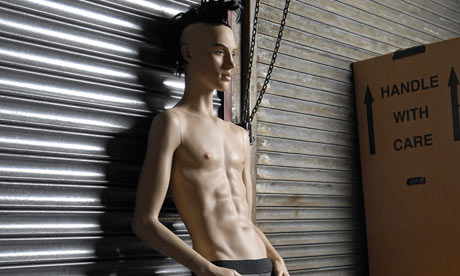
Male Mannequins with 27 Inch Waists? The Average Male has a 40 Inch Waist

http://static.guim.co.uk/sys-images/Business/Pix/cartoon/2010/5/5/1273082697974/Rootsteins-mannequins-wit-005.jpg

Dang, we're doing the same shit to men we have been doing to women for decades in terms of body image issues. As a 6', 190 lb male with a 46" chest and a 31" waist, these mannequins bear no resemblance to my body - and I am a hell of a lot more fit than most American men.

Male mannequins go on a diet

The waifishly thin "Homme Nouveau" reminds us that skewed body expectations affect men, too

There was a time, I'm told, when mannequins were supposed to look like real people. They're forms for designers to use to fit clothes without having a real human being around. But increasingly, mannequins have become more aspirational models than reflective of the actual average human body. British mannequin maker Rootstein is rolling out a new model next month that looks more like Michael Cera than a Ken doll. The latest form, dubbed "Homme Nouveau," is waifishly thin, with a very Victorian 27-inch waist and a chest spanning 35 inches. According to New York magazine, this is a noticeable shift from the classic 1967 model, which had a 33-inch waist and a 42-inch chest. The measurements of male mannequins have been reducing steadily over the years, even as American men's actual pants size has been getting bigger: The average waist size in 2006 was 39.7 inches. L'homme nouveau, meet l'homme rél.

But obviously, fashion logic operates on a different plane. New York quotes Dov Charney, the founder of American Apparel, complaining that mannequins are usually so big "we can't even fit our largest size on them." Given the cultural obsession with skinniness -- the sleek, metrosexual look coupled with emaciated hipster chic -- it's sad, but not shocking that mannequins are much smaller than the people who wear the clothes they're flaunting. Some commenters on the New York story expressed hope that the new forms would usher in slimmer-fitting clothes, complaining that regular sizes are just too big. But for most American men, "Homme Nouveau" doesn't reflect any kind of physical reality. It's just enforcing the same unrealistic body expectations that have plagued fashion for decades. Body shame might help sell clothes, but it's still a bad model.

Here is another take on the same issue from a British newspaper, The Guardian UK.

Skinny male mannequins raise eating disorder fears

Eating disorder campaigners say mannequins with 27in waists portray unrealistic image and may encourage men to starve

Eating disorder campaigners have criticised a mannequin manufacturer for bringing out a super-skinny male model that they say could encourage vulnerable men to starve themselves.

Next month Rootstein, a British firm, will unveil its Young and Restless collection, which includes a mannequin with a 35in chest and a 27in waist, 11in smaller than the average British man.

The company says the mannequins were modelled on teenage boys who were not anorexic, but were perfect for modelling the skinny jeans and slim tailoring made popular by stars such as Russell Brand. But eating disorder charity Beat said more men were suffering from anorexia and bulimia, and that the mannequins portrayed an unrealistic and unattainable image.

It said: "We are certainly aware of more males seeking help for their eating problems and it is recognised that they are more likely to develop an eating disorder as a result of trying to achieve a certain body shape and size.

"Men nowadays are subject to the same insecurities around their body and self-image as women are. Unrealistic images in the fashion world – such as these mannequins – and in the media still abound and the pressures they bring can lead to low self-esteem in often young and vulnerable people."

Kevin Arpino, creative director at Rootstein, who designed the Young and Restless range, rejected any suggestion that his mannequins could fuel eating disorders.

"It is a collection dictated by current fashion trends for skinny jeans and very tight tailoring, as seen everywhere from Topman to Gucci and in the edgier fashion magazines like Numéro.

"None of the boys we used [as models for the mannequins] were remotely anorexic. They were just teenagers – the oldest one was 20, I think – so they were pubescent really.

"It's a trend which you can see in celebrities and rock stars – Russell Brand has a little bit to do with it. But I am sure that muscle boys will have their time again."

He said the measurements for last season's mannequins were bigger, with a 38in chest and 30in waist, but that there was increasing demand for smaller models.

Dov Charney, chief executive of youth clothing brand American Apparel, has said his firm struggled to find mannequins to fit his brand's clothes. "All the mannequins out there are these beefcakes, and we can't even fit our largest size on them," he was quoted as saying in New York magazine.

According to the latest NHS statistics, the average British male takes a 38in waist trouser.


Wednesday, April 7, 2010

Men, appearance, and cosmetic surgery: The role of confidence, self-esteem, and comfort with the body

http://images.free-extras.com/pics/c/calvin_klein-664.jpg

Interesting article from The Canadian Journal of Sociology, but I am forced to ask: Why is so much of the interesting writing about men and men's issues being done by women? Seriously.

This article points to a serious change in the culture - this may in part be responsible for the dramatic rise in male eating disorders over the last twenty years.

In trying to be more like men, women are getting more heart disease and high blood pressure - and in holding ourselves to the same standards to which we have long held women, men are getting more eating disorders and more plastic surgery. Hmmmm . . . .

Men, appearance, and cosmetic surgery: The role of confidence, self-esteem, and comfort with the body

Rosemary Ricciardelli, Kimberley Ann Clow

Abstract

Recent research has suggested that perceptions of the body are important to men’s sense of confidence and that men see the body as a vehicle for personal improvement. To build on this research, an online survey investigated Canadian men’s perspectives on their appearance and their attitudes toward cosmetic surgery. Low self-esteem, lack of confidence, and comfort with one’s body uniquely predicted different aspects of men’s experiences, including attitudes about body shape, perceptions of others, pressures to lose weight, and perspectives regarding cosmetic surgery. For example, participants who were more comfortable with their bodies and higher in self-esteem were happier with their current body shape and features, whereas participants who were less comfortable with their bodies and lower in confidence put more pressure on themselves to lose weight. In addition, lower confidence significantly predicted willingness to undergo cosmetic surgery. Men’s perspectives on cosmetic surgery were thematically analyzed. These findings are situated within identity theory and sociology of the body.

Full Text: PDF
Here are the opening paragraphs of the paper (click the PDF link above to read the article).
Images of the Body

Bordo (1993) and Bartky (1990) argued that the body, particularly the female body, is dominated or oppressed through the practices and bodily habits of everyday life. Bordo (1993:16) explains that “culture’s grip on the body is a constant, intimate fact of everyday life.” This is evident historically, as objectified and sexualized portrayals in advertisements, magazines, and other media primarily portrayed images of women which perpetuated a culture of sexuality and physical appearance (Archer et al. 1983; Courtney and Whipple 1983; Goffman 1979; Lueptow et al. 2001). Images of men, in contrast, were restricted to athletic portrayals and “action shots” or facial photos, where men were individualized agents rather than sexualized marketing tools (Davis 2002; Hall and Crum 1994; Sullivan and O’Conner 1988). Thus, the portrayal of the male body tended to perpetuate more traditional images of masculinity.

Furthermore, Connell (1983:18) examined the social construction of the male body, focusing on “the physical sense of maleness.” According to Connell, the male body is athletic, developed, skilled, large, powerful, forceful, and strong. It occupies space (whereas the female body does not) and is inherently heterosexual. Boys, starting in primary school, are expected to participate in sports. As adults, men are expected to be strong, athletic, and skilled in diverse realms of their life — work, sexuality, and fatherhood. These physically embodied dimensions of masculinity are mixed with the psychological and social dynamics of masculinity, which can lead men to feel they are unable to live up to their image or expectations (Carrigan, Connell, and Lee 1985; Connell 1983). This element of masculinity is complicated by the fact that the masculine identity is constructed during times of social, structural, or personal change (Connell 1995).

More recently, the male body has become increasingly visible and sexualized (Bordo 1999; Gill et al. 2005). For example, advertisements featuring men sexually posed in briefs (e.g., Calvin Klein, Dolce and Gabbana advertisements) have become common place in magazines e.g., Maxim, Men’s Health, GQ, OUT, etc.) and on billboards. Gill et al. 2005:39–40) state that
men’s bodies are on display as never before, from the muscular heroes of the cinematic action genre, to the ‘sixpacks’ who grace the covers of Men’s Health, and the ‘superwaifs’ of contemporary style magazines.
Overall, despite the type of male body being depicted, there is widespread agreement among researchers that a shift has occurred: from being almost invisible, the male body has become hypervisible in the media Bordo 1999; Gill et al. 2005). The reasons for this shift are contested: different theorists credit different explanations, such as the gay movement, feminism, the style press, consumerism, and changing gender roles Chapman and Rutherford 1988; Edwards 1997; Featherstone 1991; Gill et al. 2000; 2005; Moore 1988; Mort 1996; Nixon 1996; Simpson 1994). Whatever the reason for this shift, one reality remains evident: the male body in contemporary culture is both highly sexual and highly visible.


Thursday, April 1, 2010

Male Eating Disorders

This slide show was my part of a presentation on eating disorders for our addictions class - I focused on male eating disorders, including Muscle Dysmorphia, which is actually a form of body dysmorphic disorder, but is nearly always comorbid with disordered eating.

One of the interesting findings, to me, is that men have fewer incidences of abuse and/or neglect in their childhood - which is very common in females with disordered eating.

These are just basic notes, as much as one can do with a powerpoint (and probably too much for a short class presentation). I offer some references at the end.
Male Eating Disorders


Monday, July 20, 2009

Eating Disorders in Straight and Gay Men

An interesting article from the New York Times. Body issues, as I have written about before, are not just an issue for women. More and more men are also feeling the pressure to look a certain way, to be fit, to be "ripped." And about 10-12% of men develop an eating disorder to deal with that need.

Eating Disorders in Straight and Gay Men

DESCRIPTION
Brendan Smialowski for The New York Times
Patrick Bergstrom, a lacrosse player who struggled with an eating disorder, is among those featured in Patient Voices: Eating Disorders.

Dr. Kathryn Zerbe, professor of psychiatry at Oregon Health and Science University and a longtime expert on eating disorders, recently took readers’ questions on anorexia, bulimia, binge eating and other problems. Here, she responds to one reader’s question about eating disorders in men.

Q

In recent years, an increasing number of men have been diagnosed with eating disorders, and not just compulsive overeating, but also disorders like anorexia and bulimia that have traditionally been associated with women. (Full disclosure: I am one such man.)

Does this represent men wanting to take on feminine roles, or feeling that they cannot relate at all to traditional, ultra-macho conceptions of masculinity, and want to take on a more “feminine” persona? Does it differ for homosexual and heterosexual men? To what do you attribute the recent rise in these disorders among men?
Anonymous

A

Some 10 to 11 percent of patients with an eating disorder are men. Fortunately our society is moving away, albeit slowly, from stereotyping men and women. Hence, like you, more men are admitting to having anorexia, bulimia, binge eating problems and even just a preoccupation with being a particular weight.

Clinicians are learning more about the millions of men who suffer from body image conflicts, compulsive exercise, weight obsession and other accompanying psychiatric problems like obsessive-compulsive disorder and depression that can accompany a bona fide eating disorder. Men also tend to use steroids more than women to develop a desired masculine build, a condition sometimes called “reverse anorexia.”

Participating in sports like wrestling, gymnastics or running can also place certain men at risk of developing an eating disorder. Those in certain occupations, such as flight attendants, members of the armed forces or actors, may also be at increased risk compared to men in the general population.

Although a large study from 2007 found that gay men do appear to have more eating disorders than straight men, these men do not necessarily want to be feminine. Nor do they seem to have trouble with their masculine role, as they define it. They do, however, desire to be attractive to potential partners and believe that being a particular weight and shape is appealing.

There is some research that suggests that gay men with an eating disorder may be more likely to have been the victim of sexual or physical abuse as a child. You and other men should be aware that the same physical consequences that occur in women with eating disorder take their toll on men, too, including osteoporosis and osteopenia (thinning bones).

Take a look at one of these books about eating disorders in men to learn more: “Making Weight: Healing Men’s Conflicts With Food, Weight, Shape and Appearance,” by Arnold Andersen, Leigh Cohn and Tom Holbrook; or “The Invisible Man: A Self-Help Guide for Men With Eating Disorders, Compulsive Exercise and Bigorexia,” by John F. Morgan.

For more on eating disorders: See Dr. Zerbe’s responses in “Readers Ask: Eating Disorders” and “Seeking Help for Anorexia, Bulimia and Binge Eating.” And visit The Times Health Guide: Anorexia and Eating Disorders.


Wednesday, February 11, 2009

Epidemiology of Anorexia Nervosa in Men


This Open Access article looks at the reality of anorexia in men, at least in Finland. There is doubtless some similarity in patterns for the rest of Europe and the US. This is a twin study, so it's going to have some interesting outcomes regarding the genetic links to this disorder.

Bottom line is that anorexia is more common in men than previously believed, and that it looks different in men than it does in women. It may be the difference in manifestation that results in men generally remaining undiagnosed.

Epidemiology of Anorexia Nervosa in Men: A Nationwide Study of Finnish Twins

Anu Raevuori1,2*, Hans W. Hoek3,4,5, Ezra Susser2,5, Jaakko Kaprio1,6, Aila Rissanen7, Anna Keski-Rahkonen1

1 Department of Public Health, University of Helsinki, Helsinki, Finland, 2 New York State Psychiatric Institute, New York, New York, United States of America, 3 Parnassia Bavo Psychiatric Institute, The Hague, The Netherlands, 4 Department of Psychiatry, University Medical Center Groningen, University of Groningen, Groningen, The Netherlands, 5 Department of Epidemiology, Mailman School of Public Health, Columbia University, New York, New York, United States of America, 6 Department of Mental Health, National Public Health Institute, Helsinki, Finland, 7 Obesity Research Unit, Department of Psychiatry, Helsinki University Central Hospital, Helsinki, Finland

Abstract

Background

To examine the epidemiology of anorexia nervosa in men, we screened Finnish male twins born in 1975–79.

Methods and Findings

Men (N = 2122) from FinnTwin16 birth cohorts were screened for lifetime eating disorders by a questionnaire. The screen positives (N = 18), their male co-twins (N = 10) and those with lifetime minimum BMI≤17.5 (N = 21) were administered the Structured Clinical Interview for DSM-IV anorexia nervosa. The incidence rate of anorexia nervosa for the presumed peak age of risk (10–24y) was 15.7 per 100 000 person-years; its lifetime prevalence was 0.24%. All probands had recovered from eating disorders, but suffered from substantial psychiatric comorbidity, which also manifested in their co-twins. Additionally, male co-twins displayed significant dissatisfaction with body musculature, a male-specific feature of body dysmorphic disorder.

Conclusions

Anorexia nervosa in males in the community is more common, transient and accompanied by more substantial comorbidity than previously thought.


Tuesday, November 11, 2008

Binge Eating Research Project

This was in my in-box tonight, and since I am a supporter of any and all research that can help us better understand disordered eating, I wanted to pass it along and encourage any men who qualify to take the survey. Thanks.

If you blog on similar topics, please consider reposting this on your own blog -- thanks again.
My name is Colleen Schreyer and I am a graduate student in clinical psychology at the University of Maryland, Baltimore County. As part of my master's thesis, I am collecting data from individuals who have engaged in binge eating, and from those individuals who can eat alot, but enjoy the process. I am hoping to collect survey information from large groups of people, especially men as they are greatly under-represented in eating disorders research, to provide a more accurate picture of binge eating and how it affects individuals differently. The survey takes approximately 30 minutes, and all participants are entered in a drawing to win an Apple Ipod. Any information collected would remain confidential and participants may be assured that I will maintain their anonymity. Email addresses will be collected only to enter participants in the drawing (optional) and will not be associated or linked with the survey responses. I currently have approval from my university's institutional review board to collect data and could provide a copy of this approval to you.

Thursday, August 21, 2008

Trek Magazine - Manorexia

This article appeared in the Summer 2007 issue of Trek Magazine (U of British Columbia) -- a compelling explanation of male anorexia. [Thanks to Paul posting at Isabella's Change Therapy for the link.] This is an important and useful article.

This appears at the end, but wanted to move it up to the top.

If you are interested in participating in a research focus group, please contact Jane Harbottle, Research Coordinator, 604.682.2344 ext: 62524. If you’d like to receive more information about treatment through the Eating Disorders Program at St. Paul’s Hospital, go to www.stpaulseatingdisorders.ca. ¤
Other help can be found here: Eating-Disorder.com
Manorexia
Issue #18: Summer 2007

Manorexia

by Vanessa Clarke

“The bottom line is I am 5' 9" and feel fat, despite weighing only 75 pounds. Just for the record, I am white, American Jewish, and 25 years old. What sets me aside from most other anorexics is that I am male.”

So writes Michael Krasnow in the introduction to his 1996 book, My Life as a Male Anorexic. It describes in frank terms the friendless years he spent consulting specialists, suffering depression, being hospitalized, running away in a bid to starve himself to death, devising intricate tricks to sidestep intervention and feeling guilty about the massive toll wreaked on his family by all this. Despite diagnosis and treatment, Michael Krasnow died the year after his book was published.

Depending on their age, people thinking of eating disorders might recall singer Karen Carpenter, whose death from heart failure associated with anorexia nervosa in the early ’80s brought that disease to mainstream consciousness in the West, or Princess Dianna, whose famous 1993 speech on the subject was made “on very good authority.” (Her own, we guessed.) Or to the fashion industry, with its seeming predilection for size zero female models and heroin chic.

Although the majority of individuals with eating disorders are female, research suggests that males account for an increasing proportion of cases. The idea that disorders like anorexia are female illnesses, however, persists. Another common misperception is that eating disorders are just a product of modern society and its ubiquitous images of unrepresentative beauty and unattainable body-types. But eating disorders aren’t new and neither are eating disorders in males a recent phenomenon. English physician, Richard Morton is generally credited with the first medical description of anorexia nervosa in the late 1600s (although the term itself was not coined until the 1800s). One of Dr. Morton’s first documented cases was that of a 16 year old boy.

Despite these centuries of recorded history, it was only a little over a decade ago that Michael Krasnow wrote: “Although concern about anorexia is growing, there is still a large unawareness, especially about male anorexia, and this is the major purpose of my story: so that other men with this problem will realize they are not alone. My parents and I could not pick up a book and read about male anorexics. For all we knew, I was the only man in the world with anorexia. My parents did not know how to deal with me or even what to think. We had no one to whom we could turn.”


Today, the level of awareness about eating disorders in men has increased, somewhat, with celebrities like Elton John and Dennis Quaid going public with their private battles. But some experts, such as Paul Gallant, mhk’95, feel that current stats on the number of men with eating disorders are probably conservative – in part due to a reluctance in males to come forward – and that current methods for diagnosis and treatment tend be skewed towards women.

Gallant is operations leader for Mental Health Provincial Programs at St. Paul’s Hospital in Vancouver, where he has been based (originally as a recreation therapist) for more than 15 years. Latterly, his attention has been focused on the Eating Disorders program, which he now co-leads. He noticed a gender-based discrepancy in reporting patterns. “I didn’t know why we didn’t see more males at the clinic,” he says. “I expected to see at least one in ten going by the stats. So I decided to look into it further.”

Gallant is now a Human Kinetics PhD candidate at UBC, exploring coping mechanisms and access to treatment in men with eating disorders. His dual role as researcher and leader means he is able to put theory into practice and is conducting a series of focus groups with male subjects who have reported or been diagnosed with an eating disorder. He hopes this will help inform new approaches for identifying males with eating disorders and provide them with the most appropriate treatments. So far, his project has been small scale because so few men have come forward. He is now looking for 20 more men with eating disorders to help him continue his research.

He suspects that common misperceptions play a large part in discouraging men from seeking help. Straight men with an eating disorder might be put off seeking treatment not only because eating disorders are commonly associated with women, but also because there is a perception that if males are susceptible to eating disorders it is because they are gay.

“If you did a study across the country, most people would guess more gay men had eating disorders per capita than straight men,” says Gallant. “But it’s important to stress that the majority of men with eating disorders – about two thirds – are straight. It’s important to explain the statistics and their implications. We want to encourage as many men as possible to disclose and come for treatment and not feel stigmatized.”

Left without diagnosis and treatment, eating disorders can have alarming consequences. Many people who develop them can also develop very serious physical repercussions, such as osteoporosis, types of arthritis, or internal system failures. At 10-20 per cent, eating disorders have the highest mortality rate of mental illnesses, and although there are no figures on comparative mortality based on gender, men face specific risk factors based on their body types.

“More attention is paid to eating disorders now because of the deaths related to them,” says Gallant. “We don’t know if the mortality rate is higher for men or women, but we do know that men with anorexia, for example, have a tighter timeline in terms of getting treatment. If you’re a male with an eating disorder at a severe level, there’s a finer line between changes in Body Mass Index and when there could be consequences to your health, because men are already leaner.” And because they are naturally leaner, weight loss may be less noticeable in males.

Eating disorders are complex conditions with a variety of causes, and are often accompanied by other conditions such as depression or schizophrenia. “That can make them a lot more complex to treat and difficult to recognize,” says Gallant. Compounding this problem for male sufferers are some of the diagnostic criteria used by physicians. Gallant says these are sometimes geared towards the treatment of females, which could explain why men tend to be overrepresented in the EDNOS diagnostic category (Eating Disorders Not Otherwise Specified). This is a sub-clinical diagnosis meaning that a patient meets most of the criteria for a diagnosis, for example bulimia, but don’t meet the full criteria as laid out in the American Psychiatric Association’s Diagnostic and Statistical Manual of Mental Disorders (which includes a category about menstruation). It depends which criteria a doctor chooses to use. Gallant prefers the slightly different set offered by The World Health Organization. These include a category on endocrine function, for example, which covers erectile dysfunction – a potential consequence of eating disorders in males.

Eating disorders can be the product of many factors, including physiological. “Most people would agree there’s a certain biological predisposition to developing an eating disorder,” says Gallant. There is also a large psychological component. Common childhood experiences of sufferers including bullying at school, a critical adult, or worse forms of abuse. Feelings of guilt often go hand-in-hand with a disorder: “Eating disorders never only affect one person. They affect everyone around that individual,” he says. The traditional stiff-upper-lip stereotype of masculinity might mean men are less open about their emotions. “They are more prone to mask them with alcohol or drugs. Substance abuse probably is higher in men with eating disorders than women,” says Gallant.

Men may also have an easier time covering up their problem behaviour. “There’s some consensus that men may compensate with over-exercising, and may purge less. Men may be able to mask their disorder a little better through sports and athleticism,” says Gallant, who points to the world of professional sport as having a concentration of cases. “Ironically, you’d be surprised at how many people from elite sports suffer from eating disorders. Not a well publicized fact, especially if the athletes are stars. They may actually perform quite well for some time and then crash.” Gallant will be presenting a talk on eating disorders in males to Human Kinetics and Coaching Science faculty at UBC to sensitize them to the danger signs. He feels that an essential part of his team’s job is to raise awareness.

The Eating Disorder Program at St.Paul’s is the provincial leader for treatment and standards, and it has links to other agencies across the province such as Jessie’s Hope and the Eating Disorders Resources Centre. “We broadcast video- and tele-conferences to rural and remote communities where we have representatives. Our partners are interested in developing the expertise to treat men. We may be the provincial centre for excellence, but we also want to offer expertise in other communities helping to identify both males and females with eating disorders and offer help on how to work with them.”

Any man or any women can apply to the treatment program if they’ve first been seen in their own regional or community program. The demand for treatment services outweighs resources and there is a detailed case by case review process based on strict criteria. The in-patient program has a wait list of six months. There are also a number of day programs and a follow-up clinic for medical monitoring.

“We want to build from the ground up,” says Gallant. “We’re sending out a message that we’re open to men and want to learn more about how we can help them. According to the literature, needs and treatment modalities may be quite similar, but we’re trying to find out what it’s like from the male’s perspective and what sort of treatment they might want to access. They will realize they’re not the lone man in a treatment program full of women, as is often the case. As word gets out, we’re hoping enough men will come forward.”


Wednesday, August 13, 2008

Patrick Bergstrom - I Choose to Live

I found this at Eating Disorder Blogs - Life After Recovery (check it, there's good resources there). This was their post:
I just received a note from Patrick Bergstrom, a former college lacrosse player recovering from a 4 year battle with anorexia nervosa. Patrick just finished working with Lacrosse Magazine on a story about athletics and ED, which will be in the September issue. He is working with the NCAA to reach out to college students and athletes. His is such a rare and much needed perspective, and he's now made it his mission to reach out and help others on the college level. So I thought I'd post his new website www.ichosetolive.com.

I also want to encourage you all to keep your letters coming for our AED benefit book on the stages of recovery! Our editorial team will be reviewing, selecting, and organizing the letters for the book in the next few weeks. Thank you so much to those who have sent your stories already. And if you're interested in contributing, please try to email your letters to gainingthetruth@gmail.com by Sept. 1. There are no format or length requirements, no "rules." Just write from the heart and tell us what recovery means in your life and what is working best for you right now.
Patrick Bergstrom, former college lacrosse player, has a new site, Mastering Recovery: An Athletic Approach, and a new blog: I Choose to Live. Here is the introduction to the new venture:

I have played in many lacrosse games, where I have battled back to beat some of the fiercest opponents. Yet, little did I know, that the biggest battle of my life would take place off the playing field? Facing my past, confronting my demons and going head-to-head with my Eating Disorder have been the hardest challenges of my young life. How does one fight a war with both his mind and body? I have always been the go to player on the field but to face this disorder, I had to seek the help of those around me. I faced the “Enabling Dictator” by becoming the ultimate team player. My heart was my guide and my friends, family, therapist, and fellow teammates were my support. The only way to achieve victory is to openly ask for help!

The essence of team…..

“The coaching staff for your team is important, but coaches don’t win games, players do. This is so true in recovery as well. My greatest weapons for destroying my eating disorder were my teammates. Who were my teammates? They were those amazing souls I spent 30-some days in recovery with. (JM and CB) We came in as strangers connected only by our failures. Yet we left united, as friends and teammates in life. I was lucky to have two of the strongest teammates one could ever wish for. I took something from each of them everyday. One gave me faith and hope when I was ready to quit, and the other made me laugh when it seemed like I could only cry. I was a guy, and I found myself being saved by two strong females. This was an amazing feeling for me, and I will never forget them. When you are in recovery, other clients are your best resources for success. Recovering from an eating disorder is a team sport.”

--Patrick Bergstrom, Mastering Recovery: An Athletic Approach.

This is an important addition to the online resources for eating disorders -- a uniquely masculine site that focuses on the connection with sports that sometimes goes unnoticed.


Sunday, August 3, 2008

Men and Anorexia

Anorexia, the eating disorder most commonly associated with young women, is no longer just a female issue -- men are now suffering from this disorder as well.

This was posted as Health Bytes:

Anorexia not just a girls’ problem, now men are falling prey

London, Aug 3 (IANS) Anorexia, an eating disorder usually associated with teenage girls, is increasingly spreading in epidemic proportion among men seeking to build “an ideal body”. According to a new survey in Britain, the number of men being treated for this lifestyle disease has gone up by 67 percent in the past five years, the Daily Mail has reported.

Though official figures show that only 32 percent, or 1,700 men have received treatment for anorexia in the past year, experts say the figure is just the tip of the iceberg, the newspaper said.

The number of children less than 14 years of age under treatment rose by 26 percent from 202 in 2001-02 to 255 during the past year, according to the figures released by the Department of Health.

Some areas are worse affected than others.

In Durham the number of anorexics being treated at hospitals has rocketed by 360 percent, in southeast London the figure has risen by 246 percent and in Yorkshire, by 139 percent.

Stressing that most of the cases go unreported, experts claim that male anorexia has become “an unrecognised spiralling epidemic as men as well as women are bombarded with images of the ideal body”.

“The rise in male anorexia actually masked a much bigger problem because men traditionally are less likely to seek help,” said Susan Ringwood, the chief executive of eating disorder charity Beat.

“There has been a rise in focus on the body aesthetic and that’s affecting men as well as girls,” she said, adding that there has undoubtedly been some influence from the rise in male magazines.

“Clinics are seeing many more men, as well as children as young as eight. We know children are more likely to develop an eating disorder during puberty, and puberty is starting on average five years earlier than it did 50 years ago.”

Consultant psychiatrist Frances Connan, lead clinician for the Vincent Square eating-disorder clinic - part of Central and Northwest London NHS Foundation Trust, said it was “doubly humiliating” for men to come forward because mental health and anorexia were seen as “girls’ problems’.

Ever look at the cover of Men's Health, or Men's Fitness, or any of the other men's magazines? The models are all chiseled and have great abs. Check out the guy on the cover here -- thin waist, defined abs, and a basically unreal image for guys to live up to.

Let's ignore the fact that the image is more than likely photoshopped, with shading added to make the abs stand out more than they normally would. The reality is that these guys only are in top shape like that for a couple of weeks at a time, during which they do as many photo shoots as possible. It's not realistic for any man to hold that condition for very long.

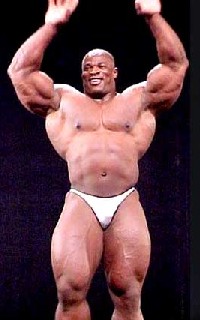
Ever seen a body builder in the off-season? Fat gut and no defintion. That's former Olympia champion Ronnie Coleman to the left, and this how he looks during the off-season.

The amount of work it takes to get in "show shape" is astounding -- the diet, the cardio, the drugs. These images are totally unrealistic for any man to live up to. But no one ever says how impossible such fitness is to maintain. So young men (and the women they want to impress) are looking for the ripped abs.

The single greatest population of steroid users is not athletes -- it's average men who no longer are content to look average, who want to look like the guys on the magazine covers.

And the real insidious thing now is that the male anorexic look is all the rage among those who hire male models at the highest levels:

Where the masculine ideal of as recently as 2000 was a buff 6-footer with six-pack abs, the man of the moment is an urchin, a wraith or an underfed runt. Nowhere was this more clear than at the recent men’s wear shows in Milan and Paris, where even those inured to the new look were flabbergasted at the sheer quantity of guys who looked chicken-chested, hollow-cheeked and undernourished.
This is the same crap that women have been facing for decades, and now men are suffering the same consequences as the women -- anorexia and other eating disorders.

Whether it's the ultra-thin look or the ripped abs look, men are facing unreal images that are creating psychological health issues.

More importantly, it comes down to the same issue -- lack of an inner sense of self-worth and a corresponding quest to find meaning in the recognition and approval of others. Nothing but self-destruction can come of this.