Showing posts with label transsexual. Show all posts

Monday, January 20, 2014

Juliet Jacques - He to She (Aeon Magazine)

Juliet Jacques

The other day, an ignorant and blindly privileged woman named Dani Katz wrote a horrible article against transgender realities, of which she showed herself to be entirely clueless. The article was published at Reality Sandwich, an otherwise progressive and open-minded site with solidly spiritual values. Katz's article hides behind the pretense of spirituality to denigrate and degrade the experience of transgender people.

You can go read it if you choose, the link is above. Or you can read this article from Aeon Magazine.

Here, Juliet Jacques discusses not only the history of transgendered people but her own history as a trans woman and how that transformation occurred both psychologically and physically.

He to She

Transformation is sold as an instant miracle — but for transsexual people the journey is slow and painful

by Juliet Jacques

 
Christine Jorgensen, formerly George Jorgensen (seen, left to right, in 1943, 1952 and 1975). Photo by Bettmann/Corbis

~ Juliet Jacques is a British journalist who writes about gender, literature, film, art and football. She has written for The Guardian, New Statesman, Time Out, The London Review of Books, and other publications. She lives in east London.

AS A BOY, growing up in a small town in the south-east of England, I found little to nourish me when I questioned my gender; there was nothing on such issues in our local library and no discussion of it at school. I used to scour the TV listings and the newspapers, desperate to find anyone with the same issues as me, and learn how they handled them. In films and documentaries, and in articles that tried to explain transsexual lives, I kept seeing the same stories: people who ‘always knew’ that they were ‘born in the wrong body’, and who had to choose between being themselves or risk their family and friends disowning them. I soon tired of them. However, one thing about these articles struck me every time: the ‘before and after’ photographs.

I remember one article in a women’s magazine about someone who was ‘Born a Man’. At the time, I didn’t think about how stupid this phrase was: I was too dazzled by the photographs of a person reclining, her palm resting where her forehead met her long, blonde hair. ‘Now I’m a Beautiful Woman!’ screamed the headline. Clearly, the photographs were the story. In her past, the woman looked like any boy, neither exceptionally attractive nor unattractive. Now, she could have been a model. I didn’t care: although I knew deep down that I wanted to be a woman, I had no interest in fashion, and I soon realised that this article wasn’t for me.

In the Sunday People, I saw an ad for a company called Transformation. ‘From He To She … Instantly!’ it promised, above photos of a stubbly, balding man and a glamorous woman in heavy make-up, brunette wig and pretty dress. It was designed to sell feminising products to male-born people who cross-dressed or were transsexual. I was skeptical about what they sold to stop facial hair growth or to develop a bust, thinking this would require more than some miracle cream or stuffing something inside a bra. The ad seemed like it came from another world; yet it made me feel that transition might be possible, even if I still didn’t really know how.

The adult me, cannier and more cynical, can see that ‘before and after’ photographs have the strange effect of masking the process of change even as they appear to reveal it. I still see the ruse all the time, in the same tabloids that my parents read during my teens, notably the Daily Mail. And it’s a stalwart on pop culture websites, the main weapon in both malicious attempts to undermine someone’s identity, as well as seemingly sympathetic articles. Recently, the shortcomings of ‘before and after’ were exposed when a number of high-profile transsexual people, such as American actress Alexis Arquette, Chaz Bono (child of Sonny and Cher) and Hollywood film director Lana Wachowski, came out. With Arquette in particular, who was constantly in the public eye, and whose film roles include a memorable performance as the young cross-dresser Georgette in Last Exit to Brooklyn (1989) — there was no point in trying to pretend that she had changed overnight; so instead of trading on ‘before and after’, media outlets studied old images for gradual movement, scanning for any ‘signs’ they had missed.

Makeover TV shows such as 10 Years Younger or What Not to Wear also rely on the trope of dramatic and instantaneous change. Admittedly, these demonstrate more of the transformative processes, but still implying that all will be perfect once they are completed, making outer appearance and inner peace synonymous. What happened to their subjects once the cameras go away?

The rise of reality TV shows has made this question all the more visible, including for transgender contestants. Big Brother, in particular, made a near fetish of featuring outsiders, presumably in the hope that they would clash with each other. It had the surprising effect of normalising transgender people, while catapulting them to sudden fame. In 2004, the trans woman Nadia Almada won Big Brother, and in 2012 trans man Luke Anderson triumphed. Neither had told their housemates about their pasts, but revealed them to the public instead. Their victories made them into transgender role models, and the internet gave them longevity, creating a strange new middle ground in the old obscurity-celebrity-obscurity narrative.

‘BEFORE AND AFTER’ pictures have been part of print coverage of transsexualism from the start. In January 1937, less than a decade after the earliest sex reassignment surgeries were performed in Berlin, the American bodybuilding magazine Physical Culture ran one of the first articles on the subject, entitled ‘Can Sex In Humans Be Changed?’ Its opening paragraph was surprisingly relaxed about the possibility of radical social change, suggesting: ‘The old landmarks are going, nothing is static, everything flows … Life is created in the laboratory [and] Sex is no longer immutable.’ The writer, Donald Furthman Wickets, went on to look at historical ideas of ‘male’ and ‘female’, and the role of hormones in determining them.

The article was accompanied by two shots of Britain’s first surgically transsexual man, Mark Weston: one of him posing in a white shirt, tie and tank top with Alberta Bray, ‘a former girl chum to whom he is now married’; the other as ‘the late Miss Mary Weston, Great Britain’s girl [javelin] champion’ during the 1920s. The only clear difference between the two was that he had grown some stubble. There was also a single image of Zdenek Koubkov of Czechoslovakia, who’d won the women’s 100m at the 1932 Olympic Games as Zdeneka Koubkova, but who had since transitioned, and was shown wearing a suit and lifting his hat to show off his closely-cropped hair. The pronouns ‘he’ and ‘him’ were used throughout, and readers were offered little sense of what happened physically to the athletes. In both cases, they were told: ‘The miracle was accomplished by surgery and duly acknowledged by law.’

Weston and Koubkov did not become international news. It was only after the Second World War, as photographs on newspaper covers became commonplace, that transsexualism developed into a mass media phenomenon. On 1 December 1952, the New York Daily News ran the sensational story of Christine Jorgensen under the headline ‘Ex-GI Becomes Blonde Beauty’ – with contrasting images of her as a male soldier, then glamorous woman, dominating the spread. Instantly, Jorgensen became a celebrity, working as an actress, singer and transgender rights advocate.

In Transgender History (2008), Susan Stryker claims the fascination with Jorgensen ‘had to do with the mid-20th-century awe for scientific technology, which now could not only split atoms but also, apparently, turn a man into a woman’. Stryker, a professor of gender studies at the University of Arizona, also notes that Jorgensen was the first American transsexual woman to become prominent after the war changed women’s relationships with paid labour and domestic work. It wasn’t just gender roles that were in flux, but gender itself.

As it transpired, The Transsexual Phenomenon (as the sexologist Harry Benjamin called it in his influential 1966 book) did not destroy US society. Or even visibly change it. Looking at the New York Daily News photographs of Jorgensen now, they come nowhere near to justifying their attention-grabbing tag – ‘Operations Transform Bronx Youth’. Jorgensen’s facial structure, her hairline, eyes, nose and chin, barely altered between 1943 and 1952: the main differences were her clothes and make-up.

While magazines like Physical Culture and the New York Daily News, were modelling a radical discontinuity between ‘male’ and ‘female’ and emphasising the otherworldly, even anarchic, intentions of those crossing them, sexologists, feminists and gender/queer theorists were exploring the space between these categories and suggesting that it was here that behavioural expectations for men and women were socially generated. The writers I liked most argued that the very possibility of gender re-assignment meant there wasn’t as much difference between the sexes as was once thought. By the late 1980s, Sandy Stone’s seminal essay ‘The “Empire” Strikes Back: A Post-Transsexual Manifesto’ was calling for transsexual people to be open about the space between male and female identity, and how they moved within it. This is the space that ‘before and after’ pictures keep hidden in order to retain their power to humiliate and shock.

Cautiously optimistic about the future: Juliet, aged 22 (left) with Joe Stretch (centre) and Joe Cross (right) at the Retro Bar, Manchester, summer 2004. Photo courtesy of the author

I SPENT MY LATE TEENS and early 20s exploring my gender. I read essays and books, and watched many more films that featured transgender characters and even, sometimes, transgender actors. I wore women’s clothes at home and to clubs and bars, trying out different styles to see what felt comfortable, and talked to people who asked whether or not I wanted to ‘go all the way’. Eventually, in March 2009, I decided that I did, and asked my doctor about gender reassignment through hormones and surgery.

I didn’t expect the sort of rapid transformation I’d seen advertised in my youth, and I wasn’t surprised to learn that from start to finish the process would take about three years, partly due to waiting times for specialised services. Nor was I shocked when told that the physical changes would not transform me beyond quick recognisability, as they had not transformed Weston or Jorgensen. Instead, they’d form part of a longer psychological process; altering my body in a society with entrenched ideas about how men and women should appear and how they should be treated, meant rethinking how I dressed, spoke and moved, where I went and with whom, and how I felt about myself.

Like Sandy Stone, I decided to document the time it took to move, in what became my transgender journey blog for The Guardian (it ran from June 2010 to November 2012). I hoped to create something between those one-off ‘transition narrative’ articles, which seemed to have barely evolved since the 1990s, and transsexual autobiographies such as April Ashley’s Odyssey (1982), which for years were the only way people could explain what happened at any meaningful length.

Ashley’s memoir, co-written with Duncan Fallowell, documented her voyage from the post-Depression Liverpool slums of the 1930s to national fame in the 1960s. There were spells in the Merchant Navy and as a performer in a Parisian cabaret, surgery in Casablanca, an acting and modelling career hampered by tabloid revelations, and a marriage to Arthur Corbett, Lord Rowallan, later annulled on the grounds that she was ‘a person of the male sex’. That her beauty came with a transsexual history was central to her celebrity, yet the path from photos of ‘George Jamieson, aged 15, at school’ to ‘Toni April, aged 21’, and finally April Ashley in the early 1960s appeared not jarring but smooth and logical. Another British autobiography, Conundrum (1974) by Jan Morris, an established travel writer long before her transition, used no images at all — an approach I much preferred.

As a rebuttal of the implied instantaneity of ‘before and after’ photographs, I wanted my Guardian posts to cover the process in real time, but it was too slow: months passed between my appointments at the gender identity clinic, the hormone prescription took more than a year to arrive, and the effects of the oestrogen were gradual. Even allowing for the fact that my blog began a year after the medical pathway, I’d said all I wanted to say about the social and psychological aspects of transitioning long before I got a date for surgery.

One thing I did find hard to chronicle was the strange effect this all had on my sense of myself as a continuous subject. For many months, coming out and changing my name seemed like the major rupture: having people refer to me differently and treat me differently felt far more sudden than anything that later happened to my body. Besides, the hormonal effects were too subtle for me to see, so when friends said I looked different, I'd ask them to explain how. Their responses usually matched my expectations — thicker hair, softer skin, fuller cheeks.

After more than a year of despairing at how little impact the oestrogen seemed to have made, I undressed in front of a mirror and was astonished by my own appearance. Even without make-up, my face suddenly looked more female than ever before. I realised that nobody had heckled me on the street for being transsexual for months. Moreover, I’d developed breasts — smaller than the inserts I’d bought a couple of years earlier, which in hindsight weren’t well-judged, presenting too fast a change in my appearance, and they were too obviously prosthetic — but a visible and important change nonetheless.

At this point, I came across Becoming (2010), a flipbook by the Berlin-based artist Yishay Garbasz. She regularly photographed herself as a standing nude after starting gender reassignment, choosing 87 of the 911 pictures for her book, and installing 28 images as a zoetrope for the 2010 Busan Biennale in South Korea. Each picture was taken against a white backdrop, without make-up, emphasising the incremental changes to her frame. In this context, even her sex reassignment surgery in 2008 did not appear abrupt or incongruous, but was rather assimilated into the physical landscape she presented.

LIKE ME, Garbasz had struggled to take control of the ‘before and after’ conceit, and expose the potentially limitless terrain contained within it. I still enjoy seeing it debunked. For example, I recently laughed at how easily the ‘dramatic weight loss’ juxtaposition was taken apart by an Australian personal trainer on her blog, MelVFitness. She showed how better posture, fake tan lotion and black bikini bottoms — as well as zooming in for the ‘before’ and out for the ‘after’ — enabled her to fake such a ‘radical transformation’ in just 15 minutes.

I’ve seen this demystification so often that I now find it strange to see such pictures in print — and never stranger than when I spotted someone I’d known by a male name at sixth-form college who’d become famous as a female model, with the newspaper spreads yet again screaming ‘before and after’. I recognised her from the opening catwalk shot long before I got to the image of her as a boy, or the story of her gradual self-realisation, which closely mirrored mine.

This took me back to a photograph of myself from 2004, which I stumbled across just after my body epiphany. It was taken in Manchester; I was pictured with two friends, Joe Stretch and Joe Cross, and wore a 1920s-style dress and a headscarf over my hair, with make-up hiding my skin texture. This find led to another kind of epiphany, which instantly closed the psychological gap between my pre- and post-transitional self, and highlighted the continuum between the various identities I’d grown into while exploring my gender. I realised that I could have easily faked transsexual ‘before and after’ pictures back then, if I’d wanted to, editing out the fact that, at the time, I presented mostly as male.

This autumn, 15 months after surgery, and finally feeling settled — like someone who had transitioned rather than someone who was transsexual — I let the American singer-songwriter Emily Forst, a keen amateur make-up artist, give me a makeover. She styled my hair and took a portrait that made me feel, for the first time since 2004, like the person I wanted to be. This came after years of dodging cameras — a hangover from the negative self-image attached to presenting as a man. Comparing the two photographs, the main differences I see are in my expression: my cautious optimism as a 22‑year‑old against the deep sadness in my thirtysomething eyes, having endured five years of street harassment, anxieties about how my loved ones would react to my transition, the physical pain of surgery, and the responsibilities that came with writing about it all.

I doubt that anyone who looks only at the before and after pictures of me would be able to see much of this. Although they would probably be better placed to tell me how my features had changed. But, really, that always struck me as the least interesting thing about my experience. And after everything that’s happened, it still does.

Tuesday, September 20, 2011

Matt Kailey - Chaz Bono on ‘Dancing With The Stars’: Exclusive Tranifesto Interview

Chaz Bono is probably the most famous trans-man on the planet. As the most visible FTM (female to male) transexual ever, he is both in demand for interviews and - I am guessing here - carrying the weight of a huge responsibility in being the "face" of FTM trans experience.

Matt Kailey - himself a trans-man - posted this interview with Chaz.

We interrupt our regular blog programming to bring you this exclusive interview with Chaz Bono just before his debut on Dancing With The Stars – tonight, Monday, September 19, at 8 p.m. Eastern time.
I was lucky enough to get to talk to Chaz by phone this weekend to find out about the big show, his book, and what he’s going to do next. (And in a shameless display of self-promotion, I left in the nice things he had to say about my book, so be warned.)
Read on, and remember to watch Chaz tonight and vote early and often to keep him on the show. Now, without further ado, heeeeere’s Chaz!
Matt Kailey: What made you decide to go on Dancing With The Stars in the first place?
Chaz Bono: I just thought it would something that was fun and that would allow me to do something that was physically challenging with my body now that I’m finally feeling comfortable in it. And I thought it would allow me to reach an audience that I really haven’t been able to reach yet.
MK: Did they teach you the dance moves?
CB: Yeah, there’s been three weeks of rehearsal, and then you go!
MK: How do you feel like you’re doing with your dancing?
CB: I think I’m doing okay. It’s really kind of hard to tell.
MK: Do you think you’re going to be nervous?
CB: Oh, yeah. It’s nerve-wracking. I’m actually at the set right now, and it’s the first time I’ve danced on the stage.
MK: Obviously, you’re aware of all the grief that’s going on about this appearance. You’ve had to hear and read some really awful things. Even in the face of all you’ve had to put up with, was it worth doing it?
CB: Yeah. I really don’t pay much attention to all that stuff. I haven’t really read anything, and the only time I have to hear stuff is a couple of interviews where people have said stuff to me. And I’ve actually even put a stop to that, because I just don’t want it in my head. So it’s pretty easy for me. I do have a fairly thick skin, so it’s pretty easy for me to drown it out and not go out and seek stuff.
Read the whole interview.

Saturday, May 7, 2011

Patricia J. Williams - Gender Trouble - Plus: A Whole Lot More on Transsexuality and Transgender

http://www.uncg.edu/csd/images/tg%20image.jpg

It's unusual to see a story about transsexuality in the mainstream media, but The Nation ran this story by Patricia J. Williams recently - specifically on transgender people as targets of harassment and assaults. She examines the ways in which transgender identities challenge our accepted gender norms.

Below this piece I am also including a couple of other articles that have been in the news recently on transgender and transsexuals.

Gender Trouble


Over the past few years, attacks on transgendered people in public places have been on the rise. In 2009 a transwoman in Queens was pelted with rocks, beer bottles and misogynistic slurs. Just weeks before in the same borough, two men used a belt buckle to beat a transwoman named Leslie Mora. In late April a widely disseminated video captured two teenage girls punching and dragging Chrissy Lee Polis from a women’s room to the front door of a Baltimore-area McDonald’s. That video, made by an employee, shows bystanders just watching, with little move to aid her.

Crimes like these often stem from simple homophobia; but they reveal a more specific discomfort with the ambiguity that transgendered people embody. The intensity of that discomfort extends to many situations that fall short of violence. Insults and isolation in housing, the workplace, gyms, schools and always, always in public bathrooms—premised on resolute gender binarism—leave transgendered people forever making the “wrong” choice. There are, for example, queasy debates at Smith and other women’s colleges about how to negotiate the presence of students who are admitted as women but graduate as men.

Transgender identities challenge us to think about the morphisms of “sex” and “gender,” “woman” and “man,” “real” and “not real.” This is a hot topic in academic circles: for example, attempting to disambiguate the notion of “identity” as a matter of legal subjectivity, when, say, a man with a heap of warrants is finally arrested—but by the time the police catch up, he has become a she, and in the name of that transformation asserts as a defense that “he” was a different person. It’s easy to dismiss this sort of discussion as funny or unimportant, but I think it’s necessary, not merely because it directly affects the lives of the transgendered but because it tests and expands the thinking of those of us who are not transgendered yet whose collective responses shape the social environment.

Take Smith. Its administration has said it welcomes trans students as part of a diverse community, but apparently not all students and alumnae agree. For some, a commitment to remaining a women’s college rests on assumptions about what a woman is as a biological matter, what gender is as a social construction and why a woman’s experience is, or is deemed to be, different from that of a man. Trans students evoke squeamishness particularly among older alums, as well as among those who come to a “single sex” school for its white-glove, ladylike connotations, or perhaps out of commitment to women’s education as a form of empowerment (Gloria Steinem went to Smith, after all). This contentious conversation scrutinizes not just the gender of individual students but overall institutional identity. The debate at Smith brought to the fore, for example, those who were unhappy to see their school’s feminine image newly shared with transmen.

The debate is difficult precisely because it feels so new—and in some ways it is. Sex reassignment technologies are so novel that the accompanying medical discourse still conflates those who have ambiguous genitalia; those whose endocrine systems are ambiguously skewed; and those whose psychology is felt to be at odds with their biology. And what about the culture of elective cosmetic surgery, or the cult of physical perfection that drives even normatively gendered people to feel “not normative enough” and so seek to become “more feminine” or “more masculine” through the wizardry of nose jobs, labial stitching, liposuction, pectoral implants and breast enhancement?

So what do we mean when we ask a pregnant person if “it” is a boy or a girl? The inquiry seems permissible only in utero. We get edgy when we don’t already know the answer when encountering a full-grown adult. Do we expand our meaning so that “woman” includes those who may have been born with uncertain genitalia but who grew up being dressed, viewed, identified as female from birth? Do we include that category of people who regarded themselves as men from the very beginning of childhood consciousness yet who, in asserting that sense of self, are not privileged with the perquisites of (white, straight) masculinity but are instead branded as freaks or frauds?

Most difficult of all, what might it mean to explode the entire category of “woman” as anything like a stable designation? What does that mean for the status of women’s colleges, women’s sports, to say nothing of the proverbial ladies’ room? After all, it’s not as though men have never been on the campuses of women’s colleges. I went to a women’s college, and “gentlemen callers” were everywhere—at meals, in seminars, in bedrooms and bathrooms, all but climbing in the windows on weekends. But those were “men” defined in a clear, binary and thoroughly heterosexual context.

To engage in gender-bending means that we are thrown into confusion with regard to everything from Title IX to the college rankings of U.S. News & World Report. Rightly or wrongly, women’s and men’s identities are still largely linked to the preservation of images of good wives in pearls and husbands in spats or, as one of the teenagers in the McDonald’s assault put it, to literally beating back competition for the affections of “my man” (or “woman,” as the case may be).

There are lessons to be mastered in all this, about principles of antidiscrimination and freedom of expression; about the complexities of perceived reputation (“I don’t want to be sneered at for still having a woman’s body,” said a Bryn Mawr student in the process of changing genders); and about institutional investments, dependent as they are on assessments of risk (Smith’s endowment managers are no doubt sweating bullets, given the power of alums as donors). Resolving these conflicts with dignity and thoughtfulness is no less important than educating and prosecuting those who use sticks and stones to beat away their terror of humanity’s infinite variability.

* * * * * *

This is a call for participation in a survey (for members of the trans community) being conducted by Jamison Green, Jason Cromwell, & Dallas Denny. I don't know the last two names, but Jamison Green is rather well-known author on transmen. I found the announcement at en|Gender.

The survey is open is open until June 28th - it takes about 20 minutes - please forward it to any any trans friends, family, or acquaintances.

Survey on Trans Language: 10 Years Later

Posted by – May 1, 2011

Jamison Green, Jason Cromwell & Dallas Denny did a survey on trans terminology 10 years ago to try to educate people who were writing about trans issues. It’s a whole decade later, & they thought it needed an update, so they’ve created a survey for those of us in the community to weigh in what terminology doesn’t suck and what does. Here’s their letter:

Greetings!

Ten years ago, we conducted a short survey of our community’s reactions to the use of descriptive terminology in the professional literature of gender identity issues. Basically, we were interested in reforming the literature so it could speak respectfully about transsexual and transgender persons. To do that, we wanted to find out which terms transsexual and transgender people liked, and which they didn’t like. The results of our study were reported at the 2001 scientific symposium of the Harry Benjamin International Gender Dysphoria Association (HBIGDA), and had an immediate impact on the hundreds of medical and social scientists who were present.

A lot has changed since 2001, and we thought it would be interesting to re-open the survey, collect new data, compare the results 10 years later with the original results, and present our analysis at the 2011 scientific symposium of the World Professional Association for Transgender Health (formerly HBIGDA) this September.

We are asking community members to rate and give us their opinions of certain terms which have been used in the literature, and some of the terms put forth by the community itself, so we can communicate the community’s opinions to the members of WPATH and (we hope) more widely in a subsequent academic publication.

There are no physical or psychological risks associated with responding to this survey, and there are no age restrictions for respondents, though we caution participants that some terms offered for your evaluation may be offensive to you or other individuals. The survey has only 8 questions (though most questions have many options to choose from) and should take less than 20 minutes to complete. Please complete it all in one sitting – if you exit the survey before you complete it, your answers will not be saved. The survey is scheduled to close June 28, 2011, so please respond soon!

If you are interested in receiving a copy of the paper which will eventually come from this, you will be given an email address at the end of the survey so you can contact the researchers separate from your responses to this survey. Any communication you initiate with us will not be associated with your survey answers, and no identifying information will be retained. We will treat your email address as confidential and will use it only for distribution of the paper to you. Your answers to the survey also will be treated confidentially, and no data reported in our analysis will be traceable to you.

Here’s the link to the survey:

https://www.surveymonkey.com/s/8RGBH25

Thank you VERY MUCH for participating in this survey and helping us with our research!!

With Gratitude,
Jamison Green, Jason Cromwell, & Dallas Denny

Let them know what you think. The paper will be published this fall.

* * * * * *

From Safe Space Radio, this show looked at being the parent of a trans child.

TransParenting, or Parenting Trans Kids

An interview with sexuality educator and mother, Sandy Lovell about parenting a trans son. Sandy shared the story of learning that her daughter was becoming a man. She described her son’s childhood and the very early ways he was drawn to play with more stereotypically masculine toys, and said he felt “in the middle” between being a boy and a girl. As a feminist mother she celebrated his gender non-conformism, although 23 years ago it had not occurred to her that he might be trans. Sandy named parental concerns for her child’s safety, his ability to find love, her grief over losing the daughter, and her struggle to accept that the transition was really necessary. Sandy also spoke movingly about how her son’s courage to be himself has inspired her to live her most authentic self, and that in many ways his transformation has been a gift to their family.


This show aired on April 13th, 2011
* * * * * *

Finally, a new study suggests that female-to-male transsexuals have brains more like cis males - which means they are more prone to autistic traits. This is one of the first definite biological links for transsexualism. Glad to see research beginning to support what transmen have known since early childhood - their body does not match their brains.

Citation:
Rebecca M. Jones, Sally Wheelwright, Krista Farrell, Emma Martin, Richard Green, Domenico Di Ceglie, Simon Baron-Cohen. Brief Report: Female-To-Male Transsexual People and Autistic Traits. Journal of Autism and Developmental Disorders, 2011; DOI: 10.1007/s10803-011-1227-8

Female-to-Male Transsexual People Have More Autistic Traits, Study Suggests

ScienceDaily (May 5, 2011) — A new study from Cambridge University has for the first time found that female-to-male transsexual people have a higher than average number of autistic traits.

The Medical Research Council (MRC) funded study, published in the Journal of Autism and Developmental Disorders, has important implications for the clinical management of biological girls with gender incongruence that persists into adulthood, and for the 'extreme male brain' theory of autism.

Professor Simon Baron-Cohen, Director of the Autism Research Centre at University of Cambridge, led the study with Rebecca Jones, now at Weill Cornell Graduate School of Medical Sciences. The team included Professor Richard Green and Dr Domenico Di Ceglie, world experts in transsexualism and gender incongruence in young people respectively, and by Emma Martin, a clinical psychotherapist and herself transsexual.

The researchers measured autistic traits using the Autism Spectrum Quotient (AQ), and compared AQ scores from five groups: 61 transmen, 198 transwomen; 76 typical males; 98 typical females; and 125 individuals with Asperger Syndrome (AS). They found transmen had a higher average AQ than typical females, typical males and transwomen, but lower than individuals with AS.

Simon Baron-Cohen interpreted the results as follows: "Girls with a higher than average number level of autistic traits tend to have male-typical interests, showing a preference for systems over emotions. They prefer not to socialise with typical girls because they have different interests, and because typical girls on average have more advanced social skills. Both of these factors may lead girls with a higher number of autistic traits to socialize with boys, to believe they have a boy's mind in a girl's body, and to attribute their unhappiness to being a girl."

Rebecca Jones added "If such girls do believe they have a boy's mind in a girl's body, their higher than average number of autistic traits may also mean they hold their beliefs very strongly, and pursue them to the logical conclusion: opting for sex reassignment surgery in adulthood."

Domenico Di Ceglie, Director of Training and Research at the Gender Identity Development Service at the Tavistock and Portman NHS Foundation Trust in London, commented: "These are important findings in the field of gender incongruence, which need to be replicated. The awareness of the presence of autistic features may help these young people to explore the reasons behind their perceptions, and help them make more informed decisions about treatment."

Emma Martin, who runs a Gender Identity Support and research group in Little Downham, UK, welcomed the new findings, and added two important caveats: "This new research reminds us that gender incongruence is incredibly complex. Every possibility should be discussed with new clients, but should not delay what can be a painfully slow process for those affected."

Wednesday, April 27, 2011

Marco Fanara - Cultural Relativism Versus Sexual Rights as a Coherent Set of Human Rights

At one point in his discussion, Fanara offers this quote:
The notion that there are two and only two genders is one of the most basic ideas in our binary Western way of thinking. Transgender people challenge our very understanding of the world. And we make them pay the cost of our confusion by their suffering. (O’Flaherty, Michael & John Fisher (2008) Sexual Orientation, Gender Identity and International Human Rights Law: Contextualising the Yogyakarta Principles)
We label anyone who transgresses the accepted gender binary as ‘different’ or weird or even ‘abnormal’ - we make them 'other' and exclude them from most communities - forcing them to live "on the fringes, or outside the periphery of society in regards to enjoying human and/or sexual rights."

These exclusionary structures - the process of "othering" - Fanara argues, "cultivate and permit symbolic and even physical violence against any form of sexual difference or ‘deviance’ that may be perceived as a possible threat to sexual ‘normalness’."

Good article.

Marco Fanara
United Nations Mandated University for Peace

May 24, 2010

Abstract:
Proponents in favour of sexual rights as a coherent set of human rights argue sexuality is a fundamental component of one’s self and are therefore universal. Opponents of such views suggest sexual rights are not in fact universal mainly due to cultural relativism, which includes, but are by no means limited to religion, cultural beliefs, social systems, and politics must be taken into account when discussing ‘universal sexual rights’. This paper aims to address and attempt to answer one question: Do various ideological differences undermine sexual rights as a coherent set of claims within human rights?
This is a short but interesting article - here is the first part of his argument:
Sexuality is an evolving concept at best, fluid and ever changing.1 It is a concept that transcends, but nevertheless includes, notions of sexual activity to encompass gender identities, sexual orientation, and reproduction, to name a few. There are many aspects that interact and contribute to one’s sexuality, such as cultural, social, economic, ethical, legal, historical, religious, biological, psychological, and spiritual factors.2 Sexuality is expressed through one’s desires, attitudes, beliefs, thoughts, values, fantasies, practices, and relationships.3 Many argue sexuality is a fundamental component of the personality of every human being, and as such are universal and entitled to protection through sexual rights.4 Miller (2008) concurs, “sexual rights make a strong claim to universality, since they relate to an element of the self which is common to all humans: their sexuality.” As is the case with universal human rights, universal sexual rights are based on the inherent freedom, dignity and equality of all human beings.5 Others argue cultural relativism and various ideological differences (be they political, religious, cultural, social or otherwise) must be taken into account when discussing ‘universal sexual rights’.

Herein, for the purposes of this paper, we will now discuss the various issues surrounding sexual rights. Albeit this paper covers an extensive array of issues, note it is by no means comprehensive or exhaustive, rather allow this paper serve as a mere introduction into the vastly complex issues surrounding sexual rights. More specifically, we will address and attempt to answer one essential question: Do various ideological differences undermine sexual rights as a coherent set of claims within human rights?

So what exactly are sexual rights? As noted by Richardson (2000), there are “competing claims for what are defined as sexual rights and lack of rights, reflecting not only differences in how sexuality is conceptualized but also the fact that there is no singular agreed definition of sexual rights.” O’Flaherty and Fisher (2008) state sexual rights are those rights relating to one’s perceived or actual gender identity and/or sexual orientation. The World Health Organization cites sexual rights as those that are:
human rights that are already in national laws, international human rights documents and other consensus statements. The include the right of all persons, free of coercion, discrimination and violence, to: (1) the highest attainable standard of sexual health, including access to sexual and reproductive health care services; (2) seek, receive and impart information related to sexuality; (3) sexuality education; (4) respect for bodily integrity; (5) choose their partner; (6) decide to be sexually active or not; (7) consensual sexual relations; (8) consensual marriage; (9) decide whether or not, and when, to have children; and (10) pursue a satisfying safe and pleasurable sexual life. The responsible exercise of human rights requires that all persons respect the rights of others.
Similarly, the Yogyakarta Principles are a set of principles on the application of international human rights law in relation to sexual orientation and gender identity. The Principles affirm binding international legal standards with which all States must comply.6 Said rights include: The right to universal enjoyment of human rights, non-discrimination and recognition before the law; The right to human and personal security; Economic, Social and Cultural Rights; The right to expression, opinion and association ; The right to freedom of movement and asylum; The right of participation in cultural and family life; The right of human rights defenders; and last but not least the right of redress and accountability. Alternatively, Miller (2008) argues there does not exist a universally, politically or substantively accepted set of sexual rights standards in the world today. She further asserts international human rights law, contrary to popular belief, actually facilitates the state’s repressive role in regulating sexual activity and expression as it says very little about the national regulation of sexuality.

The question now becomes, can states relegate the above noted sexual rights on cultural or ideological grounds? As Miller (2009) notes, “attacks on sexual rights are linked to the emergence of an amalgam of political interests that draw together justifications based on religious, culture and nation to undermine human rights.” Many academics argue a number of states restrictive and discriminatory regulation of sexuality is interrelated to power relations between heterosexuality and any ‘other’ form of sexuality and that there is little moral justification for such oppressive regulation.7 “Means to control sexuality are institutionalized not only in cultural and social norms and customs, but also in legal policy and practice.”8 What is often deemed as ‘normal’ sexuality (hegemonically masculine heterosexuality) by cultural and social expressions leaves little space for social recognition of sexual diversity and as such often times defines ‘other’ forms of sexuality as deviant.9
Full citation:
Marco, F. (2010, May 24). Cultural Relativism Versus Sexual Rights as a Coherent Set of Human Rights. Available at SSRN: http://ssrn.com/abstract=1749653


Sunday, April 3, 2011

Can Integral Theory Account for Transsexual Experience?

integral theory

In my research on female-to-male transsexuals (FTM, transmen), one of the stories I read over and over again is how these men felt that being born in a female body was some form of mistake or accident.

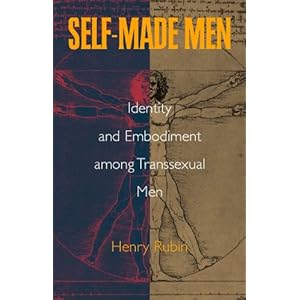
Henry Rubin's Self-Made Men (2003) offers a great look at the issue of embodiment in FTM men - most of the men in his study offered different understandings of why they were born into the wrong bodies - some are creative, some are biological:
Whereas most individuals feel that they have bodies that adequately express their true selves, these FTMs all feel as if their bodies are erroneous expressions of their core selves. Their bodies fail to express their internal male identities. An expressive error occurred, severing the link between their body and their identity. The men in this study describe a variety of possible errors, ranging from the belief that God had made a mistake, to genetic mutations, to chemical imbalances, to underdeveloped or hidden male anatomy. One man believes he was reincarnated in a female body so that he could avoid the draft during the Vietnam War. This occurrence would be fortuitous, but most of the other men are less than thrilled with the mistakes of God or nature. They have always been men, albeit men whose bodies fail to express this to the world. (p. 150-151)
And it must be stated up front that I trust their experience - I do not believe trans people are mentally ill or suffering from gender identity disorder (GID), which I am not convinced is an actual valid diagnosis for anyone. Here is how the DSM-IV-TR defines GID:
DSM-IV-TR Diagnostic Criteria For Gender Identity Disorder

A. A strong and persistent cross-gender identification (not merely a desire for any perceived cultural advantages of being the other sex). In children, the disturbance is manifested by four (or more) of the following:

  1. repeatedly stated desire to be, or insistence that he or she is, the other sex

  2. in boys, preference for cross-dressing or simulating female attire; in girls, insistence on wearing only stereotypical masculine clothing

  3. strong and persistent preferences for cross-sex roles in make-believe play or persistent fantasies of being the other sex

  4. intense desire to participate in the stereotypical games and pastimes of the other sex

  5. strong preference for playmates of the other sex

B. Persistent discomfort with his or her sex or sense of inappropriateness in the gender role of that sex.

C. The disturbance is not concurrent with a physical intersex condition.

D. The disturbance causes clinically significant distress or impairment in social, occupational, or other important areas of functioning.

When the APA membership discussed the continued relevance and use of this diagnosis, members were split - but some would definitely like to see it revised or eliminated.

Katherine Wilson, Ph.D. said that DSM fails to acknowledge that “many healthy, well-adjusted transsexual people exist” or to distinguish between such individuals and those who would benefit from a medical treatment.

She would like to see GID replaced with a term such as gender dysphoria, which would describe someone who is persistently distressed with his or her physical sex characteristics or with the limiting gender-based roles that society often imposes on men and women. (Hausman, 2003)

More importantly, trans people suffer depression, anxiety, and addictions at about the same rate as the general population (an increased prevalence likely arises as a result of the social ostracism and discrimination they experience). When they come to see a therapist, they often are not coming for counseling around gender issues - it is often for all the same reasons other people go to therapy: family, relationships, work, depression, anxiety, substance use, and so on.

So if their experience is not pathological in the usual sense, how do we account for the discrepancy between gender identity and natal physiology? The term gender dysphoria is useful, I suppose, but in the absence of pronounced brain differences between trans and non-trans people (most likely based in genetics or epigenetics), we lack a solid understanding.

The deeper one gets into these men's lives, the more one learns that it really is not even about the penis for many transmen - their breasts are often a source or torment and their experience of menstruation, especially the first time, was traumatic.

Kristen Schilt and Elroi Waszkiewicz (2006) looked at the role of surgeries in transmen in their presentation to the American Sociological Association:
For most of our interviewees, hormone therapy, which gives transmen male secondary sex characteristics like thicker facial and chest hair, and chest reconstruction take priority over phalloplasty. Chest reconstruction involves a double mastectomy to remove the breasts, signifiers of womanhood,(7) and allows for the surgical construction of a male chest. The effects of testosterone, such as beard growth, create a male appearance. Having facial hair, no visible breasts, a low voice, and “men’s clothes” function as “cultural genitalia” for transmen, as they are assumed to have a penis based on their appearance.(8) Thus, even without a “real” penis, transmen can gain a male social identity that lines up with their personal gender identity.
For transwomen, the situation is a bit different - these women report that living with a penis, although they can pass as women in society, prevents them from fully adopting their internal gender identity - for them, the surgery is important.

Setting an Integral Foundation

In the integral psychology model developed by Ken Wilber, the human being grows and develops as a body, as a psyche, as an interpersonal being, and as a member of society. Each of those domains (the It, the I, the We, and the Its) shape the individual and determine her/his identity - and all of this occurs in an interrelated and interconnected manner.

Ken Wilber (Integral Psychology, 2000), explains the interaction of the quadrants with the now familiar phrase (at least it's familiar in integral circles) "tetra-evolve" (also: tetra-arising, tetra-interact, and so on) - the idea is that all quadrants interact in the creation of a holon:
It is not enough to say that organism and environment coevolve; it is not enough to say that culture and consciousness coevolve. All four of those "tetra-evolve" together. That is, the objective organism (the Upper-Right quadrant), with its DNA, its neuronal pathways, its brain systems, and its behavioral paterns, mutually interacts with the objective environment, ecosystems, and social realities (the Lower Right), and all of those do indeed co-evolve. Likewise, individual consciousness (Upper Left), with its intentionality, structures, and states, arises within, and mutually interacts with, the intersubjective culture (Lower Left) in which it finds itself, and which it in turn helps to create, so that these, too, coevolve. But just as important, subjective intentionality and objective behavior mutually interact (e.g., through will and response), and cultural worldviews mutually interact with social structures, as does individual consciousness and behavior. In other words, all four quadrants-organism, environment, consciousness, and culture--cause and are caused by the others: they "tetra-evolve."

(It does not matter "how" this happens; that "how," I am suggesting, is more fully disclosed at the postrational, nondual waves; at this point, it is only necessary to acknowledge that this interaction seems phenomenologically undeniable. Whether you think it is theoretically possible or not, your mind does interact with your body, your mind interacts with its culture, your mind interacts with the physical organism, and your organism interacts with your environment: they all "tetra-interact.") (p. 183-184)
Among those who accept the AQAL model (pronounced "aw kwal" - all quadrants, all levels, all lines, all states, and all types), this notion of tetra-evolving is taken as foundational. It is one of the primary assumptions upon which the whole model is built - to call it into question brings whole elements of the model into question.

Wilber goes as far as to say this tetra-evolution of the quadrants is essentially obvious: "this interaction seems phenomenologically undeniable." But is it undeniable? If we can't find an explanation that allows for the transsexuality in a non-pathologized manner, then we must question the extent to which body and psyche are inextricably linked.

So then how do we fit trans people into the model?

Trans men and women grow up with the awareness that they were born in the wrong body. In fact, trans people do not feel that they are transforming, for them its a transition:
Their goal is simply to become recognizable. Who they are at heart does not change during transition. Notice that they use the term "transition" rather than "transformation." Although they do have to make a social and physical changeover from one sex to another, they are not transforming, like caterpillars becoming butterflies. They are not changing their personality, only the physical package that houses the person inside the flesh. They are not transforming themselves from women into men. They are repairing the link between their bodies and their gender identity. (Rubin, 2003, p. 143-144)
From their experience and perspective, their body is all wrong for who they are as a gendered person. They would seriously question this assumed linkage that Wilber feels is unquestioned in its obviousness. I would suspect that intersex and other transgender people might also offer resistance to the idea that the body inherently shapes identity, especially gender identity.

The great gift of postmodern and poststructural views of gender identity is that these models break the 1:1 link between genitals and gender identity. The social construction model argues that (1) gender is constructed by each individual, (2) that it is based on conscious or unconscious acceptance or rejection of cultural norms (hegemonic masculinity, for example), and (3) that gender identity is not always equivalent to biological sex identity.

The flaw, for me, is that there is considerable evidence of the ways in which biology and brain structure impact our notions of male or female. The social construction approach tends to minimize or reject this research - but an integral approach cannot make that exception. We must find a way to account for the body in trans identity development.

I am going to propose a rather radical solution to this problem - but I am at a loss as to how to describe this phenomenon without pathologizing it - I can't offer the how or the why, only an attempt at explaining the what.

Subtle Bodies and Gross bodies

In 2003, Wilber posted a series of excerpts from what was to be (before his illness) part of the Kosmos Trilogy begun with Sex, Ecology, Spirituality - one of those postings was Excerpt G: Toward A Comprehensive Theory of Subtle Energies (Shambhala Publications website).

If you choose to read that article/excerpt, please keep in mind that Wilber comes from a Buddhist background, as well as transpersonal psychology, and association with various "nondual" gurus (some toxic, some not). Because of his own contemplative experience and due to the teachings he has received, Wilber accepts ideas about subtle and causal bodies with (it seems to me) little intellectual questioning.

He has talked frequently over the years about the three bodies - gross body (physical matter, the "outside" body), subtle body (contains - or can contain - the 3 levels of emotional, mental, and higher mental), and causal body (contains an overmental consciousness [Aurobindo's overmind], and is also the source for involution of archetypes - see Plotinus).

I've never entirely bought into this notion (it always felt metaphorical to me, even though I feel I can sometimes "read" bodies, which is probably picking up on the subtle body) - while there is considerable overlap on these ideas in the writings of various mystics coming from all of the major wisdom traditions, there has not been anything empirical for me to wrap my brain around.

Until now.

As I was thinking about the topic of trans identity and the lack of "fit" in their birth bodies, I decided to look back at Thomas Metzinger's The Ego Tunnel (2009). He had written extensively on out-of-body-experiences (OBEs) in that book, which he uses as a foundation for his self-model theory of subjectivity.

He lists ownership, agency, and location at three of the defining elements of "me-ness" in most people. While these and other qualities are important, he feels it has become increasingly obvious that . . .
ownership is closest to the core of our target property of self hood. Nevertheless, the experience of being an embodied self is a holistic construct, characterized by part-whole relationships and stemming from many different sources.[5] Phenomenal ownership is not only at the heart of conscious self experience; it also has unconscious precursors. Classical neurology hypothesized about a body schema, an unconscious but constantly updated brain map of limb positions, body shape, and posture.[6] (p. 78)
Ownership would seem to be a hard word for those who feel almost betrayed by their birth bodies. Interestingly, however, in finding a way out of the "location" issue so as to explain OBEs, he may have also given us a solution to the embodiment problem in integral self theory.

Metzinger offers a brief history subtle body thinking to create an intellectual, philosophical, and theoretical foundation for his idea OBEs - here is his list:
Examples are the Hebrew ruach, the Arabic ruh, the Latin spiritus, the Greek pneuma, and the Indian prana. The subtle body is a spatially extended entity that was said to keep the physical body alive and leave it after death.[14] It is also known in theosophy and in other spiritual traditions; for instance, as "the resurrection body" and "the glorified body" in Christianity, "the most sacred body" and "supracelestial body" in Sufism, "the diamond body" in Taoism and Vajrayana, "the light body" or "rainbow body" in Tibetan Buddhism. (p. 86)
He suggests that the idea of the subtle body may be the origin of our modern conception of the soul. More importantly to our work here, however, he tries to ground the idea of the subtle body in contemporary neurobiology (specifically body schemas).
My theory—the self-model theory of subjectivity—says that this subtle body does indeed exist, but it is not made of "angel stuff" or "astral matter:' It is made of pure information, flowing in the brain.[15] Of course, the "flow of information" is just another metaphor, but the information processing level of description is the best we have at this stage of research. It creates empirically testable hypotheses, and it allows us to see things we could not see before. The subtle body is the brain's self-model, and scientific research on the OBE shows this in a particularly striking way. (p. 86)
It's not too challenging to see Metzinger's model and Wilber's model as highly similar, at least as far as a general view is concerned.

For Metzinger, the subtle body is information, the brain's self-model; this is not all that different from Wilber's subtle body containing emotional, mental, and higher mental aspects of self.

Antonio Damasio offers a neurobiological model that can possibly account for this subtle body - and we leave the causal body to Wilber and the esoteric traditions.

In each of his last several books, Damasio has been refining his brain-based model of the self, most recently in Self Comes to Mind (2010). Arguing that the origin of the self and self-consciousness is in the upper brain stem and surrounding region, he posits a proto self, an organized and coherent, though temporary neural mapping of sensation and "primordial" feeling; a core self, a kind of stream of conscious that is modified whenever an object or experience "modifies" the proto self; and an autobiographical self that possesses knowledge of past (memory) and future planning. This third stage is social and spiritual in its construction and not directly connected to brain circuitry in the same way as the earlier stages.

Again, this autobiographical self is similar to Metzinger's and Wilber's versions of the subtle body - and he does a better job of explaining its origins than either Metzinger or Wilber.

So we have the gross physical body - the sexed body - and the subtle body that contains or holds our sense of self.

So is it possible that when these two do not match in terms of sex identity (female body, male self identity, or some other incongruous combination) that we have a transgendered person? Is this the child who grows up to be transsexual?

I think this may be an integrally-oriented explanation. And of course, how this dissonance is lived out will depend wholly on the developmental stage of the individual in question.
  • A mythic-authoritarian stage person, one who is religious, would likely not be able to face or "embody" the lived conflict between body and self.
  • A rational, self-expressive person might simply see gender reassignment surgery as the only obvious option.
  • A relativistic, communally oriented person might see variety of options from (assuming he has a female body) living as a butch female, living as a male with no surgeries, take testosterone, taking T and having chest reconstruction, all the way up to phalloplasty.
There is still much to think about around this topic - but I want to think out loud and maybe get thoughts from people who think I am off the deep end or on the right track or somewhere in between.

Stay tuned.

References:
  • Damasio, A. (2010). Self comes to mind: Constructing the conscious brain. NY: Pantheon Books.
  • Hausman, K. (2003, July 17). Controversy continues to grow over DSM’s GID diagnosis. Psychiatric News, vol. 38, no. 14: 25-32.
  • Metzinger, T. (2009). The ego tunnel: The science of the mind and the myth of the self. NY: Basic Books.
  • Rubin, H. (2003). Self-made men: Identity, embodiment, and recognition. Nashville, TN Vanderbilt University Press.
  • Schilt, K. R. & Waszkiewicz, E. (2006, Aug. 10). I feel so much more in my body: Challenging the significance of the penis in transsexual men’s bodies. Paper presented at the annual meeting of the American Sociological Association, Montreal Convention Center, Montreal, Quebec, Canada. Accessed online: 2011-03-13 from http://www.allacademic.com/meta/p104747_index.html.
  • Wilber, K. (2000). Integral psychology: Consciousness, spirit, psychology, therapy. Boston: Shambhala Publications, Inc.
  • Wilber, K. (2003). Excerpt G: Toward a comprehensive theory of subtle energies. (Shambhala Publications website).

Sunday, February 20, 2011

Self-Made Men - FTM Identity and the Body

Henry Rubin's book, Self Made Men, is an excellent overview of the perspective and experience of Transmen - based on his qualitative interviews and an excellent background history of how our understanding of the transgender/transsexual person.

These are some long excerpts from a single chapter on the body and how it can feel completely alien to one's sense of identity.

This poses some serious issues to concepts of embodied consciousness (here, embodied, literally "in the body," includes the brain) - it is assumed by many philosophers and neuroscientists in the "embodiment" camp that much of who and what we understand ourselves to be is shaped by our embodied experience. The experience of transgendered people counters this position bhy demonstrating that it is entirely possible to have a sense of self and identity that is exactly opposite of the body in which one is born.

So unless we one day find a genetic component to identity, separate from body, we have to accept one of two options: (1) transgenderism is a mental illness of some type (which I do NOT believe is true), or (2) our current models of embodiment and socially constructed gender identity are inadequate or incomplete.

There is still so much we do not understand about who we are as human beings - but a book like this goes a long way toward helping us sort out parts of the mystery.

Self Made Men: Identity, Embodiment, and Recognition Among Transsexual Men, by Henry Rubin.
Chapter 3: Betrayed by Bodies
• Ed: There's the difference—there's tons of butch dykes who could so far tell you almost the exact same story. I finally decided what it is. Its that butch dykes are comfortable enough with female parts and FTMs cannot have that. They would rather die or do something drastic or get help.
In these comments, Ed makes a distinction between himself and butch women based on the specific discomfort he experiences with his female body. Like other FTMs in this study, Ed explains that there are real and empirical differences between FTMs and lesbians—these differences are historically constant and positive. From their perspective, the experiences of comfort or discomfort with one's body, especially one's gendered parts, differentiate these identities.

Ed assumes that even very butch women are more comfortable in their bodies than he is in his. Some butches, especially those who came out before the lesbian-feminist revolution, contest this assumption. Anthropologists like Gayle Rubin and Esther Newton suggest that butches share many predilections and dilemmas with FTMs, including a preference for male names, pronouns, and clothes including undergarments; great discomfort with their bodies; and related difficulties
in their sexual lives.' These scholars theorize a continuum between FTMs and butches. In this usage, "butch" is a noun.

Against this continuum thesis, most of the FTMs in this study see themselves as distinctly different from butches. They signify this by calling lesbians "butch women." In their lexicon, "butch" is an adjective that modifies the noun "woman." Ed hesitates when telling me that he "finally decided what it is" that distinguishes him from butch women. It has taken him some time to come up with something that he feels answers the question with certainty. Ed's criterion is the one most FTMs in this study prefer: the tension he felt between his body image and his material body. His male body image came into conflict with his anatomy and with how others interacted with him It is not enough for him to pass as a man in the world or be able to do the things that men do. Ed locates the difference between himself and other females, especially butch women, in his body.

FTM difference claims are unsurprising if we consider them in light of the history of chapters one and two. By articulating a difference between themselves and lesbians, these FTMs are drawing on a discourse that has successfully obtained desired medical procedures in the past. FTMs today make these same claims though it is less difficult to convince physicians to treat them. These claims about their bodies are, therefore, not just means for dealing with physicians; they also provide meaning to their enigmatic lives. Each FTM in this study felt a need to construct a biography that legitimates his seemingly strange life choice. That choice has to make sense to him as the only rational thing to do in such circumstances.

The history of becoming treatable bodies is echoed in the words of the FTMs who speak here about their bodies during childhood and adolescence. Their comments reveal their experiences of betrayal by their bodies. They also demonstrate how their perception of difference from lesbian women establishes them as treatable subjects. FTMs frame adolescence as a persistent conflict between their male body images and their feminizing material bodies. This tension between body image and material body points to the general importance of bodies to a sense of self.

FTMs describe adolescence as an extraordinarily difficult time of life when they risked and often lost their senses of themselves. They divide their lives into two halves: a "before" and "after" puberty. After puberty, as the process of sexual development took over their bodies, they felt simultaneously disembodied and acutely aware of their bodies. They become, in the words of one FTM, "social zeros."

In adolescence, these men used their experiences of disembodied awareness to reinforce their sense of difference from others with female bodies. This difference helped them consolidate their identities as (transsexual) men. They claim that their experiences of puberty were uniquely different, either quantitatively more painful or qualitatively different in kind, than that of most other adolescents. By positing that difference in their changing bodies, they provide a logical reason for modifying those bodies.

Although some may suggest that such difference claims are not empirically valid and that all teens experience this kind of distress, the experience and the claims of such difference are what is important here. Whether this difference can be proven empirically is less important in this context. The experience of difference is one way that these men determined the direction, and interpret the meaning, of their lives. By anchoring this difference in their bodies, as Ed does in the quote that opened this chapter, they could legitimate their transitions from female to male.

Body and Self
Jake: After I got [breasts], and in order to fight off the glances of the boys, I made myself as invisible as I could, which is why I never made friends in school. I totally became a nothing almost. It really angered me if the boys gave attention to me because I know they weren't giving it to me.

Henry: What were they giving it to?

Jake: The breasts. [laughs] Or some illusion or this new outfit. A physical outfit. This thing that glued on me. It was no longer me the way I liked it and it's not the way I wanted it.
All of the confusion, fear, and wonderment of puberty was complicated for Jake, as it was for other FTMs, by the secret knowledge that he was not a girl or a woman Jake, a gay man who has always been attracted to males, characterized his adolescence as lonely, mostly due to his lack of place within the gendered world of junior high and high school. He became a "nothing." Jake looks back on the new sexual attention he received from his pals with frustration, not pleasure, because the boys no longer recognized him as one of them. As his body developed the cultural signs of womanhood, he became increasingly aware that he identified as a boy on the verge of manhood. He was not the only female-bodied person to grow uncomfortable with the sexual attention given to breasts, but Jake found this attention difficult to receive because it meant that he was no longer able to socialize with others on his own terms. The problem, he says, was not exactly that he was treated as a sex object by his neighborhood chums. Instead, it was his sense of complete misrecognition based on physical cues that are culturally identified with womanhood.

For Jake and for most of the guys in this study, puberty marked the first significant "before" and "after" of their young lives. Before puberty, while their bodies still cooperated with their identities, they were able to convince themselves and others that they were, or at least were like, boys. As their bodies began to look significantly different from other boys, they had more and more difficulty being recognized for their true male selves. It became increasingly difficult to sustain a male identity as their bodies began to resemble the bodies of adult women. Breasts made it impossible to deny that they were female-bodied.

Before puberty, when their bodies were unencumbered with breasts, they were able to ignore, hide, or minimize the few physical signs, like genitalia, that marked them as female. Relative to adolescent bodies, the bodies of children are less identifiably sexed. Girls' and boys' bodies are more similar than the pubescent or fully developed bodies of women and men. This is especially true with regard to breasts, which are the most visibly gendered features of the mature human body. This relative lack of sex markings on the bodies of children made it possible for the FTMs to see themselves as boys.

Many of the participants say that before puberty they simply knew that they were boys. Others remember only a persistent sense of difference that had no name. While the former group was clearly beyond the borders of normal female-bodied subjectivity, this latter group remained just on the border of the socially prescribed roles for girls in Western culture. As youths, many of them inhabited the ambivalent position of tomboys? Texas Tomboy appropriated that moniker when he got older, but it had always been a part of who he was.
I liked being referred to as a tomboy growing up. But I always played with the boys and rode BMX and built ramps and I was the only girl in my neighborhood that liked to play like that. I remember wishing I could wear boy's underwear. I would be really persistent. I don't know what my arguments at seven years old were, but I got my way.
Texas is still persistent. He is a video artist, a part-time hustler, and a short guy who "always exceeded people's expectations ... with strength and intelligence." Texas's attitude represents one FTM's response to being called a tomboy. For him and those who responded similarly to the term, "tomboy" was an adequate label for who they were and what they liked to do in their childhood. For a short time, it gave them a place in the social order. They were different from most girls, but their sense of that difference could be explained in the deviant identity of the tomboy.

The tomboy identity comes with an implicit normative expectations that the child will grow out of it. Tomboys who do not grow out of their tomboy preferences are stigmatized. Many female-bodied individuals do grow out of their tomboy stages and become unproblematically identified as feminine women. In addition, women athletes are more acceptable today, so even very athletic females are tolerated. Other tomboys grow up to identify as gay women or lesbians. Some FTMs called themselves tomboys until it became apparent that they were expected to grow out of it.

Other men in this study immediately grasped the normative assumptions behind the minimal tolerance granted to tomboys, knew that their experiences were more than a phase, and felt patronized by the tomboy label. They understood that a tomboy is a girl who is like a boy, whereas they knew themselves to be boys. Jack and Wolfie both express their dissatisfaction with the tomboy label. They each feel that the tomboy label undermined their sense of difference from girls and trivialized their sense of themselves.
Jack: I wasn't a tomboy. I was a boy. I would rather just be called a girl than to be called a tomboy. Because that's totally dismissing. That's acknowledging what I'm doing, but saying it's a phase and I'm going to grow out of it.

Wolfie: I was very conscious of patronizing attitudes towards children and that was one part of it. A tomboy is like a "boyette."
These men were more isolated almost from the beginning of their lives. Their way of being in the world was completely unrecognizable to others. They resisted the tomboy label because they did not want to be mistaken for girls, but by refusing this label, they completely cut themselves off from the social order.

The non-tomboy FTMs classify FTM tomboys as "secondary transsexuals," whereas they see themselves as "primary transsexuals." For this group, the early recognition that they were not girls of any sort is an unequivocal sign of transsexual identification. (Likewise, the FTMs who never had lesbian careers think of themselves as "primary" and those with lesbian careers as "secondary" transsexuals.) The nontomboys express an absolute discomfort with their female bodies. The tomboys struggle longer to become certain that they are men. Another small group in this study was not tomboy-identified and was more comfortable doing activities that the culture associates with girls, such as doll play and house play. Looking back, these men identify with other "sissy boys" and feel sure that many of their childhood and adolescent boyfriends and pals turned out to be gay men like themselves.

Under the cover of heterosexual normativity, their behavior as "sissy boys" looked like normal femininity to others. This "normal" female behavior did not mean, however, that they were girls, at least not in their own minds. They report that they felt like they were boys growing up, but they were not interested in culturally hegemonic activities of "normal" boys.

Before puberty, the guys had disregarded or actively ignored what few markings indicated the sex of their bodies and identified themselves in one of three ways: (1) they were boys (with bodies that approximated the bodies of other boys) who liked to do typically boy activities, (2) they were tomboys who felt a distinct, yet not quite definable, difference from others with female bodies, or (3) they were boys who, because of their preference for activities associated with girls, evoked little suspicion from others although they knew themselves to be different from girls. The first group was more stigmatized than the other two and suffered deeper social consequences for their refusal to conform to the identities their bodies were assigning them. The second group had a temporary place in the cultural landscape of childhood, but it was a place that eventually evaporated as they matured. Finally, a twist of cultural logic gave the men in the third group a hiding place that aroused few suspicions, but made their path after puberty particularly misunderstood by others—if "she" liked doing "girly" activities and preferred men as sexual partners, why change "her" sex?

Once their bodies developed female features, all of them were forced to realize that they were unlike the boys they had considered their natural cohorts. The bodies they inhabited disfigured their essential male selves.' They were faced with a choice of maintaining their male identities at great risk of social stigma or "going underground" and playing the role dictated by their female bodies. After puberty, the social difficulties they had experienced increased exponentially as their bodies changed from relatively ungendered and asexual into female bodies. Three things—menarche, breast development, and hair growth—made them physically uncomfortable and socially alienated.
For most - if not all - of these men, the onset on menses (menarche) was one of the most disturbing and traumatic experiences of their young lives. Their once simple and mostly androgynous bodies (of which they experienced very limited awareness) suddenly betrayed them and revealed its dissonance with who they experienced as their self.

Often for the first time, they knew without doubt (and this generally coincides with the emergence of breasts) that they had the wrong body - that they were boys in a girl's body and it felt horribly wrong.
Menarche

Most female-bodied people can point to the onset of menses as a physical threshold that marks one as a grown woman. The capacity to fulfill the childbearing role remains the physical and hegemonic criterion for adult womanhood. For FTMs like Ed, this benchmark of adult female status was greeted with gritted teeth.
I remember the next day going to school and telling someone and this girl was like, "Isn't it great?" and I'm worried about it and I felt very ashamed that I was not happy at all.
Ed wants to distinguish himself from the typical transsexual portrayed on television talk shows, describing himself as "any other long-haired, some facial hair, black T-shirt guy." In the story that he tells of his first menstruation, he emphasizes the difference between his female friend's response and his own. This difference is one piece of evidence that Ed assembles to legitimate his male identity.

Shadow was born in South Dakota, which is the home of the Santee Sioux and the Lakota Sioux Native American tribes. He was given his name in a ritual by a Native American man, an older friend, because it captured the sense that he was a part of both the light and the dark. As he grew up and assumed this name, he began to frame his shadowy existence as a conflict between his body image and his material body.
My belief about my process growing up is that what I was going through during puberty was estrogen poisoning. I will swear by that now that I've started the testosterone. The way I functioned in life was taken from a point of anger. In my early twenties the violent rages were frequent. I'd say like once a month. Imagine that. [laughs]
This is an emphatic statement of the difference between a young girl who is approaching maturity with ordinary discomfort and a transsexual man as he endures his menstrual cycle.

Like several of the guys in this study, Shadow ties his body alienation to his angry and violent youth. For him, the body became his "first clue" in his search for a way to make sense of his dilemma Most of the other men understand this kind of anger as a social reaction to a difficult situation, but Shadow believes that estrogen poisoning caused his violent outbursts. Shadow's story of estrogen poisoning counters to the hegemonic cultural belief that testosterone is the likeliest cause of male rage. He does not claim that estrogens, in and of themselves, are poisonous. Rather, he explains his rage as an incompatibility between his body image and his female endocrinology. Shadow recalls visiting doctors and becoming frustrated with their inability to fix the problem.
Going to different doctors and [hearing], "Sorry dear, you're a healthy, young female. Just growing up. This'll pass. It's just what women have to go through." Bullshit! I don't care what you say, this is not normal. Then my other female friends are going through this. I knew there was something different going on.
Like the others, Shadow also used the experiences of the girls around him to sharpen his own self-understanding. These guys went through the normal body changes that are part of female adolescence.(4) However, they insist that their responses went far beyond ordinary teenage angst from the rapid and uncontrollable physical changes Texas describes it as "a tragedy." James recalls becoming embarrassed of the body he had previously loved because "it could do great things." Francis remembers a loss of self-confidence, crying a lot, and becoming acutely self-conscious. Dani calls it "a shocking experience ... mind-boggling." For many of the FTMs in this study, the experience of starting to menstruate brought on intense shame and embarrassment. Several of them, like Julian, say that their shame resulted in an extended silence that isolated them.
It felt like something so private and so humiliating and so shameful and I already was very private and secretive. Not for a second did it occur to me to go tell the gym teacher, certainly not my mother, certainly not a peer ... I don't even know if I could've said the word at that time. I don't know if I could've even said "period."
Not telling anyone about their first periods and not using sex-specific language to refer to themselves were last-ditch attempts to maintain their bodies as they were "before." By choosing to conceal the start of menses, these female-bodied people willfully refused to situate themselves linguistically as women. Partly as a reaction of disgust and shame, partly as a strategy of resignifying the material body, these men took care not to acknowledge their material bodies.

Their unwillingness to use language that refers to female bodies and female processes demonstrates the extent of their discomfort. One important strategy they deploy for preserving their sense of self is the use of euphemistic and indeterminate language to specify body parts that are abhorrent to them. They almost always use articles, rather than possessive pronouns, to refer to their female body parts. These body parts have become independent agents acting in defiance of the disembodied self. Such threats are linguistically neutralized and effaced via grammar.
There are many more stories in the book about how "The initial arrival of that "dreaded visitor" made other guys aware, sometimes for the first time in their lives, that they were not the boys they thought they were" (p. 102). The experience was sometimes overwhelming:
If menstruation stands out as the mark of womanhood, then it comes as no surprise that these men regarded it with suspicion, hostility, anxiety, and frustration. Some stubbornly refused to allow the material body to define them. For many others, this foreign body convinced them to try to live for a time as women. Those who attempted to do so claim that they were unable to perform femininity adequately and suffered through long periods of depression. Some report an inability to recall whole segments of their lives, suggesting that they withdrew from the world in order to preserve their identities. Several say that they chose to isolate themselves from others as a way of asserting themselves and preventing others from treating them in ways that offended their sense of self.
The arrival of breasts, being a visible marker of their alien bodies, posed its own set of difficulties, shame, and fear - some refer to their "treacherous bodies."
Breasts
James: I was embarrassed by my breasts. I tried to cover them up a lot. My posture was bad as a result. It was just difficult sometimes to acknowledge my body.
A writer and an executive, James tells me that he transitioned so that he could finally grow up. James's anguish came from the difficulty he had seeing himself in a body with breasts. Some FTMs on the brink of transition prioritize their breasts as the most important aspect of their appearance that they would change The chest is the body part most likely to block them from living full lives. It inhibits them from living full-time as men and causes the most discomfort when they look in the mirror Some start binding breasts from their first appearance and others take up the practice as they age and become more distraught. The men bind the breasts down using everything from control-top nylons with the legs cut out to ace bandages, even duct tape and specially made jerseys. A few choose not to bind because it is too ungainly or too hard to breathe. Another strategy for minimizing the conflict between the body image and the material body is to wear two or more shirts, even on the hottest of days.

By some accounts, breast size could be a relevant factor in determining who can live with their female parts and who cannot. Others said that site made little difference to them. The simple fact of the existence of the breasts was unbearable to most of the men in this study. During adolescence, Texas recalls, he had such a strong antipathy to the mere idea of the breasts that he believes he influenced his development.
My mom told me because she had really huge breasts in high school that I would, too. I really feel like I willed them away. I really didn't want that. I don't know, it was really hard. I really didn't like going through puberty at all. [close to tears]
Others, like Francis, who never developed or who developed later, report wanting breasts and being envious of the larger girls around them. Their typical explanation for this contradictory desire was a wish to be "normal." Having breasts would confirm their femaleness and magically eliminate those "abnormal" thoughts about being a guy. These guys seem to feel that their wishes backfired, and at least one man suggests that all that wishing got stored up in his body, eventually producing large breasts. These wishful refusals provided the strength to sustain a transsexual man's sense of his essential self while his body was betraying him As with menstruation, the FTMs felt that their responses to the development of breasts were anomalous compared to the experiences of the young women who were assumed to be their cohorts.

This perceived difference contributed to their isolation. Jack recalls the feeling of not being accepted for who he was.
They loved to have someone to pick on and I happened to be that person. Thank God for my mother. Every once in awhile I'd go, "I just don't want to go to school today." "Okay." It was so horrible. You act like a boy, you isolate yourself from the whole world. Boys don't accept you and girls don't accept you. They'd often walk by in theirgroups and yell stuff. A lot of things were, "You're so ugly" and being picked last at gym. Or nobody would call me. That's just the worst feeling in the whole world.
By falling in line, these guys could reduce the stigma that they faced, though at a huge cost to their subjective sense of self. Wolfie, like many in this study, expresses the feeling that he was faced with a choice between staying committed to his body image and subjectivity but being alone, or capitulating to social pressures and the materialist compulsion to become the woman that his body dictated he should be.
Either you have a chance at a relationship with somebody and go along with whatever the prevailing dress and behavioral ideal is or you don't. Sort of a choice between being uncomfortable in yourself or having other people make you feel uncomfortable.
Either way, they feel that adolescence brought on these choices because of the changes in their material bodies that failed to represent their subjectivity adequately.

Several men tell stories that narrate their resistance to their treacherous bodies or the social conventions associated with those bodies. John recalls:
My mom went into the section, I kept wandering off. She kept dragging me back there. The saleslady comes up and she's like, "Raise your arms up." I said "no" three times; finally I did 'cause I decided I'd let mom buy it and I'd never wear it. I actually wore it to school the day of the test and watched all the other girls take their shirts off and took a good look [laughs] and then refused. I never got the scoliosis test. I got in trouble. That's the only time that thing ever touched my body. Ever.
John refuses even now to concede that he went into a lingerie department. He will say "the section," but a heterosexual man in his social location would not say he had been in a store looking at women's underwear with his mother. He refused the saleswoman's attempts to put the garment on his body three times. Conceding to take it home was a passive move that allowed him to defer wearing it. The single time that he wore a bra became an adolescent locker-room escapade, a covert kind of panty-raid that allowed John to exercise his heterosexual, masculine desires for the girls in his cohort. Instead of a story of joy at this event, or even a certain modest embarrassment that a non-transsexual child might express, John's tells of maintaining his male gender identity despite outside attempts to discipline his body. In fact, the heterosexual masculinity of this story helps him to consolidate his gender identity.
Here is one final passage from what was one of the most illuminating chapters in the book. So much or our sense of identity is embodied - when the body does not match our perception of who we are, the psychological dissonance can be frustrating, uncomfortable, and cause terrible suffering.
These experiences confirm the idea that we have a body image, an embodied sense of our selves that may not coincide with the material body itself. "Agnosia" is the term used by phenomenologist Merleau-Ponty to designate the condition of a reverse "phantom limb." Agnosia is "the nonrecognition of a body part that should occupy a position within the body image" (Grosz 1994, 89). FTMs become disembodied selves who refuse to recognize their breasts. Transsexual men perpetually monitor their breasts because their flesh does not coincide with their body image Agnosia, in this sense, is an assertion of a self rather than a delusional condition.

After having had their chests reconstructed, many of the guys report that they could not remember what their bodies looked or felt like before the procedure. They say that this effect occurs within weeks of the surgery. This observation shows that their bodies now conform to their body image and their sense of self.' No longer agnosic, FTMs in this study feel as if they are now "tuned into one station." The alignment of body image and material body restores, to some degree, the carefree embodiment that characterized their youth.

A few of the guys noted that their disembodied awareness shifted after chest reconstruction to other, less obviously gendered body parts like hips and buttocks, as they began to be able to inhabit the upper halves of their bodies. Some report an increased desire for penis reconstruction after their chest surgeries, or increased frustration with the limitations of phalloplasty and other surgeries for penis reconstruction. These desires and frustrations indicate that the physical body remains, to some degree, out of sync with the body image and that a disembodied awareness may continue to structure their lives.
I highly recommend this book.