Showing posts with label mistakes. Show all posts

Monday, March 4, 2013

Art of Manliness - The Importance of Owning Up to Mistakes

This is an excellent post from Brett and Kate McKay at The Art of Manliness on the importance of admitting our mistakes and how to do it. One of the best ways in the world to strengthen a relationship, in my opinion, whether it's friendship or romantic, is to be able to say, "I was wrong. I'm sorry."

Quoting Tavris and Aronson (authors of Mistakes Were Made (But Not by Me): Why We Justify Foolish Beliefs, Bad Decisions, and Hurtful Acts), they conclude we must, “learn to see mistakes not as terrible personal failings to be denied or justified, but as inevitable aspects of life that help us grow, and grow up.” Sounds right to me.

Here is the first half of the article, follow the links to see the "how to" portion on taking responsibility for our mistakes.

Personal Responsibility 102: The Importance of Owning Up to Your Mistakes and How to Do It

by BRETT and KATE MCKAY on FEBRUARY 19, 2013


Yesterday we discussed the cognitive blind spots our brains generate that can make it difficult for us to honestly assess our actions and determine our responsibility for those actions and their consequences. We discovered the way in which our brains are inclined to flatter and shield our egos from blame when we make mistakes.

Despite how difficult it is to counter the mechanisms of our ego defense system, the task is not wholly insurmountable. Every man who wishes to take on the mantle of manhood must make the effort. In doing so, you will find that striving to take responsibility for your life and ownership of your mistakes is incredibly worthwhile for many reasons:

Allows you to make better decisions. Self-justifications distort reality. The more you use them, the more you create an alternate universe for yourself. This leads to a decreased ability to make good choices, as the information you’re using to do so is warped. This can keep you from the people and pursuits that could have been good for you – if only you had been able to see them clearly for what they were. For example, that professor who was “out to get you” might have become an incredible mentor, if you had seen his criticism as a desire to help, rather than an attack.

Most dangerously, one self-justification begets another, setting off a domino effect that sends you more and more off track. Once you justify one decision, you’re deeper into it, and to get rid the dissonance you’ll feel worrying if was the right choice, you’ll make a decision that digs you even further into it. And the cycle continues. For example if you bully a kid at school, you’ll then feel some dissonance in the aftermath for hurting someone (no one likes to think of themselves as cruel), so you’ll justify that decision by saying the kid is an annoying crybaby who deserved it. The more you dwell on those justifications, the more convinced of them you’ll become, and the more you’ll feel like bullying him again.

Keeps little problems from turning into big ones. Related to the point above, if you can own up to a mistake as soon as you make it and do your best to correct it or make it right, you can prevent it from turning into a huge problem that’s going to be difficult to solve. A snowballed mistake may torpedo various aspects of your relationships and career before you can get yourself out from under it.

Allows you to learn from your mistakes. Simple — you can’t learn from your mistakes if you can’t acknowledge you’ve made them! And if you don’t learn from your mistakes, you’re destined to repeat them. That’s a recipe for quickly going nowhere in life.

Engenders the respect of others. We often hide our mistakes from other people because we worry they will think less of us once they’ve seen that we’ve messed up. But, frankly acknowledging your mistakes, apologizing for them, and then earnestly working to make things right almost always has the opposite effect – people respect you for it. There might still be consequences, of course, but people will appreciate your honesty. If they use your confession as a way to belittle and use you, those are probably not the kind of people you want to work/live with anyway. It’s actually when you hide your mistakes, and they’re found out anyway, that people lose their respect and their trust in you.

Strengthens relationships. Self-justification is a cold, hard relationship killer, as it causes us to build a case of total blame against the other person when things are going poorly between you.

There are two ways to explain mistakes: the person did what they did because of the situation, or, because of who they are. We use the former explanation with ourselves — “I forgot her birthday because I have so much on my mind right now.” We tend to use the second explanation on others — “She forgot my birthday because she’s so self-centered.” We don’t critique theirbehavior, but their character – they don’t do bad stuff, they are bad. This kind of blanket condemnation is called a global label. The person is stupid, crazy, useless, selfish, immature, bitchy, evil, lazy, etc. They’re a failed human being.

Global labels are almost never accurate, but your brain finds them very satisfying to develop and spew. They allow you to see your partner as deliberately hurting you — as intentionally sinking the relationship. It’s their fault, and you’re the victim, so you feel entitled to punish and attack them.

Once you give someone a global label – “She’s self-centered” – you focus on gathering evidence to confirm your conclusion, and overlook all evidence to the contrary. Velcro and Teflon. You keep mulling over how she forgot your birthday, but don’t think about how just yesterday she canceled plans with her friends to stay home and help you finish a paper. As you strengthen your “case” against her, you’re filled with self-righteous indignation, which allows you to go on the attack. Then, when you see you’ve hurt her, dissonance arises (again nobody likes to think of themselves as mean or heartless), so you gather more evidence to justify your attacks as well-deserved. And on it goes. When the global label becomes firmly entrenched, you come to see the person as hopelessly flawed and unable to change (“You’re just like your father!”), which leads to you feeling contempt for them, one of the death knells of a relationship.

Conversely, being able to admit fault, being able to acknowledge one’s role in the current health of the relationship, and having empathy for why your partner might do what she does from time to time without being hopelessly flawed (just like you!), leads to strong, healthy relationships.

The Bottom Line: Owning up to our mistakes allows us to take responsibility for our lives. If we can’t accurately perceive who we are, how we behave (and how others behave towards us), and how our behavior affects others and our own lives, life will always feel like something that’s happening to us, rather than something we are in control of. Men with an internal locus of control – those who believe they can shape life through their own decisions and actions — are more confident, more likely to seek learning and be leaders, more disciplined, and better able to deal with stress and challenges. Men with an external locus of control, on the other hand, believe the course of their life is determined by luck and other people, and see themselves as victims. They are prone to problems with both their physical and mental health, and often plagued by stress, anxiety, and depression. When they make mistakes, they are apt to think, “Why is this happening to me?”

Men with an internal locus of control are achievement-oriented and more likely to find academic and professional success. Instead of remaining in a childish mindset, they grow into mature manhood. Instead of seeing themselves as the victim and blaming others for their failures, they learn from their mistakes and use them as stepping stones to getting stronger and moving ahead.

Read the second half of this article.

Thursday, December 1, 2011

A Real Man Admits His Mistakes and Apologizes


Deepak Chopra and Richard Dawkins have had an on-going difference of opinion over the years. For those who are not aware, Dawkins is a staunch biologist and atheist, while Chopra is an Ayurvedic doctor and believes consciousness is a fundamental force in the universe.

Apparently, Chopra had said some harsh things about Dawkins, taking Dawkins' criticisms as a personal attack and responding as a child (Chopra's assessment). There is a little history of this over at Patheos.

But unlike most public figures, Chopra apologized. I am not a fan of his work or his thinking, but I am hugely supportive of men (and all people, for that matter) who admit when they are wrong and offer an apology.

I think there has been a tendency is some traditional models of masculinity to believe admitting mistakes and apologizing is somehow weak and unmanly. That is a load of BS - it takes a lot strength and courage (two valuable traits in masculinity) to publicly admit when one is wrong.

A Public Apology to Dr Richard Dawkins


Monday, April 18, 2011

We Must Own Our Mistakes - And Face the Consequences with Strength

http://lawofhollywoodland.files.wordpress.com/2009/04/prison-break-lane-garrison-dui1.jpg%3Fw%3D300

One of my clients told me about this Today Show segment with a former star of the TV series Prison Break, Lane Garrison. In less than 30 minutes (in 2006) he made a series of mistakes that cost a teen boy his life and landed Garrison in jail for 40 months - after he pleaded guilty to all changes against him.

He did a horrible thing - and a family lost their son. As Garrison admits, he deserved the jail time. But while most kids his age (he was 26) would have fought the charges and tried to plead them down, he stood there in front of the judge and court and the cameras and said, "Yes, I am guilty."

That takes courage and strength. We all mess up, seldom as bad as that, but do we own the mistakes and face the consequences? Would we "man up," as Garrison calls it in the interview, if we were in that same spot he was in?

I'd like to think I would, but I'm not sure I would be that strong.


'Prison Break' star not free from pain of actions

Lane Garrison owned up to deadly accident but wishes he could make it better with family of dead teen

By Courtney Hazlett
TODAY.com
updated 4/18/2011

In 2006, actor Lane Garrison, then best known for his role on “Prison Break,” made 26 minutes worth of terrible, tragic decisions.

At a supermarket near his home in Beverly Hills, Calif., he accepted an invitation from star-struck high schoolers to go to a party. He went, he drank and then he left the party with three teens to get more alcohol. While driving, Garrison jumped a curb in his Land Rover at about 50 mph and hit a tree. The accident killed Vaughn Setian, a 17-year-old Beverly Hills High School student, and injured two 15-year-old girls.

When the time came to go to trial, Garrison did something you don’t often see celebrities do: he owned up to his actions. On May 21, 2007, he pleaded guilty to vehicular manslaughter, drunken driving and providing alcohol to a minor. He was sentenced to 40 months in prison. For the first time since his 2009 release, the actor spoke about the experience Monday, on TODAY with Matt Lauer.

But Garrison has more to say about his experiences. He wants young people to know what life is really like behind bars and that not being able to contact the Setian family has been one of the most difficult parts of the experience.

“I wish I could have talked a little bit more about what life was like inside prison so that people could understand the consequences of their actions. Really see what’s going on inside of a prison, inside of a jail — which obviously I put myself in,” Garrison said after his TODAY interview. “Waking up in a cell covered in ants and roaches. Being tortured by guards. Not having anything but four walls. One of the things about jail that’s weird is that you’re sent to a place where you’re supposed to sit there and think about your actions and their consequences and why you’re there. And I think now, it turns more into — the minute you go there, it’s just survival.”

Survival is one thing. Knowing you’re wholly responsible for a family’s grief is an added challenge. “There’s a family that doesn’t have their son. The least of my worries was doing jail time. The whole notion that I was responsible for someone losing their life, that’s what really ate me up inside,” Garrison said. “This is something that I am never going to get over, they’re never going to get over.”

Getting through prison — eight different prisons, in fact — was something Garrison did by making the choice to be a “bright light in a dark place.”

“These people were in so much pain, no matter what crime they committed — and I didn’t ask, because in there you’re all the same. You’re a number, not a name. Most guys can’t leave, they can’t write, their parents were drug dealers and they were doing drops for them on their way to school by the time they were 11 years old. They’ve never had one chance, let alone two,” Garrison said.

“There were days in there that I felt, ‘how can I help these guys?’” At one point the actor organized a talent show. As president of the substance abuse program at one prison, he was able to use the program’s budget to get a Thanksgiving dinner delivered. Garrison recalls the reaction he got afterward: “There was a man over in the corner and he calls me over and is sobbing. He’d been locked up for 15 years. And he said ‘I want to thank you so much for doing this for us. Just the smell of real food gave me back all the memories of my family that I’d forgotten. I haven’t smelled real food in 15 years.’ And there are days like that that I’d think, I’m in here for a reason.”

Through all of this, Garrison wishes that he could have contact with the family of the young man he killed. Through his attorneys, he has reached out to the family. During the trial, Garrison was ordered to not make contact with the victims, which was difficult for him.

“It was eating me up inside. I literally wanted to scream. Walking into a courtroom and having the family right there and not being able to say anything literally made me go insane,” he recalled. “I just wanted to scream and say this is who I am; this is who I’m not. If you want to slap me, punch me, whatever. I just wanted some kind of contact with them. I pray to God that over time, that will happen.”

In the meantime, Garrison is moving forward with his life, but that too is taking time. After his April 29, 2009, release, it took him about a year to be able to function on a level close to normal, much less work. “My nervous system was shot. You’re desensitized after, by all that you’ve seen. And as an actor, that’s the worst thing you can be. To be a good actor you have to feel life, and observe life. And it felt like I came back from war. It took me about a year to adapt, to hug someone, to be able to tell someone I love you. Or even be able to hold a coffee cup. Post-prison, I was jittery.”

Garrison is currently appearing on a multi-episode arc on “The Event,” his first television work since his release (he’s also written a screenplay, “One Heart,” and participated in “Graduation Day,” a PSA about drinking and driving).

“It’s amazing,” he says of being back at work. “I want to do it every day. When I show up on set, I feel like, ‘this is my home. I’m supposed to be here.’ There is nothing better to me.”

Regardless of where Garrison’s career takes him, he is certain about the events of December 2006. “There was no other choice than to say, ‘I’m guilty. I made a bad decision.’ This family is in pain because of me,” he said. “I’m just trying to tell people what it’s like so they don’t make the same mistakes.”


Saturday, June 12, 2010

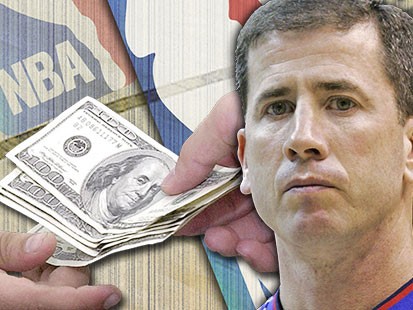
A Betting Man - Tom Matlack Talks to Disgraced NBA Referee Tim Donaghy

http://donenriko.files.wordpress.com/2008/10/donaghy.jpg

Tom Matlack talks to disgraced NBA referee Tim Donaghy about betting on games he refereed, gambling in America, and the road to recovery and redemption. Interesting.

Here is the introduction to the interview.
My column (and this magazine, for that matter) isn’t about Hollywood images of manhood. I will certainly write about and interview plenty of guys marines to athletes to guys working in the trenches of poverty and abuse. But to me, manhood and goodness are not about getting it right from the you’re going to do about it.

As my grandmother told me when I called her shortly after being tossed out of the house fourteen years ago for being a drunk and a liar, “Tom, it’s not how you fall in life that counts; it’s how you pick yourself up.”

So when I say everyone has a story, I mean everyone. I am particularly interested in guys who made huge mistakes in their lives. Are they now following my grandmother’s advice? To me, manhood is about redemption. It’s about admitting you screwed up. I’m always willing to listen to guys who others might criticize me for talking to, even just to learn what not to do.
I am generally impressed with anyone who effs up and learns from the experience - but to do so on a grand, and very public, scale takes a lot of courage.

Read the whole interview at Scribd, or read it below.