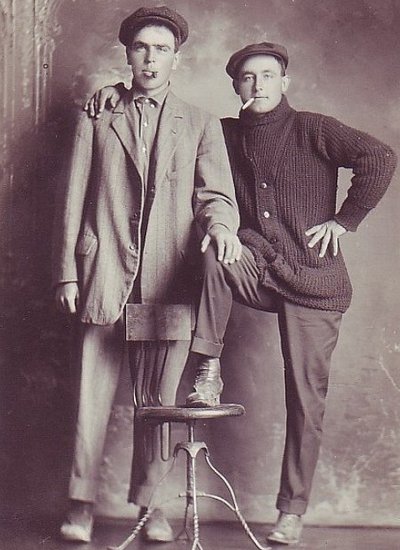
This is a nice little article dispelling the myth of the alpha male - men and masculinity is far more complex than a polarity between alpha male and beta male. The "Manly Guest Contributor" of this article is Scott Barry Kaufman.
The Myth of the Alpha Male
A Manly Guest Contributor
July 7, 2014
Editor’s note: This is a guest post from Scott Barry Kaufman.
There are a lot of false dichotomies out there — left brain vs. right brain, nature vs. nurture, etc. But one really persistent myth, that is literally costing human lives, is the distinction between “alpha” and “beta” males.
As the story typically goes, there are two types of men.
“Alpha” males are those at the top of the social status hierarchy. They have greater access to power, money, and mates, which they gain through physical prowess, intimidation, and domination. Alphas are typically described as the “real men.” In contrast are the “Beta” males: the weak, submissive, subordinate guys who are low status, and only get access to mates once women decide to settle down and go searching for a “nice guy.”
This distinction, which is often based on observations among other social animals (such as chimpanzees and wolves) paints a very black and white picture of masculinity. Not only does it greatly simplify the multi-dimensionality of masculinity, and grossly underestimate what a man is capable of becoming, but it also doesn’t even get at the heart of what is really attractive to women.
As the expression goes, when all you have is a hammer, all you see are nails. When we impose just two categories of male on the world, we unnecessarily mislead young men into acting in certain predefined ways that aren’t actually conducive to attracting and sustaining healthy and enjoyable relationships with women, or finding success in other areas of life. So it’s really worth examining the link between so-called “alpha” behaviors (such as dominance) and attractiveness, respect, and status.
The Science of Dominance
Consider one of the earliest sets of studies on the relationship between dominance and attractiveness. The researchers presented their participants with videotaped and written scenarios depicting two men interacting with each other. The scenarios varied on whether the male acted “dominant” or “nondominant.” For instance, here’s an excerpt of a scenario in which the male was depicted as dominant:
John is 5’10” tall, 165 lbs. He has been playing tennis for one year and is currently enrolled in an intermediate tennis class. Despite his limited amount of training he is a very coordinated tennis player, who has won 60% of his matches. His serve is very strong and his returns are extremely powerful. In addition to his physical abilities, he has the mental qualities that lead to success in tennis. He is extremely competitive, refusing to yield against opponents who have been playing much longer. All of his movements tend to communicate dominance and authority. He tends to psychologically dominate his opponents, forcing them off their games and into mental mistakes.In contrast, here’s an excerpt of a scenario in which the same tennis player is instead depicted as “nondominant” (the first three lines, in italics above, were kept the same across conditions):
. . . His serve and his returns are consistent and well placed. Although he plays well, he prefers to play for fun rather than to win. He is not particularly competitive and tends to yield to opponents who have been playing tennis much longer. He is easily thrown off his game by opponents who play with great authority. Strong opponents are able to psychologically dominate him, sometimes forcing him off his game. He enjoys the game of tennis but avoids highly competitive situations.Across four studies, the researchers found that the dominance scenarios were considered more sexually attractive, although dominant John was regarded as less likeable and not desired as a spouse. Taken at face value, this study seems to support the sexual attractiveness of the dominant alpha male over the submissive beta male.
But not so fast.
In a follow up study, the researchers isolated various adjectives to pinpoint which descriptors were actually considered sexually attractive. While they found that “dominance” was considered sexually attractive, “aggressive” and “domineering” tendencies did not increase the sexual attractiveness of either males or females. There seemed to be more to the story than just mere dominance vs. submissiveness.
Enter a study by Jerry Burger and Mica Cosby. The researchers had 118 female undergraduates read the same descriptions of John the tennis player (dominant vs. submissive), but they added a crucial control condition in which some participants only read the first three sentences of the description (see italics above). Consistent with the prior study, women found dominant John more sexually appealing than submissive John. However, the John depicted in the control condition had the highest ratings of sexiness of them all!
What’s going on? Well, this most certainly doesn’t mean that the extremely brief three-sentence description of the John depicted in the control condition was sexually appealing. Rather, it’s more probable that hearing about either dominant or nondominant behavior, in isolation of other information about him, made him less sexually attractive. The researchers conclude: “In short, a simple dominant-nondominant dimension may be of limited value when predicting mate preferences for women.”
Next, the researchers fiddled with the descriptors of John. In the “dominant” condition, participants read a short description of John and were told that a recent personality test found that his five most prominent traits were aggressive, assertive, confident, demanding, and dominant. Those in the “nondominant” condition read the same paragraph but were told that John’s five most prominent personality characteristics were easygoing, quiet, sensitive, shy, and submissive. Those in the control condition only read the short paragraph but were not told anything about John’s personality.
The researchers then asked women to indicate which of the adjectives used to describe John were ideal for a date as well as for a long-term romantic partner. They found that only 1 woman out of the 50 undergraduates in their sample actually identified “dominant” as one of the traits she sought in either an ideal date or a romantic partner. For the rest of the dominant adjectives, the two big winners were confident (72% sought this trait for an ideal date; 74% sought this trait for an ideal romantic partner) and assertive (48% sought this trait for an ideal date; 36% sought this trait for an ideal romantic partner). Not one woman wanted a demanding male, and only 12% wanted an aggressive person for a date and romantic partner.
In terms of the nondominant adjectives, the big winners were easygoing (68% sought this trait for an ideal date; 64% sought this trait for an ideal romantic partner) and sensitive (76% sought this trait for an ideal date and ideal romantic partner). Not one woman wanted a submissive male for either a date or romance. Other low-ranked nondominant adjectives were shy (2% for dating; 0% for romantic) and quiet (4% for ideal; 2% for romantic).
This analysis was revealing because it suggests that dominance can take many forms. The dominant male who is demanding, violent, and self-centered is not considered attractive to most women, whereas the dominant male who is assertive and confident is considered attractive. As the researchers suggest, “Men who dominate others because of leadership qualities and other superior abilities and who therefore are able and willing to provide for their families quite possibly will be preferred to potential partners who lack these attributes.”
Their results also suggest that sensitivity and assertiveness are not opposites. In fact, further research suggests that the combination of kindness and assertiveness might just be the most attractive pairing. Across three studies, Lauri Jensen-Campbell and colleagues found that it wasn’t dominance alone, but rather the interaction of dominance and pro-social behaviors, that women reported were particularly sexually attractive. In other words, dominance only increased sexual attraction when the person was already high in agreeableness and altruism.
Along similar lines, Jeffrey Snyder and colleagues reported that dominance was only attractive to females (for both a short-term affair and a long-term relationship) in the context of male-male competitions. Tellingly, women did not find men attractive who used aggressive dominance (force or threat of force) while competing for leadership in informal decision making among peers. This suggests that women are attuned to cues that indicate that the male might direct his aggression toward her, with dominance toward competitors considered more attractive than dominance toward friends or coalition members. To put this study in a real-world context, the guy in high school that all the girls go for is the guy who can dominate a player from a rival school on the football field on Friday night, but who’s likeable and friendly to his own classmates during the week.
Distinguishing between the different shades of dominance, and how they interact with kindness, is not just important for understanding sexual attraction among humans. It also has deep implications for the evolution of social status.
“But wait…don’t some women go for the Bad Boy? I’ve seen it happen!”
While studies show that most women find prestigious men more attractive than dominant men for both short-term affairs and long-term relationships, the research also suggests that, when given the choice, some types of women will still pick the dominant asshole over the upstanding prestigious man. Women with a “fast life” history (meaning they grew up in an insecure and unstable environment with little or no parental support), insecure attachment, and who hold hostile, sexist attitudes about their fellow females typically prefer a short-term mating strategy and engage in frequent, uncommitted sexual activity (Olderbak & Figueredo, 2010; Bohner et al, 2010; Kirkpatrick & Davis 1994). These sorts of women typically prefer the stereotypical dominant and aggressive “alpha” male to the more pro-social, prestigious male (Hall & Canterberry, 2011).While it is possible to pick up some types of women by acting “alpha,” because of the kind of women this seduction method attracts, the flings you successfully land can become messier than you bargained for. It’s for this reason that men who go for the alpha male ideology often fall victim to a selection bias in regards to their perception of women: because the women who are attracted to them are less stable and more promiscuous, they come to believe that all women are “skanky” and “crazy.”At the same time, when these men try their dominant pick-up techniques on more well-adjusted women, their hostility and narcissism creep the women out, and cause them to turn these guys down. This rejection makes these would-be “pick-up artists” more hostile to women, and they figure the problem is that they’re still too much of a “nice guy.” They then try to up their alpha quotient even further, which makes even more women turn away from them. And the cycle continues.Dominance vs. Prestige
In our species, the attainment of social status, and the mating benefits that come along with it, can be accomplished through compassion and cooperation just as much (if not more so) as through aggression and intimidation. Scholars across ethnography, ethology, sociology, and sociolinguistics believe that at least two routes to social status – dominance and prestige – arose in evolutionary history at different times and for different purposes.
The dominance route is paved with intimidation, threats, and coercion, and is fueled by hubristic pride. Hubristic pride is associated with arrogance, conceit, anti-social behaviors, unstable relationships, low levels of conscientiousness and high levels of disagreeableness, neuroticism, narcissism, and poor mental health outcomes. Hubristic pride, along with its associated feelings of superiority and arrogance, facilitates dominance by motivating behaviors such as aggression, hostility, and manipulation.
In contrast, prestige is paved with the emotional rush of accomplishment, confidence, and success, and is fueled by authentic pride. Authentic pride is associated with pro-social and achievement-oriented behaviors, agreeableness, conscientiousness, satisfying interpersonal relationships, and positive mental health. Critically, authentic pride is associated with genuine self-esteem (considering yourself a person of value, not considering yourself superior to others). Authentic pride, along with its associated feelings of confidence and accomplishment, facilitates behaviors that are associated with attaining prestige. People who are confident, agreeable, hard-working, energetic, kind, empathic, nondogmatic, and high in genuine self-esteem inspire others and cause others to want to emulate them.
These two routes to male social status have also been observed among the Tsimané (a small-scale Amazonian society). In this society, dominance (as ranked by peers) was positively related to physical size, whereas peer-ranked prestige was positively associated with hunting ability, generosity, and number of allies.
Interestingly, while advocates for acting dominant often point to chimps as proof of the exclusivity of this route to male status, recent research has shown that even among primates, alpha male status can be achieved not only through size and strength but through adept sociability and the grooming of others as well.
Flexibility and Adaptability: The Advantages of Prestige
While it’s tempting from the above descriptions to decide that dominance is “bad” and prestige is “good,” that’s a bit too simplistic. What too often goes missing in discussions about being “alpha” or “beta” is that status is context specific. A CEO of a Fortune 500 company has a high level of status in our society, but if he was thrown into the general population at Sing Sing Prison, he’d find himself at the very bottom of the pecking order. You can be an alpha amongst one group, and a beta in another.
In the context of a harsh, dangerous environment, the dominant male is valued because he can get what he wants, and provide resources to those who will submit to and follow him. He doesn’t need to employ skills beyond strength and intimidation. But outside of pure barbarian society (i.e., most of human history), it’s the prestigious man who rules. He’s primed to have the most success in the widest variety of circumstances.
In one set of studies conducted on university-level varsity athletes, dominant individuals were found to have lower levels of genuine self-esteem, social acceptance, and agreeableness and higher levels of narcissism, aggression, agency, disagreeableness, and conscientiousness. Dominant individuals were rated by their peers as higher in athleticism and leadership, but lower in altruism, cooperativeness, helpfulness, ethicality, and morality.
In contrast, prestigious individuals had lower levels of aggression and neuroticism, and higher levels of genuine self-esteem, social acceptance, agreeableness, and even GPA. What’s more, prestige was weakly related to self-aggrandizing narcissism. Just like their dominant peers, prestigious individuals were rated as being better leaders and more athletic, but they were also considered more intellectual, socially skilled, altruistic, cooperative, helpful, ethical, and moral.
These results clearly show that dominance and prestige represent very different ways of attaining and maintaining status. But it’s also worth once again reiterating the overlap: qualities like strength, leadership, kindness, and morality can exist in the same person; strict categories of “alpha” and “beta” truly set up a false dichotomy that obscures what a man is capable of becoming. While dominance may be advantageous in a narrow set of circumstances, prestige is far more valued in nearly every context. Due to their authentic pride, prestigious individuals are more likely to be respected, socially accepted, and thus successful. Who would you rather have on your team — Kevin Durant or Dennis Rodman?
Here’s another way of looking at the difference between the two routes to status: Dominance is a short-term strategy for success; prestige is a long-term one. Dominance is a quality that can help you conquer, but it lacks the ability to govern what you’ve won. Amongst chimps, once a male has fought his way to the top, and becomes the alpha, his enjoyment of that status is short-lived; another dominant male will soon come along to challenge him and knock him off his throne. On a cultural level, peoples like the Mongols or Vikings dominated others and were the alphas in their time, but were unable to adapt, and died off. Prestigious men — like the Founding Fathers — were able to create a legacy that continues on today.
Conclusion
It is neither the alpha nor the beta male that is most desired by women.
Taken together, the research suggests that the ideal man (for a date or romantic partner) is one who is assertive, confident, easygoing, and sensitive, without being aggressive, demanding, dominant, quiet, shy, or submissive. In other words, a prestigious man, not a dominant man.
In fact, it appears that the prestigious man who is high in both assertiveness and kindness is considered the most attractive to women for both short-term affairs and long-term relationships. This research should offer some assurance that the genuinely nice, passionate kid who learns a culturally valued skill can be immensely attractive.
Further, seeking to become a prestigious man is not only the surest route to success with women, but achievement in any area of life.
Thus, I think a much more effective and healthier route for men having difficulty attracting women is not to attempt to cultivate the traits of the stereotypical, dominant “alpha,” but to cultivate the traits of the prestigious man. This means developing a skill that brings value to society, and cultivating a stable sense of identity. Such a route will not only make you more attractive to women, but will also create the most satisfying life for yourself in general. In my view, attempting to don the persona of the “alpha” is analogous to building a house of cards. There’s no stable foundation supporting your worth.
It’s time we shed these black and white categories, and embrace a much more multidimensional concept of masculinity. The most attractive male is really a blend of characteristics, including assertiveness, kindness, cultivated skills, and a genuine sense of value in this world. The true alpha is fuller, deeper, and richer.
______________________________
Scott Barry Kaufman is Scientific Director of The Imagination Institute and a researcher in the Positive Psychology Center at the University of Pennsylvania. He is co-author of Mating Intelligence Unleashed: The Role of the Mind in Sex, Dating, and Love and author of Ungifted: Intelligence Redefined.