Showing posts with label veterans. Show all posts
Showing posts with label veterans. Show all posts
Monday, May 26, 2014


Saturday, May 3, 2014
Wartorn 1861-2010 - A Documentary on War and PTSD

No new information here for those who work with PTSD and especially combat-related PTSD, but this is still an essential documentary for those who love, live with, or know the young men (and women) coming home from Iraq and Afghanistan. An estimated 25-35% of combat veterans (mostly men) from these two recent wars will experience symptoms of post-traumatic stress disorder. This HBO documentary examines their experience, their symptoms, and their lives once they return home.
Wartorn 1861-2010
68 Minutes
After the Civil War more than half of the patients in mental institutions were veterans. In 1980 post-traumatic stress disorder (PTSD) became an accepted diagnosis for veterans with psychological wounds. Based on personal accounts of American soldiers whose physical and mental health was torn asunder by the shock and fear of bloodshed and PTSD, the documentary narrates the chronic effects of battle agony and post-traumatic anxiety on military personnel and people close to them throughout American history... from the Civil War through today's modern warfare in Iraq and Afghanistan.
There's a lot of confusion about post-traumatic stress. What are some of the physical manifestations? Well, the hallmark symptoms are the agitation and being keyed up and on edge. And the problem with PTSD is that those symptoms don't go away when soldiers come back home. It's almost like a seizure where they don't have control, they don't know when it's going to happen, and they have to constantly plan so that if it does happen, they're in a place where they can recover.
So what about the people that don't get it? Is there anybody that you can honestly say was in a great deal of intense combat situations and comes back completely fine? Those folks are pretty rare. There's that mythology of the warrior that the only thing you should feel when you shoot an insurgent is recoil. But in fact, nobody is really unscathed unless you really have no compassion for human life. If you have a total disregard maybe the only thing you feel is recoil. Everybody else carries something with them.
In August 1943, General Patton slapped a young soldier who was hospitalized with nervous exhaustion. He was reported to have said: I won't have the hospitals cluttered up with these sons of bitches who haven't got the guts to fight. Send that yellow son of a bitch back to the front line.

Monday, May 28, 2012
Happy Memorial Day - Perspectives . . . .

According to Wikipedia, Memorial Day was originally known as Decoration Day (because people had begun decorating, both during and after the Civil War, the graves of family members who had been killed):
On May 5, 1868, in his capacity as commander-in-chief of the Grand Army of the Republic - the organization for Union Civil War veterans - Logan issued a proclamation that "Decoration Day" should be observed nationwide.[14] It was observed for the first time on May 30 of the same year; according to folklore, the date was chosen because it was not the anniversary of a battle.[15]Over the decades, Memorial Day became a national holiday and a community celebration of our military and its fallen heroes. "Taps" is the somber traditional song played in Memorial Day events:
Events were held in 183 cemeteries in 27 states in 1868, and 336 in 1869. The northern states quickly adopted the holiday; Michigan made "Decoration Day" an official state holiday in 1871 and by 1890, every northern state followed suit. The ceremonies were sponsored by the Women's Relief Corps, which had 100,000 members. By 1870, the remains of nearly 300,000 Union dead had been reinterred in 73 national cemeteries, located near the battlefields and therefore mostly in the South. The most famous are Gettysburg National Cemetery in Pennsylvania and Arlington National Cemetery, near Washington.
The Memorial Day speech became an occasion for veterans, politicians and ministers to commemorate the War - and at first to rehash the atrocities of the enemy. They mixed religion and celebratory nationalism and provided a means for the people to make sense of their history in terms of sacrifice for a better nation. People of all religious beliefs joined together, and the point was often made that the German and Irish soldiers had become true Americans in the "baptism of blood" on the battlefield. By the end of the 1870s much of the rancor was gone, and the speeches praised the brave soldiers both Blue and Gray. By the 1950s, the theme was American exceptionalism and duty to uphold freedom in the world.
While I appreciate the need and the desire to honor those who have served and died for their country, today I want to offer a slightly different perspective - one that I have only come to over the past 15 years or so. Additionally, in the pictures I am including in this post, I want to highlight the humanity of these men and women in such inhumane circumstances.

When I was young (teens and twenties) I tended to think of soldiers as brain-washed kids whose souls had been removed in basic training so that they could be made into efficient killing machines (think of the basic training part of Full Metal Jacket). Maybe part of that view was shaped by my father's insistence that I follow the family tradition and join the Navy or the Marines (all males on my dad's side have done this as far back as anyone knows), and my sense of relief (yes, I mean this) when he died before I had to make the choice to do as he wanted and be miserable, or refuse and be rejected as a wuss and a coward.
I was not cut out to be military. I knew that as a child, and my life has born out that instinct.
But I know now that the men and women who serve are often horrified by the things they have to do in combat, and with a few exceptions (those who are not mentally well), killing is the last thing they want to do. Some studies have shown that during WWII and earlier wars, as many as 80% of soldiers did not fire their weapons in combat situation (these numbers come from U.S. Army Brigadier General S.L.A. Marshall, whose methods and veracity have been challenged). Marshall felt that the soldiers simply could not take another life - and, as draftees, they had not been trained to do so.
By Vietnam that had changed, with up to 95% firing in combat situations. Part of the reason this changed was due to the training they received (from Greater Good, by Lt. Col. Dave Grossman):
Since World War II, a new era has quietly dawned in modern warfare: an era of psychological warfare, conducted not upon the enemy, but upon one’s own troops. The triad of methods used to enable men to overcome their innate resistance to killing includes desensitization, classical and operant conditioning, and denial defense mechanisms.As it turns out, however, killing people carries a cost to those who do so. The numbers are alarming, with between 18 and 54 percent of the 2.8 million soldiers who did tours of duty in Vietnam suffering from post-traumatic stress disorder (PTSD) These numbers are significantly higher than previous wars. A 1988 study (Jeanne and Steven Stellman at Columbia University), the first one to look at the environmental influence on PTSD, found that those most likely to suffer PTSD served in high intensity combat situations (again from Greater Good):
__
By the time a soldier does kill in combat, he has rehearsed the process so many times that he is able to, at one level, deny to himself that he is actually killing another human being. One British veteran of the Falklands, trained in the modern method, told Holmes that he “thought of the enemy as nothing more or less than Figure II [man-shaped] targets.”
There is “a natural disinclination to pull the trigger… when your weapon is pointed at a human,” says Bill Jordan, a career U.S. Border Patrol officer and veteran of many gunfights. “To aid in overcoming this resistance it is helpful if you can will yourself to think of your opponent as a mere target and not as a human being. In this connection you should go further and pick a spot on your target. This will allow better concentration and further remove the human element from your thinking.”
These veterans suffer far higher incidence of divorce, marital problems, tranquilizer use, alcoholism, joblessness, heart disease, and ulcers. As far as PTSD symptoms are concerned, soldiers who were in noncombat situations in Vietnam were found to be statistically indistinguishable from those who spent their entire enlistment in the U.S.The PTSD rates seems to be even higher now (and we may not know the full extent of the problem until 5 or 10 years after these wars are over) - but the walls between the soldiers who carry this wound and getting some help are often daunting.

During the Bush administration, the VA was directed to significantly reduce its diagnoses of PTSD, an order that was overturned by Obama. But the challenges to getting service remain, not least of which is the shortage of social workers (the VA does not yet hire counselors, marriage and family therapists, or licensed substance abuse counselors, despite regulations having been changed to include counselors and other masters level therapists).
According to this 2010 article from the American Observer:
You can listen to one soldier's story, that of Matt Southworth:Members of Iraq Veterans Against the War . . . . On the anniversary of the start of the war in Afghanistan the veteran's group declared its aim to halt the redeployment of soldiers with psychological health problems like post-traumatic stress disorder , traumatic brain injuries and military sexual trauma.Veterans describe various institutional challenges that lie along two fronts—getting soldiers the treatment and time to heal, but first, simply ensuring that soldiers who suffer from trauma are identified. They attribute the challenges to stigma, inadequate screening, insufficient resources, and ultimately the military, whose ultimate goal is returning service members to active duty.
Listen to Matt Southworth talk about his experience
Top officials in the VA, as late as 2009/2010, do not even believe PTSD is a legitimate diagnosis. Deputy Assistant Secretary for Policy at the VA, Michael McLendon, was quoted in a Boston Review (Nov/Dec 2009) article as follows:
[PTSD] is not a diagnosis based on empirical evidence, but rather . . . it is an artificial construct erected by a vote of selected psychiatrists. This does not mean that there are not problems that certain individuals do have [and] issues that need to be addressed. But rather, it means that we have created policies and programs that have not served veterans well.This lack of support is part of the problem. More than any other group, the military should understand the psychological cost of killing. But treating PTSD takes time and that costs money when veterans are involved. Part of why Bush and the VA wanted to minimize the numbers of soldiers coming back from Iraq and Afghanistan with PTSD was that it was adding up to a lot of money. It's much easier to deny their symptoms, give them a collection of medications (Alternet, 2010) that amounts to a chemical straightjacket [Paxil (an antidepressant), Klonopin (a mood stabilizer), and Seroquel (a controversial anti-psychotic drug)], and send them back for another tour of duty.
Medications can be necessary for some survivors, but individual and/or group therapy is even more important. Returning for another tour of duty is NOT a good clinical choice, even if it seems to be a good financial choice on paper (retraining a soldier lost to PTSD can be very expensive - but we ask them to serve as volunteers, and promise to take care of them, so spend the damn money to train someone else, and spend the damn money to help the soldier with PTSD).
The lack of real or perceived social support is often part of the problem.
In a 2003 study from Karestan C. Koenen (VA Boston Healthcare System and Boston Medical Center), Jeanne Mager Stellman and Steven D. Stellman (Columbia University), and John F. Sommer Jr. (The American Legion), conducted over a 14-year period with Vietnam veterans, the key to recovery from PTSD is perceived social support.
High combat exposure, perceived negative community attitudes at homecoming, minority race, depression symptoms at Time 1, and more anger at Time 1 predicted a more chronic course. Community involvement at Time 1 was protective and associated with decreased risk at Time 2. Discomfort in disclosing Vietnam experiences was associated with an increased risk for developing PTSD but did not predict its course. Combat exposure predicted PTSD course more strongly than any other risk factor. Findings suggest recovery from PTSD is significantly influenced by perceived social support.Social support is exactly what the Vietnam vets did not get. I recently spoke with a 73-year-old veteran of that war, who had served in a combat role, who said, with sadness and some tears, that no one had ever thanked him for his service to his country - not family, not friends, and not co-workers. He said that experience made him bitter and hurt him deeply.
Things have shifted in the last couple of decades. Many Americans opposed both Gulf Wars and the war in Afghanistan, but even among far left liberals the slogan was, "Hate the War, Love the Soldier."

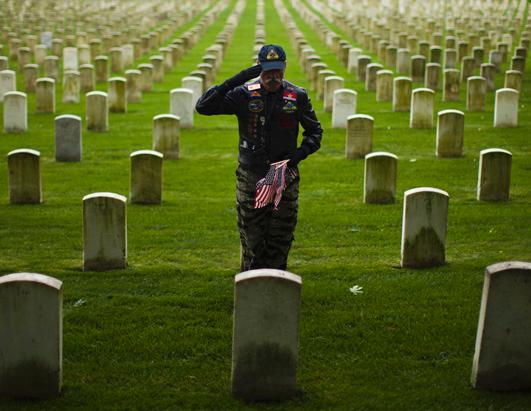
So on this memorial day, let us praise the fallen, those who gave their lives for their country, but let us also love the men and women who have returned from any and all of our wars with psyches broken by the horrors they have seen and committed. No person should have to carry that burden alone, or in silence.
Where the government is failing these walking casualties of war, let us take the lead and give them the social support that can make the difference between a lifetime of suffering or the promise of healing and a return to a life in the world, not apart from it, an outsider in one's own home and country.
These men and women have paid a deep price in service to their country, our country, we owe them some compassion and some support.
Want to help?
(inclusion of listing here does not imply endorsement)
- Soldier's Best Friend is non-profit dedicated to providing "United States military veterans suffering from Post Traumatic Stress Disorder (PTSD) or Traumatic Brain Injury (TBI) with a trained Service or Therapeutic Companion Dog, most of these dogs of which will be rescued from local shelters."
- VA Voluntary Service - Volunteer to help care for wounded veterans.
- Angels of Mercy / No Soldier Left in Need - Donate clothes to wounded soldiers returning stateside, or donate to long-term rehabilitation programs.
- Wounded Warriors Fund - Donates everything from phone cards to TVs to wounded soldiers.
- Adopt A US Soldier - “Adoption” is as easy as writing letters or as involved as sending care packages.

Friday, November 18, 2011
Real Warrior Profile - Major Ed Pulido
When we hear about soldiers wounded in battle in Iraq or Afghanistan, we tend to hear mostly about the ones who have recovered from frightening injuries and seem to have found a sense of peace with their new lives.
We hear less often about those men (and women) who recover from their physical wounds but struggle with the emotional and psychological wounds, with PTSD. The Real Warrior series looks at some of those men and women.
Channel N, from Psych Central, posted this particular video, which is how I learned about the project.
We hear less often about those men (and women) who recover from their physical wounds but struggle with the emotional and psychological wounds, with PTSD. The Real Warrior series looks at some of those men and women.
Channel N, from Psych Central, posted this particular video, which is how I learned about the project.
A Real Warrior
Major Ed Pulido
A US Army veteran describes what it was like to experience a severe blast injury in the Iraq war that affected him both physically and psychologically. 17 surgeries and many months in hospital saved his body, but it took more than that to heal from PTSD that also resulted. Now retired, he works to inspire others to seek help. The military media campaign Real Warriors profiles a series of veterans who suffered from PTSD and demonstrated the strength to seek assistance in recovery.
See all the videos here.
Producer: Real Warriors Featuring: Maj. Ed Pulido Format: Flash Date: 03/08/10 Length: 00:06:01 Video Link:
http://youtu.be/8HA1YGvEyiU

Friday, July 22, 2011
Bob Minor: Eighteen Suicides a Day . . . .

Committed by military veterans, almost exclusively male. This report comes from Bob Minor, a board member of the America Men's Studies Association. We have to do better than this for our veterans.
I've seen young men (mostly) come back from a 2nd or 3rd tour of duty with little more than a short meeting when they get home telling them not to beat their wives or abuse drugs and alcohol. Many of them need therapy and they need to be in a culture that does not shame them for feeling pain and grief.
One young man came back from Iraq several years ago having never fired his weapon or seen any combat, but one of his jobs had been to pick up the fragments of bodies that had been blown up by roadside IEDs - the pieces were put into garbage bags to be identified later so they could be shipped back to the States for burial. He came back as a full-blown alcoholic.
AMSA Board Member Bob Minor: Eighteen Suicides a Day
Eighteen U.S. veterans, on average, commit suicide every day. Eighteen. Every day.
That’s the latest statistic of one of the most under-reported costs of our wars. It adds up to more than are actually being killed in our on-going wars themselves.
There is still debate about how many Vietnam veterans have committed suicide on top of the more than 58,000 who died in that war. The number might be as low as the 1987 Centers for Disease Control estimate of 9,000 or as high as 200,000.
One retired VA doctor who supports the latter figure wrote that: “the reason the official suicide statistics were so much lower was that in many cases the suicides were documented as accidents, primarily single-car drunk driving accidents and self inflicted gunshot wounds that were not accompanied by a suicide note or statement.”
There are many messages one can take away from these grim statistics, but few as moving as the one that hit me as I watched a “60 Minutes” interview a while back with a young American soldier in Afghanistan.
He had just survived a firefight where he lost two close comrades. His interview was punctuated with the welling-up of tears that he continually fought back as he struggled to keep in place the mask of his war-assigned duty to cover up what was tearing him apart inside.
How damaging is the emotional toll for our men, and now some women, who must suppress the feelings that connect them to their humanity in order to fight wars for a system that parties away on the other side of the world, a system where their mostly well-off leaders tell them they must do this thing, and that they can earn no higher honor?
It was difficult enough for many of us to sit through the first thirty minutes of the box office hit “Saving Private Ryan” without turning our eyes away as bodies were blown apart and men cried out in agony before our eyes. What must the real experience have done to those men who endured the gruesome, relentless destruction of their comrades for days on the Normandy beaches?
One salty old Navy veteran of the actual event, confessed to me that he cried during those scenes in the film, adding: “I don’t know why.” It wasn’t like him to so react, but those feelings were obviously there in some depths he no longer believed he could access.
It’s still true that a major measure of manhood in our culture is a man’s willingness to go off somewhere to kill other men and be killed by other men. And this kill-or-be-killed agreement for something abstract like the “American way,” “freedom,” or “the country” constitutes proof for many that they did live up to what it is to be real men.
And if that is the measure of a man, then equality in patriarchal terms means women will also have to take upon themselves the idea that their life is as valuable only to the extent that they are willing to give it up.
Yet current impressions remain that women’s lives are more valuable than men’s in these matters. A woman taken in combat (think the Jessica Lynch capture and rescue fable the military cooked up) is still a much more tragic event in our media and political culture.
For men, let’s just keep the body count as low as possible. But a woman taken in combat indicates the enemy has fallen to new lows.
The justification for this difference was that men are somehow inherently violent. They’re more ruthless, competitive, and cutthroat in an inborn, genetic sense.
Internalizing this kill-or-be-killed ideal teaches men that their lives are important only to the extent that they sacrifice them at work, in sports, or in war, for their families, for the team, for the nation. We reward them for killing and dieing in the national interest.
To get men to internalize this message requires relentless monitoring. “Boys will be boys” supports the early version of this message: beat or be beaten. Boys enforce on each other that toughness and aggressiveness are valued, while nurturing, and being emotionally (other than sexually) moved by others is for girls.
Sympathetic emotions must be stuffed down as deeply as possible to get men to become fighters in life. The hurt, fear, and confusion all humans feel cannot bubble up or it will destroy the missions assigned to manhood.
Stuff them deep, boys and men. Keep them deep enough that they will never enter into your conscious judgment to infect how you decide to treat another human being, especially another male.
Should you feel any bond with the man who is your enemy in business as well as war, you are liable to wimp out. And that is still for sissies.
Our men are suffering post-traumatic stress disorder not just because of what they witnessed but because they are human beings – as fully human as our women – who are being asked to do something far out of touch with their humanity. And like it.
They are still those little boys they once were whose minds had to be worked on relentlessly to get them to believe that war was their manly duty. And fear of what would happen to them if they did not conform meant they had to deny all within that could threaten the profitable agenda of the military-industrial-prison-media complex.
They did not want to be considered queer for staying in touch with what still lies down deep within and conflicts with what they’ve been told they must do. They did not want, after all, to be treated the way society has treated gay men.
They came to believe that the alternatives to living this version of manhood could be death, humiliation, and rejection. For they knew that this American warrior code still says a man will get rewarded for killing another man, but can be killed for loving another man.
Tags:
Sunday, April 17, 2011
Young Male Veterans Have One of the Highest Levels of Unemployment in the Country

Via ABC News - the government needs to do much better than this for our veterans. These (mostly) young men gave of themselves in service of their country and their country betrays them. It's been nearly 20 years since the military update its employment transition programs for veterans - which is partly why the unemployment rate for young, male veterans (ages of 18 to 24) was 21.9 percent in 2010 - more than twice the national average.
Young Male Veterans Have One of the Highest Levels of Unemployment in the Country
WASHINGTON, April 16, 2011
In the military, Eric Smith led a four-man ICU team, performing procedures that only the most experienced civilian nurses were trained to perform, but more than three years after leaving the Marines he hasn't even been able to get a job "changing bed pans."Smith, 26, is in the same situation as many veterans, whose military training and experience gave them skills that should be in high demand in the civilian job market, but have struggled to find work because they do not have certification in their field.
The former Navy corpsman and member of Iraq and Afghanistan Veterans of America testified Wednesday at a Congressional hearing led by Sen. Patty Murray, D-Wash., on reducing unemployment among veterans.
He described how he found himself standing in front of his local 7-11 for work when he came home from his second tour in Iraq in August 2008.
"I'd walk there in the early mornings, maybe around five or so, and I'd walk from my house to that 7-11 and wait out there for work -- that's how bad it got," Smith said in an interview with ABC News earlier this week.
Young male veterans returning from the fight overseas are encountering another one at home -- with unemployment. According to recently released Department of Labor statistics, in 2010 the jobless rate among all veterans who have served since 2001 is 11.5 percent -- 2 percent higher than for non-veterans, at 9.4 percent. Young male veterans between the ages of 18 to 24 had an unemployment rate of 21.9 percent in 2010.
"That is over one in five of our nation's heroes who cannot find a job to support their family, do not have an income that provides stability, and do not have work that provides them with the self-esteem and pride that is so critical to their transition home," said Murray said at the hearing on Wednesday.
Military Skills Hard to Translate to Civilian World Without Certification
A major problem for veterans is not having certification showing that skills learned in the military is directly applicable to the civilian workforce.
For the first two years of his enlistment, Smith worked at the Balboa Hospital's intensive care unit in San Diego, leading a four-man team for an ICU with more than 20 beds.
As a Navy corpsman in Iraq, Smith treated Iraqi civilians, Iraqi soldiers and Marines on the battlefield.
"The classic war wounds," he said. "A lot of blast injuries, shrapnel injuries, things of that sort. It was IED [hell] basically."
Upon returning home from his second deployment in 2008, Smith first applied to work as a certified nursing assistant at a local hospital in Maryland. He said the interview went well, but he never received a call, and is convinced the reason is because he did not have a certificate saying he could do the things he said he had done in the military.
"I never got a call back afterwards, even though I thought I was going to, the reason being, I think, and I'm pretty sure, I'm 99 percent positive, is the fact that I did not have those civilian certifications that said I was able to do that," Smith said. "So basically everything on that resume was hearsay."
Smith joined the Navy at 17, wanting to follow in the footsteps of his grandfather, father and older brother. He graduated from the Naval Hospital Corps school. Yet without certifications accepted by the civilian workforce, he essentially has to rely on his General Educational Development (GED) certificate, the equivalent of a high school diploma.
Smith said he's also frustrated by the lack of a uniform process for acquiring these civilian certifications while in the military.
According to Smith, the Navy offers some opportunities to gain these certifications, but the systems are not standardized. For example, certification is easily attainable for a corpsman who is assigned to a small command in an outpatient clinic with rigid 9-to-5 hours. He or she can then leave work to attend certification courses. However, a corpsman who works 12-hour night shifts at a hospital ward or who is preoccupied with back-to-back combat deployments cannot.
Returning to School for Certification: Wasting U.S. Tax Payer Dollars?
Smith acknowledged that he could return to school to obtain a degree as a physician's assistant, and take advantage of G.I. Bill benefits, which would cover the cost of education as well as housing while attending school. However, he said, it does not make sense for him to go to school for what he already knows, just to get the certificate.
"That would be counterproductive in a sense. I'm using my G.I. bill money, which is finite, for something I already know how to do. It is a waste, it is redundant, there really is no point in that," Smith told ABC News.
Furthermore, Smith said, attending school to become certified would be a waste of tax dollars -- first, the money already invested in his training, and second, for redundant education under the G.I. bill.
"The thing is, why should I have to, in a sense, 'double-dip,' you know, pay again to get this training all over again? Training that I've already had, training the Navy has invested money in already," Smith said.
"Today, several years later, I am still struggling to find a job and utilize the skills that the Navy spent over $1 million and six years to give me," Smith told members of Congress on Wednesday.
Before leaving the service, all service members attend the Transition Assistance Program (TAP), run by the Department of Labor to help veterans successfully transition into the civilian workforce. Smith said that although the information was valuable, he took it so far in advance of his exit, he didn't retain a lot of it.
During the hearing Wednesday, Murray pointed out that the TAP program is only mandatory for the Marine Corps, and recommended reform.
"As it stands right now, it is not as good as it can be. This program needs to be customized, it needs to be updated, and it needs to be delivered in a way that is relevant and most importantly, accepted by service members," Murray said.
During the hearing Wednesday, Department of Labor Assistant Secretary for Veterans' Employment and Training Raymond Jefferson identified six areas of the TAP program for improvement, such as creating different levels of job counseling for different levels of readiness, and updating the TAP Employment Workshop content. Jefferson said the content had not been significantly updated in 19 years.
Deputy Assistant Secretary of Defense John Campbell echoed the need for reform.
"The current program has been in place for nearly two decades without major enhancements," he said. "To strengthen and improve TAP, DOD, DOL and VA are collaborating to re-engineer, redesign, and transform the current program in a way that will better meet the needs of Service members and their families in the 21st century."
But for Smith, the reforms may not come soon enough.
Smith said he started receiving VA benefits about eight months ago, which he supplements with odd jobs around the neighborhood. He is currently living at home in Baltimore, and looking for steady work. Since returning from service, he has worked as a bartender, at a drywall plant and even as a drug-test patient.
"It is kind of disheartening in a way that on one hand, I'm 19 years old in the ICU changing the dressings on fresh surgery wounds, and I get out there in the civilian world, and I'm not even able to change a bed pan," he said. "It's kind of depressing."


Tags:
Friday, July 9, 2010
Tom Matlack - A Good Man: Discussing Army Behavioral Health
Tom's latest column at Huffington Post takes a look at the military's version of behavioral health, or what we generally consider mental health.
On the bright side: Government To Stop Requiring Veterans To 'Prove' PTSD
Tags:
On the bright side: Government To Stop Requiring Veterans To 'Prove' PTSD
WASHINGTON — The government is making it easier for combat veterans diagnosed with post-traumatic stress disorder to receive disability benefits.
A Good Man: Discussing Army Behavioral Health
Tom Matlack, Former venture capitalist turned writerPosted: July 8, 2010
"You need somebody to assure you that it's not abnormal. It's not abnormal to have difficulty sleeping. It's not abnormal to be jumpy at loud sounds. It's not abnormal to find yourself with mood swings at seemingly trivial matters. More than anything else, just to be able to say that out loud."
--General Carter Ham, Commander of U.S. Army Europe and one of the U.S. Army's eleven four-star generals.
I interviewed Bob Davis, a Veterans Outreach Coordinator for the Red Sox Foundation/Massachusetts General Hospital Home Base Program. Bob has been an Army reservist for more than 12 years, working as a member of the 883rd Medical Company Combat Stress Control Unit based in Boston. He served two tours of duty in Iraq, during which he was awarded the Bronze Star, two Army Commendation Medals, the Combat Action Badge, and the Combat Medical Badge for his service. Bob earned an associate degree from American Military University in 2008 and is currently pursuing a Bachelor of Fire Science Management. When not at the Home Base Program, Bob works as a firefighter for the city of Newton, Massachusetts.
Q: Tell me a little bit about how you got into the army.
A: I grew up here in Boston, West Roxbury, and I had been kicking around the idea of joining the service all through high school. I was a great student but decided I was better off working and making money. Then a couple years later, I was 18 years old and my girlfriend was pregnant, so I went back and finished school. I've always wanted to join the service; my dad was a Marine in Vietnam and several of his brothers served as Marines in Vietnam. A couple years later, my girlfriend and I broke up. So at the age of 23, I walked into a recruiter's office, decided I wanted to join the Army, and I got into the field of behavioral health. I was working as an EMT at the time, so I already had a medical background.
I really put myself into making rank and doing my job well and was promoted five times. I really enjoyed it, always thought I'd do twenty years. But now, two deployments later and all banged up -- my entire life has changed. I've got a wife, another kid, a job that I love that is more than full-time, and now a part-time job with Home Base.
Q: How did it come about that you were deployed for the first time?
A: In 2002, we were kicking around the idea here in the States of searching for WMDs in Iraq. I got a sense months in advance that we were going to deploy, because mental health assets in the Army are few and far between. I think there are 12 combat stress units in all five services.
We deployed into Iraq, set up a hospital, and then did outreach to people that were seeing and doing terrible things. These are people who want to talk to somebody but don't necessarily want to come out of their job because it's something they trained for most of their adult life. They really believe in what they are doing. Plus, they don't want to leave their buddies.
But combat stress is an all-encompassing behavioral health issue. What's difficult is that behavioral health is a matter of degrees. Everybody's own frame of reference is the worst because it's the only one they know. If the soldiers just wanted to interact with somebody, that's what we were there for.
Q: Your unit was actually embedded in with the troops?
A: My team was under the operational control of the Third Infantry Division, which is the group that went into Baghdad in 2003. So we saw the groups taking the most casualties, the frontlines, and those interacting with the civilian population.
Q: I have read about the mindset of the guys who are on the absolute frontline in Afghanistan, and there's this kind of adrenaline rush that causes those guys to want to go back.
A: It's a very real phenomenon. I work as a firefighter, and that's probably the second closest thing to being in combat -- knowing you rely on the person to your left and right to keep you alive, to watch your back. You're giving up a part of your own security to someone that you trust to have your back. And in the midst of all that, you yourself need to be a force to be reckoned with.
Q: What happened in your second deployment?
A: My second deployment was, for lack of a better term, a shit show. In 2005, instead of being a division mental health asset, three of us were dedicated to 900 people of a battalion. It's a role that we took on willingly, because we really got further into a deployment style than ever before -- a chance to grow very close to them. It was Second Brigade combat team of the 101st Airborne Division in Mahmudiyah, Iraq, south of Baghdad. The Triangle of Death.
Some of this group was unfortunately involved in an incident you may have heard about in the press: Four soldiers snuck away from their checkpoint one night, got drunk, went to a family's home near their checkpoint, raped and killed the 14-year-old daughter, killed the entire family -- a 6-year-old girl, two parents -- set the house on fire, tried to cover up the crime as a Sunni-on-Shi'ah or Shi'ah-on-Sunni violence. And for several months, nobody was the wiser. Looked like a local incident. Later on that summer, two soldiers from the battalion were kidnapped from a checkpoint. Of course, it became a huge operation to try to find these missing soldiers. And in the course of this search for the missing, somebody finally opened their mouth.
The reason this weighs so heavy is that in the period between the event happening and it coming to light several months later, every one of those soldiers that participated in the rape and murder of this family came to us for help, claiming combat-related concerns. Of the four, my psychiatrist identified one of them as a personality disorder who probably came into the service with that and was worthy of a discharge. Little did we know, we had just processed out the main perpetrator of the crime before it ever came to light. He was ultimately arrested by the FBI and tried in a civilian court last year.
You think you're dealing with people that are all on the same level. You think everyone is basically doing good, and then you find out that the population of the service reflects that of society. Not a day goes by that I don't think about some way, shape, or form of how that could have been prevented. That's the crux of behavioral health.
Q: What was the worst combat situation you found yourself in?
A: Everybody got shot at, everybody in Iraq has an IED story driving down a road. But mine was far less insidious. All over Iraq, there would be random rocket attacks. By time our stuff identifies the incoming trajectory, they're already gone. This happened to our base maybe eight or 10 times in the course of a year. Nobody was injured. Then one time, a rocket hit 10 feet next to my tent, destroying the tent next to me. Me and my buddy just happened to be in our tent, and when the rocket hit -- it's this weird whistle you only hear for a half a second, and it didn't make a sound until a half a second before it exploded. I'm thrown to the ground. The guy I'm working with goes to the ground. We get up, run outside and see a tent collapsed, on fire, debris everywhere.
The two of us find the two people inside. One's unconscious, the other has a cut on his head. Me and my partner just grabbed the two of them and walked them outside. By now, everybody on the base is running towards us, and the medics take over, start treating those two. We got our bells rung. Turns out when I fell to the ground, I got a compression fracture in my C5-C6 vertebrae and tore my rotator cuff. Ever since then, I have some small neuro-deficit on my left side.
Q: How did you get hooked up with the Home Base organization?
A: I like taking care of my soldiers, and I made it my mission when I came home to seek out benefits that I was entitled to and make sure younger soldiers or soldiers with fewer resources were getting them, too. That was my sole exposure to being an advocate for veterans. It was local. It was to do good for the people in my circle, those for whom I felt responsible. Other than that, I never wanted to do anything as a vet. It always pained me to some degree because I had all that behavioral health knowledge I didn't use in my civilian job.
Then, last November or December, an email was distributed throughout my Army Reserve unit saying hey, the Red Sox Foundation and Mass General Hospital have this job for a veterans outreach coordinator. And my wife said, "This job is written for you." I wasn't looking to make our life harder by taking on a second job, but I also don't ever want to regret missing up an opportunity to say that I saw a job that was tailor-made for me. There's the obvious name recognition that comes along with Red Sox and Mass General. I started in February, and I've loved it every minute.
Q: What is your sense of how prevalent the problem is?
A: Coming from a behavioral health background in the Army, I'll tell you there are far more people that need help than are reported as needing help.
Q: Because of self-reporting or because they don't have the ability to get help?
A: Both, but I think it's more a matter of self-reporting. There's still such a stigma attached to mental health. You're the best-trained, best-equipped fighting person the world has ever seen. Oh and by the way, when you can't sleep at night, call this number because now you're a mental health casualty, now you're PTSD and you'll be debilitated or lessened in some way for the rest of your life because we put it on paper once when you were 20. Some people mask symptoms. Alcohol and substance abuse are a problem. Some people join the service hiding stuff from the military, and then they deploy overseas, and when their 90-day supply of Ritalin runs out and they're not themselves, they have to go see behavioral health. And they admit that they lied, which is not the bigger concern. It's how do we get a stock of meds that we don't supply to help this person?
Q: What do you say to families and to servicemen who clearly have a problem but aren't acknowledging it?
A: Two things have recently begun to take hold in the military that are, I think, a huge boon to people seeking help. First is the idea this is a normal reaction to an abnormal situation. The other is the combination of peers coming out and seeking help along with senior leaders admitting they need help. Retired General Fred Franks has been a huge advocate of getting the word out. He suffered an injury -- I believe in Vietnam, had his left leg amputated below the knee, fought to stay in, and served as an armored commander in the First Gulf War. He made no secret of the fact that his fight was not just physical, but all of the stress-related stuff that comes along with it.
Q: The trauma that triggers the post-traumatic stress, is it usually something that's happened to the soldier or something the soldier actually witnesses?
A: There are people exposed to combat everyday that don't have problems. There are some exposed to combat once that have problems the rest of their life. There are those that never face an enemy and feel the helplessness of just having rockets lobbed at them, and then there are those struggling with the idea of pulling the trigger on another human being. So what is it? I don't know.
Q: Do you feel like you personally had any occurrence of it?
A: I've been diagnosed by the VA with PTSD. I spoke to someone for a period of time, and for me, a valuable resource was the support of my wife and family. As I mentioned, my father was a Vietnam vet. It's important people know that "talking to someone" is not just lying on a couch Freudian-style with someone examining your relationship with your mother. It's talking to people that went through similar situations. It's talking to people that you trust about what you're going through. After several months of realizing you're not the only one, you start to sleep a little bit better at night.
Q: Was it the event where your tent was torn up that triggered you?
A: That was one of the things. I have, to this day, a startle response. You know how a fire truck has that air siren? The first half a second of that winding up, it draws air into the horn, and for a split second, it sounds like a rocket. I'm a firefighter. How do I avoid that horn? Obviously when I'm on the truck and I'm running the horn, I know what it is. But I've jumped out of bed in my house when a half a mile away in the middle of the night when a fire truck driving someplace unrelated winds up.
As I told you, I worked as an EMT. The first time I went back to work and had to treat a little kid, a toddler, I almost lost it because in Iraq, I was at a checkpoint one time when a family come in. Their house or their vehicle or something had been hit by some type of explosive that might've been an IED, it might've been one of our outgoing mortars that missed its target. I still don't know. But an 18-month-old or two-year-old toddler died right there in my arms, with my medic next to me -- nothing we could do. He came in with his mother and father and grandfather, who are shredded with injuries, and are all going to make it. And this little boy with a pinhole-size hole in his belly was dead before he ever knew what happened.
And dealing with kids, that's a hard proposition anyway, but every injured kid is going to remind me of that for the rest of my life, and every fire I ever go to with kids inside, I'm going to think of that. But is it unmanageable? No. I go home and I hug my kids a little bit harder maybe than the next guy does.
Q: I interview all kinds of guys and I have a couple of standard questions I ask them.
A: Sure.
Q: Who taught you about manhood?
A: My father.
Q: Was he a tough guy?
A: My father is not a tough guy at all. My dad stands about five-foot four, is a very quiet guy, not very animated, but firm in a way like you think of an oak tree. Unbending, always knew he was there if I needed him.
Q: How are you different from him?
A: I'm very animated. I'm very loud, and I had more than my fair share of fights (laughs) that I couldn't talk my way out of.
Q: When was the last time you cried?
A: (Laughs.) I'm going to tell you the truth. The Lost finale.
Q: Oh yeah?
A: I brought the DVDs of the first two seasons to Iraq with me. I turned other people on to the show. So what actually happened at the end isn't important. The idea that a part of my life had just ended, a cultural phenomenon just ended, brought a tear to my eye -- more of the happy kind of tear. But I'm not afraid to cry. I'm not afraid of being emotional. I'd rather tell you the truth about what I'm feeling, and if it means shedding a tear, I'd rather do that than be stoic and be hurting inside.
Q: Last question. What's your favorite guy ritual thing to do?
A: Probably working with my hands, and it's a thing I developed over time. I'm not a builder; I'm not a carpenter. But it's the idea of accomplishing something I never did before. When I hear the doctor or the psychiatrist, that I work alongside sometimes, I look at them and wonder -- this Harvard-educated, wealthy, middle-aged guy, has he built something recently that he's proud of? I always used to wonder, would I be that guy left out in the cold who can't fend for himself? Now, there's nothing that's not doable.
Follow Tom Matlack on Twitter: www.twitter.com/tmatlack


Tags:
Subscribe to:
Posts (Atom)