The Effects Of Unemployment On Men And Their Manliness
Art of Manliness wrote recently on Dealing With Unemployment Like a Man. It’s a great site and a great post. Since I am in this situation at the moment, I thought it prudent to comment in my own way.
If you choose to be unemployed, you may find this article not as relevant at the beginning. However, you will find it poignant at some point during your self-imposed sabbatical. This article is written for those of us that did not choose to be unemployed. It was out of our hands and now have to make the best of it.
I have never been unemployed before. It was a HUGE adjustment. Imagine going 100 miles per hour for 20+ years and then nothing. The only thing I’ve experienced that comes close to the feeling is finding out your mate has not been faithful. You go from “everything is great” to the “world has ended”.
I am certain this is the same feeling people get when they retire. It’s like driving along in your car and suddenly, unexpectedly getting hit by another vehicle. You take the drive, the car, the action for granted - then your entire perspective on everything, literally everything, changes instantly. It certainly shakes things up.
This article focuses on 5 effects of unemployment men often take for granted. I am sure there are many more, of course, but these 5 aspects of manliness were affected greatly during my layoff. My intent on discussing this is not to tell you how to deal with your situation - everyone is different. Also, AoM did a fantastic job in identifying a plan, albeit obvious ideas, which we all need to remind ourselves of during unemployment.
Monday, October 13, 2008
The Effects Of Unemployment On Men And Their Manliness


Sam Shepard's "Fool for Love" Explores Masculinity
"Fool" explores masculinity
Noah Heinrich
Every good play asks questions; Sam Shepard's gritty drama "Fool For Love" asks the most important ones: What is love? What does it mean to be a man? Can anybody escape his or her destiny? These are the questions the protagonists of the play, Eddie and May, are asking themselves as they attempt to live life despite their stormy and complex love affairs and their own flaws.
Eddie is a dreamer, a modern-day cowboy and a womanizer. May is strong willed, but emotionally vulnerable. The plot of "Fool For Love" follows an especially turbulent day in the lives of these young lovers.
For their senior theses, Jessica Radowitz, Matthew Peck and Hannah Fenlon decided to collaboratively stage a production of "Fool For Love," with Radowitz as director and Peck and Fenlon cast as Eddie and May respectively. Although Radowitz is the director, or the "fearless leader" as Peck described her, she collaborated with Peck and Fenlon on most decisions on acting and staging.
The choice of "Fool for Love" was also a group effort, as all three seniors helped to decide which play to produce.
"Something about Shepard's writing stood out to us," Radowitz said. "["Fool For Love"] is really nice for a thesis."
Both Radowitz and Peck found themselves faced with challenges regarding the character of Eddie, the male lead. Radowitz described directing a play about "what it means to be a male hero" as "a good challenge for me, as a female."
Peck, who portrays Eddie, found stepping into the role to be "very difficult." I grew up in the suburbs of Chicago," Peck said. "I had no exposure to the West. [Eddie] is a rodeo hand, a 'Marlboro man,' which is far away from what I am."
"Fool For Love" is a difficult sort of play, both for directors and actors. There are only four characters, and the clash of personalities between two of them is the crux of the story. Only an experienced and talented group of people can pull off such a play succesfully. Despite the difficulty, Radowitz and Peck are confident that they will succeed.
"Everyday, I learn something new," Radowitz said when asked if she has encountered any large challenges. "There are no bumps that have slowed the process."
Peck is also confident in the team's ability, though he admits that he is a bit nervous.
"There's another level of nerves when you're doing a thesis," Peck said. "It's a culmination of all of your experience."
Despite a 1985 movie adaptation, "Fool for Love" is not a household name. All of the action takes place in a small motel somewhere out west, and with a cast of four, the characterization and scripting is key.
Sunday, October 12, 2008
Lessons in Unmanliness: Willy Loman
Willy Loman exhibits so many traits of a man who is not in possession of himself -- which is crucial to owning a mature masculinity -- and several of them are well-covered in this post.
Ditto that on the movie version -- very faithful to the play and incredibly well-acted by Hoffman and Malkovich.Lessons in Unmanliness: Willy Loman
Occasionally, the Art of Manliness runs a series called “Lessons in Manliness.” They are an attempt to glean important life lessons from successful and inspiring men. Today, we’re going to do something a little different. We’re going to look at a man who was a paragon of unmanliness. The hope is that we can learn from his mistakes and not repeat them ourselves.
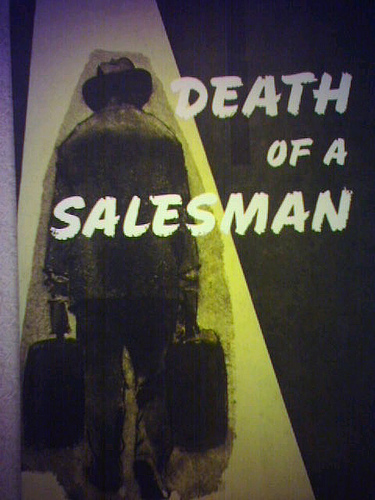
This first profile in unmanliness takes a look at traveling salesman, Willy Loman from Arthur Miller’s play Death of a Salesman. Death of a Salesman explores the world of post-war America and the effect that America’s new found prosperity had on men. During the 1950s, men began to feel pressured to not just provide for their family but to also give them the luxuries that society was coming to believe every household was entitled to. Every family deserved a house with a picket fence, a new car in the garage, and all the newest appliances to make life easier. Advertisers pitched the idea that the American dream was in reach of every man. Yet the reality then, as it is now, is that strenuously reaching to keep up with the Joneses can stretch a family perilously thin. Unfortunately, Willy Loman bought into the idea and he let it destroy him and his family. There’s nothing wrong with wanting to provide nice things for your family; Willy just went about it all wrong. Here are a few lessons we can take from Willy on how not to be man.
Success doesn’t come from just luck, popularity, or personality. All throughout the Death of a Salesman, Loman tells his two sons, Biff and Happy, that the key to success in life is to be “well liked” and that all you need is “a smile and a shoeshine.” According to Willy, if you can become popular and get people to like you, you’ll have it made in life. The other part of Willy’s success equation was dumb luck; he thought men just stumbled into success the way his brother apparently came into his diamond fortune in Africa. But this philosophy simply sets Willy and his sons up for failure. Good luck and being well liked will only get you so far in life. The true lynchpin of success is tireless ambition and hard work. Neither Willy nor his sons ever learn this, and they are consequently failures at the game of life. Don’t be superficial like Willy; put you shoulder to the wheel.
Luxuries aren’t worth taking on debt. Willy wanted to give his family the best in life. He wanted his wife to have a refrigerator, a vacuum cleaner, and a car. There’s nothing wrong with such a desire. The problem is that Willy took on massive amounts of debt to buy these things. His debt load was so crushing that he decided to kill himself so his family could have the insurance policy to pay for it all. Avoid debt like the plague. Sure, some debt is necessary in the form of a mortgage or student loans. But having the latest gizmo is not worth the financial and emotional stress that comes with consumer debt. A man should seek to be independent and self-reliant. Debt will only get in the way of that goal.
Don’t live in the past. As the play progresses, Willy begins to retreat more and more into the past. He daydreams about a happier time when his sons loved him and he was a success at work. As he mulls over the past, Loman tries to figure out how things went wrong. Usually he pegs not being “well liked” as the root of his current troubles. Willy is like that former jock who has done absolutely nothing with his life since his glory days on the high school gridiron. Their best days are always behind them. Living in the past won’t get you anywhere. We should always learn from it, but our focus should be on the present and future.
Stay faithful to your wife. During Willy’s sales trips to Boston, Willy begins to have an affair with a character known only as “The Woman.” His son Biff goes to visit Willy in Boston and catches his father in his adultery. In one of the most powerful scenes, Biff confronts Willy about buying The Woman new stockings instead of buying them for his wife. To Biff, the idea that Willy would treat some stranger better than his poor family back at home is the ultimate betrayal. After Biff’s encounter with his father and his harem, Biff loses all interest in school and fails math, thus setting him up for failure down the road. Adultery is an ugly, ugly thing. It can destroy your family. A manly man is faithful to his wife and devoted to his family. Do all you can to affair proof your marriage.
Running from your problems won’t solve them. Ultimately, it is Willy Loman’s denial of reality that leads to his downfall. He makes his sons lie to him so he doesn’t have to face the truth. And in the end, Willy chooses to escape from reality altogether by killing himself. He figures that the only way he can be of any worth to his family is if he dies, and they get the insurance policy. Instead of facing his problems, he runs from them. Sure, his death allows his wife to pay off the mortgage, and she says that her family is free. Willy does become sort of a sacrificial lamb for his family. But he has forever robbed his wife of a husband and his sons of a father. He could have solved these problems without killing himself if he had confronted them head on. Don’t shirk the responsibilities of your decisions, no matter how serious the consequences. Be a man of honor and confront your problems directly.
Note: If you haven’t read or seen Death of a Salesman, check it out. Very good. The film adaptation starring Dustin Hoffman and John Malkovich is wonderful.
Friday, October 10, 2008
Oprah: Dr. Oz Explains The Differences Between Male And Female Brains
Oprah: Dr. Oz Explains The Differences Between Male And Female Brains
Yesterday, Dr. Oz was back on Oprah to talk about health, and, in one of the most interesting segments, he broke down the male and female brains. First of all, did you know that we all start off with female brains in utero? It's not until testicles are formed, that the testosterone shoots up to the brain and changes it. There are fundamental differences between male and female brains, for example, women have a whole section that's dedicated just to worrying about shit. Men typically have larger brains (women's brains shrink with pregnancy), but they aren't any more powerful than women's. We just pack more neurons into a smaller package. (Sound familiar?).
Reconciling Masculine and Feminine World Views
Reconciling masculine and feminine world views
The masculine and feminine traits are not something we have due to our biological sex but abilities, attitudes and behaviour which we acquire from social interaction and unanalysed learning. We can say that gender is a socially constructed notion.CJ: Dr. Lalit kishore
GENDER IS viewed as a socially constructed notion. Thus, the masculine and feminine traits are not something we have due to our biological sex but the abilities, attitudes and behaviours which we acquire from social interactions and unanalysed learning. Gender in a social conception of what it means to be a man or a woman in a social context and it can change. In fact, most educators and social scientists think that there is nothing that is masculine and feminine in it, but nonetheless, there are abilities and attitudes acquired as mental conceptions which can be looked upon as feminine or masculine.Another notion about human beings which has brought a lot of harm to gender equity in that we have started treating them as ’resources’ or ’ means and instruments’ hence ’commodities to be used by and sold in the market’. For gender equity, human beings need to be taken as goals in themselves instead of their objectification as ’resources’ (Svennbeck).According to Huston, family is the most significant socialising agency, which influences the notion of gender roles. Besides parents, the cultural milieu, peers educational institutions, media and also market forces play important roles in sex — stereotyping the roles of males and females in the society. Nonetheless, parents are most important influence or gender role influence of their children in the early years of development.Accordingly, two world views and life systems get formed which need to be respected and balanced. There is a need for equity by valuing equally the women’s world.Over the years, due to their lived experiences, both men and women have imbibed different influences and ethics. Many educators, feminists and social scientists now believe that the feminine view of the self is quite different.
It is generally built upon relatedness or connection to others and has the abundance of empathy, receptivity and intuition.The dominant views of women on the process of knowledge have the following elements: (1) Knowledge in seen as constructed and the knower an intimate part of what is being known and that gets known, ie, a communion with what is being tried to be understood, (2) An attentive caring is important to the knower and the object of knowing or subject matter, i.e, a feeling for the self and other people, objects, words or knowledge system; and (3) Process of knowing is effective when there is an emotionally charged mutual relationships among the knower and teachers.There are two kinds of ethics which have got developed over the years in male and female ethics. Male ethics is based upon the ethics of competition and subjugation with a knowledge system that is formal and abstract with everything being treated as a resource or a commodity. On the other hand, female ethics is based upon the elements of receptivity, relatedness and responsiveness.
Wednesday, October 8, 2008
New Man Episode 32 - Robert Masters: The World Needs More Anger
Episode 32: Robert Masters: The World Needs More Anger

Why does the macho jerk seem to get the girl while the nice guy gets left behind? It might just have something to do with their relationship to anger.
This week we welcome Robert Augustus Masters back to The New Man and share his uncommon insights about the role of healthy anger in our lives. Robert gets into the juicy details about:
Listen as Robert helps us find that healthy middle way when it comes to our anger.
- How to separate anger from aggression
- What is the cost of ignoring your anger?
- Why does the world need more anger?(hint: more anger with less aggression)
- What is our moral fire
- Soft does not have to mean weak.
- What are you really pissed off about?
Related Links:


Tuesday, October 7, 2008
Do our children need male primary school teachers?
From the Times Online (UK):
Here is the response from a male primary school teacher mentioned at the end of that post:Do our children need male primary school teachers?
Are male primary school teachers vital role models for young boys? According to a new survey from the Teacher Development Agency, they are.
The research finds that male primary school teachers have acted as "fundamental role models to one in two men" (48 per cent), that more than a third of men feel that having a male primary school teacher challenged them to work harder in school, while a fifth believe that male primary teachers helped build up their confidence. Interestingly, the men questioned also said that they were more likely to approach male teachers with issues of bullying (50 per cent), problems at home (29 per cent) and questions about puberty (24 per cent).
With the new school year underway, and applications for primary school teacher training courses soon closing, it seems a good time to discuss this subject. Just 13 per cent of registered primary school teachers are men, and new data from the Higher Education Statistics Agency shows that just 23.8 percent of those qualifying to become teachers in 2006/7 were men.
The new report also comes on top of others along the same lines. Another one released by the TDA last year suggested that boys in primary school wanted men to teach them - there are so few male teachers, that many children have never been taught by one.
But before we just accept all this at face value, and once again rue the world we live in (all these poor boys, not enough male teachers. Woe is us), let's look at this all slightly differently.
For one thing, what about the girls? I'm pretty sure that it's good for boys and girls to be taught by both men and women. More family break-ups and single parent families means that many girls as well as boys are growing up without strong male role models. Surely it would benefit all children to have more male role models in their lives.
And if we are all agreed, then we need to look at why there aren't more male teachers - um, isn't it the fault of young men who don't want to see teaching as the "right" career for them? Is this really something the goverment needs to change? Perhaps there is some kind of cultural bias at play here (a thought that teaching is a job for "girls") or more worryingly, a fear of paedophilia (as the Telegraph reports). Do men want jobs where they will earn more money, or are we in a vicious circle whereby there are so few men in the classroom, few boys grow up thinking that it is a job for them?
Graham Holley, the TDA chief executive seems to be suggesting that more men would teach if only they really understood the effects they could have. It seems to me a little naive, but he says:
"It is telling that more than 1 in 10 men would consider a teaching career if they felt they could improve the life chances of young boys, or if they heard positive things about male teachers from friends, family or the media. Not everyone can be a sports star or TV star, but they can be a ‘star’ in the classroom and help inspire thousands of young minds. We need to celebrate the important roles both male and female teachers play in schools, and work to redress the gender balance to ensure the healthy development of children today.”
So men, come and tell us why you won't teach - and if you might consider it if only you knew how rewarding it could be.......And parents, do you care what the gender is of your child's teacher, as long as she or he can teach?
Just to throw a spanner in the works, there have been some suggestions that any plans to recruit more male teachers to act as positive role models for boys might be counterproductive. Alexandra Frean reported last year that research commissioned by the Department for Children, Schools and Families found little evidence that this "simplistic" approach worked, and also suggested that male teachers could be too harsh on boys (although this was in secondary, not primary schools). It also said that two thirds of pupils felt that the gender of their teacher was not important.
UPDATE: Please read School Gate's latest post - by a male primary school teacher....
(There is a good video about this whole issue - including a section asking children why they think there aren't more male teachers - on teachers TV).

Why I went into education, by a male primary school teacher
Earlier today I asked whether children needed more male primary school teachers, and why men don't want to go into teaching. Now Dominic Martin, who teaches Year 2 at Beech Hill Primary School in West Denton, Newcastle Upon Tyne, explains why he did make this choice. Dominic, who's 34, qualified as a teacher three years ago.
"I was working in retail management, but as I approached 30, wondered if I actually wanted to be doing it forever. My parents were both teachers, so I had seen them work and was aware of the ups and downs. What really appealed was the idea of working with young children, the way they can throw everything at you, and how they are discovering things all the time. I wanted to help them make those discoveries.
I applied for a PGCE, and got my fees paid, as well as a grant. I have to say that people who apply for secondary education do get a higher grant, and that I'm convinced primary school teachers need a higher profile. This is particularly true of male primary school teachers. When has the TDA ever run an advert showing a male primary teacher engaged in some fantastic work with a young class? Only by seeing the job 'live' if you like, will people think, 'oh yes I could do that', or 'that looks like the job I want to
do.'
I am one of two male teachers out of about 30 staff. Perhaps being male helped me get the job, but I hope it was more that the head saw me as being a good teacher. The quality of teaching and learning must always come first and should always be secondary to the sex of the teacher.That's what really matters. However, I do think it's advisable to have a balance within a school, so that children can spend time with men and women. It's good for children and parents to see that men are capable of being carers too.Some people were a bit surprised that I was going to be working with such young children, and there is sometimes the danger of a stereotype - those fears of paedophilia,which I can understand. However, I have always found parents to be very trusting and think that a lot of this depends on how the school is managed and the ethos of trust within it. I am happy to hold a child's hand and wouldn't pull away from a child who was upset or needed me. But I know the limits - I wouldn't have a child on my lap.
Sometimes I think that boys do respond to me in a different way - they want to impress me or behave better for me. But that's probably unconscious behaviour. What I do hope is that I am a positive role model for them, and that I teach all my pupils well."
Monday, October 6, 2008
Men Who Love Cats . . .
 . . . Not there is anything wrong with that.
I don't know . . . I like cats (and all other creatures) and have even had a cat as a roommate, but I am mostly a dog guy, so I don't quite get the whole cat thing. Moreover, I can't ever see a pet as my primary relationship -- can these guys really be emotionally healthy if the cat comes before commitment?
Sorry, Fido, It’s Just a Guy Thing
IF you ask Adam Fulrath who is the love of his life, he will barely blink an eye before responding: Parappa.
Mr. Fulrath, a 37-year-old design director at Time Out New York, keeps five photographs of Parappa, a shorthaired, bicolored, mixed-breed cat, on his desktop. He knows that it might be considered a little weird that a grown man would be so enamored with his kitty, but Mr. Fulrath, who is into video games and comic books and calls himself a “straight, geeky guy,” doesn’t care.
“She’s my primary relationship,” he said.
Mr. Fulrath is one of a growing number of single — and yes, heterosexual — men who seem to be coming out of the cat closet and unabashedly embracing their feline side. To that end, they are posting photographs and videos of their little buddies on YouTube and on Web sites like menandcats.com, and Twittering about them to anyone who will listen.
Indeed, it seems that man’s best friend is no longer a golden retriever, but a cuddly cat named Fluffy. This movement, such as it is, is in direct contrast to the most notable in the recent spate of reports about the relationship between a man and a cat, which were far darker; they focused on a young actor who was recently on trial in New York City for killing his girlfriend’s cat — he said it attacked him — only to have a jury decide after several days that it could not reach a verdict.
If it had been a little less violent, that case might have been more in line with what the world seems to expect of men and cats.
The image of the crazy spinster cat lady persists, and plenty of people do wonder about a guy with a cat. As a writer on adventuresofacitygirl.blogspot.com put it: “Single men and cats are like a burger and broccoli. Separately they are okay, but together it just seems off.”
But those who see a growing link between men and cats see that attitude (not to mention the cat slaying) as old-fashioned.
Clea Simon, who wrote “The Feline Mystique: On the Mysterious Connection Between Women and Cats,” said: “I do think it has become more acceptable for men to own cats — partly for practical reasons, like the growing realization that they’re better city pets, and partly the whole acceptance of our cross-gender traits that men crave intimacy, too.”
Stacy Mantle, the founder of Petsweekly.com, a magazine for pet lovers, said that men are becoming more “cat literate” because they themselves are evolving.
“It’s the unevolved members of the species who tend toward abuse of cats — and oftentimes, women and children,” said Ms. Mantle, who owns 18 cats.
Although there are no hard (or soft) statistics (it is rare to find an owner, man or woman, walking a cat in public), it seems that single, heterosexual male cat owners are on the rise. Over the last few years Sandra DeFeo, an executive director at the Humane Society of New York, said she had seen an increase in the number of single, straight men who are adopting cats.
Carole Wilbourn, a cat therapist (yes, really) in Manhattan, said that the number of her single, straight male clients has risen about 25 percent over the last five years.
When the Web site PetPlace.com asked its readers, “Do Real Men Own Cats?” almost 84 percent of respondents said “yes.” “Only intelligent, aware, caring men love cats,” one reader said. And in a 2005 survey by Cats Protection, an animal welfare agency in the United Kingdom, the majority of the 790 people who responded said it was cool for a guy to own cats.
This line of thinking does not surprise cat lovers, many of whom believe that only pillars of virility and masculinity would dare to own one. They are quick to point out other well-known macho cat owners: Ernest Hemingway, Mark Twain, Victor Hugo and Marlon Brando, who reportedly found a stray cat on the set of “The Godfather” and incorporated it into a scene.
John Scalzi, 39, an author in Bradford, Ohio, has been a cat guy his entire life. In September 2006, he posted a picture of a piece of bacon taped to his cat, Ghlaghghee (pronounced Fluffy — an ode to George Bernard Shaw), on his Web site www.scalzi.com/whatever. Thousands of viewers apparently found this hilarious.
Mr. Scalzi, who is now married and has a daughter, blames Hollywood for the continual bad rap that has befallen the male cat owner. Originally, he said, only strong men like Don Corleone, or the villains in a James Bond film, had cats.
“But then in the Seventies, Eighties and Nineties, Hollywood decided that we need to have the token gay man as the witty sidekick friend of the main female protagonist,” he said. “ ‘What kind of signature thing can we give him to convey that he is not an entirely masculine being? I know! We’ll give him a big fluffy cat!’ ”
In fact, Mr. Scalzi thinks that dogs are for the weaker of spirit, since the dog is, in effect, “your wingman.”
“If you’re feeling insecure about your space in the world, you get a dog because he will always back you up,” he said. “He’s the insecure man’s best friend.”
A man with a cat, on the other hand, “is secure with himself,” he said. “He’s sharing his space with a predator.”
Many women agree that guys with cats are extra special.
“They make the best boyfriends because they’re totally cool with staying home and watching a movie,” said Elizabeth Daza, 28, a video producer in Manhattan, who dated a cat-owning man for eight years. “Straight men with cats seem to be really secure and stable. They don’t need to be running around the park and proving their masculinity like the dog guys.”
On a practical level, cats are easier, male owners say — especially if they (the men) travel a lot. They can leave the cat alone for days on end, and the cat will survive.
“I would feel guilty if I had a dog and was out of the country for three weeks,” said Mark Fletcher, 38, an entrepreneur in Redwood City, Calif. who has two cats, Einstein and Babe (as in Ruth).
What’s more, cats are relatively low maintenance.
“A dog is a lot of work,” said Nader Ali-Hassan, 29, an account executive with a digital marketing firm in Cleveland.
Although he is married, he has had cats his entire life, and even has a picture of Ringo, a longtime feline companion, in his office.
“Maybe it’s not the most masculine thing in the world, but I’m comfortable enough in my own manhood,” he said. “The cat’s nice. I come home after a long day of work, it sits in my lap, I pet it, and then it goes about its business.”
SOME guys are even using their cats as vehicles to celebrity, like Paul Klusman, 39, a Wichita, Kan., engineer who catapulted to Internet fame after posting “An Engineer’s Guide to Cats” on YouTube in April.
The film, which features his three cats, Oscar, Ginger and Zoey, garnered about 3 million views. Mr. Klusman said he received about 300 marriage proposals from “lonely cat ladies from all over the world,” in addition to more risqué propositions.
“Any single, straight man who has the slightest bit of insecurity about his own sexuality will probably find it difficult to admit to owning or even appreciating cats” he said, echoing Mr. Scalzi’s sentiments.
Of course, it can become tricky, like when the cat gets in the way of a relationship.
The Cats Protection study found that single male cat owners were more likely than their female counterparts to have made, or consider making, a sacrifice for their cat — including giving up a holiday or going into debt for their cat if necessary.
Single men were also almost as likely as single women to break a friendship rather than lose their cat, and would consider choosing their cat over their partner.
This happened to Mr. Fulrath, who dated a woman who was allergic to cats.
“I thought, ‘This is never going to work,’ ” he recalled. “My cat takes priority over the new relationship. Realistically, unless there’s something absolutely amazing about her, he wins.”
Saturday, October 4, 2008
Does Feminism Discriminate Against Men? Part 3: Power and Powerlessness.
Disclaimer: The views expressed here are those of the blogger and the subjects of the conversation and do not represent my own unless otherwise stated.
My opinion, for what it's worth: to say that women have not been oppressed by men because they are not "fewer, dumber, or weaker" than men is just plain silly. Warren Farrell is full of partial truths that he suggests are the whole truth -- as much as that is true, he should be regarded as interesting but possibly harmful to the cause of a mature and compassionate masculinity.
The Integral Naked discussion is here -- this post is a summary by Corey deVos.
Does Feminism Discriminate Against Men? Part 3. Power and Powerlessness.
Warren Farrell and Ken WilberWritten by Corey W. deVos
In the third installment of this provocative conversation, Warren Farrell and Ken Wilber explore the nature of power and powerlessness as experienced by both men and women, discussing why it is that one gender’s power does not necessarily translate to the other gender’s oppression.
Power and powerlessness both lay at the heart of our ongoing cultural discussion of equality among the sexes. Too often we perceive this as a somewhat binary distinction—one group as the oppressor, the other as the oppressed—and thus one gender's power tends to be equated with another group's powerlessness. Typical of this line of thought is the claim that men have held the majority of the power for millennia, which has made women powerless by default. However, this oversimplification of sex and gender can be counterproductive in many important ways. As Ken Wilber has pointed out, the only way a group can become oppressed is if it is fewer, dumber, or weaker than another, three qualities that could not possibly be meaningfully applied to women as a whole. By the same logic, considering women to have been at the brunt end of oppression for all these years is actually both insulting and demeaning to the female gender. While there are certainly many genuine cases of both men and women being violently oppressed throughout history, we must avoid the temptation to think of either gender’s history as merely one of oppression. History is not a story of men oppressing women for thousands of years, and then collectively waking up to the folly of our ways. Men and women were both being oppressed—by each other, and more importantly, by the challenge of survival in a mysterious and hostile world.
In order to get a full grasp of this complex and fairly volatile issue, we must consider two different types of power and powerlessness, one type belonging to men, and the other to women. Since the very first waves of feminism, women began comparing their public roles to those belonging to men, and began to perceive a very real imbalance of opportunities for women to excel in the workplace. This, many people claimed, was testament to the outright disempowerment of women everywhere. A man's success was viewed as the only power that carried any real currency in society, and so a movement was born—or rather multiple movements, each building upon the triumphs and trappings of the last. Women's liberation allowed women to suddenly move into the workplace, more than ever before in history, and is now viewed as one of the most remarkable victories of the human spirit. Together, men and women began to view the public sphere as the arena of power itself, where all the gaps between oppressor and oppressed ultimately dwell, and the only place where they can be resolved. And in so doing, the "invisible power" of women was often devalued, if acknowledged at all.
However, once women began moving en masse into positions of social authority, many began to realize that men’s ostensible “success” in the public sphere was not necessarily a product of male power, but rather of male powerlessness—one of few options available to the highly disposable roles society offers to men. These roles often require a considerable sacrifice of time, energy, and happiness, as well as frequent abandonment of interest in things like music, poetry, dance, and other artistic expressions. Such material success often requires men to cut themselves off from all the qualities that are commonly associated with female power—namely love, connection, and compassion—and often replace them with the sort of hyper-masculine pathologies perceived as necessary to ensure financial prosperity, such as callousness, ruthlessness, and a tendency toward avarice. These traits started to define success for a great many people, traits that were in actuality a portent of how little power men really had.
When trying to weigh the distribution of power between men and women, Warren suggests a very interesting metric: life expectancy. For example, we can point to the significantly lower life expectancies among African Americans when compared to Caucasians as a valid measure of disempowerment—it could be surmised that because African Americans tend to have notably less societal power on average than Caucasians, they are subject to more stress and hardship throughout a lifetime, leading to more exhaustion, illness, and thus reduced life-spans. But the fact that men of all races can expect considerably shorter life-spans than women is not often regarded as symptomatic of this same sort of power imbalance, despite the fact that there appears to be no real biological reason why this should be the case. Of course it is entirely too simplistic to say that, since women tend to live longer lives, they therefore have more power—but we might be able to infer that, of the power men and women do already have, women's power may be more healthfully wielded.
Just as we might look to life expectancy as a measure of male vs. female power, we might also consider suicide rates as an indicator of overall powerlessness. Here too we find a tremendous imbalance between male suicide rates and female suicide rates, which predict that adolescent men are as much as four times more likely to kill themselves as women—and the ratio only becomes greater with age, with elderly men being more than one thousand percent more likely to commit suicide than women of the same age. Just as a woman's power can be characterized as being "invisible" and therefore all-too-easy to overlook, men's powerlessness has become invisible to the majority of society, even while it is being confused for his power. Again, it would be simplistic as to think that, since men kill themselves more often than women, they are more powerless than women. But perhaps we can suggest that the lack of recognition of this powerlessness is what causes so many males to prematurely end their own lives. The case could be made that the expectations for males to conform to the rigidly defined societal pressures of sexuality, success, and service are much greater than they are for females—which is certainly not to say that women do not have their own sets of societal pressures bearing down upon them from all angles, pressures which themselves directly impact a woman’s identity—but they tend to carry different sorts of consequence in the public sphere.
As Warren poignantly states, the weakness of men is the facade of strength, while the strength of women is the facade of weakness. The goal, obviously, is to thoroughly understand both power and powerlessness as they relate to men and women, thus enabling both sexes to move beyond the often-constricting roles we have created for ourselves. Some may consider it odd or disingenuous to have two men like Warren and Ken discussing women's issues as they do in this dialogue. It is not unusual in academia to believe that only women should deal with women's issues, and only men with men's issues, as neither can speak to the experience of the other. These rules of engagement have only reinforced the enormous divide between us, and it is only through self-awareness and inter-gender dialogue that we will strengthen our ability to honor and cultivate the brilliance inherent within both genders. The fact remains that both men and women are in this mess together—we created this mess together, step-by-stumbling-step, all throughout history—and therefore such identity politics have no place in this conversation. There can be no real progress for women without men's own progress taking place right alongside, just as there can be no real progress for men without honoring and deepening the many victories women have created for themselves in recent decades. We are defined only in relation to each other. Only together are we whole, completing the most sacred circuit the universe has ever known—a circuit through which life continues to proliferate, consciousness continues to amplify, and history continues to whisper its secrets to future generations.
Friday, October 3, 2008
Bad Boys Can Blame Behaviour on Their Hormones
Out-of-control boys facing spells in detention or anti-social behaviour orders can now blame it all on their hormones.Bad boys can blame behaviour on their hormones
- 15:37 30 September 2008
- NewScientist.com news service
- Andy Coghlan
The "stress hormone" cortisol – or low levels of it – may be responsible for male aggressive antisocial behaviour, according to new research. The work suggests that the hormone may restrain aggression in stressful situations.
Researchers found that levels of cortisol fell when delinquent boys played a stressful video game, the opposite of what was seen in control volunteers playing the same game.
The results suggest that biology rather than peer pressure might play a larger role than previously thought in delinquent behaviour, and raise new possibilities for diagnosing and treating such disorders.
Virtual rival
The study pitted each volunteer against a pugnacious, virtually generated rival boy in a computer game that had them competing for a monetary reward. The game was deliberately rigged to subject volunteers to stress, frustration, provocation, and taunting from their adversary.
Saliva samples from the 95 control volunteers showed that their cortisol levels rose by an average of 48%, as expected in stressful situations. But in the 70 participants with conduct disorder, levels of cortisol dropped by an average of 30%.
The researchers, based at the University of Cambridge, suggest that the delinquent youths may be so used to provocative and stressful encounters that they no longer respond by producing the "restraining" hormone cortisol.
What stress?
"They are behaving as though there's no stress at all," says lead researcher Graeme Fairchild, who led the study.
"It could be that they're used to provocative situations and habituated to stress," he says.
The disparities only arose during the game situation. Otherwise, the daily patterns of cortisol production were similar in delinquent and control volunteers.
One other surprise was that the cortisol drops were about the same across all the delinquents, whether they originally became disruptive during childhood or during adolescence.
Although it's already accepted that there is a strong biological component to "early-onset" conduct disorder, which develops around the age of five, the current thinking is that when delinquency develops in teenagers, it's mainly a result of malevolent peer pressure, perhaps combined with lack of supervision at home.
The new research challenges this picture by showing that in both groups, cortisol levels fell – a biological rather than peer-led response.
Treatment hope
"It could be that the same latent trait exists in both groups," says Fairchild, who has initiated new brain imaging studies to see if there are differences in the way delinquent brains function.
The results also raise the possibility of finding biological markers in the blood of infants that identify those most likely to develop conduct disorders.
Families and children could then be given help to manage and refocus their behaviour before it degenerates into the usual habits of lying, stealing, violence, malevolence and lack of concern for other people.
Alternatively, the research might lead to new drugs that have the same effect.
It's too soon to say whether extra cortisol would help. But Fairchild cites earlier experiments showing extreme violence in rats unable to make corticosterone, the rat equivalent of human cortisol. When the rats received extra corticosterone to compensate, it calmed them down.
Journal reference: Biological Psychiatry (DOI: 10.1016/j.biopsych.2008.05.022)
Teenagers - Learn more about a uniquely human phenomenon in our comprehensive special report.
The Human Brain - With one hundred billion nerve cells, the complexity is mind-boggling. Learn more in our cutting edge special report.

It's never simply a single quadrant affair (this one being exterior-individual - IT) -- if there are hormone issues, then what is going on psychologically (interior-individual - I) has an impact, as well as the physical environment (exterior-collective - ITS) and the cultural context (interior-collective - WE).
The Buddha was said to have discovered on the eve of his enlightenment...the entire edifice of causality - the circular structure of habitual patterns, the binding chain, each link of which conditions and is conditioned by each of the others - that constitutes the pattern of human life as a never-ending circular quest to anchor experience in a fixed and permanent self. This insight came to be named with the Sanskrit word pratityasamutpada, which literally means "dependence (pratitya) upon conditions that are variously originated (samutpada)." We will use the term _codependent arising_, since that gloss best expresses the idea, familiar in the context of societies of mind, of transitory yet recurrent, emergent properties ofThe same basic principle applies to the quadrants of integral theory. It's useful to isolate causes, but it never is that simple, which is why the targeted drug therapy idea seldom works as expected -- human holons are much more complex than that.
aggregate elements.