Showing posts with label femininity. Show all posts

Wednesday, March 12, 2014

What the Summer's Eve "Manly Mistake" Commercial Says about Men and Femininity

Wow, I had not seen this commercial. I'm sure it's supposed to be incredibly over-the-top and maybe the reaction below is taking it too seriously. But even in satire there are serious truths. For men, any hint of femininity is to be feared and immediately rejected with as much manliness as possible.

Femininity: Feared and Reviled

by Lisa Wade, PhD,


The paradox: masculinity is strength, power, and dominance… but femininity is terrifying. Gender rules insist that men must avoid association with the feminine at all costs because, if they do not, they are weak. They are pussies, bitches, women, girls. Femininity is weakness and yet, oddly, it has the power to strip men of their manliness. It is as if, as sociologist Gwen Sharp once put it, “masculinity is so fragile that apparently even the slightest brush with the feminine destroys it.”

Behold the best example of this phenomenon ever:


Let’s be clear. The reason he’s afraid of femininity is because it’s reviled. It makes you a woman, which makes you worthless. Which is fine for the ladies, but dudes are advised to avoid personal denigration if at all possible.

Thanks Summer’s Eve, you make my job easy.

Lisa Wade is a professor of sociology at Occidental College. You can follow her on Twitter and Facebook.

Friday, September 27, 2013

Men Are People and Women are Women

This collection of links from Bookforum's Omnivore blog is from the first week of the month, but there are some useful and interesting links here with which to waste some time.

Men are people and women are women


Sep 3 2013
9:00AM

Thursday, August 30, 2012

Not Male? Not Female? Must Be Agender - The Emerging Gender Neutrality


I suspect there have always been people who do not comfortably identify as either male or female, a self-perception that seems to be more common in the asexual community (according to the article, a 2011 study found that 23% of this community feels gender neutral). So now there is a name for this gender identity, or perhaps it's a lack of gender identity (?) - agender, or gender neutrois.

Isn't this simply a rejection of the gender binary? It seems that it may be a little deeper than that. All five of the people the author spoke to had no need for masculinity or femininity, so it's beyond gender fluidity. This is all very interesting to me . . . .

The article is from Rachel White (she of the wonderful Rachel Rabbit White blog) in the NY Magazine's The Cut blog.


Neither Man Nor Woman: Meet the Agender


"I didn’t really want nipples," Cory said, running a hand through a mop of bleached blond hair. Born female, 23-year-old Cory uses the pronoun co—and asked that we refer to co that way, too—and got elective surgery to remove co's breasts last year. But co is not transgender in the traditional sense, transitioning between female and male. Co wants neither gender. So co joined the ranks of the agender—or, in a more florid recent coinage, the gender neutrois.

"You read stuff on Tumblr about how us nonbinary people just want to be special snowflakes," explained Cory, who is special but made of sturdier stuff than a snowflake. Was Cory's desire to remove co's secondary sexual traits a ploy for attention? A reaction to internalized sexism? The result of sexual repression? "I tackled all that stuff with my therapist. We came to the conclusion that I was not okay with this part of my body. Regardless of where that came from, it was there." Co has neither breasts nor nipples now.

"It is so perfect," Cory said. “For me this is what neutral looks like and feels like.”

I found Cory through the #nonbinary #agender #neutrois tags on Tumblr. The social network has become an unofficial home for the gender neutral. Though most group themselves with the transgender community, they reject the narrative of a person born into the wrong, oppositely-gendered body. All five neutrois individuals I spoke to have no need for masculinity or femininity at all.

L to R: Cory, Micah, Ashton

"You read all these trans youth narratives, the kid insisting he was a boy and going to grow a penis. That was me when I was 3," explained 26-year-old Micah. "I was like the poster trans kid. But then somewhere in there, it shifted."

Skyping from an airy San Francisco apartment shared with a fiancĂ©e, Micah has chestnut hair styled like a surfer's, sea-glass eyes, and rose-flecked skin. For Micah, gender neutrality has involved laser hair removal, a double mastectomy, a low dose of hormones, and the pronoun they. Asked about their ideal gender-neutral body (though our subjects' chosen pronouns drive Microsoft Word's Spelling and Grammar Check nuts, I see no reason not to oblige) Micah replied, “This is it.”

Micah came out of the closet twice, first when they entered a relationship with a woman, and again when they transitioned to neutrality last year. Though Micah identifies as both agender and asexual—which they define as "a lack of sexual attraction"—girlfriend Tammy identifies as a sexual female.

"When we started dating I got really confused," Tammy reflected. "Was I now dating a girl? I knew I wanted to be with Micah, but did that mean that I was now a lesbian?" After "six months of confusion," Tammy settled on "queer," and has stuck with her queer relationship with Micah for five and a half years.

When they first started dating, Tammy thought she could "make" Micah desire sex. "Now we've just found so many different ways of expressing love, other than what the usual sexual relationship looks like. Sometimes we feel like being more intimate, and sometimes we don't."

When I spoke to the pair together Tammy mostly deferred to Micah, who was uncomfortable discussing the mechanics of their physical relationship. "Too much focus on genitals," they said, then compared sex to asparagus: "OK when cooked properly, but I never really have a craving for it." A blog post Micah wrote about the relationship emphasizes "cuddling" and "communication."

"There are more ways to express intimacy than just sex," Micah concluded, referencing Asexual Visibility and Education Network founder David Jay. Reached by phone, Jay emphasized that most asexual people have a gender. There is, however, significant overlap between those who lack sexuality and those who lack gender: A 2011 survey of the asexual community found that 23 percent of those surveyed identified as neither male nor female—although most do not go so far as to have their nipples removed.

Why did this iteration of gender and pronouns emerge? There are virtually no studies on people who identify as agender. In 2010 the National Transgender Discrimination Survey Report on Health and Health Care found that 12 percent of self-identifying transgender people surveyed identified as gender nonconforming. And there may be a connection to asexuality: Jay says the asexual community has become a safe space for those questioning gender. Tumblr has become the unofficial support space for agender exploration and, sometimes, fierce debate. (On recent post read, “So there is this guy on Facebook. He’s agender. He’s about fifteen other labels as well.... the thing about this guy though is that he isn’t really agender for any reason other than a political statement.”)

For Micah, “not growing up was always a huge factor, and still is. I idolized Peter Pan,” they told me, noting that they are sometimes mistaken for a young boy. “In San Francisco I am seen as a lesbian," Micah continued. "I hate being called a lesbian, because it means I am a girl. But queer people are visible here and I am visibly queer. But at home in Mexico, queer doesn't exist."

After coming out, Micah lost contact with their Mexican family. They launched an agender blog, Neutrois Nonsense, and built a small online community there. Micah says their website receives over 12,000 pageviews a month, and a related Tumblr account has 2,200 followers.

Ashton, a 21-year-old Kansan, also passed as a lesbian until coming out as agender. Large and square shaped with a pinkish complexion, silvery-blond short hair and wire-frame glasses on a slight nose, Ashton (who also uses the pronoun ‘they’) used to work 50 hours per week in a factory and spends downtime in a transgender support group. (Ashton thinks the internet makes it easier to find one's way to an agender description. "You have Google in a tab next door, to explain things.")

Ashton’s supervisor and two other women at the factory formed a small queer community, which Ashton joined. “Most people who work there are male, so the women there really bond over female-ness. One day I counted 32 times that I was called by a female name--lady, miss, girl.” Ashton recounts a lot of joking around and sometimes going out together after work.

But Ashton was met with silence when they revealed their agender identity at the factory.
Persevering, Ashton wore a Pride shirt to work another day, which showed three boxes: ‘Female’: blank, ‘Male’: blank and ‘Blank’: checked. “I was asked to switch it inside out because it was distracting and offensive,” Ashton told me during a Skype chat in July, noting a fear of getting fired. Two weeks later, it happened. Ashton wrote on Tumblr: “I just lost my job for being a lesbian presenting assumed transguy atheist liberal who knows what else.”

Losing the job was something Ashton couldn't afford, since they are saving up for a double mastectomy. “I bind my chest for 11 or 12 hours a day when I am at work," they said before getting fired. "The recommended limit is 8 to 12 hours with as little strenuous activity as possible. I am doing lots of lifting and am on my feet all day. It is hot, sometimes my back spasms.”

Micah has faced loss in the name of gender neutrality, too. Upon finding out that her one-time daughter would be getting a double mastectomy, Micah's mother disowned her child. To this day she lights candles and talks to angels on Micah's behalf.

"My wife views Micah's actions as an act of terrorism, the fact that we have to have things on Micah’s terms," Micah's father explains. Their family is Mexican and Jewish. "She is worried about social and cultural things: how will Micah connect with Mexico?"

Micah's father supports his child's transition, as well as Micah's relationship with Tammy. The pair would like to marry and have children; Micah's father thinks they shouldn't wait for his wife's approval, because they may never get it.

Micah is actually the third name that they have tried out during transition—first it was Mich then Maddox as an online moniker, but it didn’t feel right ‘in real life.’ But Micah says they're sure that this is it. Micah is working on the legal paperwork to cement this chosen name. I ask, is there anything more to the transformation?

 “I don't remember aspiring to grow up to be a man, but was disgusted by the idea of growing up to be a woman. Physically I don't think I want anything different than what I have today, my own skin.”

All that's left now is aging. Micah imagines growing into a wrinkly, graying little kid, sort of like Benjamin Button, the F. Scott Fitzgerald creation who ages backwards: starting old and becoming younger.

Tuesday, May 22, 2012

Allison Hope - A Penis and a Dress: Why the Gender Binary Needs to Go Away


The other day I posted a video on intersex children, and some estimates suggest that 1 in 100 children born do not conform to the biologically "standard" male/sexual genitalia. Gender identity is even more fluid in many people's opinions - there are stereotypes of traditional masculinity or femininity, but very, very few people conform to these stereotypes, or would even want to.

In this article from Huffington Post, Allison Hope makes the same argument that has been promoted on this blog for years - the gender binary is no longer useful and needs to be let go.

A Penis and a Dress: Why the Gender Binary Needs to Go Away


Allison Hope, PR specialist and journalist
Posted: 05/22/2012

If your genitalia don't match the gender you most identify with, the American Psychiatric Association slaps you with the weighted label "gender identity disorder." There's current dialogue around changing the label to "gender incongruence," but it still boils down to the same ignorance: Society is placing judgment on you because you don't play by the rules.

What kind of message are we continuing to send to pregnant people everywhere? We live in such a deeply gendered society that our kids have no fighting chance when it comes to freedom of gender expression. Mainstream voices continue to use the wrong dialogue to talk about those who transcend gender norms; the recent Washington Post piece "Transgender at five" is a perfect example. By using language like "gender identity problems" and "condition" to describe a child who doesn't want to dress, act, or play like a girl just because this child was born with a vagina, the piece reinforces the existing model rather than poking holes in it. Our tunnel-visioned, outmoded landscape needs a fresh, fundamental critique. We're looking at biological sex and gender in all the wrong ways.

The solution? We need to raze the binary gender system entirely.

A lofty, pie-in-the-sky goal, perhaps, but one that we're entirely capable of achieving. What purpose does aligning biological sex with societal ideas of gender norms serve, anyway? Why should someone with a penis be outfitted in blue and get toy trucks while someone with a vagina gets shuffled off to ballet class and squeezed into frilly dresses? Monitoring someone's psychosexual development might be important for health reasons, but policing their gender certainly is not. How do our constructs of "maleness" and "femaleness" contribute to a better world? They don't.

Medical treatment, such as hormone therapy and surgery to more closely match bodies with an authentic sense of self, is currently the right decision for some people, but our existing, binary gender system makes it impossible to determine whether any of those people might feel more at home in the bodies in which they were born if only we backed away from trying to assign labels and behaviors to match our genitals. It's likely that some people would not want physical alterations if we taught everyone from birth that the body you were given doesn't dictate what childhood and adult expressions and activities you can engage in. In fact, not only would life get infinitely more accepting for transgender folks, but doing away with gender labels would solve millennia-old problems like misogyny, for one. Listen closely: Can you hear the glass ceiling shattering?

Envision a society where less emphasis is placed on body parts to describe identity. Imagine a world where someone with a penis can wear dresses every day if this person desired. Gender-neutral bathrooms and department stores and professional sports become the rule rather than the exception to it. Children can choose to wear whatever they want, play with whatever toys they prefer, and "It's a baby!" replaces the gender-assigned announcement that proud parents send out. We let our children identify themselves, or not, as they grow, and do not impose gendered rules on their tiny, vulnerable, developing senses of self.

After all, the biological spectrum is much more varied than just "man" or "woman"; when you factor in hormonal, chromosomal, and physical makeup, you get all sort of natural variations of sex that could, and probably would, translate into many different genders if only we allowed for it. If we shook the very foundations of our limiting, binary-gendered society, we're likely to see a very colorful array of confident, creative, beautiful people who span the range of internal and outward gender identity and expression.

We're getting closer in Western thought to at least allowing our children to re-identify when the labels we've placed on them don't match their own self-identification, but we continue to fail at backing the conversation up to the point in time when we looked at our little embryo via ultrasound and decided whether we wanted to know the gender. Who cares what color we paint the nursery walls? We should reinvent our society so that our children can express themselves freely without the constraints of gender. Until we get rid of "male" and "female" as pillars of personhood, we will never see a solution to the discrimination waged against those who do not fit cleanly into the existing and limiting categories.

Sunday, June 5, 2011

Elizabeth Debold - What Do We Mean by “Masculine” and “Feminine,” Anyway?

This is an old post from EnlightenNext, but Elizabeth Debold investigation of "What Do We Mean by 'Masculine' and 'Feminine,' Anyway?" is still an interesting and useful perspective.

At the end of the article, she asks that we try not using the terms masculine and feminine in business or personal growth contexts for the next year, which would have been 2010. This seems like a great idea - I'm not what value those terms have in realms outside of gender studies and psychology.

The problem is that people tend to think in terms of stereotypes (masculine = assertive, agentic, rational; feminine = collaborative, communal, feeling) - connecting these traits to a gender binary creates a lot of problems when we are working with individuals.

For example, as a male, I am more collaborative (f) than assertive (m), more agentic (m) than communal (f), and more rational (m) than feeling (f), but I am also intuitive (feminine) and empathetic (feminine).

I suspect most people, male or female, or a mix of these traits, not two-dimensional caricatures.

What Do We Mean by “Masculine” and “Feminine,” Anyway?

228-problem1_masfem

Quick: “masculine”–take ten seconds and say the words that come to mind that describe masculine. Next, do the same with “feminine.” That was the first exercise that my friend and colleague Cindy Wigglesworth and I asked participants to do in the breakout session that we led at the Integral Leadership in Action conference (October 15-18). What did the participants say? Innie and outie (hence the photo that I put at the top of the blog). Yin and yang. Active and passive. Driving and yielding. Assertive and receptive. Thinking and feeling. Eros and Agape. Rational and emotional. Hard and soft. Pointed and embracing. Strong and… You know, the ususal opposites or polarities that are often associated with men and women. While some describe (or infer) the different bodies that we inhabit, others reflect the different roles and opportunities that women and men have had in culture. “Masculine” and “feminine” don’t each describe one thing–they are a kind of grab bag of stereotypical gender qualities. Cindy and I wanted to encourage these representatives of the integral movement to put a temporary halt to their use of these terms and instead speak much more specifically and precisely about what one really is referring to.

The ILiA group is pretty much focused on business and organizational applications of integral theory (usually, Ken Wilber’s integral theory), and these organizational change agents often work to transform businesses and business leaders from being overly “masculine” to embracing more of the “feminine.” In our postmodern times, the “feminine” has become a buzzword for the kinder and gentler qualities that we want to see valued more in culture. Fine. But labeling those qualities “feminine,” which means “related to females,” seems problematic to me. Masculine and feminine are such value loaded terms–asking a man to be more feminine, or telling a strong woman that she should express more of her feminine side is often confusing, suggesting that somehow either the individual should be more of the other gender or is doing gender, which is one of the deepest aspects of our identity, wrong. If you want someone to change, being more precise about the change you’re looking for is much more helpful to him/her. Speaking about being attentive and listening more is a much clearer direction than asking an individual to be more feminine. Moreover, isn’t it more likely that our culture is more likely to change by adopting values that refer to general human qualities or competencies (listening, assertiveness, compassion, rationality) rather than to whatever the feminine means as a whole?

Cindy and I spoke about how our ideas of gender have changed as human consciousness and culture have developed. There really wasn’t a sense of masculine and feminine as we think about it now until the late medieval period–those words weren’t even in the English language until the fourteenth century. They really are concepts that emerge with modernity, when the entire social world in the West was divided by gender into the male public sphere and the female domestic sphere.

Cindy likes to think about the polarities that we associate with masculine and feminine (like agentic and receptive) as comprising a system in which both qualities are needed. She was drawing on Barry Johnson’s important work on polarities and how to work with them. She also suggested that we might think about when gender/sex matters and when it doesn’t. Certainly, gender/sex matters when you want to make babies! But in many, if not most, spheres of life, gender or one’s sex shouldn’t matter. Maybe one needs to develop certain competencies–such as in being more connected in relationship or more willing to take risks–but these are not really about gender, even if, at this point in human cultural development, men may often have more experience and comfort with risk and women with a certain connection in relationship.

One of the points that I hope that I made well was that using the term “feminine” to refer to the change we want to see in others or in organizations (and society) ends up hurting women. Believe it or not. It suggests that we women have no developing to do. And, given the crises we are facing, we ALL need to be doing all we can to develop and to consciously evolve. We women don’t have a lot of experience or mettle with standing up and staying together under pressure. Men, actually, are often better at that and we can learn a lot there. Moreover, pushing men to be more “feminine” (rather than coaching them to develop certain skills that are important to us all), too often creates distrust and a deep sense of separation, rather than the unity that we so badly need. Your average sensitive guy might not say anything–he knows better–but, given a chance to talk about it, that sentiment is right on the surface.

Our solution, for the time being, is to ask all integralists to put the words “masculine” and “feminine” on furlough for a year. Let’s see what happens when we stop using those words in business or in relation to personal growth or change. My hunch is that we’ll all be more effective at bringing about the changes that we want to see. Can we all give it a try and then compare notes next year at the ILiA conference?


Friday, March 25, 2011

So much for aggression being “male” and conciliation being “female”

http://justjudyjudyjudy.com/wp-content/uploads/2009/10/obama_clinton1232658178.jpg

Maureen Down observes that in the Obama Administration, the liberal men (including generals) waffled on the no-fly zone over Libya, but not the women, the were strongly in favor of taking military action. She sees this as a shift (perhaps fleeting) on the hegemonic view of women as peaceful and conciliatory and men as militant and aggressive. Perhaps - but for Rush Limbaugh to call Obama and his male advisers the "new castrati" is to perpetuate the old stereotypes. But should expect nothing less from a bloviator like Limbaugh.

I see it a little differently.

Obama's leadership style is a little too centered in the "Human Bond" stage of development (worldview), generally seen as "Consensus" leadership, and identified with terms such as egalitarian, feelings, authentic, sharing, caring, and community. To me, this is the biggest flaw in his presidency - he won't simply step up and say, "after consulting with X, Y, and Z, I am going to do . . . ." He wants a consensus, and human beings as politicians are never going to reach much of a consensus about anything, especially if many of them are operating in the same worldview as Obama (or concerned about re-election).

So, in this case, many of the generals were probably hesitant to commit more resources to yet another military action, especially after Iraq and Afghanistan (and remembering Rwanda). And my guess is that many of Obama's advisers feared the liberal response that was vocally opposed to this action, while fearing if they did not act the GOP (McCain wanted to send in troops) would brand him as a effeminate wimp.

Looks like he got both responses anyway - which is all the more reason to make a choice and make it happen. He needs to stop worrying about getting people to agree - he is president now, not a community organizer.

Certainly, as this article suggests, there were some gender differences - but as the explanation also details, the differences in opinion between the men and the women were more a factor of experience, which in this case the women had and the men did not (and those men with experience did not want to get sucked in to another regional skirmish).

In the end, this is yet another example of Obama lacking the fluidity to adapt his leadership style to the situation at hand (added to health care reform, closing Guantanamo Bay, corporate regulation, and all the other instances where he has failed to step up and take charge).

Fight of the Valkyries

By MAUREEN DOWD
Published: March 22, 2011

They are called the Amazon Warriors, the Lady Hawks, the Valkyries, the Durgas.

There is something positively mythological about a group of strong women swooping down to shake the president out of his delicate sensibilities and show him the way to war. And there is something positively predictable about guys in the White House pushing back against that story line for fear it makes the president look henpecked.

It is not yet clear if the Valkyries will get the credit or the blame on Libya. But everyone is fascinated with the gender flip: the reluctant men — the generals, the secretary of defense, top male White House national security advisers — outmuscled by the fierce women around President Obama urging him to man up against the crazy Qaddafi.

How odd to see the diplomats as hawks and the military as doves.

“The girls took on the guys,” The Times’s White House reporter, Helene Cooper, said on “Meet the Press.”

Rush Limbaugh mocked the president and his club of “male liberals,” saying: “Of course the males were opposed. It’s the new castrati. ... They’re sissies!”

Susan Rice, the U.N. ambassador and former Clinton administration adviser on Africa, was haunted by Rwanda. Samantha Power, a national security aide who wrote an award-winning book about genocide, was thinking of Bosnia. Gayle Smith, another senior national security aide, was an adviser to President Clinton on Africa after the Rwandan massacre. Hillary Clinton, a skeptic at first, paid attention to the other women (putting aside that tense moment during the ’08 primaries when Power called her “a monster”). She also may have had some pillow talk with Bill, whose regrets about Rwanda no doubt helped shape his recommendation for a no-fly zone over Libya.

How odd to see Rush and Samantha Power on the same side.

We’ve come a long way from feminist international relations theory two decades ago that indulged in stereotypes about aggression being “male” and conciliation being “female.” And from the days of Helen Caldicott, the Australian pediatrician and nuclear-freeze activist who disapprovingly noted the “psychosexual overtones” of military terminology such as “missile erector” and “thrust-to-weight ratio.” Caldicott wrote in her book “Missile Envy:” “I recently watched a filmed launching of an MX missile. It rose slowly out of the ground, surrounded by smoke and flames and elongated into the air — it was indeed a very sexual sight, and when armed with the ten warheads it will explode with the most almighty orgasm.”

There have been women through history who shattered gender stereotypes, from Cleopatra to Golda Meir to the “Iron Lady” Margaret Thatcher, whose critics on the left sniffed that she was not really a woman. As U.N. ambassador, Madeleine Albright pushed back against Colin Powell on a Balkans intervention — “What’s the point of having this superb military that you’re always talking about if we can’t use it?” she asked him — and Condi Rice pushed ahead with W. and Dick Cheney on invading Iraq.

When President Obama listened to his militaristic muses, it gave armchair shrinks lots to muse about. As one wrote to me: “Cool, cerebral president chooses passion and emotion (human rights, Samantha, Hillary, Susan) over reason and strategic thinking (Bob Gates, Tom Donilon). Is it the pattern set up by his Mom and Michelle — women have the last word?”

White House aides smacked back hard on the guys vs. girls narrative. A senior administration official e-mailed Politico’s Mike Allen that Power, Smith and Hillary Clinton weren’t even in the meeting where the president decided to move forward and tell Rice to seek authority at the U.N. for a no-fly zone. Maybe they were already nervous that the president was sightseeing in Rio with his own girls and watching drum performances while senators like James Webb and Richard Lugar were charging him with overstepping his authority in Libya, and Dennis Kucinich talked impeachment.

Whatever the reason, the spinners were so afraid that the president would seem to be a ditherer chased by Furies that they went so far as to argue that three of the women were not even in the room for The Decision. So the women were in their place? Where, the kitchen?

As compelling as the gender split is, it’s even more interesting to look at the parallels between Obama and W. Candidate Obama said about a possible strike on Iran, “The president does not have power under the Constitution to unilaterally authorize a military attack in a situation that does not involve stopping an actual or imminent threat to the nation.”

Yet both men started wars of choice with a decision-making process marked more by impulse and reaction than discipline and rigor.

Denouncing the last decade of “autopilot” for presidents ordering military operations, Senator Webb told Andrea Mitchell on MSNBC: “We have not had a debate. ... This isn’t the way that our system is supposed to work.”


Monday, March 14, 2011

Chris Dierkes - Against The Use of the Terms Masculine and Feminine in the Spiritual Path

Several years ago, for a few months, I thought David Deida was the sh!t - mostly because some integral people had promoted his version of gender and sexuality as integrally informed.

Then I read his books, and did some background research, and discovered that (1) he just amplifies and perpetuates destructive gender stereotypes (but he makes them sound cool), including his "stage three" non-gender bound versions of masculine and feminine, and (2) that he was another of the many "integral" people who (supported and promoted by Ken Wilber) was a student of the dysfunctional, abusive, authoritarian, cultish guru last known as Adi Da (also known as Bubba Free John, Da Free John, etc).

Wilber wrote many glowing endorsements of Adi Da, and while eventually warning people to join Da's community at their own risk, he never recanted his assertions that Da was the first and greatest Western Avatar - even after Da had proclaimed himself God, asserted that enlightenment required devotion to and worship of him, and was exposed in many news reports and eye-witness accounts as an abusive, drug-abusing sex addict.

If only figured that Deida would be associated with Da at some point (1986-1988).

Admittedly, Deida is a brilliant and well-educated man - check his Wikipedia page for details on his life. Yet there is something troubling about his views on sexuality - not the least of which is that he has been willing adopted by the "pick up artist" community.

In this article from Beams and Struts, Chris Dierkes offers a very cogent explanation of why Deida's gender and sexuality teachings are problematic. This is a long and well-argued piece, so please go read the whole article - I am posting what amounts to the introduction to get your interest.

Against The Use of the Terms Masculine and Feminine in the Spiritual Path

Written by Chris Dierkes


[Warning: Video somewhat NSFW].

Discussions concerning the masculine and feminine have a long and controversial history in the cultures of spiritual practice.

The key commonality to teachings that use masculine and feminine in spiritual discourse is to assume the existence of a masculine and a feminine principle. These principles are said to be universal (even cosmic) in nature and therefore trans-cultural. Further, the masculine and feminine qua principles are not to be defined solely as men and women. That is a man can be said to have a feminine side and women a masculine side.

This idea of the masculine and feminine principle runs through the teachings of Tantricism as well as the Taoism traditions. The teaching has a long and honorable heritage. Just so in the (self-named) integral world the terms masculine and feminine (as principles) are bandied about quite frequently, and in my experience typically in quite ignorant and deluding fashion.

There is quite a bit of criticism out there about the use of the terms masculine and feminine in integral thought (our own Sr. Vanessa is one of the experts on this conversation), which has to my mind too often been categorized as postmodern and therefore deficient (and therefore able to be ignored). A brilliant counter-example to that trend—one that takes seriously these issues and offers a substantive critique is this article on the Divine Feminine by Elizabeth Debold (highly recommended). Also, this one by Elizabeth.

Into that fray, I offer this post. It is meant to be controversial and generate intense thought and discussion. Before I go there, however, I want to make clear that just because I’m taking a fairly critical stance on this one issue (the use of masculine/feminine) in relation to spiritual teachers in the integral world does not mean I think they have nothing to offer. I’ve learned a great deal from many of them and appreciate much of what they do. The main reason I offer this criticism is because I think it is creating an unnecessary barrier to the dissemination of their teachings. Here less would be so much more.

shiva-shakti

I’ll begin with the video at the top of this article by David Deida, perhaps the most (in)famous contemporary teacher of masculine and feminine. I should say upfront that I actually think David often gets a bum rap. This video is good because you hear David’s own words rather than summarized versions (whether pro or con) of his ideas. Nevertheless I still think there is a serious categorical error in what he says.

Deida clearly articulates the idea of a masculine and feminine principle. The Masculine, Deida says, is the Witness or the Unmoved aspect of Consciousness. The Feminine, in contrast, is Light or Energy-Radiance, the Manifest Form of Consciousness.

This teaching is the classic teaching of the Shiva-Shakti Tantric tradition. Lord Shiva is Dark and Unmoved, The Death or Deatheless Ease of Consciousness. Goddess Shakti is the Dancing Wild Energy of Manifestation.

Now you’ll note that David says his description of Consciousness and Light as Masculine and Feminine is how he paints, a form of art, and a description (really an interpretation I would say). Too often people have forgotten how this is an artistic painting and not a scientific description of reality.

yin/yang

Another teacher who uses Masculine and Feminine in integral spiritual discourse is Genpo Roshi (Big Mind/Big Heart teaching). This article lays out nicely Roshi’s views on the matter. Genpo is more influenced by the Taoist tradition of the Yin/Yang symbol than the Shiva-Shakti imagery.

In fact though the Yin-Yang and Shiva-Shakti imagery are often thought to be interchangeable, it’s worth asking whether they are so. Notice that in the Taoist symbol it is the Feminine (Yin) that is dark, receptive, and unmoved while in the Tantric system it is The Masculine (Shiva) arguably exhibits those traits. In the Taoist system it is the Masculine (Yang) that is energetic, the force of evolution, something akin to the Shakti (Feminine) in the Tantric system.

I don’t want to push those distinctions too far, but notice that in some sense, the language and categorization is a bit arbitrary.

Third, Sofia Diaz, one of the leaders of Integral Feminism. She writes:

So we’re basically talking about something that is invisible because it is so present all the time. And it is important to make the distinction between the terms feminine, woman, and female. The Feminine is an aspect of existence that is independent of women. A more absolute definition would be that, relative to the Masculine Principle of absolute infinity, the Feminine Principle is everything that appears, everything that is noticed, even the noticer himself or herself. However, in terms of human embodiment, it is expressed as a woman’s body, because the Feminine is the receptive principle and the masculine is the penetrative principle. Our relationship to the Feminine is our relationship to embodiment.

I think this equation of Embodiment with the Feminine and Infinity with the Masculine (as trans-personal Principles) is deeply flawed. By interpreting, naming, and labeling the principle of Consciousness-Agency as Masculine and Embodiment-Radiance as Feminine, we end up converting what are (in many cases) specific cultural and historical expressions of gender into Cosmic Archetypes of the Universe. The technical philosophical term for such a mistake is essentializing—making what is specific, chosen, and open to change into something eternal, essential, and given in the Universe. This doesn't mean I think their teachings, practices or ways are invalid--I'm simply talking about interpretation and categorization here.

Read the whole article.

For what it's worth, Deida was a student of and co-creator of partnership teachings with Sophia Diaz from 1983 to 2000, so there is bound to be considerable overlap in their perspectives (Deida, David and Diaz, Sofia; The Tantra of Relationship [Audio program], 1990).


Friday, December 17, 2010

Take the Bem Sex-Role Inventory

You can take the Bem Sex-Role Inventory online - with instant scoring (write down your numbers when the pop-up results screen comes up, it doesn't save them for you). This was one of the most widely used gender scales (and may still be). A 25-year re-evaluation suggested it needs to be revised - not sure if it was or not - seemed pretty sex-role traditional to me.

Here is a brief summary on interpreting your results (more is available at their website):
Find out your sex type by consulting the following chart.
Masculinity greater than 4.9 and Femininity greater than 4.9 = Androgynous
Masculinity greater than 4.9 and Femininity less than 4.9 = Male sex-typed
Masculinity less than 4.9 and Femininity greater than 4.9 = Female sex-typed
Masculinity less than 4.9 and Femininity less than 4.9 - Undifferentiated
The publisher of The Bem Sex Role Inventory (BSRI) describes the purpose of the test in this way:
"The Bem Sex Role Inventory (BSRI) provides independent assessments of masculinity and femininity in terms of the respondent’s self-reported possession of socially desirable, stereotypically masculine and feminine personality characteristics. This can also be seen as a measurement of the extent to which respondents spontaneously sort self-relevant information into distinct masculine and feminine categories. The self administering 60-item questionnaire measures masculinity, femininity, androgyny, and undifferentiated, using the Masculinity and Femininity scales." - http://www.mindgarden.com/products/bemss.htm
Bem’s conception of gender typing placed a high value on individuals demonstrating flexibility in their ability to embody the positive values of both genders, as is llustrated in the following quote.
"The concept of psychological androgyny implies that it is possible for an individual to be both compassionate and assertive, both expressive and instrumental, both feminine and masculine, depending upon the situational appropriateness of these various modalities. And it further implies that an individual may even blend these complementary modalities in a single act, such as the ability to fire an employee, if the circumstances warrant it, but with sensitivity for the human emotion that such an act inevitably produces."
The corollary of this positive view of androgyny would hold that being sex-typed or undifferentiated (having neither characteristics valued for men or women) would be less adaptive or advantageous for the individual. One interpretation of strong sex-typing is that highly sex-typed individuals have constrained the possibilities for their development by accepting society’s determination of what the might become.
My sense is that this is, at best, a very crude inventory. It's binary (male-type or female-type), but if you score high on both elements you are then androgynous, or if you score low on both you are undifferentiated. Not much sensitivity or sophistication.

Anyway, here are my scores, making me androgynous apparently.
72.222 out of 100 on masculine
60.833 out of 100 on feminine
49.167 out of 100 on androgynous

Saturday, October 9, 2010

David Franklin - "The 'Hidden' Patriarchy of the Men's Movement"


There's a Facebook group called Radical Men - I "liked" it, which makes me a member, in essence because some of the other people involved are people I respect. This is their group description:
Men living radically alive, from their authentic power, creating healthy relationships with their own sexuality, spirituality, and greater purpose.
That's cool. But I hadn't really noticed much going on there, until this post came up the other day.

In general, I am in agreement - with the caveat that there really has been a movement of men into the feminine, and too far so - men who have eschewed masculinity as aggressive and destructive, which is simply wrong, and pathetic to boot. These men are often deeply associated with radical feminism, not so much the healthy feminism where men are still valued as men.

Here's a very simple summary:
Thesis: Traditional masculinity is too limiting and too cut-off from our whole being.
Antithesis: We need to reclaim our femininity and repress our violent masculinity.
Synthesis: We are both masculine and feminine, to varying degrees, and must be able to embody both polarities in healthy, fluid ways.
This is a broad generalization, but it is essentially true in my experience.

Franklin's article makes this argument as well, and while parts of it do not feel "correct" to me, that may be more about me and my own sense/experience of masculinity. On the other hand, I totally agree with him about using being "woman-like" or "gay" as ways to subjugate men/boys into the traditional masculine roles. That shit needs to stop.

by Radical Men on Friday, October 8, 2010

It’s time for an empowered men’s movement, one based on response rather than reaction.

Yes, there have been attempts. And yet, it seems like something has been missing. Like men have been flailing around in the dark, searching for meaning and identity with no real roadmap, grasping for some way to feel like “men” again. Looking at what and who not to be, as opposed to what and who to be.

In the initial part of the movement, there was an emphasis on reclaiming the “wild man,” leaving behind (and sometimes blaming) the ways of the feminine. Beating drums in the woods, hooting and hollering and dancing and crying, breaking the shackles of our mothers (and women in general) who supposedly were to blame for our emasculation. That somehow women (and the feminine) tamed us, and that we needed to escape.

There was also the response to feminism to fuel the movement; men thinking they were “bad,” and as such turning into pleasing “nice guys” in order to make up for their supposed defectiveness. Identity came in the form of standing up for women, with little sense of self to sustain the effort.

More recently, there has been critique on the current state of men being lost, wishy-washy, flowy, sensitive, and emotional, supposedly with “all heart and no spine.” Interestingly enough, these characteristics are attributed to being “too feminine.” Hence, we as men had better reclaim our masculine spine and balls. (And, I’m confused: since when does “all heart” have anything to do with being lost, wishy-washy, flowy, sensitive, or emotional?)

The interesting thing in all of these approaches is that they are sourced in reaction rather than response. In essence, they are “anti-feminine” and “pro-masculine” as the solution to become real men. They require shedding aspects of our femininity (or simply settling for the superficial aspects) and claiming more of the masculine aspects.

Much of men’s identities is focused around not being feminine, hence derogatory terms such as “pussy,” “crybaby,” and “acting like a girl (or woman).” We do what we can to avoid as coming across too feminine. Masculine identity is based on acting tough, having our shit together, being on purpose, working, and getting things done. Trace it even deeper, and we find the roots of homophobia: a mask for our insecurity and fear of being feminine (read: weak).

The shame in all this (in addition to being anti-feminine) is that none of these approaches truly honor the essence of the feminine. Yeah, some give it lip service, such as attempting to gain feminine trust (read: manipulate feminine trust), becoming more emotionally literate, or engaging in “goddess worship” (read: passive-aggressive mask to gloss over our anger at women and come off as sensitive guys who love and adore them, and who, of course, wouldn’t mind getting a little sex in return for their efforts. Interestingly enough, many of these men are not so glossed over and idealizing around their anger with their own mothers, sisters, grandmothers, etc.). Hmmmm . . . must not be the promise of getting laid in return.

For as much as we’ve tried, many men have attempted to claim some of the surface qualities (or even shadow qualities) of the feminine, rather than embodying more of the essential qualities. To me, wearing feminine clothes and having long hair, being able to cry, dancing, and going with the flow don’t represent the heart and depth of the feminine. Using these qualities as evidence seems even more patronizing and patriarchal: is that all we see the feminine as representing?

Read the whole post.


Saturday, July 17, 2010

Stereotypes of Masculinity and Femininity - Power & Weakness

I found this as Sociological Images, a very cool site if you have never heard of it. In the social constructionist model of human identity, language has a major influence on how we conceive of ourselves - so when our language is gendered in sexist ways, our ideas of masculine and feminine will also be sexist, because those gender concepts are linguistic and socially constructed.

Power = Masculine, Weakness = Feminine

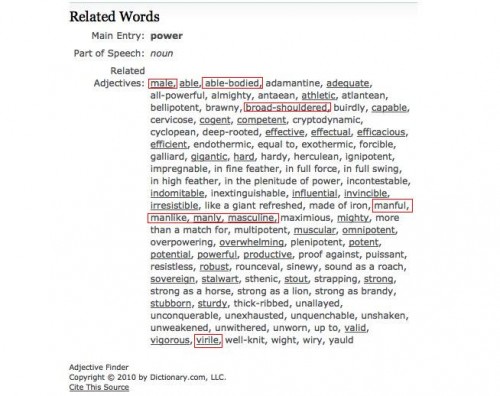
Edna Sednitzer, who blogs at Red Light Politics, sent us in two screencaps of what she came across during a recent search on Thesaurus.com. She searched the word “power” and this is one of the entries that came up, for “related adjectives” (some words I found notable highlighted in red):

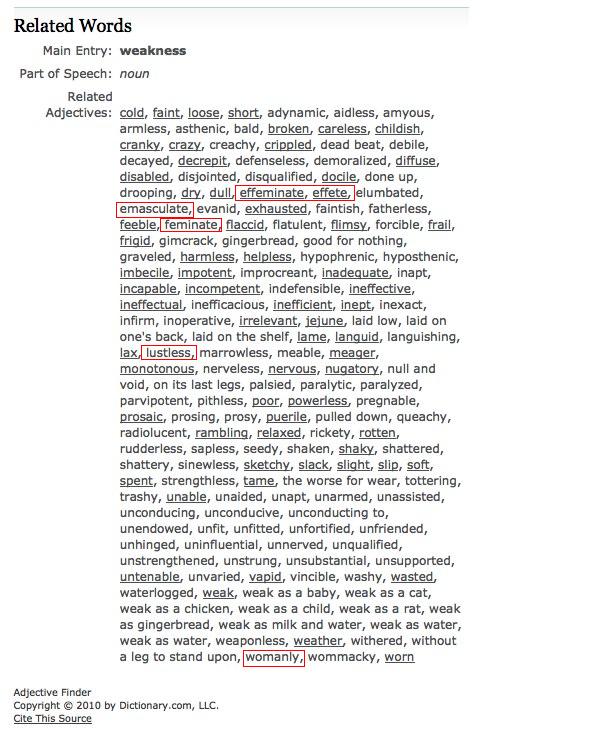
Out of curiosity she then searched “weakness,” and here are the suggested adjectives:

At least according to this thesaurus, masculinity is powerful, capable, competent; femininity is weak and incompetent. There’s a sexual component as well — notice that power is associated with being virile, while weakness = lustless. Of course, we also associate men and masculinity with the active pursuit of sex, while women are supposed to be the objects of pursuit, not actively sexual.

Anyway, it’s a great example of how language is gendered in a way that privileges masculinity and men over femininity and women.


Friday, June 11, 2010

Being a Container - Holding Space For Others

http://www.goodmind.com.au/SiteMedia/w3svc784/Uploads/Images/86554180-b2ea-4a56-88fd-d57580de587e.jpg

I've been sitting with this Daily Om for a while now, trying to decide how I wanted to post it, but suspecting there is something in this that I wanted to talk about. Here is the brief post - below I will try to talk about my perspective on this idea of being a container - something to which I think male energy is particularly suited.
Being a Container
Holding Space For Others

Sometimes we are called simply to hold space for a friend as they go through whatever they need to go through.

We have all been called upon at one time or another to help a loved one through a difficult time. When the help required consists of concrete actions, such as running errands or making phone calls, we know what to do. But sometimes we are called simply to hold space for the person as they go through whatever they need to go through. They may need to express anger or grief; they may need to talk or be silent. They may need us to hold their hand; they may need us to give them time alone. Whatever the case, when we hold space for someone, we offer ourselves up as a container for the overwhelming feelings they may be encountering due to their circumstances.

When we offer ourselves in this way, the more centered and grounded we are, the better. Our steadiness allows our companion to lean into us for support, as our presence provides an environment in which they can be free to move. We can also help by being responsive, allowing them to dictate the flow of action from talking to not talking, from anger to grief, and back again. By being aware and open, we can help them confront their feelings when that feels right, and back off from them when they need a break. Holding space requires humility, conscientiousness, and the ability to step out of the way, to honestly understand that this is not about us.

When we love someone in this way, we provide a space in which they can simply be. Able to feel what they need to feel without worrying about how they are being perceived. We can provide this offering in person, over the phone, or even from a distance, through meditation. However we do it, when we hold space for someone in need, we are offering a gift of the highest nature.

In my experience, it feels as though masculine energy is well-suited to holding space, to acting as container for the experience or feelings of others - especially a partner. We are larger, more solid, more dense - capable of grounding the fluidity of emotions.

However, it requires us to get out of the way, to not be hooked by the emotions. We need to be present, however, engaging our empathy and connecting with the other person. This is what a good therapist does with clients.

We are not there to fix things, or make things better - simply to witness and to hold the space - to act as a container. Masculine energy is well-suited to this (not just men, because women have masculine energy just as men have feminine energy) because it is structured, strong, protective. When we are present as that energy, fully present, we can hold powerful and wild feelings, grounding them and letting them dissipate - we do this well as long as we do not attach to them, or get hooked by them.

Masculine energy provides a container for the fluidity of feminine feeling (again, not necessarily man and woman) - just as feminine energy can soften the hardness of masculinity, wear smooth the edges and fill its space with feeling.

Since we all contain both forms of energy, we can do this for ourselves as in our relationships. However, it's easier to learn it first with a partner in my experience.


Sunday, December 7, 2008

Chogyam Trungpa - Perception and Perceiver

Cool quote today from Chogyam Trungpa's Ocean of Dharma.
PERCEPTION AND PERCEIVER

The feminine principle is the perception of colors, directions, time. Thus it is the manifestation of the colorful aspect of the world. Without it, there is no perceiver of this. The perceiver is the masculine principle. In this framework, the masculine principle is not regarded as the master dominating the scene. Moreover, we are not saying that the feminine principle belongs to women and the masculine principle to men. Wherever there is a perceiver, that is the masculine principle; wherever there is a perception, that is the feminine principle.

From "Femininity," in THE COLLECTED WORKS OF CHOGYAM TRUNGPA, Volume Six, page 565
Nice distinction he draws on the inner psychology of perception.


Sunday, November 23, 2008

Deepak Chopra - Male and Female Spiritual Potential

A cool passage from one of Deepak Chopra's books on the melding of interior masculinity and femininity in men.

Male and Female Spiritual Potential

Male and Female Spiritual Potential

In men this merging of male and female within oneself means the advent of tenderness, nurturing, and trust. Having a woman supply these qualities is not enough. Male attributes of force and violence have become grotesquely exaggerated in this world because men leave the feminine energies to women. Aggression and violence will become unnecessary as the shadow energies they disguise–fear and impotence–come to the surface to be recognized and healed.

Being vulnerable will then be seen as a human quality, not a weakness that makes a man only half a man. Competition based on raging (and insecure) ego will diminish with healing, and the ability to cooperate will increase.

The worth of women in men’s eyes will rise as men stop defining themselves as the opposite of female. Spiritually, male is the complement of female. Once this is accepted the awakening of male spirituality can come about, since it takes an infusion of female energy before our bodies and minds can totally merge with the silent field of pure awareness.

For women, the journey to wholeness is different, because it first entails raising female qualities to full dignity with male. A woman must build up her energies, so long forced into submission by society, whereas a man typically has to diminish the dominance of his.

In both instances what is being achieved is balance.

Adapted from The Path to Love, by Deepak Chopra (Three Rivers Press, 1997).

Tuesday, August 19, 2008

Gender Identity Disorder?


Another interesting post from Mental Health: About Life. I'm curious about this being a disorder. Maybe another term is needed, although the article suggests a possible biological origin that would make it some form of genetic mistake that those who share these feelings are seeking to correct through "passing" or through surgery.

I think we have a lot to learn about the biological and psychological -- not to mention the cultural -- meaning of gender that perhaps those who are trans-gendered can hep us understand, as Riverwolf pointed out in a recent comment.

Following this post on the psychology of this "disorder," there is a real-life example of how problematic the reality can be for a young person struggling to make sense of who s/he is. It's a sad and disturbing story.
Here's my take on this -- if my little boy wanted to wear dresses, so be it. If he wants to be Xena instead of Rambo, so be it. But when it came time to go to school, we'd have a talk about clothing and social expectations. I would make sure he understood that I loved him exactly as he is, but that not all people are so understanding. It's a tough thing for a kid at that age to have to deal with, but children can be brutal about others who are different, as you'll see below.

This is why I would (regretfully) feel compelled to have that talk.

A little background -- Larry had always been effeminate and enjoyed wearing female clothing. He also enjoyed taunting the straight boys who were freaked out by him, at a time (middle school) when gender identity is a touchy subject for many kids. Brandon was the object of his obsession, and he had his own emotional issues as well.
A day or two before the shooting, the school was buzzing with the story about a game Larry was playing with a group of his girlfriends in the outdoor quad. The idea was, you had to go up to your crush and ask them to be your Valentine. Several girls named boys they liked, then marched off to complete the mission. When it was Larry's turn, he named Brandon, who happened to be playing basketball nearby. Larry walked right on to the court in the middle of the game and asked Brandon to be his Valentine. Brandon's friends were there and started joking that he and Larry were going to make "gay babies" together. At the end of lunch, Brandon passed by one of Larry's friends in the hall. She says he told her to say goodbye to Larry, because she would never see him again.

The friend didn't tell Larry about the threat—she thought Brandon was just kidding. There are many rumors of another confrontation between Larry and Brandon, on Feb. 11, the day before the shooting. Several students and teachers said they had heard about a fight between the two but they hadn't actually witnessed it themselves. The next morning a counselor at Casa Pacifica asked Larry what was wrong, and he said, vaguely, "I've had enough." When he got to school, his friends quizzed him about his noticeably unfabulous appearance. He said that he ran out of makeup and hair gel (which wasn't true) and that he had a blister on his ankle (this was true—he'd just bought a new pair of boots). Larry walked alongside Boldrin to the computer class and sat in front of a computer. A few minutes later, a counselor summoned him to her office. She told him that his grades were so low, he was at risk of not graduating from the eighth grade. He went back to his computer. He had written his name on his paper as Leticia King. Most of the campus heard the gunshots. Some described it like a door slammed shut very hard.
The parents are responding to this by suing the school for not enforcing a more strict behavior code.

They (both parents and teachers) seem to have tried to do the right thing, as much as they could, in supporting Larry, but I suspect he didn't get the mental health counseling he needed to deal with who he was becoming. I think the counseling, along with a support group of peers, such as Wingspan here in Tucson, would have helped him deal with the anxiety in a more appropriate way than teasing his peers.

Larry was certainly flamboyant and acting out in unhealthy ways, but it was Brandon who pulled the trigger. Yet the school failed to discipline Larry for taunting Brandon -- taunting can go both ways. In the end, it really doesn't matter. Larry is dead, and Brandon has to live the rest of his life with what he did (and I don't think he should be tried as an adult -- he needs therapy, not jail).

This example shows just how tough a situation it is when a young person struggles with Gender Identity Disorder. I have no good answers, but I hope no other young person ever dies such a needless death.

Here a couple of websites for more information:
All Mixed Up by Madeline H. Wyndzen, Ph. D., a transgendered professor of psychology. She discusses her personal experiences with gender dysphoria and critiques the mental illness model of "gender identity disorder".
Gender Identity Disorder by George A. Rekers, Ph.D.
Gender Identity Disorder - Psychology Today


Tags: , , , , , , , , , , ,