Showing posts with label masculine. Show all posts

Tuesday, November 4, 2014

The Masculinity Myth: Here's What Women Really Want

http://resources3.news.com.au/images/2014/06/20/1226960/838315-d2790670-f800-11e3-ba3b-878da0800edb.jpg
and he's an effing criminal for crying out loud.

I find these "studies" interesting - what a woman finds attractive looking at pictures has little (if anything) to do with what kind of man they would actually go out with (or more). Consistently, studies show that women who are ovulating prefer more traditionally masculine looking men (from Discover News, Aug. 18, 2010):
Starting in the 1990s, studies began to show that in the days before ovulation women start to become more attracted to men who have deeper voices and more chiseled, masculine and symmetrical faces. According to some studies, that may be because men who look like George Clooney are more likely to have dominant social roles, better genes and stronger immune systems.
Woman in relationships experience an even greater increase in their desire for highly masculine men during ovulation - and ovulating women in relationships are also more likely to cheat on their partners than non-ovulating women.

Unless this variable was controlled for in the study below (from Mother Nature Network), it is meaningless (even if it makes us less masculine looking guys feel better).

The masculinity myth: Here's what women really want

(Hint: It's not what Hollywood has been telling you.)

Mon, Nov 03, 2014
Jenn Savedge, Author of parenting books blogs about raising children and health issues.
In theory, masculinity signifies health and strength — but that's not the whole story. (Photo: Pressmaster/Shutterstock)

If old stereotypes are to believed, women like their men oozing with masculinity. But a new study flips that thinking on its head, revealing that what women really want in a man might be far from this tired depiction of masculinity.

Even though it had never been proven, the stereotype of women liking masculine men has been around for so long that it was considered true by default. Experts theorized that masculinity signified health and strength, thus it was more appealing to potential mates. But a recent study conducted by British researchers at Brunel University in London has revealed that the appeal of more masculine men only holds for women from Westernized, urban communities. Throughout the rest of the world, women prefer feminine-looking men to their more masculine counterparts.

For starters, the team attempted to define "masculinity" in terms of appearance. They compiled data using computer simulations to merge photos of men’s and women’s faces into composite, “average” faces of five different ethnic backgrounds. They edited the photos of the men to make some more "masculine," and others more "feminine." To do this, they calculated the differences between the male and female faces. To make a photo more masculine, they increased these differences. Conversely, to make an image more feminine, they minimized the differences.

Then they showed the images to both urban and rural residents of 12 countries and from different ethnic groups. Participants were shown three sets of photos from models of five different ethnic groups. They asked each of the 962 subjects which of the faces they found most attractive. In urban areas, they got the response they expected. Women consistently found the men with the most masculine traits to be most attractive. But the responses of the remaining women shocked the researchers, as they seemed to prefer men with more neutral or even feminine-looking faces.

Researchers theorized that maybe city-dwellers have developed the masculinity preference as a means to make a snap judgment about a man's health without any other background information.

Either way, the study flies in the face of the age-old notion that women prefer manly men, or that the roots of this so-called preference could be found throughout history.

More likely, the masculinity myth is just another urban legend.


The opinions expressed by MNN Bloggers and those providing comments are theirs alone, and do not reflect the opinions of MNN.com. While we have reviewed their content to make sure it complies with our Terms and Conditions, MNN is not responsible for the accuracy of any of their information.

Thursday, May 1, 2014

Nicole Daedone - As Above, So (Very Different) Below: On the Masculine and Feminine


Interesting . . . . I'm not sure how I feel about this. The masculine/feminine dichotomy, even when used to represent psychological features inherent in all people, perpetuates the "essentialism"  argument that men and women, masculine and feminine (the two are ALWAYS conflated, like it or not) are essentially different (the whole men are from Massachusetts and women are from Vermont thing).

I don't even buy into the "masculine is about action, feminine is about connection" stuff anymore. It's a comforting stereotype allowing people to make broad, unsubstantiated generalizations.

I am more aligned with gender fluidity, and the dropping of labels for how one embodies gender. But I recognize that mine is a minority position. So for the rest to the people, there is this . . . .

Nicole Daedone is an author, consultant, teacher and entrepreneur in service of bringing a more fulfilling sense of orgasm to the world. Voted one of Vanity Fair’s Twelve Women Who Changed the Way We Look at Sex, Nicole first came to prominence as the leader of the Slow Sex Movement and the innovator of the 15 minute orgasm. Throughout her work, Nicole has expanded the horizons of sexual experience, which has earned her invitations to share the stage as a speaker alongside other luminaries such as Neil Stauss, Tony Robbins, Naomi Wolfe and Esther Perel, as well as inclusion in Tim Ferris’ breakthrough book “The Four Hour Body.” Nicole brings a no-nonsense, empirical approach to the question most of us ask, “How do I have a better sex life?” But much more than that, her life has been spent exploring the impact our full human potential in the arena of sex and what benefits that can bring to not just individuals and couples, but to communities, organizations and societies as a whole. What becomes possible for our lives, our health, our happiness, and our prosperity when we learn to live in a continual state of orgasm? This is the territory Nicole continues to explore today.

* * * * * * * * * *

As Above, So (Very Different) Below: On the Masculine and Feminine

February 2, 2014 | Nicole Daedone


Recently I was reading an article about male-female dynamics that said the number one complaint women have about men is that all guys want is sex. The number two complaint is that he doesn’t even know what he’s doing once he gets there. The man’s number one complaint, for his part, was that women make everything so difficult.

I loved this. Not because I am a fan of the war of the sexes (if there is such a thing) but because it points toward something so much bigger. If we pull back the lens, these very day-to-day complaints start looking like clues in the mysterious game that I like to call “Masculine/Feminine.” Part of me cringes to use those terms. They have been co-opted by a whole lot of people who use them a whole lot differently than I do. So let me be clear. Masculine/Feminine is not a synonym for male/female or man/woman. The latter are rough approximations of a very nuanced truth, the incarnation of masculine/feminine qualities painted with very broad strokes. Man/woman is an impressionist’s version of a water lily; masculine/feminine is the lily itself, with all its uniqueness and subtleties and gradients.

So you can look at the complaints men and women have about each other as clunky approximations of the deeper, more precise, and more relevant forces working in the world. The forces I call “masculine” and “feminine.” Male/female are physical-realm analogues of underlying principles, which are begging to be brought into relationship within each of us. We see in the male/female dynamic the desire for wholeness within ourselves. This article will explore how to bring the two into communication, and to see how to maintain connection.

So, a request. If you look at what follows as being associated directly with men and women, rather than the forces of masculine and feminine that are within all of us, you could easily accuse me of gross generalizations and gender stereotyping. So just don’t do that, okay? When I use “her,” know that I am referring to the feminine within all of us; when I use “him,” the masculine. Thanks in advance for your understanding.

The basic experience of masculine is the desire to act. The masculine force is forward-moving, direct, focused and bright. It is powerful, but it does not generate power. You might think of it as the turbine on a ship; it’s what makes the ship go. It’s the part that is easy to see from the outside but without the coal-fired engine down below, it’s not going anywhere.

The coal-fired engine is the force of the feminine. It is dark, rich, unpredictable, and generative. The feminine is where true power comes from; it is the creative force that fuels the turbine of the masculine so the ship can move forward. Without cooperation between the two, the ship is going nowhere.

Once each of us learns to be at ease in both positions–to go above, where the masculine operates, and below, where the feminine is found, and to understand the customs of each domain within ourselves–we will finally be able to transition out of polarized role-playing (man as “masculine” and woman as “feminine”) and into something infinitely deeper.

* * *

So we’re on the same page: we all have masculine and feminine forces within us, and both need to be activated in order for us to feel whole, complete, catalyzed. Here’s the quandary. To come together, the masculine and feminine must cooperate. They must work together. For starters, both of them need the creative energy of the feminine in order to get into flow. The feminine cannot access her power alone; she needs him to help pull it out of her. It requires a kind of mining, and mining is the masculine’s specialty.

But problems arise right away, for his approach to mining alienates her. She desires gentle coaxing; he seems to bark orders. The feminine feels like she’s getting yelled at from above. To her, he sounds all-knowing, entitled, and demanding. He may be saying, “Let’s go to the store.” But for some reason she hears, “You are incompetent. Why didn’t you go to the store already?”

For his part, the masculine can barely understand a word out of her mouth. Truth is she can’t always put into words what she wants to say. Because words are not a problem for him, he assumes that she is being evasive, dramatic or tricky. He gets frustrated. She gets hurt. He’s just trying to help, and can’t understand why she can’t just take the help he’s offering. Why she can’t get herself into shape.

The feminine has impediments the masculine doesn’t understand. She has flows and rhythms that she needs to answer to. He’s up there looking down, and things look so obvious; just do it, already! She’s down there with gunfire and emotions, saying, “Yeah, you think it’s so easy, you come down here and do it!” She’s the man in the trenches. He’s the general.

Of course she wants his guidance. He has a bigger view from up above. Of course she wants some vision and perspective. But she does not operate in the suggested ways. Not because she is defiant, not because she is oblivious, but because she has a different set of circumstances to contend with.

The other element is that beneath this game, she knows that she holds the power that they both need. He in his position doesn’t understand why she won’t just give it to him. It’s simple enough, from his perspective. Just give it to me and we will both be happy. When she can’t—she just can’t—he perceives it as manipulation, sloth, recklessness. In truth, they are both bound together by the same dilemma. Her sex is power, electricity, fuel. Both want it converted to a usable form, which is what happens when they meet. But he gets frustrated trying to “get it right,” and she gets frustrated because she can’t just “give it away.” He has to earn it.

Her inability to offer well-thought-out, articulate reasons leads him to believe that she is not very smart. So he speaks to her as if she’s stupid, which offends her. After all, she has the power he needs. Should he not treat her with a little more care?

Moreover, isn’t it obvious? If he doesn’t earn it, he won’t respect it. If he doesn’t respect it, he won’t know what to do with it. He will risk wasting it and how will her power and vision be activated in the world without him? So what she is waiting for is a kind of reverence. Not adoration. Simple reverence for what she is carrying inside of her. Reverence slows his impatience, softens his entitlement, adds subtlety to his directness. Then she involuntarily opens. But to the masculine, reverence is humbling. To admit how deeply he desires to serve? To recognize that it will be through surrender rather than force that he will get it? Humbling indeed.

But it is the only way. In fact, both masculine and feminine must surrender to the power of the lower. It is only in this surrender that the power can actually begin to ascend. They are not surrendering to one another; they are surrendering to the power that exists inside of her.

Surrender comes more naturally to her than to him. She is closer to the creative source, and understands how to surrender to it intuitively. This is where we get it all mixed up when we get to the concrete experience of male-female relating. Because the feminine knows the pleasure of surrender, women tend to surrender to the men they love. More aptly said, we abandon ourselves to them in the attempt to surrender enough for two. We try to surrender for both of us. The feminine is formless, so has an easier time tying herself into the shape she thinks she should be in. But desire will not take that which is not offered. So she can attract, entice, seduce—but she cannot surrender for him. For he himself is also standing at the edge of the cliff, asking to be taken with complete abandon. He must offer himself. Only then will he receive the life in which he can become himself. She must do the same, but to the orgasm itself, not the signifier which is the man. Both dive into the same pool together—the pool of feminine, of Orgasm in its truest sense—and from that pool they emerge refreshed.
Read the whole article.

Tuesday, August 20, 2013

Brandon Ambrosino - The Tyranny of Buffness (The Atlantic)

Men are starting to face the same self-image and body-image challenges women have been dealing with for decades, if not centuries. Perhaps men is too general - right now it is mostly gay men (as Brandon Ambrosino points out in The Tyranny of Buffness [below], from The Atlantic), and whatever it is that we now are calling those guys previously known as "metrosexuals."

To be "sexy" or "masculine," or even to be manly, now requires several hours a week in the gym. A man must be muscular (but not TOO muscular - massive bodybuilders still scare people), and he must be lean (but not TOO lean, which just looks freaky).

This is the new ideal for a lot of men:


Hugh Jackman is buff and lean, just enough of each to be a role model for a lot of men. He put some muscle on his former-model body for X-Men and decided to keep it. So he works out hard with heavy weights and basic lifts. This is a huge improvement over the 1990s role model of Brad Pitt, circa Fight Club. I remember reading the forums at some fitness sites and everyone wanted to look like Brad Pitt (or at least have his abs, which other than a big chest is the mark of fitness for men).


He looked a lot better, i.e., more buff, when he made Troy:


How many men can actually look like Hugh Jackman or Brad Pitt? So why do we feel we need to do so to be "real" men? Why do we even try if our genetics have not endowed us with the gift of easy muscle growth and good metabolism?

I am not immune to this issue. I work out hard several days a week, and I eat a diet my friends have described as freakishly clean. As a personal trainer, I feel I need to be the exemplar for the lifestyle I teach my clients, but I can be very self-critical if my abs disappear or if lose muscle weight as I increase my cycling work.

As hard as it has become for cis men to deal with these new standards (many of them self-imposed), based on this article it appears to be 10 times as challenging in the gay community.

The Tyranny of Buffness

My boyfriend expected me to be lean and muscular. But I couldn't live up to that standard, and neither can a lot of guys--and we shouldn't have to.


By Brandon Ambrosino | August 16, 2013

phlubdr/flickr

I didn't know I was skinny-fat until my Russian boyfriend told me so. Actually, I didn't even know that was a thing until he told me so.

I did, however, suspect something was wrong with my body the first night I stayed over his house.

I went to use the bathroom in the middle of the night, and ran into his roommate, Julio. I don't remember what he said, but I remember where he looked. He seemed to direct his entire conversation--and disgust--at my exposed midsection.

Also known as my love handles.

Julio (gay) and my boyfriend both possess the envious V-shape: broad shoulders narrowing down to a waist that hasn't smelled a carb in years. Their arms are huge, their chests are cut, their abs are visibly defined.

I went into the bathroom. I looked at myself in the mirror. Sure, I was a professional dancer, and I did yoga, and went running, and watched what I ate. And yes, I was probably in pretty good shape. But I didn't look good enough.

The longer I stared at myself, the more I began to notice what it was that made Julio cringe. My chest was dystrophic. My arms were unformed. My neck was frail. Skin hung over the band of my underwear and, on top of that, I was hairy. Everywhere.

I began to panic. This was the first night my boyfriend saw me naked. He had that godlike body to offer me--and all I could give him was ... was this hairy, love-handley mess of skin?

I went back to the bedroom and turned off every light in the house on my way there.

The tendency of gay men to emphasize physical appearance is "hard to dismiss," says Dr. Duane Duncan, Research Officer at the Australian Research Centre in Sex, Health and Society. In his article "Out of the Closet and Into the Gym," Duncan acknowledges that the idealized male physique is "a major point of cultural reference in the dominant representation of gay men."

"We're doing this to ourselves," says Dr. David Brennan, a clinical social worker from the University of Toronto. "Our entire culture is showing the same body image. And the question is, does that affect us?"

Obviously, this question is politically charged. Anti-gay politicians are more than ready to pathologize any traits gay men may have in common. On the flip side, many gay-rights activists go to great lengths to deny altogether that there are any identifying features of what opponents pejoratively term "the gay lifestyle." In response to this double bind, some researchers have conducted studies to answer the gay body image question. But even then, it seems as if the methodological frameworks underpinning the studies are influenced by one of these political extremes.

Brennan, a gay man himself, insists gay culture's preference for a specific physical ideal does indeed affect those who fall short of the prevailing standards. Some of these negative effects include low self-esteem, eating disorders, and body dysmorphia. Brennan also says some gay men who don't measure up might even develop "an increased use or dependency" on drugs and alcohol.

And even though the research into this area is fairly recent, Brennan suggests the literature we do haveshows that gay men on average tend to experience more body dissatisfaction than heterosexual men. (Some research suggests that gay men and straight men share similar concern for their bodies, but because of the pressures of heterosexual society, straight men don't feel comfortable talking about it. In other words, the differences might be more announced than pronounced, which is the argument offered by the authors of The Adonis Complex.)

But while a conclusive decision has yet to be reached, contemporary gay trends certainly lend credence to Brennan's theory.

Take, for instance, Grindr-a gay social networking app that helps you "find gay, bi, curious guys for free near you." Grindr displays thumbnail pictures of potential, um, "friends" organized by their proximity to your immediate location. Users can scroll through several hundred pictures - an assortment of faces, biceps, and abs - until they find the one guy that tickles their fancy.

Senthorun Raj, a writer at The Guardian, recently described his Grindr experience:
Sorting through each profile makes me feel like I'm a kid in an adult candy store: 'window-shopping' my way through, hoping to find the right guy to fit my current mood. ... I'm in control of who I respond to, how quickly I respond, and the nature of the conversation I am having.
The term "window-shopping" immediately jumped out at me. I've gone "shopping" for men in similar ways, both on and offline. Hm ... that one's balding. That one has gay-face. Oh, the one with big shoulders carrying a briefcase down Fifth Avenue--follow him!

In other words, there are times when I act like I'm on Grindr even when I'm not. What's troubling about this is that, without being aware of it, I've helped to perpetuate the same exclusivity that Brennan says "makes some gay men feel left out or without value."

There's no doubt that there are some benefits to Grindr. In a phone interview, Grindr founder and CEO Joel Simkhai said his company "creates a virtual community" for people who might otherwise feel isolated and alone--think the Middle East or the Republican National Convention.

But when you think about some of the language that characterizes the Grindr experience--"No Asians or Fems!"--you've got to wonder about the kind of community that's being created.

***

The tendency to conflate muscularity and masculinity is widespread throughout gay culture, according to Dr. Murray Drummond. In his article "Men's Bodies: Listening to the Voices of Young, Gay Men," Drummond argues that we often take for granted that muscularity signifies both physical and emotional strength. In gay communities, he says, muscle means something very specific - such as "a sense of control ... [and] an air of resilience."

It's easy to begin to psychoanalyze why this might be the case. There are several different theories about gay muscularity, each one less politically correct than the next. Brennan suggests a view most notably argued by A. Klein in a 1993 book titled Little Big Men. After the AIDS crisis, he says, many gay men hit the gym to avoid looking thin and frail, which might have been taken as signs of being diseased. This new drive to achieve an athletic body was described by Drummond as a form of "protest muscularity."

Another motivation might have been to overcome the homophobia--internalized or otherwise--that saw gay men as weaker than their straight counterparts. Yet another opinion is that in the late 1970s, the growing physical strength of gay men mirrored the continued social strength they were achieving.

Of course, these theories don't entirely explain why younger gay men who didn't live through the AIDS crisis or pre-Stonewall homophobia hold the same muscular ideals as our forerunners. Not to mention, does there have to be a psychological reason for gay men to like muscles?

I was 12 the first time I connected muscularity with gayness. I came across an erotic photography collection by an artist named Tom Bianchi who specializes in the male nude and gay erotica. His subjects are muscular demigods who look very much like my Russian.

Looking at Bianchi's images in seventh grade turned me on. Looking at them today--well, alright, they still turn me on. I also feel pressured to transform my body so that I can be accepted into the community that Bianchi represents.

Bianchi told me in a phone interview that while he doesn't want his photography to pressure me, he hopes it serves to encourage me--and all gay men--to realize our physical potential.

"We have the powers of co-creation," he said. "That's a teaching of the Hindu Vedas. It's remarkable how much power we have to change our physical bodies."

But not all gay men are able to live up to Bianchi's standards, even with a rigorous diet and exercise regiment. Patrick Giles, in a critique of Bianchi published in the Harvard Gay & Lesbian Review, pointed this out. "What about heredity, somatotype, [or] the greater inherent potential of big-muscled people over the smaller-muscled?"

Giles points out that money is also a factor. According to a 2012 LGBT community survey, a higher percentage of gays than straights pay for gym memberships, personal trainers, and weight management programs. This is great for those who can afford such things--but what about those who can't? There's also the question of motivation. Research shows that gay men tend to take care of their bodies more than straight men. But the same research shows gay men are motivated less by the desire to be healthy, and more "for the express purpose of increasing attractiveness."

But whether we're limited by our genes or our funds, it's clear that not all gay men live up to Bianchi's standards. And the fact is - we shouldn't feel like we have to.

As far as Giles is concerned, beauty acts hierarchically in the gay community. Those who have the resources to "Adonize" their bodies are rewarded with power and influence. Everyone else is excluded--and then blamed for not working harder.

Bianchi admits his photography showcases a certain muscular ideal, but he argues that it's hardly unique to his work, or to gay culture. "Our human ancestors recognized that if a man was strong enough to catch prey, then he was attractive."

"Look at Michelangelo's David," he continued. "Muscles have always been signifiers of the power of being, and that's very attractive to us."

But is it true that male muscularity has always been idealized throughout history? Cultural historian George Mosse argues that Bianchi's ideal man is a relatively new invention. In his book The Image of Man, Mosse dates the idealization of the male physique to the Napoleonic Wars (1803-1815). That isn't to say Bianchi is wrong, it's just to admit that not all historians agree with the assertion that history shows a ubiquitous privileging of muscularity.

In other words, sure, there's Michelangelo's David--but let's not forget about Donatello's.

***

The Russian put me on a strict diet after our first night together: No carbs or sugar - not even fruit. When waitresses offered me dessert, he would tell them we only wanted the check. He took me to hot yoga a few days a week, and the gym on the other days. And there was no more midnight munching.

In five weeks I lost 30 pounds. One year later, I lost him.

The obvious question is, why did I allow my boyfriend to influence how I saw my body? The simplest answer is that I didn't want to lose him. He was a hot, Jewish doctor from Eastern Europe with green eyes and a gorgeous physique. There were plenty of other "qualified" guys for him to date, and so I thought I should try to make my body look like theirs.

But another part of the the more complicated answer has to do with the larger gay community. It wasn't as if my partner's ideas about body image were unfamiliar to me. If anything, he was only echoing ideals I had already learned and internalized from my gay peers and the media--ones that I sometimes also perpetuated.

I wonder if being publicly concerned about our bodies is as much a gay rite of passage as loving Judy Garland or watching Ab Fab.

***

Before I hung up with Tom Bianchi, I asked him if he ever air-brushed his images.

"If it inhibits the essence of the photography, I'll edit it out," he said. "For instance, I see no reason to memorialize the red spot from an in-grown hair on someone's ass."

That blemish sounds like one of the "dappled things" the Victorian poet Gerard Manley Hopkins wrote about in "Pied Beauty."

"Glory be to God," sings Hopkins, for all things that are "original, spare, strange," for all things "fickle" and "feckled."

Things like finches' wings, and the spotted underbellies of trout.

Things like love handles, and the extra flap of skin that hangs over my underwear band.

Things like the red spot from an in-grown hair.

Bianchi's art tends toward a Platonic ideal of male beauty. Hopkins, on the other hand, celebrates the beauty found in the diversity of imperfection.

To the photographer, the blemish inhibits a subject's beauty. To the poet, the blemish is what makes him beautiful.

Copyright © 2013 by The Atlantic Monthly Group. All Rights Reserved.

***

Related Story
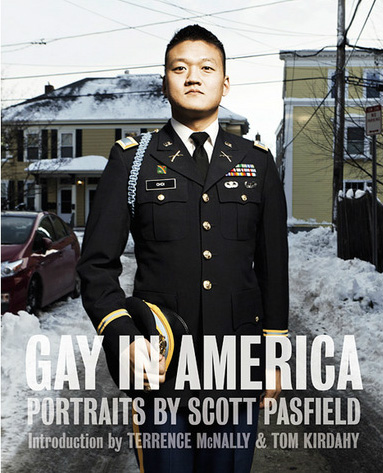


'Gay in America': Photographs of Gay Men From All 50 States