Thursday, March 12, 2009

ATOMIC DOG - Where it Rains Doughnuts and Boobs

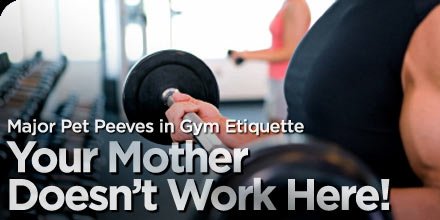
A little lesson on foo-foo gym etiquette from TC Luoma at T-Nation. While he has offered a more serious list in the past (including my favorite: Do NOT do bicep curls in the squat rack - I hate that), this list is a little more humorous, although I have actually seen some of these things a little too often.

Oh yeah, if you are easily offended, please DO NOT read this. I don't need you telling me how rude or crude this is - that's just how TC writes.

By now, you gotta' be asking yourself why I work out at this foo-foo gym. It's simple, really. It's really close to my house and they've got two power racks that don't get used much. I also like a few of the trainers, who, because of client demands, are largely unwilling accomplices to all this aforementioned core training.

As you might guess, most of the gym members are largely ignorant of the customs of the gym world. Any group of humans that congregate for a shared purpose or activity develops a type of social etiquette. Unfortunately, in a gym like this, where many of the members are transient, this etiquette never gels. Newbies don't learn the customs and this lack of gym etiquette perpetuates itself as newbies beget more newbie's.

It's with this in mind that I offer my crash course in foo-foo gym etiquette, which should serve as a companion piece to my first article on the subject where I wrote about many of the usual etiquette breaches like using a cell phone in-between sets and curling in the squat rack.

While this second batch of breaches might be less commonly seen or experienced, you should do your best to keep it that way by printing this out and slapping it on the locker room wall.

Don't Hair-Dry Your Balls.

Why can't I walk into the locker room of my gym without being greeted by the sight of some old bastard, one foot on top of the counter, crotch spread wide like a model in a Hustler photo shoot, using a portable hair dryer on his balls? It's ghastly. Not only that, it makes the room smell like the cheddar-cheese covered popcorn my Nana used to make on her old potbelly stove and it makes me feel nostalgic and sad.

Use a towel on your nads, or maybe do a little manscaping, for Chrissake. Less hair would allow you to dry faster, possibly saving others from having that terrible vision loaded forever onto their mental hard drive.

Besides, on most of you old guys, your unkempt equipment looks like gray and dying willow trees...except for that albino geezer; yours looks like you've got a tiny naked Ann Coulter for a penis.

Don't Use the Power Rack for Your Stretchie Cord.

For the love of God, don't tie your $4.99 K-Mart Sporting Goods' Department stretchie cord with built-in handle to the power rack so you can "work" your rotator cuff, thereby monopolizing the darn-near-only serious piece of equipment in the entire gym.

That's like using your company's only super computer to play Lee Trevino's "Fighting Golf" game when the guy who wants to do climate change analyses has to wait.

It just...ain't...right.

Don't Wear Cut-Off Sleeves.

You don't have a single piece of clothing that has sleeves. Sure your arms are decent; they're your one good body part, but you're like those semi-anorexic chicks who get huge implants and won't wear anything short of an iron lung that isn't so tight a blind man can simply trace his fingers across the front of your shirt and read the Braille message formed by the Montgomery tubercles on your areolas which, predictably enough, read, "My daddy abused me so I have an eating disorder which led to a distorted body image and compelled me to buy obscenely large implants."

In other words, it reeks of insecurity.

But I guess that's not really a matter of etiquette, is it? More of a pet peeve, I suppose. What is a matter of etiquette, though, is middle-aged and old bastards who have no arm development at all and wear cut-off sleeves or white, ribbed, yellow stained, moldy tank tops that you usually see old Italian guys wearing on hot summer Sunday afternoons as they sit on their stoops and reminisce about the Brooklyn Dodgers.

These guys are usually sporting so much hair on their biceps, triceps, and semi-exposed back that it serves as a matted repository for sweat and every time they get off a bench, it leaves a moist, acidic, acrid, drippy residue and, frankly, given a choice, I think I'd rather sit on hot tar.

Plus it's such a God-awful look. I could watch an autopsy and still not lose my appetite, but the sight of you guys in your Dr. Zaius costumes makes me want to give up eating forever.

Wear T-shirts. Preferably cotton.

Don't Give Us Guys Dirty Looks.

Hey you hot female types, don't get attitudinal when you catch us eyeballing you when you're doing Kama Sutra style stretches on the mat. Listen, if you dress in a Wonder Bra sports bra, and wear low-slung built-in camel toe tights...hell, it's all we can do to not pull down our sweats and jizz on your taut, tan, glistening belly while screaming like a wolverine.

Besides, what are you so shy about? Most of us have gal pals who've seen you naked in the dressing rooms and then dutifully described to us what you look like naked.

We know what size, color, hue and texture your nipples are. We know if your labial lips are tight and pursed like the lips on George W.'s face, or if they're full and oversized like Lisa Rinna's pontoon-boat lip job.

It Rains Doughnuts and Boobs

We know whether you shave your pubes completely off, maintain a tight little landing strip, or if, after a workout, they look like the matted seaweed that washed up on shore after a tropical storm. So relax, we already know your bodies really well; nothing to be shy or embarrassed about. Think of us as your doctor, or a really friendly uncle.

Don't Ask Me for a Spot if You're Going to Lift Like a Moron.

Where did you mutts get the idea that you shouldn't do full-range bench presses, military presses, or squats? Which ACE certified I-spent-a-weekend-studying personal trainer told you that doing full-range motions leads to injury and that you should instead do 1/2 reps for eternity?

Likewise, who told you that putting your feet on the bench while benching is a good idea?

Never mind. It's not my job to yank you out of your world with its candy-colored sky where it rains doughnuts and boobs.

However, don't ask me to spot you if you're going to lift like an ejit. Hell, I'm editor-in-chief of a large, respected weight lifting web site. As such, I've got a reputation to protect. I can't risk someone I know or respect walking into the gym only to see me spotting your inane reps; they might think we're training partners, and within days my shame would spread and before you knew it, readers would leave the site by the thousands and we'd have to close up shop and I'd end up at my old job, which was emptying the spit bucket at cockfights.

Don't Assume Placing a Towel on a Bench Retains Your Rights to the Bench For All Time.

Okay, so you learned to lift from watching kinetoscopes of Jack Lalanne or something. It's only natural that you think circuit training is the cat's pajamas. The thing is, it's rush hour at the gym and there are only two flat benches in the whole damn place.

You can't simply put your towel on the thing and assume it's yours in perpetuity, or at least until you make your next rotation of 10 exercises before coming back to the bench. Look at it this way, would homesteaders in the Wild West been safe from claim jumpers simply because they put a towel on their piece of land?

I don't think so. Some cattle or railroad baron would have hired killer pistoleros to ride onto your land when you were in town buying penny candy and a smokin' hot corset for your woman. They'd tried to steal your towel, or at least defile it by taking a dump on your land and then using it to wipe their butt.

Come to think of it, that might be an appropriate response when you try to claim a bench for an inappropriate amount of time by laying your towel on it.

Ditch That Smug Bosu-Ball Face.

So your ACE-certified trainer taught you to do a Mr. Miagi/Karate Kid one leg in the air, one leg balanced atop the giant breast implant known as a Bosu Ball, two arms curling tiny, tiny weights, exercise.

Well, aren't you spay-shul?

Never mind that the gym floor is peppered with these things, so much so that it looks like a microscopic view of some kid's acne riddled face with the Bosu balls being the pimples and us being the bacteria, and that they form a kind of obstacle course between me and my destination.

No, what bugs me most is the superior attitude of the guys using these things. You think your methods are like, more advanced, to those of us who lift on terra firma, right? Well, you don't know nothin', only you're the gap-toothed hillbilly and I'm the city slicker in bitchin' skin-tight neoprene black vest looking for a couple of mopes to drive my pickups to Aintry while I take those canoes down the river.

I don't mind your delusion—too much—and if you want to live in that same candy-colored-sky world as Mr. Half Repper or Mr. Feet-on-the-Bench, where it rains doughnuts and boobs, that's quite all right.

But knock off the superior look, okay? The truth is, you're wasting your time. Because of the inherent stability of the thing, you can't use any appreciable amount of weight, so your biceps never develop, and if you think you're building your core by doing that silly maneuver, save us all a lot of aggravation and do the one-legged stuff when you're standing in line at the pawn shop after rummaging through your keepsake box and hopefully finding, shuffled among all the Jonas Brothers' concert ticket stubs, the claim ticket for your balls.

Don't Do Dumbbell Curls 3 Inches From the Rack.

Let's say we're in the buffet line at Gasteau's Deep-Fried House of Gastroenteritis. You stop and ladle out a generous scoop of creamed corn, but instead of going back to your chair to eat it with your pimply date, you eat it right there, thereby blocking me from the creamed corn. What the hell? You telling me I gotta' wait for you to finish eating your creamed corn before I can have some?

What kind of cruel, perverse, fuck-your-neighbor, Thunderdome world did you grow up in?

It Rains Doughnuts and Boobs

That scenario is no different from when you grab a pair of dumbbells off the rack and instead of going back to your "chair" or at the very least, backing up six feet, you start to do your spastic curls right there, thereby blocking me and about a dozen other frustrated lifters from grabbing the weights immediately above, below, or next to the weights you just picked up.

If I owned a gym, I'd hire an ex-communicated priest to walk around the dumbbell rack with a 6-foot long broomstick. If a lifter didn't step back at least the distance of the broomstick after he grabbed a pair of dumbbells, the priest would enthusiastically shove the stick up the offender's ass.

I've by no means covered all breaches of gym etiquette, but this is probably a good start. Hopefully, because of etiquette crusaders like myself, gyms will one day be a place where we can all work out without wanting to harpoon our fellow members with the Olympic bar, which might in itself be construed as a breach of etiquette.


Wednesday, March 11, 2009

The New Man Episode 53 - Stuart Davis: Pt2 How to Pull Your Head Out of Your Ass

Here is part 2 in the kick ass New Man interview with musician, actor, integral Buddhist, Stuart Davis.

Episode 53: Stuart Davis: Pt2 How to Pull Your Head Out of Your Ass

Listen Now
RSS: Subscribe
RSS: iTunes

We’re back for Part 2 of our hilarious discussion with Stuart Davis -- rock star, buddhist monk and host of “Sex, God, Rock n Roll”.

In this episode we discuss:

  • a good woman will challenge and support you to be a better man in every area of your life
  • becoming a father can crush any grand ideas you have about who you think you are
  • there is no such thing as an “un-spiritual” moment
  • stepping into “the fire” of life and confronting your deepest fears
  • the significance of being able to laugh at yourself
  • how surrendering doesn’t mean defeat
  • what happens when we resist our life
  • the amazing new pill, “Alco-hard”
  • the new TV show “Sex, God Rock n Roll”

Tuesday, March 10, 2009

"Clark Kent, Naked" by Fred Moramarco


This poem comes from Men of Our Times: Anthology of Male Poetry. There isn't a lot of good poetry out there about being a man, or mature masculinity, so I'll find what I can. I want to include some poetry and art here, in addition to all the other stuff.

Clark Kent, Naked

They found him in a phone booth, huddled,
frail as a foetus, shivering in the cold.
The problem, he said, was that when he began
to take off his clothes for the usual transformation,
the blue and red suit with the yellow "S"
emblazoned across the front, just wasn't there.
He couldn't believe it, he said, and kept disrobing
when he was assaulted by a transient who took the pile of clothes.
He insisted that no one tell Lois as they led him away
covered by a wool blanket, babbling incoherently
to the air in front of him, remembering how things used to be.

~Fred Moramarco

Monday, March 9, 2009

Shawn Phillips - Living the Un-Reasonable Life

Shawn goes for the video mode of communication this morning. A nice piece. Check out his blog for lots of other good stuff, and to get his Premium Nutrition Shake, Full Strength.

Living the Un-Reasonable Life

Mon, Mar 9, 2009

This Monday I’m getting back to the ease of the video to explore the deception of sacrifice and Living the Un-Reasonable Life.

Not sure what the Reasonable life is? It’s the sort of sleep-walking through life that is more common than either of us care to consider. It’s following the path as we’re supposed to, settling, adapting, getting by.

Wonder if you’re living a reasonable life, watch this episode. It’s a valuable 4 minutes that I’m sure you’ll enjoy.

Watch for the Key Moment…

Watch and listen for the punch line, “The shocking TRUTH is most people take better care of their ____________ than they do of themselves!!!

Until Next Week…

Stay Strong,

Shawn

Saturday, March 7, 2009

The Psych Files - Episode 87: Manhood: Are You A “Real Man”?

This is an interesting discussion of some recent papers on the precarious nature of masculinity.

Episode 87: Manhood: Are You A “Real Man”?

Why does it seem that males in many cultures have to "prove" their manhood? Do women have to prove their womanhood? Why is this and what happens when men feel like they are less than a man? In this review of a recent research article entitled, "Precarious Manhood", we take a look at this intriguing issue.

  • Authors: Vandello, J.A., Bosson, J.K., Cohen, D., Burnaford, R.M. & Weaver, J.R. (2008). Precarious Manhood. Journal of Personality and Social Psychology, 95 (6), 1325–1339.
  • Here is the homepage for Joseph Vandello (University of Southern Florida).
  • Abstract: The authors report 5 studies that demonstrate that manhood, in contrast to womanhood, is seen as a precarious state requiring continual social proof and validation. Because of this precariousness, they argue that men feel especially threatened by challenges to their masculinity. Certain male-typed behaviors, such as physical aggression, may result from this anxiety. Studies 1–3 document a robust belief in (a) the precarious nature of manhood relative to womanhood and (b) the idea that manhood is defined more by social proof than by biological markers. Study 4 demonstrates that when the precarious nature of manhood is made salient through feedback indicating gender-atypical performance, men experience heightened feelings of threat, whereas similar negative gender feedback has no effect on women. Study 5 suggests that threatening manhood (but not womanhood) activates physically aggressive thoughts.
  • Thanks to Matt Selznick who is working with me to revamp The Psych Files website.
  • In case you’re interested in the movie I mentioned in this episode here it is in Amazon: The Indian in the Cupboard

Friday, March 6, 2009

Is Courage a Masculine Virtue? - Two Views


From In Character, two views on courage as a masculine value. The first is from Harvey Mansfield, the author of Manliness, and the second is from Ayaan Hirsi Ali, author of Infidel and The Caged Virgin: An Emancipation Proclamation for Women and Islam.

Essentially, what we see here is the clash of two very different worldviews.
Is Courage a Masculine Virtue?

Yes, sort of...
Do we really want two tough, aggressive sexes?

By Harvey Mansfield

Courage is not solely for men, but it is mainly for men. The Greek word for courage is andreia, which comes from he-man and also means manliness. The Greek philosopher Aristotle was, however, critical of the implication in his language that courage was for men only. He said something not so definite: men find it easier to be courageous than women, and women find it easier to be moderate than men.

We all know of courageous women unafraid to risk their lives in defense of a principle — Ayaan Hirsi Ali, for example. We know of many more women who would defend their children with their lives, the sort of action that made Rudyard Kipling say that “the female of the species is more deadly than the male.” And we know women who can rise to the occasion, overcoming their ordinary characters, like Grace Kelly in the film High Noon, a pacifist who shoots an outlaw who is about to shoot her man.

Aristotle makes this remark in the Politics, because such inclinations are relevant to politicians who must know the natures of those they rule. But in the Ethics he speaks of courage as a virtue, and does not mention this sex difference. The reason is that virtues are not suggested to us but are demanded of us, and Aristotle does not want to give excuses for not being virtuous based on human weakness (you notice he impartially does not excuse men for being rowdy). The ethical way of treating this question is not so forgiving of women as the political way, which is more accommodating of their tender natures.

But do women in fact have more tender natures than men, making them less apt for courage?

It’s not a question that would have been raised as a public issue before our time. Previously it was taken for granted that men and women were different, especially regarding courage. The same Aristotle who implicitly demanded courage of women also said that courage was especially to be found in battle. One gets “the red badge of courage” in war, and women were not thought to be cut out for war. To kill women in war was considered barbaric because women were by nature non-combatants.

Our thinking today offers two objections to this universal verdict of common sense. The first comes from feminism, particularly the feminism that began with Simone de Beauvoir’s Second Sex, first published in English in 1953, which denies any and all sex differences in human nature. The second is in our social science, which is hostile to common sense and unwelcoming to “natural inclinations” of any sort.

Since de Beauvoir’s book, feminism has been committed to the position that the sexes are not essentially different. To deny this, or to imply that it is wrong, is to be guilty of essentialism, a grave sin in both reason and morality. Essentialism makes reason rigid and morality judgmental. It turns one into a bully hiding behind the excuse that God or nature made things the way they are, leaving men with no choice but to discriminate against women.

Of course, feminism in its latest phase is less radical than the de Beauvoir model, and also less interesting. Feminism has succeeded in making its point that women should be excluded from nothing, and so most women think that it is time for détente between the sexes. They find they are attracted to men after all, even to manly men, and they often hesitate or refuse to call themselves feminists. In theory they are still very reluctant to admit that women are less capable than men in any regard, for they see no reason to make unilateral concessions that may turn out to their disadvantage. Some women may want to join the military, and though most women would not follow them, they would not prevent them.

In practice today most women, especially younger ones, yield somewhat, admitting if only by implication that natural sex differences do exist. They are willing to let men be men, subject to the age-old criticism that today’s women have begun to indulge in once again. This criticism is not the attack on the chauvinism of the entire male sex characteristic of radical feminism, but the polishing of morals and manners that a woman reserves for her man. For “her man” — Sarah Palin’s “my guy” — has reappeared. This is a sign that women are, if only in practice, ready to admit (again by implication) that they don’t mind counting on — which means depending on — a man.

For their part, men have largely dropped any objections to having women at work with them. They have no strong objection to women in the military. If some women want opportunity for courage, they perhaps think, let them have it. Most women in the military are not in combat units, and the combat efficiency of American armed forces does not appear to have suffered. There have been a few female suicide bombers among the Islamic terrorists, young and either deluded or conscripted, but it’s safe to suppose that if women were the leaders of Islamic radicalism they would go in for raising consciousness rather than terrorism.

Giving women equal opportunity for displaying courage does no obvious harm if the need for courage remains clear. It would not be good to measure the amount of courage we need from the willingness of women to produce half of it. Less obvious harm might result from the loss of tenderness, and the loss of esteem for tenderness, in women. Do we really want two tough, aggressive sexes instead of one tough, the other tender? And do we want to dispense with gallantry in men, which is related to protectiveness in husbands?

Social science, like feminism, has no appreciation for natural inclinations. It tries to isolate what is natural or inherent from what is conventional or constructed, so that a certain trait is either one or the other — or a combination of pure nature and pure convention. But courage is never purely one or the other; it is both, working together, human choice giving specificity to nature’s given inclinations. The result of too much exactness is social science studies concluding either that there is no room for human choice — women are fated to be timid — or that there is no guide for human choice — women can do anything they please. Responsible choice guided by the inclinations of human nature is abandoned, and social science offers partial and partisan studies supposedly proving that women are either prisoners or conquerors of their inclinations. Social science sets itself against the impressions of common sense, yet studies in social psychology and evolutionary biology tend to confirm those impressions, otherwise known as “traditional stereotypes.” Social science blunders into popular discourse, destroying the authority of common sense and replacing it with confusion. Not to be excluded from anything open to men seems to be the most powerful desire of women today. Women want to be able to say they can do anything. Men do not feel this about themselves, vaguely aware as they are that women are indispensable. Perhaps the best contribution they can make now to understanding between the sexes is to refrain from asking women to prove they can do anything.

One last point: In the age of sexual liberation, every woman not protected by poverty and extreme old age needs the courage to defend her virtue.

.....

Harvey Mansfield is the author of Manliness (Yale University Press) and the William R. Kenan, Jr. Professor of Government at Harvard University. He is a Distinguished Research Fellow at the Hoover Institution’s workshop on virtue and liberty.

...............

No, but...
The question of courage and its manly denotation is relevant now more than ever.

By Ayaan Hirsi Ali

I was born and raised in a society that had a clear definition of man and woman, their roles in private and public life, and perhaps most important, how to raise boys and girls to be men and women.

Man was defined as the maintainer and protector of women, his family, his tribe, and his religion. Woman was his supporting actor: obedient, compliant, nurturing, and patient.

In that context, I remember no ambiguity about courage: it was a masculine virtue. In fact, in my native Somali language the words courage and manly are interchangeable.

A woman can display bravery if she saves her honor, the lives of her children, or protects the property of her husband or clan. She can display it if she endures torture, even the threat of rape and death, but keeps secret any information that might compromise her family (father, husband, or the clan at large). However, her ability to overcome fear, show resilience, and outwit an enemy is praised as a manly virtue. The tales my grandmother told me as a child were full of brave women, but their courage was described in masculine terms: as in “she was fearless, she had balls of steel.” As a child, when I owned up to naughty deeds as an instigator or participant, knowing that physical punishment could follow, my father often exclaimed in admiration, “She is my only son.” This hurt my brother’s feelings, and I preened about with pleasure. What father and brother did not question, however, was that an act of courage was, by definition, masculine, even if it were carried out by a female.

A girl wasn’t raised to be valiant; she was not urged to be heroic. It was not expected of her. If, regardless of her rearing, she were to commit an act that advanced the interest of her family, she was celebrated as a woman who showed the positive masculine trait of courage.

If, on the other hand, she became so bold as to question the inferior position that she and her womenfolk were allotted, then she was not seen as brave but as bewitched, inspired by the devil and bent on creating chaos.

A man who, in times of hardship, fails to fight by hiding or running away is condemned as a “woman,” effeminate and cowardly. Cowardice is a feminine trait in tribal, nomadic, and Islamic cultures.

As a child and young adult, I bought into our guiding principle that men are more courageous than women. I was raised not to envy men because they hunt for us; they struggle with nature in order to protect us; they cross rivers and take on the high seas; they make war and thus need to assemble and lead an army to conquer, to rule, to destroy what another has built. They do all this for us women and our children, so we would not be sold into slavery or condemned to a life in degradation. More important, the courage required of them, their manliness, is about sacrificing their lives for a higher goal: Allah and their kin.

I was taught that all of men’s activities are full of risk and require one to overcome the fear of death, disease, isolation, and the loss of one’s wife and children. It was at the age of twenty-one that I became disillusioned with the promise of protection from my menfolk. On the border between Kenya and Somalia, just after the civil war began, I saw men with no sense of direction, discipline, or energy to fight. The women walked, gathered food, found water, and told stories of hope and better times to come. They found ways to reach family members dispersed across the world and appeal to them for help. There were definitely some brave men who delivered on their promise of protection. But the greatest shock came to me when I saw victims of rape (assaulted by the Kenyan border police) who were left in a vulnerable position, unguarded by the men of their clan. And after these women were raped, no male member was brave enough to confront the Kenyan police. They were left alone to die. Their agony, and perhaps eventual death, was justified as a way of washing the shame off the clan (their male relatives). The moral reasoning for leaving them in their makeshift tents was derived from both the tribal tradition and the Koran. It was here that I saw how religion and tribal custom combine to paint the female victim as the perpetrator. All the promises of protection disappeared in an instant.

Now, living in America, and before that in Europe, it is not as clear to me whether courage (or any other virtue) can be described as masculine or feminine. The difference in physical strength between the sexes explains, at face value, why the military is still a man’s world. In the sciences, the higher echelons of the corporate world, and largely in politics, women are represented, but by a minority. That is probably a capacity issue that has more to do with the challenges of balancing motherhood with a demanding career rather than overcoming fear.

There is so much ambiguity over the various roles of women and men in Western society that it becomes hard to answer In Character’s question except with the banality that “there are courageous men and courageous women just as there are cowardly men and cowardly women.” It is interesting for me to see how the struggle in the West to give women equal rights has emancipated women, improved our position, protected us from violence, and given us the opportunity to live free and fruitful lives. It is a far cry from anything I had ever known or thought possible when I lived in Africa.

It is equally interesting to see how much ambiguity there is between men and women in this society where women are emancipated. I have met men who regard themselves as “bisexuals” and “metrosexuals.” I have also met and read the works of women in Europe and America who describe courage as a permanent struggle against male domination in general, even after that struggle has been won many times over here. That sounds to me like struggle for the sake of struggle, with no aim. Indeed, most of these women emphasize the process and don’t really care to give a purpose for all the struggling.

As for the males who are uncertain about their position in the gender divide, their preoccupation is not with courage but is a different kind of permanent struggle: the one to find oneself, or in other words, navel-gazing as a state of mind.

The question of courage and its manly denotation is relevant now more than ever for the West. For as people who have never known peace and prosperity long enough to groom themselves to a state of metrosexuality assert themselves in hordes, and come to possess weapons of mass destruction, manly courage becomes indispensable for survival, world peace, and order. What do al Qaeda operatives, Somali pirates, Mahmoud Ahmadinejad’s militia, Hugo Chavez’s rhetoric, and even the new Russian authoritarianism have in common? An analysis of their rhetoric quickly shows that they all see Americans and Westerners in general as cowardly, in its feminine connotation. The West’s preoccupation with personal expression of gender is causing it to become distracted from an enemy who has never had that same luxury. It would be prudent to keep this in mind.

.....

A former member of the Dutch parliament, Ayaan Hirsi Ali is author of Infidel (Free Press) and The Caged Virgin: An Emancipation Proclamation for Women and Islam (Free Press). She collaborated with slain filmmaker Theo van Gogh on the film Submission.

Thursday, March 5, 2009

New Man Episode 52 - Stuart Davis: Spirituality and Dick Jokes

A greatly entertaining episode of The New Man podcast in which Tripp talks with an integrally informed musician and crazy man known as Stuart Davis. Good stuff!

Episode 52: Stuart Davis: Spirituality and Dick Jokes

Listen Now
RSS: Subscribe
RSS: iTunes

Stuart Davis, Musician / Artist
Stuart Davis

In part 1 of our talk with Stuart Davis -- rock star, buddhist monk and host of “Sex, God, Rock n Roll” -- we hear how a “spiritual” guy can also be unapologetically rude and crude.

Stuart shares some hilarious stories about how he would rather be dead than conform to any means of authority -- family, religion, school, day jobs and women’s clothes included.

We also discuss:

  • it’s easy to be a punk and point out society’s shortcomings -- it takes skill to offer something constructive
  • his relentless pursuit of freedom has landed him in jail and almost killed him
  • drummers aren’t complete idiots (some of them at least)
  • how spirituality turned him into a self righteous asshole
  • how life can be enjoyable after the sparkle and “rush” has passed
  • what had him see the real meaning of his life
Be sure to keep an eye out for Stu's latest TV show "Sex God Rock n Roll" on HDNET this summer.

Wednesday, March 4, 2009

What Women Think Men Want

Interesting thoughts from these women at Alpha Women.

Seems they may be thinking of the generic "man" and they have pretty low expectations for who men are. Probably with good reason. Immature men - which is many of them - have set up women to have low expectations.

Only by being true to ourselves as mature men can we change their minds. We are so much more than how we are portrayed in the media. There are many good, responsible, loving, mature men out there - let's set a new standard for women (or men, for that matter) to look for in us.

For example, JJ thinks that men want one thing, validation. Sure. Some do. But a mature man is not looking for validation from others, because it comes from within. And Gwen thinks men just want to be challenged. Yeah, probably true for some men. Not me. It's not about challenge, it's about a woman being my equal in some ways, but feminine in others.

One thing feminism has done to both men and women is make us think that we are the same aside form our genitals. True, but partial. We are very different in many ways, and those differences are what create the sexual friction for those who are straight in their orientation. My guess is that there is some of the same polarity between gay men or women, since we all have masculine and feminine energy.

Anyway, back to the post. To their credit, they do talk to some men. And Dawn Allen offers some interesting insights gained from her clients. See here is the beginning of the article.

What do Men Want?

Well, we should have seen this coming. In response to last week’s Straight Talk, Lori asks us “What do men want?” It’s only right that we examine both questions, and to do that we sought out some extra male help: let's see what these newcomers have to say.

Gwen says: Generally, women and men want the same things: to be loved, to be shown love and to be respected. For the specifics of each individual man, you'd have to ask that man.

From what I've gathered through research for my book, men resoundingly stated they wanted “a lady in the streets and a freak in the bed.” This is true, but it runs even deeper than that. Men who want a solid, long-lasting relationship desire a woman who will provide them with a constant challenge. Things can’t be too easy for him or he will become bored and seek another challenge. Basically, a woman can't allow a man to become so comfortable in the relationship that he feels she'll stick around even if he walks all over her. My parents have been married over forty years and my mother constantly challenges my father.

At the same time, men do not want to be emasculated. They want their woman to respect them. Again, much like the answer to last week's question ("What Do Women Want?"), men require balance—I found many women to be a bit too overbearing in their interactions with mates.

Gwen Jimmere is Creative Director of Twisted Pearl Media Group, a self-described "Relationship Advice Giver" and author of the soon-to-be-released If It Walks Like a Duck...and Other Truths My Mother Taught Me. Through her no-nonsense blog, TheDuckWalk.com, she provides real answers for real-life relationship questions.

JJ says: This is a tough question for me because I have been spending the last couple of years looking at my life differently. I'd like to say that this answer is too complex to give in a paragraph or two, but the truth is that it comes down to one word--the essence of what men want (or dare I say need) is validation--validation physically, emotionally, intellectually, and (in many cases) spiritually. Depending on their maturity level, men go through different stages of validation at differing rates (and even get stuck in some stages). But one thing is for sure, the way into a man's heart is to validate for him exactly who he wants to be or who he thinks he is.

During childhood, little boys' validation comes from their parents, as both mentors and guides through life. At some times, boys seek out their mother for validation; during others, they need their father. But in all cases, both a mother and a father are needed to give a little boy the validation he needs to grow up healthily.

However, as little boys turn into little men and enter adolescence, they begin to look toward their peers to validate their manliness. This often causes a lot of confusion, as it is usually the blind leading the blind. Yeah, they are beginning to date and learn about women, but more than anything, at this stage, they are seeking the approval of their peers.

Then, as men set off into the professional world, usually in their early to mid-twenties, they pull away from their peers as validating sources and begin to look to their significant others-–their wives and their girlfriends. It is at this stage that men also begin to look beyond what they can do for themselves as validation for who they are. For some, this stage can last a lifetime, but for most the validation from their wife becomes less and less important.

Somewhere around 40, many men go through a mid-life crisis of sorts. They feel that they have a good life, but begin to question what their real purpose is. They ask themselves “Is there more to life than this?” They begin to look for validation well beyond their family and their peers and often begin to seek validation by society as a whole. It is said that most men hit their peak of success in their forties and fifties; I believe it is for two primary reasons. First, they are coming into their own, learning what they are best at; second, they are more driven for gaining validation externally at this stage of life than at any other.

Finally, as men reach the end of their life and begin to face their mortality, they again come back to their roots and their legacy for validation. Somewhere in their late fifties to early sixties, most men begin to turn to their spouse, their parents, their children, and even internally (to themselves) to validate who they are.

And so, to answer the initial question of what men want: they simply want to be validated for the men they think they are.

JJ Reich is the founder and president of Impossible Futures, LLC, personalized coaching for small to medium businesses.

Dawn says: I have asked a lot of my male clients this question, and I’ve gotten some great answers, which truthfully surprised me at times. From what I’ve learned listening to men, one of the things men want most is a woman who is confident and comfortable with herself. When a woman is confident and comfortable in her own skin, she is able to give her attention to the man she is with, rather than worrying about herself.

Men love to be with a woman who knows how to listen and be present with them, and isn’t silently comparing them to an internal agenda she might have. If a woman knows how to relax, be herself, and have a good time with a man, he will adore her for it.

Men love women who are interested in them and their lives. If a woman talks incessantly about how miserable her ex was or about all the things that are going wrong in her life, a man is going to feel like no matter what he does, he’s going to have a difficult time making this woman happy—and most men really do want to make women happy. If they think they’re succeeding in that endeavor and being appreciated for their efforts, they’ll just try that much harder to make the woman happy and feel drawn to be around her all the more.

In today’s world, we have so few chances to actually make real connections with people, that when we do, it can be very powerful. All it takes to make a real connection is for a woman to be able to listen, pay attention to the man she’s with, and be interested. If she can also enjoy herself in the process, be lighthearted and have a good time, most men will think she’s fabulous.

Of course, men like women who look nice because men are very visual creatures, but it’s more about a woman looking like she’s put a little bit of effort into looking nice for the man she’s with rather than any huge gestures. Most men don’t particularly need or want an extremely glamorous woman. They just want someone who’s attractive and knows how to take care of herself.

Men don’t require a lot from women in order for them to be happy, because much of their masculine happiness comes from making the woman in their life happy. If a man knows he’s doing that, and that the woman appreciates it, that’s really about all any man wants.

Dawn Allen, CDC, CPTF, is a Love, Attraction and Relationship Coach. She specializes in helping single, savvy, smart women who are having trouble finding and keeping a great man to learn how to be open to love and easily attract the man of their dreams. Her website is InspiredHeartCoaching.com.

Go read more at Alpha Women.


Tuesday, March 3, 2009

Shawn Phillips - “What’s the difference between a man and a boy?”

Great article from Shawn Phillips. If you're not reading Start Strong Monday, you should be. This is a plug for a his nutrition drink, which I'm guessing is quite good (his brother is Bill Phillips, founder of EAS), but be that as it may, still some good points here.

“What’s the difference between a man and a boy?”

Mon, Mar 2, 2009

This question almost knocked me out of my chair one day recently when I was in a meeting with a top-shelf marketing agency explaining why Full Strength is the perfect nutrition solution for the High-Performing man.
boystomen
“I’d been very deliberate about creating this performance-food for men,” I shared.

And when I explained that most supplement companies go after boys, they couldn’t see the difference. They fell prey to the simple, “Men are older than boys…right?,” was the response.

“I don’t think this could be more wrong. Sure, age is part of the equation but let’s be clear, not every boy becomes a man. There’s no assurance there,” I said.

That’s when I stood up, and scribbled this table out on the white board. And that was the end of questions. The difference was crystal clear. I am certain you will agree.

BOYS MEN
GADGETS TOOLS
UNPREDICTABLE DEPENDABLE
CONSUME PRODUCE
TAKE GIVE
SEEK POWER CULTIVATE STRENGTH
HIDE FEAR HAVE CONFIDENCE
THINGS ASSETS
MORE MUSCLE MORE VITALITY
AVOID EMBRACE
LUST LOVE
TRY DO!
GLORIFY EFFORT CELEBRATE RESULTS
DO THINGS TO… GET THINGS DONE
SEEK PRAISE GIVE PRAISE


hr_line

The Terrain of Men
Spend some time with marketing agencies and leading brands in this country and you’ll see that most everything is marketed to boys—very little is for men (even though it may say so). Hence, their cloud of confusion.

Once you see the difference between men and boys with this clarity things change. Now you can separate the men from the boys, to reach those who will most benefit from my premium nutrition shake.

This is important for, as anyone can see from the box, it’s men that I built my Full Strength for.

Sure, it’s an amazing nutrition for men (and wanna be men) of all ages but Full Strength is as much about a way of approaching life—a lifestyle of Strength and Performance—as it is about integrated nutrition. And I know from experience that it’s the men who have the greatest demands in life that feel the most astounding benefits.

Let’s face it, it takes some life experience before you can truly appreciate some of the finer things in life. When I was 22 I didn’t care much for a great French Bordeaux, nor a fine pair of shoes, a custom tailored suit, a massage or even a nice leather interior on my car. It was more about fast cars and functional things.

My, how things can change. If you find yourself identifying with the column on the right, you might give Full Strength Chances are good it’s going to be a nice fit and a great addition to your strength…Now and for life. a try.

It’s really darn easy. You get shipping and I’ll send you two free samples to try. Of course, a “real” man would go for the real test-drive with the 2-Weeks to Full Strength experience. Hey, either way; your call.

Here’s to the Full Strength Man.

Until Next Week…

Stay Strong,

Shawn

Monday, March 2, 2009

Henry Rollins - Iron and the Soul

Very cool, love Henry Rollins. Found this at Jason Ferruggia's site, one of the best training sites on the web.

Iron and the Soul

February 28, 2009


By Henry Rollins

I believe that the definition of definition is reinvention. To not be like you parents. To not be like your friends. To be yourself. Completely.

When I was young I had no sense of myself. All I was, was a product of all the fear and humiliation I suffered. Fear of my parents. The humiliation of teachers calling me “garbage can” and telling me I’d be mowing lawns for a living. And the very real terror of my fellow students. I was threatened and beaten up for the color of my skin and my size. I was skinny and clumsy, and when others would tease me I didn’t run home crying, wondering why. I knew all too well. I was there to be antagonized. In sports I was laughed at. A spaz. I was pretty good at boxing but only because the rage that filled my every waking moment made me wild and unpredictable. I fought with some strange fury. The other boys thought I was crazy.

I hated myself all the time. As stupid at it seems now, I wanted to talk like them, dress like them, carry myself with the ease of knowing that I wasn’t going to get pounded in the hallway between classes.

Years passed and I learned to keep it all inside. I only talked to a few boys in my grade. Other losers. Some of them are to this day the greatest people I have ever known. Hang out with a guy who has had his head flushed down a toilet a few times, treat him with respect, and you’ll find a faithful friend forever. But even with friends, school sucked. Teachers gave me hard time. I didn’t think much of them either.

Then came Mr. Pepperman, my adviser. He was a powerfully built Vietnam veteran, and he was scary. No one ever talked out of turn in his class. Once one kid did and Mr. P. lifted him off the ground and pinned him to the blackboard.

Mr. P. could see that I was in bad shape, and one Friday in October he asked me if I had ever worked out with weights. I told him no. He told me that I was going to take some of the money that I had saved and buy a hundred-pound set of weights at Sears. As I left his office, I started to think of things I would say to him on Monday when he asked about the weights that I was not going to buy. Still, it made me feel special. My father never really got that close to caring. On Saturday I bought the weights, but I couldn’t even drag them to my mom’s car. An attendant laughed at me as he put them on a dolly.

Monday came and I was called into Mr. P.’s office after school. He said that he was going to show me how to work out. He was going to put me on a program and start hitting me in the solar plexus in the hallway when I wasn’t looking. When I could take the punch we would know that we were getting somewhere. At no time was I to look at myself in the mirror or tell anyone at school what I was doing.

In the gym he showed me ten basic exercises. I paid more attention than I ever did in any of my classes. I didn’t want to blow it. I went home that night and started right in. Weeks passed, and every once in a while Mr. P. would give me a shot and drop me in the hallway, sending my books flying. The other students didn’t know what to think. More weeks passed, and I was steadily adding new weights to the bar. I could sense the power inside my body growing. I could feel it.

Right before Christmas break I was walking to class, and from out of nowhere Mr. Pepperman appeared and gave me a shot in the chest. I laughed and kept going. He said I could look at myself now. I got home and ran to the bathroom and pulled off my shirt. I saw a body, not just the shell that housed my stomach and my heart. My biceps bulged. My chest had definition. I felt strong. It was the first time I can remember having a sense of myself. I had done something and no one could ever take it away. You couldn’t say **** to me.

It took me years to fully appreciate the value of the lessons I have learned from the Iron. I used to think that it was my adversary, that I was trying to lift that which does not want to be lifted. I was wrong. When the Iron doesn’t want to come off the mat, it’s the kindest thing it can do for you. If it flew up and went through the ceiling, it wouldn’t teach you anything. That’s the way the Iron talks to you. It tells you that the material you work with is that which you will come to resemble. That which you work against will always work against you.

It wasn’t until my late twenties that I learned that by working out I had given myself a great gift. I learned that nothing good comes without work and a certain amount of pain. When I finish a set that leaves me shaking, I know more about myself. When something gets bad, I know it can’t be as bad as that workout.

I used to fight the pain, but recently this became clear to me: pain is not my enemy; it is my call to greatness. But when dealing with the Iron, one must be careful to interpret the pain correctly. Most injuries involving the Iron come from ego. I once spent a few weeks lifting weight that my body wasn’t ready for and spent a few months not picking up anything heavier than a fork. Try to lift what you’re not prepared to and the Iron will teach you a little lesson in restraint and self-control.

I have never met a truly strong person who didn’t have self-respect. I think a lot of inwardly and outwardly directed contempt passes itself off as self-respect: the idea of raising yourself by stepping on someone’s shoulders instead of doing it yourself. When I see guys working out for cosmetic reasons, I see vanity exposing them in the worst way, as cartoon characters, billboards for imbalance and insecurity. Strength reveals itself through character. It is the difference between bouncers who get off strong-arming people and Mr. Pepperman.

Muscle mass does not always equal strength. Strength is kindness and sensitivity. Strength is understanding that your power is both physical and emotional. That it comes from the body and the mind. And the heart.

Yukio Mishima said that he could not entertain the idea of romance if he was not strong. Romance is such a strong and overwhelming passion, a weakened body cannot sustain it for long. I have some of my most romantic thoughts when I am with the Iron. Once I was in love with a woman. I thought about her the most when the pain from a workout was racing through my body. Everything in me wanted her. So much so that sex was only a fraction of my total desire. It was the single most intense love I have ever felt, but she lived far away and I didn’t see her very often. Working out was a healthy way of dealing with the loneliness. To this day, when I work out I usually listen to ballads.

I prefer to work out alone. It enables me to concentrate on the lessons that the Iron has for me. Learning about what you’re made of is always time well spent, and I have found no better teacher. The Iron had taught me how to live.

Life is capable of driving you out of your mind. The way it all comes down these days, it’s some kind of miracle if you’re not insane. People have become separated from their bodies. They are no longer whole. I see them move from their offices to their cars and on to their suburban homes. They stress out constantly, they lose sleep, they eat badly. And they behave badly. Their egos run wild; they become motivated by that which will eventually give them a massive stroke. They need the Iron mind.

Through the years, I have combined meditation, action, and the Iron into a single strength. I believe that when the body is strong, the mind thinks strong thoughts. Time spent away from the Iron makes my mind degenerate. I wallow in a thick depression. My body shuts down my mind. The Iron is the best antidepressant I have ever found. There is no better way to fight weakness than with strength. Once the mind and body have been awakened to their true potential, it’s impossible to turn back.

The Iron never lies to you. You can walk outside and listen to all kinds of talk, get told that you’re a god or a total bastard. The Iron will always kick you the real deal. The Iron is the great reference point, the all-knowing perspective giver. Always there like a beacon in the pitch black. I have found the Iron to be my greatest friend. It never freaks out on me, never runs. Friends may come and go. But two hundred pounds is always two hundred pounds.