Man Was Himself For 27 Minutes Today
ST. LOUIS—Temporarily ceasing all his regular affectations and posturing, local man Jeremy Claremont was his actual, genuine self for nearly half an hour today, sources have confirmed. “I was definitely myself for about six minutes there while eating breakfast, and then again during the first three minutes and 45 seconds of my commute, right up until the point I hit traffic,” said Claremont, speaking to reporters during one of the 27 nonconsecutive minutes in which he exhibited his true personality. “I also let my guard down at 1:14 p.m., when I was eating lunch with coworkers, but that stretch ended by 1:22, around the time the topic of conversation switched to business. Likewise, I didn’t betray my authentic self during the cumulative six minutes I spent urinating today.” According to reports, the 36-year-old was unable to be himself during the eight hours he slept, as he spent nearly all that time dreaming he was someone else.
Friday, November 22, 2013
Man Was Himself For 27 Minutes Today
As reported by The Onion (America's Finest News Source), there is now proof that men can be their authentic, true selves for at least small portions of each day. Who would have ever thought that possible?


Thursday, November 21, 2013
TC Luoma - Burn Fat, Build Muscle With Forskolin (T-Nation)
This supplement has been on the market for a few years now, but it is one I have not tested for its efficacy in my own body. However, in the years since it has hit the market, there has been some promising research with human subjects that demonstrates increased muscle mass, decreased body fat, and higher free and total testosterone.
Sounds good.
T-Nation's supplement side, called Biotest, introduced one of the first high potency and biologically available versions of this supplement (priced correspondingly higher than other products). However, the studies have all used 250 mg of a 10% extract, with no sophisticated delivery systems. I have included some of the abstracts mentioned in the references section at the bottom of the post.
Biotest makes good products, but it's worth trying the cheaper versions if you feel so inclined.
[Full text is available online at the link above.]
Sounds good.
T-Nation's supplement side, called Biotest, introduced one of the first high potency and biologically available versions of this supplement (priced correspondingly higher than other products). However, the studies have all used 250 mg of a 10% extract, with no sophisticated delivery systems. I have included some of the abstracts mentioned in the references section at the bottom of the post.
Biotest makes good products, but it's worth trying the cheaper versions if you feel so inclined.
Burn Fat, Build Muscle With Forskolin
by TC | T-Nation

Here's what you need to know...
• Forskolin's thyroid stimulating strength has been compared to thyrotropin or TSH.The boss at my last job used to keep a box of discarded supplements next to his desk. They were things people had sent us to try. Most of the time we'd take a look at the ingredients, roll our eyes, and then shoot them into the box with a fade-away jumper.
• Forskolin caused male subjects in a 12-week trial to experience a 16.77% increase in total Testosterone.
• Forskolin increases the metabolism, burns fat, breaks down triglycerides, and increases lean body mass.
But the contents of that box fascinated the head of the advertising department. He must have been was one of those "one man's garbage is another man's treasure" guys at heart, because he'd rifle through the box like an adolescent looking for the one-eyed Teddy Bear he wasn't quite ready to give up.
He liked experimenting with a good number of those throwaway supplements, so much so that we joked about how we'd have to bury his green, glowing liver in a toxic waste repository after he died.
One day, though, he came in holding up his latest and greatest find from the box. It was a relatively small, white, plastic bottle from England. "Hey, what the hell is in this stuff?" he said. "I put on 10 pounds in the last 3 weeks and my strength has gone through the roof!"
This was the first time we'd heard him use those kinds of cliches, so one of the other guys in the boss' inner circle felt compelled to try the mysterious supplement, too. A couple of weeks later, he reported more or less the same effects.
That's when we started to look into the supplement. It was called creatine monohydrate. The company I worked for was EAS and they became the first U.S. company to aggressively market creatine, and the number of people willing to fork over 70-plus dollars for a tiny bottle that today would sell for a couple of bucks became the stuff of supplement-company legend.
Creatine is a good part of the reason why nowadays you can't swing a hypertrophied dead cat without hitting the head of an owner of a supplement company. Many of them wanted to recreate that success story, but in a lesson they should have learned from any one of a number of gold rushes in the 19th century, gold ain't that easy to find in them-there hills.
Is There More Gold in the Box?
There's no one alive, I presume, that continually uses every supplement at the same time, let alone every Biotest supplement at the same time, and I'm certainly no exception.
But every so often, I start using a Biotest supplement that I haven't, for whatever reason, used for awhile. In that sense, I'm sort of like that EAS employee who kept digging in that box. Now I know what you're thinking. You're assuming I've found something magical in our supplement line, something like the next creatine.
Well, you'd be mostly right. I have "re-discovered" something really interesting, and now that I'm using it once more and enjoying its effects, I've begun digging into the research again and frankly, I can't figure out why this product didn't cause more of a creatine-like frenzy. By all reason, it should become a staple in everyone's supplement arsenal because it's really, really, cool.
Enter, or should I say, re-enter, forskolin, a supplement that raises thyroid hormone levels and Testosterone levels. The increased levels of those two hormones naturally lead to an increase in fat burning and lean body mass, but forskolin is blessed with other fat burning and muscle building properties, too (explained later on in this article).
And I'm not just offering rat studies as proof, either. There have been a number of research studies conducted with real live, honest-to-goodness fat people. Here's a rapid-fire compendium of results from just a few studies on forskolin:
• Male subjects in a 12-week trial experienced a 16.77 +/-33.77% increase in total Testosterone compared with a 1.08 +/- 18.35% decrease in the placebo group.And there are lots of other studies, too, all pretty impressive.
• Female subjects in an 8-week study lost a mean of 9.17 pounds weight, while experiencing gains in lean body mass (without weight training).
• The total body weight of a mixed group of men and women in a 12-week study decreased from 74.7 kilograms to 73.5 kilograms while experiencing increases in lean body mass (without weight training).
• The forskolin users in a mixed-sex group of 50 test subjects experienced a 1.78 percent increase in lean body mass (compared with a 0.20 decrease in the placebo group) and a decrease in mean body fat from 35.8 to 34.0 percent (while the placebo group showed an increase from 38.8 to 39.0 percent).
Increased Thyroid Hormone Production and Increased Testosterone Production

Forskolin is a compound derived from the herb, Coleus forskohlii, and it stimulates an enzyme called adenylate cyclase, which increases cellular concentrations of a cellular messenger called cyclic AMP, or cAMP.
Now cAMP is one versatile little bugger in that it interacts with a host of different types of cells. When you raise levels of cAMP, you lower blood pressure, reduce intraocular (eye) pressure, inhibit platelet aggregations (clotting), promote vasodilation (opening up of blood vessels), increase bronchodilation (improved breathing), and, most importantly to us, increase thyroid hormone secretion and speed up lipolysis (fat burning).
Forskolin's thyroid stimulating strength has even been compared to thyrotropin or TSH, which is pretty damn impressive. Not only does this increased thyroid hormone production increase fat loss, but increased levels of cAMP activate something called protein kinase that's been shown to activate hormone-sensitive lipases, which are involved in the breakdown of the building blocks of fatty tissue known as triglycerides.
Furthermore, forskolin has a nifty little trait of improving the fat-burning ability of any other fat burning ingredients you might be taking, which is why it's included in Biotest's popular fat burner.
In addition to breaking down and burning fat, forskolin also increases lean body mass. A higher level of intra-testicular cAMP mimics the action of luteinizing hormone and that translates to an increase in Testosterone production, which as you know is a pretty nice thing to have if you want more muscle.
This increase in Testosterone levels of course contributes to additional lean body mass, but higher levels of cAMP in skeletal muscle also leads to an increase in protein synthesis (which is amplified by the complimentary increase in Testosterone), so you get a nice two-pronged mode of action.
Let me spell it out for you. If you use forskolin to increase levels of cAMP, you end up mimicking the effects of mild calorie restriction and exercise, without actually reducing calories or even exercising, and it does this without making you all jumpy and sweaty-palmed like a lot of compounds that burn fat. Of course, if you add some actual, bonafide exercise to the picture, you naturally get much more impressive results.
So Why Isn't Everybody in the World Using Forskolin?
I suspect that conventional forskolin supplements, i.e., those made with ground up parts of the plant, suffer from the same triad of problems affecting most herbal supplements: standardization, potency, and absorption.
In short, plant products usually face the same challenges as plants themselves. I'm sure you've experienced having a great-tasting tomato, only to follow it up with a tomato that's only fit to be hurled at the neighbor who runs a leaf blower at 7 AM on a Saturday.
If something like taste varies so greatly, you can easily see how levels and potency of different plant chemicals can vary from crop to crop and even plant to plant. One bottle of an herbal supplement might work well, but the next may only be fit to be shot into a refuse box. I think that's the reason forskolin hasn't caught on in the bodybuilding or fat loss world.
What you need to do to get an effective product is to extract and purify the active ingredient, in this case, forskolin 1,9-carbonate (the compound is a "carbonate ester" of forskolin). Then you get a highly pure, single compound that gives powerful, consistent results. Furthermore, by extracting and purifying the active ingredients, you extend forskolin's duration of action from 4 hours to 12 hours.
Lastly, if you've got the technology, you combine forskolin 1,9-carbonate with a self-microemulsifying nutrient delivery system, which improves the bioavailability considerably. That way, you make sure that you actually do get an increase in Testosterone and thyroid hormone, along with the fat burning and muscle building effects you're looking for.
No Fade-Away Jumper for Forskolin, 1-9 Carbonate
Forskolin, 1,9-carbonate shouldn't be compared to creatine. Creatine puts on body weight really, really fast. Granted, most of it is water weight, but no one can deny its effects. Carbolin-19's effects are much more subtle, but over the long run, equally impressive.
References
Godard, et al., Body composition and hormonal adaptations associated with forskolin consumption in overweight and obese males, Obesity Research, 2005 Aug;13(8):1335-43.
Majeed, et al., Diterpene forskolin: A possible new compound for reduction of body weight by increasing lean body mass, Nutraceuticals, March/April 2002, pp. 6 - 7.
Tsuguyoshi, Clinical report on root extract of Perilla Plant (coleus forskholii) in reducing body fat, Asanto Institute, Tokyo, Japan, 2001.
Kamath, Efficacy and Safety of Forslean in Increasing Lean Body Mass, Department of Ayurvedic Medicine, Kasturba Medical College, Manipal, India, 2005.
Luoma, TC, Luoma's Big Damn Book of Knowledge, Leningrad State Publishing House, Leningrad, 13th edition, 2013.
* * * * *
Body Composition and Hormonal Adaptations Associated with Forskolin Consumption in Overweight and Obese Men
Michael P. Godard, Brad A. Johnson, Scott R. Richmond
Obes Res. 2005;13:1335–1343
Abstract
Objective: This study examined the effect of forskolin on body composition, testosterone, metabolic rate, and blood pressure in overweight and obese (BMI ≥ 26 kg/m2) men.
Research Methods and Procedure: Thirty subjects (forskolin, n = 15; placebo, n = 15) were studied in a randomized, double-blind, placebo-controlled study for 12 weeks.
Results: Forskolin was shown to elicit favorable changes in body composition by significantly decreasing body fat percentage (BF%) and fat mass (FM) as determined by DXA compared with the placebo group (p ≤ 0.05). Additionally, forskolin administration resulted in a change in bone mass for the 12-week trial compared with the placebo group (p ≤ 0.05). There was a trend toward a significant increase for lean body mass in the forskolin group compared with the placebo group (p = 0.097). Serum free testosterone levels were significantly increased in the forskolin group compared with the placebo group (p ≤ 0.05). The actual change in serum total testosterone concentration was not significantly different among groups, but it increased 16.77 ± 33.77% in the forskolin group compared with a decrease of 1.08 ± 18.35% in the placebo group.
Discussion: Oral ingestion of forskolin (250 mg of 10% forskolin extract twice a day) for a 12-week period was shown to favorably alter body composition while concurrently increasing bone mass and serum free testosterone levels in overweight and obese men. The results indicate that forskolin is a possible therapeutic agent for the management and treatment of obesity.
[Full text is available online at the link above.]
* * * * *
A Coleus forskohlii extract improves body composition in healthy volunteers: An open-label trial
Seika Kamohara, Somboon Noparatanawong
Personalized Medicine Universe; Volume 2, July 2013, Pages 25–27
Abstract
Purpose: Coleus forskohlii (CF) is a south Asian herb that has been historically used in Ayurvedic medicine. The root of CF contains forskolin, a biologically active compound that has been demonstrated to improve well-being in some individuals by promoting lean body mass and supporting healthy metabolic function. We conducted an open-label study to evaluate the efficacy of CF root extract for weight management.
Methods: After obtaining informed consent, 15 healthy volunteers participated in an 8-week open-label study. The subjects received 500 mg of CF extract (10% forskolin) twice a day with their meals. Body composition measurements were conducted using a bioelectric impedance analyzer once each week. Body weight (kg), fat content (kg), lean body mass (kg), and basal metabolic rate (kcal/day) were also measured and documented.
Results: Of the 15 subjects, 12 (mean age 32.2 ± 2.3 years) completed the study. Significant decreases compared with baseline were observed after 8 weeks for body mass index (BMI) (24.92 ± 0.87 to 23.99 ± 0.86 kg/m2, p = 0.0038), body weight (66.33 ± 3.00 to 63.96 ± 3.10 kg, p = 0.0038), fat content (29.64 ± 2.19 to 27.77 ± 2.27 kg, p = 0.0038), lean body mass (44.34 ± 2.98 to 43.93 ± 3.01 kg, p = 0.0044) and basal metabolic rate (1379.1 ± 74.4 to 1363.9 ± 77.5 kcal, p = 0.0254).
Conclusion: These findings suggest that CF root extract has potential as an adjunct therapy for the treatment of obesity. Further studies using double-blind, randomized, placebo-controlled designs are warranted to conclusively demonstrate the effectiveness of CF root extract in personalized supplements and/or pharmacological interventions.
Wednesday, November 20, 2013
Charlie Glickman - The Experiment That Taught Me What Rape Culture Is
From Role/Reboot, this is an excellent article by Charlie Glickman on how he became acquainted with how women are treated by men in public - the foundation of rape culture.
The Experiment That Taught Me What Rape Culture Is By Charlie Glickman
November 18, 2013

This originally appeared on CharlieGlickman.com. Republished here with permission.
I remember exactly when I first understood what rape culture meant.
I was 19 and a sophomore in college. I was talking with a woman I knew about gender and sexual politics, and I just wasn’t getting it. She was describing what it was like for her to move through the world as a woman, to be constantly under sexual surveillance, to always be worried about whether some guy would harass or attack her, to never know if she could walk down the street without getting cat called. This was pretty foreign to me, because I’d never seen any of this happening.
Partly, that was because I’d never really fit in with most other boys and I didn’t understand how the performance of masculinity encourages boys and men to compete with each other to demonstrate their manhood. I simply didn’t play those games. But more than that, it was because men don’t do the same things when they see a woman with a man. I had no idea that women’s experiences walking down the street were so different when I wasn’t there.
So my friend gave me a challenge that changed my life. She offered to walk down the street on a weekend night and allow me to walk behind her so I could see what happened. I took her up on it and the next Friday night, out we went. She was dressed in pretty standard “going out” clothes and we headed out to the strip of stores, bars, and restaurants that most college campuses seem to have within walking distance. I stayed about 20 feet behind her—close enough to observe without seeming like we were together. And I was shocked at what I saw.
Individual guys whispered or made comments about her as she passed them. They’d ask her where she was going or simply turn and stare at her ass. Groups of guys were worse, though. I could see them checking her out and talking to each other about her body and appearance. A few times, one guy in a group would say something and the rest of them would laugh while staring at her. And twice, one guy said something, followed by another guy escalating either the volume or the message, with another dude chiming in. I could see them all competing with each other to be the most macho, not caring that their games were at the cost of my friend’s feelings of safety.
It was an eye-opening experience for me. It was the first glimpse I got at the crap that women have to put up with, simply for moving through the world. I started paying attention to it more and thought about how I would feel if I couldn’t go anywhere in public without having to think about getting harassed, how I would feel if I couldn’t feel safe walking down the street. If a picture is worth a thousand words, getting to see this for myself was worth so much more.
Over time, I came to see that I needed to do more about this than simply not participate in it myself. In my workshops on sexuality, masculinity, and gender, I’ve had the opportunity to talk with people of all ages, genders, sexual orientations, and backgrounds about these topics. And one pattern that consistently shows up is that there are a lot of cisgender men who act like this without realizing the impact it has. Many of them are so surrounded by the Act Like a Man Box that they see it as totally normal. Some of them would like to break out of it, but they don’t know how and don’t have the support to do it. And a lot of them are scared to change because other people will attack and shame them back into the box. It’s not just men who reinforce this prison.
I also started to understand the connections between street harassment and sexual assault. One of the common threads is the belief that one person’s desires for sex, sexual attention, or validation as a man outweighs another person’s autonomy, safety, and consent. Another is that very few folks are actually teaching boys and young men about respect. Most of the conversations that I’ve seen center on shaming them without giving them the skills they need to navigate relationships.
What if we could actually talk with boys about how to ask for sex, or ways to flirt without being creepy? I know some parents who are doing this, but the “boys will be boys” attitude is still common. Just as most people shy away from talking with girls about these issues out of discomfort with addressing adolescent female sexuality, we also avoid looking at adolescent male sexuality with any clarity. So is it any surprise that people grow up confused about relationships? Is it all that shocking that many of my coaching clients struggle with these same issues as adults?
I’m deeply grateful to my friend for showing me what rape culture is about. For helping me understand that the world she moved through was so different from the one I moved through. For making it possible for me to take my first steps toward understanding what she and other women deal with every day.
If you’re a cisgender man, I really encourage you to ask a friend if she’d be willing to do this experiment with you. Trust me. It’ll change your life.
Charlie Glickman is a sexuality educator, occasional university professor, writer, blogger, and coach. In addition to working with individuals and couples to help them create happier sex lives, he teaches workshops and classes on sex-positivity, sex and shame, sexual practices, communities of erotic affiliation, and sexual authenticity. Find out more about him on his website (www.charlieglickman.com), on Facebook (www.facebook.com/drcharlieglickman) and follow him on Twitter (www.twitter.com/charlieglickman).
Tuesday, November 19, 2013
Michael Boyle - Only One Body

From Mike Boyle's Strengthcoach.com blog - a little reminder that this body is our only body. I bet many of you spend more time and money taking care of your car or your house than you do your body.
Only One Body
By Michael Boyle
( the following is reprinted for a third time. Back in 2009 I might get a few hundred views. This time I might get a few thousand. I’m not sure where I posted it first by this is the third time on this site.)
Imagine you are sixteen years old and your parents give you your first car. They also give you simple instructions. There is one small hitch, you only get one car, you can never get another. Never. No trade-ins, no trade-ups. Nothing.
Ask your self how would you maintain that car? My guess is you would be meticulous. Frequent oil changes, proper fuel, etc. Now imagine if your parents also told you that none of the replacement parts for this car would ever work as well as the original parts. Not only that, the replacement parts would be expensive to install and cause you to have decreased use of your car for the rest of the cars useful life? In other words, the car would continue to run but, not at the same speed and with the efficiency you were used to.
Wow, now would we ever put a lot of time and effort into maintenance if that were the case.
After reading the above example ask yourself another question. Why is the human body different? Why do we act as if we don’t care about the one body we were given. Same deal. You only get one body. No returns or trade-ins. Sure, we can replace parts but boy it’s a lot of work and it hurts. Besides, the stuff they put in never works as well as the original “factory” parts. The replacement knee or hip doesn’t give you the same feel and performance as the original part.
Think about it. One body. You determine the mileage? You set the maintenance plan?
No refunds, no warranties, no do-overs?
How about this perspective? One of my clients is a very successful businessman. He often is asked to speak to various groups. One thing he tells every group is that you are going to spend time and money on your health. The truth is the process can be a proactive one or a reactive one. Money spent on your health can take the form of a personal trainer, massage therapist and a gym membership or, it can be money spent on cardiologists, anesthesiologists, and plastic surgeons. Either way, you will spend money.
Same goes for time. You can go to the gym or, to the doctors office. It’s up to you. Either way, you will spend time. Some people say things like “I hate to work out”. Try sitting in the emergency room for a few hours and then get back to me. Working out may not seem so bad. Much like a car, a little preventative maintenance can go a long way. However, in so many ways the body is better than a car. With some good hard work you can turn back the odometer on the body. I wrote an article a while back ( Strength Training- The Fountain of Youth) that discussed a study done by McMaster University which showed that muscle tissue of older subjects actually changed at the cellular level and looked more like the younger control subjects after strength training.
Do me a favor, spend some time on preventative maintenance, it beats the heck out of the alternative. Just remember, you will spend both time and money.
Monday, November 18, 2013
A Sexist Report from the World Economic Forum on Global Gender Equality
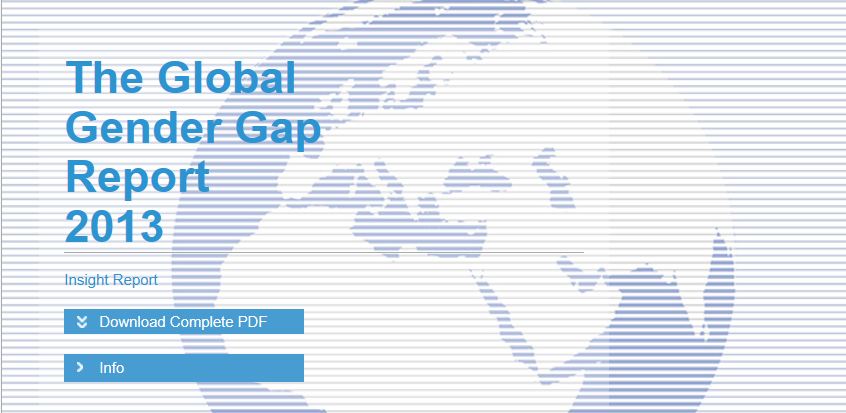
Over at the Good Men Project, John Edale exposes the sexist data collection and interpretation model used by the World Economic Forum in their Global Gender Gap Report. It's strange that the authors of the study chose a skewed assessment model over a seemingly balanced model an gave no explanation for their choice.
From page 4 of the report:
“To capture gender equality, two possible scales were considered. One was a negative-positive scale capturing the size and direction of the gender gap. This scale penalizes either men’s advantage over women or women’s advantage over men, and gives the highest points to absolute equality. The second choice was a one-sided scale that measures how close women are to reaching parity with men but does not reward or penalize countries for having a gender gap in the other direction.”Without explanation, the authors chose the 2nd measure - and although it says it does not reward or penalize countries for a gender gap in favor of women, it also penalizes REAL gender equality.
Their report becomes mere nonsense when their model is applied to individual areas of assessment.
When measuring enrollment in tertiary education (college, university etc) this produces some bizarre results. The number one ranking nation is Qatar with a staggering female to male student ratio of 5.60. The US comes in at 32nd place with a ratio of 1.41, while the UK is 36th with a ratio of 1.38. Over half of the countries surveyed have more female than male students. Apart from suggesting that the term “reverse gender gap” may be a misnomer in this particular area, it also means that those countries which currently have a perfect 1.00 ratio (Switzerland and Guatemala) are relegated to the bottom half of the table.It gets even weirder in the healthy life expectancy category. The Russian federation, with a 10-year gap between female and male life expectancy comes in first place, despite the fact that in that country females live to be 65 and men only make it to 55.
Yet in Japan, where women live to be 78 and men live to 73, with only a five-year gap, Japan placed 36. People live longer and the men are closing in on the women in life expectancy, but they are penalized for approaching equality.
How is this about gender equality where any real equality - like Switzerland and Guatemala having a 1:1 ratio of men and women in college education - is penalized because the women are not surpassing the men?
This smells like radical feminism and not even remotely related to gender equality.
A Gender Gap Is a Gender Gap Is a Gender Gap
November 17, 2013 by John Edale

The World Economic Forum published a report on gender gaps throughout the world praising countries in which men lag behind women. John Edale deconstructs this report and advocates for true equality not just a different inequality.
Last month the World Economic Forum published its annual Global Gender Gap Report. The report measures the progress that has been made in reducing gender gaps throughout the world in areas such as education, literacy, health and earnings. It then combines the data from these different indicators to produce a Global Gender Gap Index, ranking countries according to their overall performance.
The report received a significant amount of press coverage in the UK, with the BBC even scheduling a month-long “100 Women” season of programs and events to coincide with its release.
The main conclusion of this year’s report is the welcome news that many of the disadvantages facing women around the world are slowly being overcome.
However, for me, the usefulness of the report, and at times even its validity, is undermined by the fact that it takes a strange and openly one-sided approach towards gender equality.
Earlier this year I wrote about the problem of educational underachievement by boys in the developed world, and how reluctant we seem to be to even acknowledge this as a problem let alone try to get to grips with it. I was therefore interested to see what approach the report would take towards this particular gender gap.
The beginning is certainly promising. When explaining the ways in which the Index was calculated the report states that it “ranks countries according to their proximity to gender equality rather than to women’s empowerment. Our aim is to focus on whether the gap between women and men in the chosen indicators has declined, rather than whether women are ‘winning’ the ‘battle of the sexes’.” (page 4)
However, on the very same page, the report goes on to explain :
“To capture gender equality, two possible scales were considered. One was a negative-positive scale capturing the size and direction of the gender gap. This scale penalizes either men’s advantage over women or women’s advantage over men, and gives the highest points to absolute equality. The second choice was a one-sided scale that measures how close women are to reaching parity with men but does not reward or penalize countries for having a gender gap in the other direction.”
One might imagine that the first scale would be the obvious, common sense choice, and the only one compatible with the aim of ranking countries according to their proximity to gender equality, and yet the report’s authors opt instead for the second “one-sided” scale.
If you are wondering what the reasons for this were then I’m afraid you will have to keep on wondering.
“We find the one-sided scale more appropriate for our purposes” is the only explanation the reader is given.
The report is almost 400 pages long. One might imagine that a paragraph or two could have been spared to provide some kind of glimpse into the rationale behind a decision which fundamentally alters the nature of the Index, and contradicts its stated aim.
Whatever the reasons, one of the results of using the second scale is that the large gender gap in educational achievement that has existed throughout the developed world for over two decades simply vanishes. Countries where women achieve more than men educationally are all given the maximum possible score in this category (1.000) when calculating their overall place on the Index.
As well as the main Index, the report goes on to provide separate tables ranking countries according to their performance on each individual indicator. At this point even the commitment not to reward cases in which women are outperforming men is abandoned.
The countries which are ranked highest in each category are not those which have the smallest gender gap, but those which have the largest “reverse” gender gap.
When measuring enrollment in tertiary education (college, university etc) this produces some bizarre results. The number one ranking nation is Qatar with a staggering female to male student ratio of 5.60. The US comes in at 32nd place with a ratio of 1.41, while the UK is 36th with a ratio of 1.38. Over half of the countries surveyed have more female than male students. Apart from suggesting that the term “reverse gender gap” may be a misnomer in this particular area, it also means that those countries which currently have a perfect 1.00 ratio (Switzerland and Guatemala) are relegated to the bottom half of the table. Beneath these are the minority of countries which have more male than female students, with Chad being at the very bottom of the pile with a dismal ratio of only 1 female student for every 4 males.
Perhaps the oddest thing about this whole odd table is that the size of the gender gap in the worst country is surpassed only by the size of the gender gap in the “best.”
Sometimes the language used in describing the results becomes distinctly Orwellian. At one point the report states that “Philippines is the only country in Asia and the Pacific that has fully closed the gender gap in both education and health.” (page 21)
At enrollment in primary education, Philippines has a female to male ratio of 1.02. At secondary education this has risen to 1.19, and at tertiary education to 1.24. By what definition can this be described as a “fully closed” gender gap?
The WEF’s methodology produces some surreal results in other categories too.
In the Healthy Life Expectancy table, the top ranking country is the Russian Federation, where women can expect to enjoy an average of 65 healthy years, compared to only 55 for men.
However, Japan, which has the highest figure of all for women (78 years) is way down in 36th place. Japan’s problem is that its pesky menfolk aren’t lagging far enough behind. They are stubbornly hanging on for an average of 73 healthy years, which is spoiling the country’s ratio.
Thus we have a situation where a country in which both genders enjoy longer, healthier lives, and where the gap between the genders is smaller, is actually penalized in the rankings precisely because the gap is smaller.
If the validity of this logic is accepted then the best thing any man can do to make his country a more equal place is to throw himself under the nearest bus.
Does this back-to-front approach to gender equality really benefit anyone?
Surely organizations like the World Economic Forum are running the risk of discrediting the very notion of a struggle for equality in the eyes of many people who might otherwise have been supportive?
The crime writer Raymond Chandler once said “If you believe in an ideal, you don’t own it, it owns you.”
Too many of today’s guardians and gatekeepers of Equality don’t seem to see things that way. They believe the ideal is theirs to tweak, twist and reinvent as they see fit.
Maybe we need to become more willing to ask them why?
Photo/ Flickr— Neela
Saturday, November 16, 2013
What Does Manhood Mean in 2013? (from New York Magazine)
From New York Magazine, Ann Friedman looks at what it means to be a man in 2013 - and she uses four press items from the weeks preceding the September 20 article. One of the cool things she included is the Life of Men from Esquire magazine - check it out.
Here is a summary of what she finds in the confusion of men today around definitions of masculinity:
Here is a summary of what she finds in the confusion of men today around definitions of masculinity:
The JWT report gives an overall impression that, just like femininity, masculinity is increasingly defined by both playing to and against type. It's growing a really impressive beard and ordering a kale salad for lunch. It's knowing Super Bowl trivia and being an emotionally supportive partner. But if this makes it sound like men are joining women in having a less gender-bound view of their sense of self, it’s not that simple. According to the JWT research, even though millennial men are, more than older men, okay with using concealer and learning to poach eggs, they also say they're more frustrated with not knowing what it "means" to be a man.The confusion around masculinity, as far I am concerned, is a good thing - it indicates that the old stereotype of the rugged, emotionally distant, and potentially violent male is no longer a given, no longer the gender role in which boys are automatically embedded as they grow into men. There are now masculinities - and that makes a better world for men and women.
What Does Manhood Mean in 2013?
By Ann Friedman
9/20/13
What does it mean to be a man in 2013? Consider four data points from recent weeks:
1. Tech entrepreneur Bryan Goldberg, who became an Internet laughingstock last month when he issued a stupendously tone-deaf announcement for Bustle, his new site aimed at women, was bashed all over again this week following a New Yorker profile in which he appeared to be overcompensating for his prior gender gaffes. “We didn’t want pink everywhere,” he told the magazine, noting that women seem to be interested in all kinds of things, from earrings to Zumba to Amanda Bynes to Syria. Women, in Goldberg’s view, have complex desires and interests, some of which conform to classic feminine stereotypes, but many that do not. And what of men? According to Goldberg, they like sports and financial markets and ... not reading books. A man is a simple creature.
2. Hanna Rosin, author of The End of Men, declared the end of patriarchy. In an era when middle-class men are struggling to hang onto their jobs and cultural relevance, it’s only feminists who keep the concept of male dominance alive, she argued, by purposefully highlighting the “statistics that make women look most beleaguered.” In other words, how can we be living in a patriarchy if the definition of “male” no longer carries with it a guaranteed level of social and economic status? Without such power, man is over.
3. Esquire revealed its “Life of Men” project, a photo gallery and accompanying questionnaire that aims to “create a living portrait of the American man right now.” There’s a healthy dose of masculine swagger among the subjects, but if there’s one common theme, it’s family. Over and over, these men — some of the most professionally accomplished specimens in America — name their children as their greatest achievement, their best day as the one on which they met their wife. A man is a nurturing partner and father.
4. That theme was echoed somewhat in a new report from the market-research firm JWT on male consumers and masculinity, which found that “emotional support for family” ranked just behind “financial support for family.” The JWT report says two thirds of men would make their work schedule more flexible or stay home with their family full-time if they could afford to. This was confirmed by a new Pew study this week, which declared that there are more men on the “daddy track” than ever before — though not always, it took pains to note, voluntarily. “Men’s ideas,” reported NPR, “have shifted closer to what many women have long felt.” But still, a man is a provider.
What’s striking isn’t the lack of consensus on what defines masculinity now, but the utter confusion about how to go about doing so. That’s because America is finally getting around to having the conversation about what it means to be a man that, decades ago, feminism forced us to have about womanhood. Women still face social consequences when they don’t conform neatly to gender norms, but many of even the most ideologically progressive men are just now starting to talk about how to break with masculine stereotypes and still hang onto a sense of gender identity. Goldberg and Rosin, in using traditional definitions of manhood (the simple, stoic breadwinner), declare him dead, or at least less marketable to advertisers. Men’s magazines, which now peddle facial moisturizers but still often shy away from heartfelt confessionals, have spotted how hard it is for men to balance both embracing and rethinking masculine stereotypes — and they’ve made some attempts to address it, but mostly ended up documenting the confusion.
And much of that confusion can be traced back to the fact that we’re still adapting to an expanded definition of what it means to be a woman. “The most complicated aspect of manhood is dealing with antiquated social norms about gender roles,” says my friend Eric Uhlir, who lives in D.C. “Society, at least American society, still hasn't realized that it's not just a woman's job to raise a child but everyone's job in a sense. We just drop it in women's laps and men just pretend like it's not even a problem. That feels like the most pervasive gender stereotype the world's brohemians don't seem to understand or just choose to ignore.”
Brohemian is an apt term: The JWT report gives an overall impression that, just like femininity, masculinity is increasingly defined by both playing to and against type. It's growing a really impressive beard and ordering a kale salad for lunch. It's knowing Super Bowl trivia and being an emotionally supportive partner. But if this makes it sound like men are joining women in having a less gender-bound view of their sense of self, it’s not that simple. According to the JWT research, even though millennial men are, more than older men, okay with using concealer and learning to poach eggs, they also say they're more frustrated with not knowing what it "means" to be a man.
JWT’s millennial men were more likely to answer affirmatively to statements like "Men can't be men anymore.” These guys have never lived in an era of rigid gender rules. The report says they seek the perceived trappings of manly men of the past to reinforce their masculinity while they pursue the other, more traditionally feminized lifestyle choices they also desire. This theory might explain why you can often find rugged pickaxes in high-end clothing shops of urban America.
“One of the reasons that I think facial hair — mustaches and beards, specifically — have come so much back in vogue is because there seems to be an almost primal urge to reclaim our right to be men and to look like men,” says Phil Walker, a gay man who lives in D.C. and has been known to sport an impressive mustache.
Sometimes the thick beard and the artisanal pickax on the mantel betray the fact that — gender enlightenment aside — a man may not be completely ready to abandon the traditional greatness of being a guy. Even if he wanted to, it would be tough to pull off. “How can guys pick themselves up by their bootstraps and bring home the bacon when we're also embracing the idea that everyone is entitled to whatever bacon they want, however they want to get it?” asked my friend Dylan Lathrop. The real challenge is compromise and balance.
And this is why I think Rosin is wrong about the end of patriarchy. “Patriarchy” doesn’t just mean concrete systems that ensure only men have access to the upper echelons of power; it also encompasses our ingrained cultural understanding of what men should be and how they show dominance. If it looks like we’ve reached the “end of men,” that’s only because patriarchy (alive and well!) tells us the only way to be a man is to be The Man — economically, politically, and socially. If patriarchy were really over, stay-at-home dads wouldn’t be the death knell of an entire gender. They’d just be … men. They are men.
Ultimately, confusion about modern masculinity is a good thing: It means we’re working past the outmoded definition. Men are increasingly comfortable breaking masculine gender stereotypes, but want to hold on to certain gender signifiers? They're uneasy about living in such a mixed-up, muddled-up, post-gender world, but don't want to go back to the rigid roles of the past? Welcome to where women have been since second-wave feminism! It's confusing out here.

Friday, November 15, 2013
Male Workers Support Cracking Glass Ceiling

I have long suspected this to be true, but now there is research to confirm it - male workers support having women as their bosses.The funny thing is that men support women becoming CEOs more than women do.
Full Citation:
Semykina, A, Linz, SJ. (2013). Job Satisfaction and Perceived Gender Equality in Advanced Promotion Opportunities: An Empirical Investigation. Kyklos, 2013; 66 (4): 591 DOI: 10.1111/kykl.12038
Men Support Cracking Glass Ceiling
Nov. 12, 2013 — Male workers appear to support women becoming CEOs even more than female workers do, finds new research on the proverbial glass ceiling and job satisfaction in six formerly socialist countries.
The study, co-authored by Michigan State University economist Susan Linz, found that both sexes actually report higher job satisfaction when they believe a woman has a chance of becoming chief executive of a company or organization.
"Promoting gender equality at the top has positive consequences for job satisfaction for both men and women," Linz said. "So it's worth it for firms to create environments where women have opportunities to advance, as higher job satisfaction means higher productivity, higher revenues and a healthier bottom line."
The study, which appears in the international research journal Kyklos, is one of the first to examine the link between job satisfaction and advance promotion opportunities at a time when more women worldwide are reaching the upper management ranks in spite of significant barriers.
In a surprising twist to the findings, men generally reported higher job satisfaction than women when it came to gender equality in the top job.
"We find little evidence that men dislike working for a woman or view women's advancement to upper-level positions as creating a more competitive work environment," Linz said.
Instead, she said men may view women's ascension to the top as an indicator of their own promotion opportunities. "In other words, if they can do it, I can do it."
For the study, Linz and Anastasia Semykina of Florida State University surveyed more than 6,500 workers from 700 employers in the socialist-turned-capitalist countries of Russia, Serbia, Armenia, Azerbaijan, Kazakhstan and Kyrgyzstan.
The researchers asked how likely it is that a woman could hold the position of director and linked the employees' answer to his or her response on job satisfaction. While results from individual countries varied, overall the researchers found that men and women tended to support gender equality in the workplace.
"Even in cultures where women may still not be considered equal," Linz said, "there is a positive link between job satisfaction and perceived gender equality -- and it's particularly strong among the younger generation."
Linz said it would be interesting to see similar studies conducted in the United States, Europe and Asia.
Thursday, November 14, 2013
Omnivore Linkage - Gender, Patriarchy, and MRAs
Here is a new collection of links from Bookforum's Omnivore blog, this one dealing with gender issues, patriarchy, men's rights activists, feminism, and other interesting topics.

Gender-specific
Nov 14 2013
9:00AM
- From Reconstruction, a special issue on politicized (re)productions of gender.
- In a world where men and masculinity are valued above women and femininity and the voice of god sounds like a man, can there be any sense of justice?
- I’m not a feminist but: These American teens look up to their strong mothers and believe in equal rights — so why won’t they use the F-word?
- Noah Berlatsky on what Joss Whedon gets wrong about the word “feminist”.
- From New Left Project, it is perhaps one of the most used terms in feminist discourse, but the concept of patriarchy has a history that we need to address; and pornography, patriarchy and liberalism: Bob Brecher on re-reading Andrea Dworkin.
- From New York, what does manhood mean in 2013? Ann Friedman investigates.
- The Masculine Mystique: For the past decade, the Men's Rights Movement has been gaining traction on the Internet — and growing ever more radical in its attacks on feminists.
- A good men’s rights movement is hard to find: Jaclyn Friedman on how the rise of men's rights activists is hurting women — and men.
- In response to the rampant misogyny of the Internet, feminists are putting "misandry" on shirts, hats and jewelry.
- How Jezebel smashes the patriarchy, click by click: An interview with the website's founder, Anna Holmes, on Photoshopped models, encyclopedic thinking, and why she couldn't care less about male readers (and more and more).
- Lisa Wade on power, Mickey Mouse, and the infantilization of women.
- A look at the 20 worst gender-specific products possible.
Wednesday, November 13, 2013
What Is Your Passion? What Is Worth Fighting For?
This new article from T-Nation is part of their powerful words series - inspiration, motivation, and introspection (my words, not theirs). On the surface it is an exhortation to find your reason for getting and staying fit, but there is more to it than that.
We all have to find our fight in life, the thing we are passionate about (or the things). Even when we can identify the passion, we also must find our motivation to engage in that passion with our full commitment, our full selves.
The author, Nate Miyaki, provides his reasons for being in the "fight" to be and stay fit"
As I grew older, I realized that staying fit protected me from being deeply depressed, from low self-esteem, and from gaining the middle age spread my parents acquired. I exercise to live.
But there are more fights in life than fitness.
What are you REALLY passionate about? What in your life is worth fighting for, living for, sacrificing for?
We all have to find our fight in life, the thing we are passionate about (or the things). Even when we can identify the passion, we also must find our motivation to engage in that passion with our full commitment, our full selves.
The author, Nate Miyaki, provides his reasons for being in the "fight" to be and stay fit"
I can tell you some of the things I'm fighting for, just to give you ideas. It's because I come from a family that's struggled with addiction, and linking my identity to athletic pursuits has given me a better obsession.For me it was obesity, diabetes, and heart disease [dad], as well as obesity, blood clots, and cancer [mom], the lifestyle diseases that killed my parents. It was being an athlete first to fit in with the other boys (a challenge for all nerds), and later because I LOVE to compete. Now I compete with myself.
It's because I think we're all searching for the same three things in life: a passion, a sense of purpose, and peace of mind. We just go about it in different ways. It just so happens that I've been lucky enough to find all three in this game, and don't think I could find it anywhere else.
As I grew older, I realized that staying fit protected me from being deeply depressed, from low self-esteem, and from gaining the middle age spread my parents acquired. I exercise to live.
But there are more fights in life than fitness.
What are you REALLY passionate about? What in your life is worth fighting for, living for, sacrificing for?
Find Your Fight
by Nate Miyaki | T-Nation

The most valuable lesson I've learned has nothing to do with the nuts and bolts of training or diet. The true key, the secret to your success in physique transformation or strength sports, and maybe even in life, is this:
You gotta know what you're fighting for.
Until you find what you're truly fighting for, all training programs and diets (even the best ones), will be relatively meaningless.
The Lost Generation
For the most part, our generation has become a bunch of whiney, lazy, entitled pussies. People have lost their warrior spirit, their dedication, and their willingness to strive.
We've become highly skilled at acquiring facts and information, analyzing, and sounding intelligent, but we are doing less and less. We know distraction well, but discipline has become a foreign language. We've gotten great at throwing forum and social media posts like right and left hooks, but run like cowards from any real-life fights.
How do we change that? Some modern guru is going to tell you it's all about drinking some magical tea and floating through space in a lotus pose. They'll spice it up with some mysticism and cultish codependency as well. None of that is really necessary because, believe it or not, the answer is a lot more simple and straightforward.
Learn from Cinderella Man

If you haven't seen the movie, Cinderella Man, you should. Here's the Cliff Notes synopsis:
It's based on the "true story" of James Braddock, a boxer who retires due to injury. He works as a day laborer to support his family during the Great Depression. Having lost all his possessions and savings and unable to pay the bills, he gets an opportunity to return to the ring in a last-chance effort to save his family.
During his comeback, Braddock is pitted against a fighter that had beaten him earlier in his career. In the middle of this rematch, Braddock is winning, which initiates the following exchange between Braddock's opponent and his trainer in-between rounds:
Trainer: What are you doing? You beat this guy easy last time.Braddock had watched his family starve and suffer. Fueled by more than personal ego, vanity, or even mere competition, Braddock becomes a different animal in the ring, fighting for survival. He somehow finds a way to beat younger, stronger, heavier, and more skilled boxers. When asked by a reporter how the impossible became possible, he gives a simple answer:
Fighter: He ain't the same guy.
"This time around, I know what I'm fighting for."
Finding Your Fight
I don't know what that is for you. And I don't think any life coach or guru can give you some magical formula to figure it out. More than giving you any awesome diet or training plan, it would be my greatest pleasure in the world to be able to provide that answer for you. Unfortunately, I can't.
Ultimately, you're going to have to take some personal accountability, look at your life, look inside yourself, and come to your own conclusions. As a matter of fact, part of finding your fighting spirit is realizing that you can't always rely on someone else, or wait for a savior to solve all of your problems. You have to solve them for yourself.
What I can do is tell you what has motivated others. Maybe that will give you some ideas. For some, it really was about survival. They had a health problem they had to fix, and their life, or quality of life, was suddenly on the line. For some, their sport was how they made their living, and food on the table was dependent upon victories.
For some, it was to give them a competitive edge in a career outside of sports. Working out and eating right gave them better energy, cognitive function, and focus behind the desk, allowing them to push harder than the competition, and ultimately crush it.
For some, it was about being picked on as kids, and if the world wasn't going to give them respect, they were going to build themselves up and take it. For some, it was just like what martial arts can be to others – a way to channel negative energy into positive, to learn lessons that translate to life, to find some kind of deeper meaning through physical challenges. Some used nunchucks; others used dumbbells. No matter, either served to fulfill their purpose.
I can tell you some of the things I'm fighting for, just to give you ideas. It's because I come from a family that's struggled with addiction, and linking my identity to athletic pursuits has given me a better obsession.
It's because I think we're all searching for the same three things in life: a passion, a sense of purpose, and peace of mind. We just go about it in different ways. It just so happens that I've been lucky enough to find all three in this game, and don't think I could find it anywhere else.
How Will You Know?

I might not be able to tell you how to find your fight, but I can certainly tell you how you'll know when you've found it. There will be no more beginnings or getting back on track. There will be no defined ends as some 90-day program's promise. There will only be putting one foot in front of the other, in the next step of a never-ending journey.
It's going to make the road any easier. Excellence is never easy – that's the point. There will be ups and downs, adversity, and setbacks. There will be days where you will absolutely want to quit. But when you know what you're fighting for, you will find a way to persevere.
- Days will run into months, months will run into years without ever having to start over. You'll just keep moving forward.
- You won't complain of the struggles. You'll embrace them, because you'll know that your ability to push through is what will ultimately separate you from the rest of the pack.
- There will be no more New Year's resolutions, only daily ones. And sticking to them will not be an option. It will be a necessity.
- You will not find excuses. You'll find ways.
- You'll stop looking for short cuts and quick fixes, because you'll know that a worthwhile mission lasts a lifetime.
- You'll stop training for gym or virtual high-fives, but rather for personal satisfaction and accomplishment.
- You won't have a sport or a hobby. You'll have a way of life
- All of a sudden those 20 different diet and training programs that didn't work in the past, will all work.
This is life. The obstacles are never-ending. That's why it's imperative that you find a true reason to keep going, not some make-believe, self-induced, bubble gum fitness one.
The Rules
The path to success lies in the purpose, not the person. We're all capable of great things. Ordinary men that had a purpose have achieved great things. Extraordinarily gifted men with no mission have chronically underachieved. Society provides plenty of examples of both.
- Rule #1: Find what you're fighting for.
- Rule #2: First learn rule #1. Everything else is just details.
Tuesday, November 12, 2013
Researcher Claims Progress on Predicting Whether "Bad Boys" Will Grow Out of It or Not

This press release comes from the University of Michigan, where psychologist Luke Hyde is specializing in antisocial behavior in young men. His 2011 paper, written with Ryan Bogdan and Ahmad R. Hariri, is "Understanding risk for psychopathology through imaging gene–environment interactions," and it is available for free online.
I'm not sure about this kind of stuff - although I am sure parents will line up for the exam. So if a kid has the specific genetic traits and the parents give the "correct" answers, is the kid labeled for life as an antisocial personality? Is he written off or put on meds he may not need? This is a seriously slippery slope.
Bad Boys: Research Predicts Whether Boys Will Grow out of It or Not
Nov. 5, 2013 — Using the high-tech tools of a new field called neurogenetics and a few simple questions for parents, a University of Michigan researcher is beginning to understand which boys are simply being boys and which may be headed for trouble.
"When young children lie or cheat or steal, parents naturally wonder if they'll grow out of it," said Luke Hyde, a U-M psychologist who is studying the development and treatment of antisocial behavior.
Hyde, a faculty associate at the U-M Institute for Social Research and assistant professor of psychology, is an expert on how genes, experience and the brain work together to heighten or reduce the risk that normal childhood transgressions will develop into full-blown conduct disorders in adolescence and early adulthood.
"The lifetime prevalence of conduct disorder is around 10 percent, and even higher in males and low-income populations," Hyde said. "The total cost to society is enormous, since these behaviors are often chronic, lasting through adulthood."
With colleagues at U-M, Duke University, the University of Pittsburgh and other institutions, Hyde has been exploring the role of the environment and biology as they interact over time to shape behavior. In particular, he is using the techniques of a new field called neurogenetics, which combines genetics, neuroscience and psychology, to learn how genes and neural processes interact with harsh environments, including dangerous neighborhoods and harsh parents, and with a child's own levels of empathy and personality traits, to increase the risk of antisocial behavior.
In one recent study, for example, Hyde and colleagues studied subjects with over-reactive amygdala responses. The amygdala is an almond-shaped part of the brain's primitive limbic system involved in processing fear and other visceral emotions. It has been associated with impulsive, aggressive behavior, as well as anxiety disorders and depression.
"Previous research suggests that the amygdala becomes over-reactive probably as a result of both genetics and experience," Hyde said. "And once the amygdala is over-reactive, people tend to behave in an anxious, over-reactive way to things they see as a potential threat.
"Our study found that this tendency is moderated by a person's environment, including the social support they get. If they're not getting support from family, friends, neighbors or professionals, then the link between the amygdala and anxious behavior is much stronger."
In another study, Hyde and colleagues showed that kids who are impulsive are only at higher risk of engaging in antisocial behavior if they live in dangerous neighborhoods.
Hyde also identified specific items within childhood behavior checklists that can be used as early as the age 3 to identify kids who will likely have worse trajectories for antisocial behavior compared to other children who have similar behavior problems, such as throwing tantrums.
These items assess observable behaviors that include whether the child is cruel to animals, doesn't seem to feel guilty after misbehaving, is sneaky, lies, is selfish or won't share, and won't change his or her behavior as a result of punishment.
"The results of this test aren't really meaningful until age 3," Hyde said. "Before that, many of these behaviors are fairly common and don't predict anything. But after age 3, if children are still behaving in these ways, their behavior is more likely to escalate in the following years rather than improve."
There is good news, though. Kids who scored high on this test benefitted just as much as other kids from interventions, according to Hyde. These interventions, often called parent management training, focus on giving parents better skills to manage child behavior problems, including training parents to spend more positive time with their kids, use time-outs instead of physical punishments, and reward good behavior by giving out stickers.
"Parents need to know that intervention works, especially if it's done early," Hyde said. "They need to go for help if they see signs of trouble. Clinical psychologists, among other professionals, have empirically supported treatments that are quite effective for children, especially in this age period."
Subscribe to:
Posts (Atom)