Tuesday, January 20, 2009

The Smithsonian - History of the Hysterical Man

History of the Hysterical Man takes a look at an interesting book - Hysterical Men: The Hidden History of Male Nervous Illness - by Mark Micale, a professor of the history of medicine at the University of Illinois, in which 'he explores the medical tradition of ignoring masculine “hysteria,” and its cultural consequences.'

This is an excellent interview, and a book that many of us should likely read, along with I Don't Want to Talk About It: Overcoming the Secret Legacy of Male Depression, by Terrence Real.

History of the Hysterical Man

Doctors once thought that only women suffered from hysteria, but a medical historian says that men were always just as susceptible

  • By Abigail Tucker
  • Smithsonian.com, January 05, 2009

The term “hysteria” comes from the Greek word for “womb” and refers to a disease that was once diagnosed almost exclusively in women. Women’s asthma, widow’s melancholy, uterine epilepsy -- these were all synonyms for a strange complex of symptoms that included unexplained pains, mysterious convulsions, sudden loss of sensation in the limbs and dozens of other complaints without apparent physical cause. Particularly during the Victorian age, doctors thought hysteria demonstrated the general fragility of the fair sex. The best remedy was a good marriage. But all the while untold numbers of men were suffering from the same illness. In his new book, Hysterical Men: The Hidden History of Male Nervous Illness, Mark Micale, a professor of the history of medicine at the University of Illinois, explores the medical tradition of ignoring masculine “hysteria,” and its cultural consequences.

What is hysteria?

It’s more or less impossible to define hysteria in a way that a physician today would find acceptable. The meaning has changed dramatically over time. It’s an enormous collection of possible symptoms that are of the body but that can’t be traced to any known physical disease. It can look like a manifestation of epilepsy, a brain tumor, advanced syphilis, Parkinson’s, but upon examination it’s none of these. Ultimately the suspicion forms that though these are bodily manifestations, the cause is psychological.

Why don’t we hear that diagnosis anymore?

The term is no longer used because American psychiatrists over the past half century have decided not to use it. They’ve renamed it, breaking it into various parts, labeling it differently. These successor categories all have the quality of sounding more scientific, which is no coincidence. There’s “somatization disorder” and “psychogenic pain disorder” and a whole string of other labels that basically cover the same category that Freud and his predecessors were comfortable calling hysteria.

Why was it so rarely diagnosed in men?

It’s not that the behavior didn’t exist. It did exist. It was rampant. Men were as prone to nervous breakdown as women were. It was not diagnosed for social and political reasons. Men were believed to be more sane, more motivated by reason, more in control of themselves emotionally. If you were to diagnose honestly, that would have pretty quickly called into the question the difference between the sexes and the idea that men were more self-possessed than their fragile, dependent female counterparts. Ultimately it comes down to patriarchy and power.

For a brief time, in Georgian England, it was almost fashionable to be a hysterical man. Why?

In 18th-century England and Scotland, it was acceptable to acknowledge these symptoms in men and call them “nervous.” The label was applied, and self-applied, to men who were upper-middle or upper class, or aspired to be. They interpreted these symptoms not as a sign of weakness or unmanliness but as a sign that they had a refined, civilized, superior sensibility. If the weather depresses you, if you get emotionally involved in reading a Shakespeare play, if you tire out easily, it’s not because you’re unmanly, it’s because you have a particularly sophisticated nervous system that your working-class counterparts do not. And if you can convince other people in society of this, then doesn’t it mean you’re better suited to govern the state wisely?

How did historical events, like Napoleon’s conquests, shape hysterical diagnoses?

The history of masculinity is very caught up with contemporary events. If there’s something in the history of the time that requires men to suddenly fulfill their most traditional, stereotypical roles -- such as defending the homeland -- then that tends to be a period of very conservative gender attitudes. That ‘s what happened with the Napoleonic period. When there’s a war, and one country after another is being invaded by this short, upstart Frenchman, what becomes important is producing virile soldiers. During and after the Napoleonic period, and especially in Britain, there was a change in how nervous disorders in men were seen. They went from being signs of refinement and civilization to signs of weak and unmanly behavior -- and, a generation later, as signs of physical and biological degeneration.

What about the fact that doctors of the day were almost all male?

Doctors themselves are products of a society and, in the case of Europe when the medical profession first rises, every doctor is by law male, because women are barred from university. Ninety percent of the doctors are coming from the rising middle classes and they were very concerned, as part of their professional ascent, that they appear as men of science. They saw middle-class men as especially rational and controlled and self-disciplined. It’s not surprising that when they saw cases of hysteria in middle-class men behind closed doors, they just didn’t theorize about or print the cases in the way they do so extensively with their women cases. It’s their own image, in their own minds, that they’re protecting. Wild behaviors were an object of study, not something they saw in themselves.

Did writing this book involve assessing any hysterical tendencies of your own?

I joke with my colleagues that, despite the title, this book is not my autobiography. But it does help to be somewhat self-aware psychologically. For me it’s a fascination with a behavior pattern that is opposite my own. Obsession and over-control are my chosen pathologies, my neuroses of choice, and for that reason I’ve been interested in those who negotiate the world through hysterical outbursts.
Read the rest of the interview.


Monday, January 19, 2009

Kurt Barstow - Embracing Imperfection

Kurt Barstow has been posting a lot of good stuff lately, and as I have noted before (over at IOC), it's not the run-of-the-mill New Age crap you often find in spirituality columns. This one on embracing imperfection is no exception.

The ability to accept and embrace imperfection is crucial for men. We have often been raised to see mistakes or imperfections as failure, rather than opportunities for growth. No one can ever be perfect, but we can always be growing toward that impossible goal.

And yet, we are always already exactly who and what we need to be. Yes, we can improve our behavior and our understanding of the world (relative reality), but that doesn't impact our already perfected Buddhanature (absolute reality). Kurt looks at this issue in the column.

Embracing imperfection


Art Hit, Perfection in Imperfection
The psychologist and meditation teacher Tara Brach begins her book Radical Acceptance (Radical Self-Acceptance on audio CD), about the problem of self-aversion (apparently a uniquely Western phenomenon), with a quote from the Zen Master Dogen: "To be in harmony with the wholeness of things is not to have anxiety over imperfection." As the most imperfect sort of perfectionist--one who has a perfect ideal somewhere in mind but is either so scared off by it that I don't get beyond thinking to doing, or doesn't put in the time with detail to actually perfect something--I was very moved by this notion that trying to live up to perfection is one of the chief factors behind self-hatred. My anxiety has always manifested itself primarily as self-consciousness based in unexamined fears and limiting beliefs that have held me back and stunted developmental progress much of my life. I can't speak. I'm ineloquent. I have nothing to say. I can't express myself emotionally. If people really know me, they won't like me. I'm not good enough. I won't ever succeed. I have no power. My sexuality or my sexual orientation will be disapproved of. I am a failure. People will either think I'm crazy or an idiot. These ideas have lived so far beyond their time that I feel a certain amount of embarrassment in listing them, along with the relief that comes from recognizing them as, in fact, beliefs rather than realities. The defenses that provide the protective armor shielding me from experiencing these beliefs as actual realities--silence, inaction, isolation, not showing up--keep me from experiment, responsibility, and connection to others.

A few years ago I had a sort of vision of what I now take to be two types of consciousness. In one image was a long-haired barbarian prisoner in a dungeon with hands shackled, raging against his chains, struggling, spit flying, and hair whipping about. Almost immediately an alternative image came to mind of a farmer walking up a hill toward a gnarled oak tree at dawn. Dew was on the grass and mist rolling off the top of the hill. The air was fresh, the outlines of things had a crisp coolness. The farmer was a part of the landscape and the landscape a part of the farmer. The prisoner I have taken since to be an image of the separate self, which is what we feel most attached to when we have anxiety over imperfection, whereas the farmer is an image of the Self, connected to the oneness of things, in harmony with his surroundings. So it seems that the only way to remove the shackles of the prisoner is by recognizing the imperfection that is built into our very nature. Another way of talking about this would be to discuss our sin, or "missing the mark," although I am hesitant to do so or to use that word because of all the devilish uses to which it has been put. It is perhaps one of the most overloaded and unlovingly, divisively used words of the last millennium. But to paraphrase Dogen, to have anxiety about our sin (our imperfection) is to be out of touch with the wholeness of things. Once when I was behaving badly in some way or other and feeling remorseful, my partner looked at me and said, "Don't you realize that you are pre-forgiven." It brought me back from self-isolation into the community of human beings. Forgiveness is discussed today as a process that is as much about ourselves as it is for others, but we shouldn't forget that it is indeed for others too. We can all do that for each other. We should all be so generous.


Broken mirror

In our own times the urge toward self-improvement, toward perfection is great and can be almost overwhelming. But we are, in fact, perfect as we are in every moment. How could it be otherwise? This is not to say that we can't be lovingly self-reflective to help determine how we might be in the next moment. The anxiety over imperfection can keep us from looking at ourselves. I noticed the other day, for example, that I was falling far short of living up to at least half of The Eightfold Path of Buddhism. Right action, trying to do the right thing, and Right Speech, trying to say the right thing, realizing your speech affects the psyche of others, are certainly areas where I have fallen down, acting in self-interest or lying. And Right Thought, realizing that your thought is as important as anything else you do, and Right View, a correct understanding of how the world works, are areas in which I have probably been even weaker. (I am definitely one of those people who missed out on the rule book about how the "real world" operates). I realized in taking a look at this that I didn't hate myself because of it, but simply that there were some venerable moral guidelines that could help me to be more in touch with my wholeness and with my connection to the world. In addition to my moral failings, I haven't had money for months to pay the rent. I'm unemployed. I'm scattered somewhat in my job search. I can get depressed and procrastinate. I can be irritable. I can do the wrong thing for the right reasons. I am not a bad person because of this, however. In fact, my frustration with myself is entirely understandable if not entirely helpful. It took, in fact, just a little help from my sister, taking me by the hand, going to the computer, and saying, "You could try this and this and this," to help me get out of the circumlocutions and fears of my own head and to normalize the process for me of looking for a job. Sometimes it takes someone else doing the simplest thing to get us out of our own self-critical, anxious heads.


C Blair Howell, Perfection in Imperfection

The spiritual life is dependent on connection more than anything else. Being stuck in one's separate self sense is its great enemy. That separate self sense is very different than the hermit in his cell constantly praying to God, who presumably is connected to the wholeness of things. Connection can be found in sangha (or spiritual community), in family, in relationships, in friendships, in community, in work, in nature, in meditation or prayer, in reading, on the internet, in commerce. I have always been a slow learner. I only seem able to learn through, sometimes painful or difficult experience and it usually has to hit me over the head fairly hard. But Spirit is in all these manners of connection. Our isolation is a way of protecting ourselves. It is a defense of the ego, a way of hiding our imperfection. To embrace our imperfection is to see ourselves as whole and connected to the Kosmos. It also allows us to love others more perfectly.


Saturday, January 17, 2009

The Perils of Masculine Intimacy in Bad Influence (1990)

This is a cool site - Film of the Month Club looks at a different movie each month. The new post takes a look at the cult-classic film Bad Influence, and especially at the nature of masculine relationship presented in the film.

The Perils of Masculine Intimacy in Bad Influence (1990)

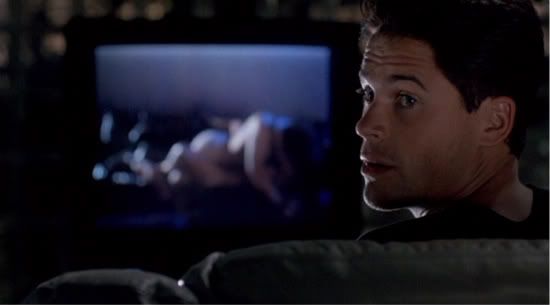
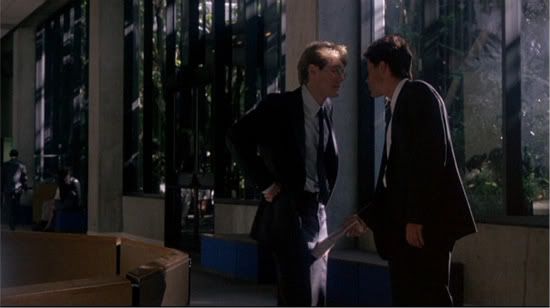
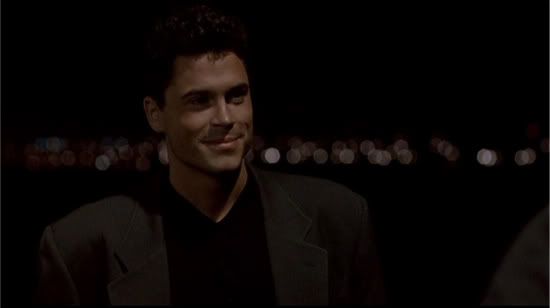
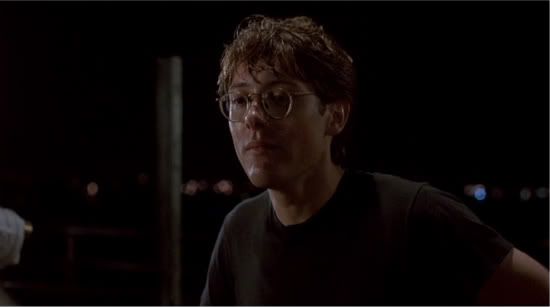
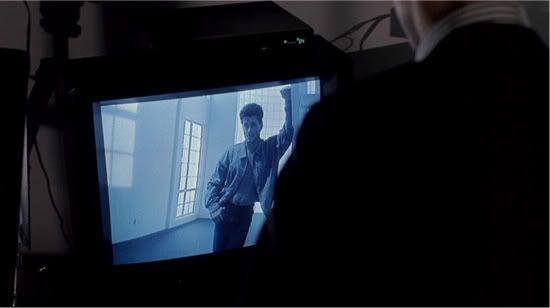
Curtis Hanson's Califor-noir Bad Influence (1990) impressed me mostly as a "downlow" narrative of male-male courtship, depicting the peculiar perils of same-sex intimacy. I don't think I read the film as "gay" in any way. Nor do I find it especially homoerotic (despite the camera's lurid titillation by the seedier tinge of Rob Lowe's beauty).

Rather, what I find most interesting in Bad Influence is Hanson's provocatively cinematic exploitation of queer(ish) visual tropes as a way to evince the essentially uncertain perils of male-male intimacy. I'm also fascinated by the fact that Hanson, presumably developing this film in the later 1980s, was able to make a film about the erotics of masculine intimacy while somehow eliding/escaping certitudes of gayness and/or straightness.

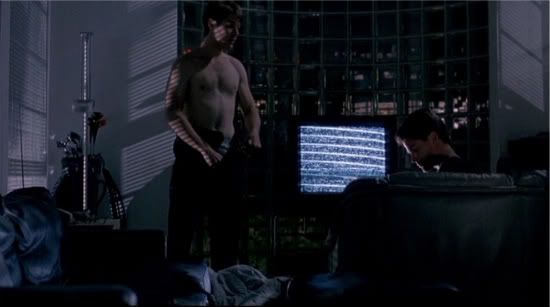
Most centrally, and putting aside for the moment the (open) question of whether or not Lowe's Alex is "real," Bad Influence is "about" the relationship between Spader's Michael and Rob Lowe's Alex (if that is indeed his "real" name)...

I love that the environment of Alex and Michael's first real interaction -- the piers, just after Michael has checked out the men's room and discovered it closed -- is a physical location rife with "cruising" metaphor.

And that their subsequent exchange -- a battery of awkward greetings, dropped glances, and coy smiles -- is as fraught as any flirtation, a feinting encounter that becomes all the more electrifying for the speed with which it evolves into a thrilling new relationship.

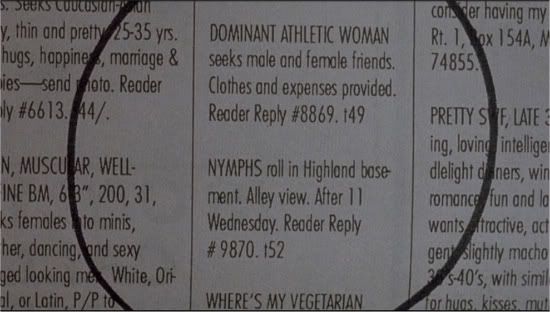
I found it impossible to forget the obliquely erotic charge of this first encounter between Michael and Alex, especially as their impromptu "date" continued, first to a dive bar where they seemed only to be interested in each other and then to an underground nightclub where their scopes widened. Here, I think it worth noting how Hanson uses the "code" of the underground nightclub network to mark the next three beats of Alex and Michael's evolving relationship.

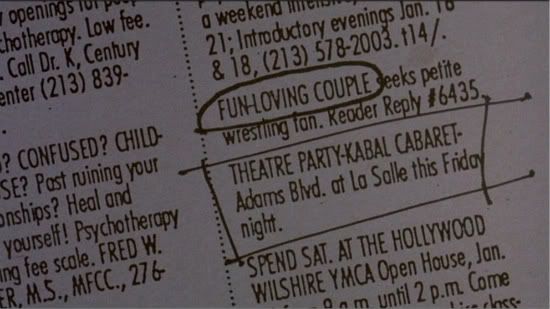
First, it's a bit of role play, requiring a touch of subservience on the part of the masculine subject. And while I wouldn't go so far to say that Lowe's Alex is the aforementioned "dominant athletic female" (though it is a somewhat amusing thought), I would suggest that the personal ad "code" does cue Spader's Michael for the "role" he takes in his subsequent relationship with Lowe's Alex. In the scenes that follow, Alex is calling the shots and Michael's learning the pleasures of taking orders. By the time of their next big night together, the two men have experienced a somewhat surprising degree of physical intimacy.

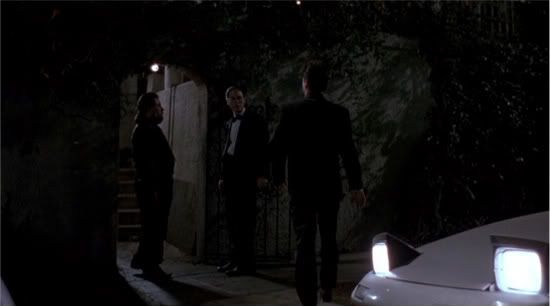
So it may be little surprise that Spader's Michael finds himself thrust into the throes of a minor identity crisis, as when he visibly bridles when Lowe's Alex voice calls from behind: "Gay White Male!"

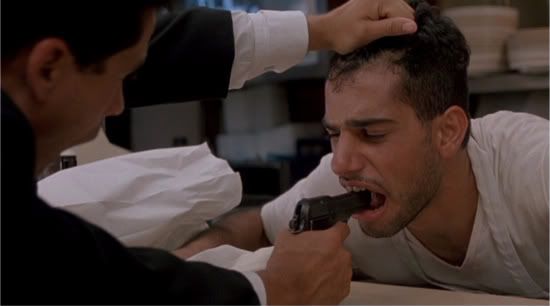
Spader's Michael is, of course, visibly relieved to realize that "Gay White Male" is not his new title but (like "Dominant Athletic Female" before it) merely the "code" for Alex and Michael's next adventure. This moment, too, is when I become convinced that Hanson is using such "code" to underscore that Michael and Alex are getting a little too close. Indeed, the "Gay White Male" evening of adventures commences a phase when things between Michael and Alex start getting scary, when their macho playdates transform into a set of dangerous secrets that Michael must learn to guard -- to "closet" -- lest they destroy the careful construction of his public persona. The homosexual horror of this next phase in Alex and Michael's evolving intimacy is enacted gruesomely, first in their shared predatory late-nite rampage (which includes the bizarrely sexual attack on the donut shop guy, an assault which culminates when Lowe doesn't "shoot" the dude's head off, but instead "squirts" in his mouth)...

And which continues as Alex stages his careful incrimination of Michael, a nefarious scheme which promises to render permanent their passing intimacy.

At this moment in the narrative, Alex's motives beg for elaboration, yet Hanson doesn't budge. Perhaps as a result, Bad Influence becomes more interesting than it should be. And, for me, the unknowability of Alex's motives clarified the gendered operation of identity-theft noir pics more generally. At this juncture in the narrative, I found myself reflecting on the identity problems in movies like Fight Club and Strangers on a Train or, say, Single White Female or The Hand That Rocks The Cradle or Rebecca. In this screening of Bad Influence, though, I realized that the threat in female-centered identity surrogation noir is most often that of a kind of erasure, where the ominous figure (either the new friend or the absent predecessor) threatens to stealthily overtake the life of the central character, until she must fight back in order to protect her own integrity/personhood. In male-centered pics (like Fight Club or Strangers on a Train or Bad Influence), on the other hand, the ominous new character is not so much about identity dissolution/displacement but more about the threat of unveiling a core, intimate truth about the male protagonist. (As when, here, Lowe's Alex taunts Spader's Michael with the breathy allegation: "I didn't make you do anything that wasn't in you already.") The thrill of male-centered identity surrogation films often follow from one man's choice to reveal his true desires to a charismatic male stranger and, subsequently, how this other man chooses to utilize this intimate "secret" to compel the protagonist to do terrible things. It's a fascinating, gendered tension -- identity dissolution versus identity revelation -- that I don't think I would have discerned where it not for the curious peril of masculine intimacy in Bad Influence. It's also why, to my mind at least, why the third beat in Alex and Michael's relationship is cued by the final bit of personal ad "code": Fun Loving Couple.

While Alex has wreaked his desired havoc in Michael's life and is ready to move on (to a porny threesome with two women no less), Michael decides brings a third into the drama of his primary relationship with Alex. And not only is Michael's "third" a man, but it's Michael's brother Pismo (Christian Clemenson). In this moment, the model of masculine intimacy embodied by the Michael-Pismo dyad (a signal of the intrinsic, if imperfect, reliability of filial trust) stands in a conclusive contradistinction to the Michael-Alex dyad (an example of the perilous thrills of the mancrush). And, of course, with the normative masculine intimacy of his connection with his brother to moor his unsteadiness, Michael's relationship Alex ends where it began -- in the cruisy isolation of the pier -- with one man decisively communicating to the other who's on top.

All told, Curtis Hanson's Bad Influence is a surprisingly rich exploration of the perceived perils of masculine intimacy and, in the best noir tradition, Hanson is somewhat astonishingly unapologetic in his use of queerish/erotic visual tropes to explore the uncertain terrain of male-male emotional infatuation.

~ Brian (aka StinkyLulu)
for my unedited ramblings on the film, see also StinkyBits.

Friday, January 16, 2009

The Men's Room 11 - Images of Men & Masculinity in Film & TV

An interesting video clip from what appears to be some form of "cable access" show for men. Nice concept.

This episode talks about how men and masculinity are portrayed in film and television - and how those images shape the way men think of themselves. The portrayal has changed quite a bit over the years, and not always for the better.

I'm not down with all their assertions, but I certainly support this kind of discussion. It's about time men talk about what it means to be a man, and how stereotypes limit us.
Filmmaker & film studies professor Larry Benequist stops by to talk about men in movies & TV, including The Sands of Iwo Jima, Rebel Without a Cause, Casablanca, Rio Bravo, To Have and Have Not, High Noon, Dirty Harry, Every Which Way But Loose, Tight Rope, Cop Land, Happy Days, XXX, The Fast and the Furious, White Heat, Kojack, Platoon, Father Knows Best, The Simpsons, Boondocks, and The Groomsman.

In The News: Men and depression hit the big time! And join the Walk a Mile in Her Shoes, Men's March to Stop Rape, Sexual Assault & Gender Violence April 14th!


Thursday, January 15, 2009

Tom Venuto - Fat Loss For Beginners


I stumbled across this cool article while doing some research for a friend. Tom Venuto was a well-known bodybuilder for many years, and he now has a pretty popular blog and online coaching business.

In this article, he gives some basic information on how to begin a fat-loss program. This is good advice for anyone, even men, who wants to be healthy and fitter.

Part of being an integrated man is being fit, in whatever way that works for you, and not allow our health to be something that keeps us from being our best possible selves.

Fat Loss For Beginners
8 Tips For Getting Started

By Guest Author, Tom Venuto, Competitive Bodybuilder

EVERYONE who wants to get leaner should read this article. Yes, I know it says "Fat loss for beginners," but sometimes we veterans forget what we once knew or we don't practice what we now know. If you're a beginner, this will be an introduction. If you're experienced, let this be a reminder.

1. JUST GET STARTED - TAKE DECISIVE ACTION!

There are so many opinions about how to lose body fat that many people end up completely confused and they don't do ANYTHING!

They've read about 27 ways to diet, 34 ways to do cardio, 101 ways to lift weights and 79 supplements to take. But they still don't have a clue how to start.

You stuff your brain with so much information it feels like it's going to explode, but then you never do anything about it. You're like a deer stuck in headlights. Sound familiar?

I call this the "paralysis by analysis" syndrome.

The most important thing you can do is take action. Just begin the journey and figure it out as you go. Better still; get a coach or trainer right from the start.

Actually, losing fat is not that complicated. You don't need a PhD in exercise physiology to figure out that any exercise is better than no exercise. You don't have to be a genius in nutritional biochemistry to figure out that an apple is better than a pop tart. Getting lean is simple: Exercise. Eat healthier foods. Eat smaller portions. Isn't this stuff just common sense? Didn't your mother tell you this?

So what's stopping you? What makes you freeze up?

If you're like most people, FEAR is stopping you. You're so afraid of doing something wrong, you choose to do nothing rather than make a mistake or look foolish.

What you must understand is that people who accomplish much and people who accomplish little BOTH have fears. The difference between the two is that the latter feels the fear and lets it immobilize them. The former feels the fear and does it anyway.

Begin the process. You can always fine-tune your program as you go. Naturally, it's better to aim and then fire, but its better to fire and then adjust your aim later than not to fire at all. You can't win a battle by hiding in the trenches.

2. WALKING IS A GREAT WAY TO START A CARDIO PROGRAM

Ok, so you've decided to forge ahead in spite of your fear and start working out. Congratulations. Now what? How do you choose between Stairmaster, Tae Bo, Lifecycle, Yoga, Kickboxing, Elliptical machine, jogging, swimming, etc.?

Any exercise is better than no exercise so stop over-analyzing: just pick something and start. Just do it.

If you can't make up your mind, then here's the simplest, easiest, most guaranteed way for any beginner to successfully start a fat loss program:

Walk!

Here's why:

It requires no equipment
It requires no knowledge of exercise technique
It can be done by almost everyone, regardless of experience
It can be done almost anywhere
It's safe

For all these reasons, walking is the perfect way to begin. However, the better your condition becomes, the more you'll need to advance to higher levels of exercise intensity to reach higher levels of fitness.

I'm not saying you should abandon walking, but if you decide to keep walking, a casual stroll will no longer do. For an experienced exerciser, I would consider walking a method of locomotion more than a serious workout.

There's a big difference between walking for health vs walking for fat loss. Even a 10 or 15-minute casual walk has health benefits. But if you want to turn walking into an effective, fat-melting workout, you'll need to push yourself for 30 minutes or more several days per week. Walking briskly uphill (or on an inclined treadmill) is an excellent fat-burning workout for anyone.

3. DON'T GET CAUGHT UP IN MINUTIA - FOCUS ON FUNDAMENTALS

Read any book about success and it will tell you "pay attention to detail." Sounds like good advice - unless you haven't mastered the fundamentals yet. In that case, it's the worst advice you could follow.

Every day people send me questions like these:

"Should I use a fast acting protein powder like whey or would casein be better? What if I mix both and also add a little bit of Soy? If I use all of them, what ratio of the three would be ideal and when should I take them?"

"I want to do the ephedrine-caffeine stack and it says to take 20 mg of ephedrine with 200 milligrams of caffeine. The ephedrine comes in 25 milligram tablets, so should I chip a little bit off the tablet to get the right ratio?"

Do you see the problem here?

These are legitimate questions, but they're completely moot if you're eating doughnuts and sitting on the couch all day long. Fix your diet and get your butt moving first, then worry about the little things.

Emerson said, "The height of the pinnacle is determined by the breadth of the base." The heights you reach will depend entirely on how broad a foundation you build. Great coaches such as Vince Lombardi and John Wooden credited most of their success to drilling their players on fundamentals.

Forget about ALL the minutia until you have the fundamentals down cold!

Forget about supplement dosages
Forget about macronutrient cycling
Forget about tempo manipulation
Forget about glycemic indexes
Forget about the latest Bulgarian or Russian periodization program

Master the fundamentals first!

The fundamentals of fat loss include: (1) Do your cardio, (2) Lift weights, (3) Burn more calories than you consume (4) Eat 5-6 small, frequent meals and never skip meals, (5) Keep your fat intake low, but include small amounts of good fats, (6) Eat natural foods; avoid processed & refined foods, (7) eat more complex carbs, fruits & vegetables, (8) eat lean proteins with each meal, (9) Think positive: visualize yourself as you would like to be.

If you're not doing all these things, and you're looking for the perfect supplement stack or the optimum periodization plan, I'm afraid you're barking up the wrong tree.

I don't want you to think that details don't matter - they do. The "Law of Accumulation" states that every success is a matter of hundreds or even thousands of tiny efforts that often go unnoticed or unappreciated. Everything counts. Everything either helps or hurts. Nothing is neutral.

The problem is when you get bogged down in minutia before you've even learned the basics. Minor details produce minor results. Major fundamentals produce major results.

Don't major in minor things. Lay your foundation first, then move on to the finer points. And remember, as Jim Rohn says, always be suspicious of someone who says they've found a new fundamental.

4. KNOW YOUR CALORIES

The most important dietary factor in fat loss is not how many grams of carbohydrate, protein or fat you eat, the most important factor for fat loss is calories. Eat more than you burn each day and you will store fat. Eat less than you burn each day and you will lose fat.It's just that simple.

Where the calories come from is important too, but unless you understand the calorie concept, nothing else matters.

I'm appalled at how many people claim to sincerely want to lose body fat who admit they haven't a clue how many calories they eat.

Get serious! If you don't have the faintest idea how much you're eating, how can you expect to make any progress?

Did it ever occur to you that your ONLY problem might be overeating!

Do you realize that too much of anything gets stored as fat?

That's right - even if you're eating nothing but "natural and healthy" foods, if you eat too many of them, you're still going to get fat.

Portion control, my friend, portion control!

On the other hand, maybe you're under-eating and slowing down your metabolism. There's a fine line.

For all the details on your daily calorie needs, refer to my article Calorie Calculators.

5. NEVER, EVER QUIT! MAKE FITNESS A LIFESTYLE!

Do you know what is the biggest mistake made by beginners?

They quit!

Remember in the January issue, where I mentioned how attendance in our gym shoots up for about 6-8 weeks around New Year's? Well, it's back to normal now because all the quitters dropped out already.

What's especially sad is that most people quit right when they're on the verge of making substantial progress.

Remember: You're never a failure as long as you're working on the progressive realization of a worthy goal. But the second you quit, then it's official - you're a failure.

Quitting should not even be an option because...

FITNESS IS A LIFESTYLE!

Don't let these four words slip by you just because it's an oft-repeated cliché. This is an important mindset! You have to stop thinking of getting in shape for a New Year's resolution, vacation or wedding (or a contest, you bodybuilders). You must start thinking about getting healthy and in shape FOR LIFE.

When you're just starting out, firmly resolve that quitting is not even an option. Don't approach this endeavor with an "I'll try" attitude. If you accept quitting as a possibility, you might as well not even start; just grab that remote control, a bag of chips and get back on the couch where you were before.

Also, understand that results may come slowly in the beginning if you're not the genetically-gifted type. This process requires great patience and persistence for most people.

Most beginners never allow themselves the time it takes to get any momentum going. They expect too much too soon, get discouraged and quit.

It takes a big push to get started. It's like getting a rocket off the ground - it uses most of its fuel just launching off the pad, but once it's in the air and the inertia has been overcome, it can keep going with very little energy expenditure. Don't quit just because it's difficult to "launch!"

6. GET A PERSONAL TRAINER, COACH, OR MENTOR

Life is too just too short to learn everything there is to know on your own. Don't waste time climbing the ladder only to find it's leaning against the wrong wall! Learn from the experts. Get a trainer, personal coach, or mentor to help you start right - right from the start.

7. JOIN A GYM IF YOU CAN, BUT A SET OF DUMBBELLS ARE MORE THAN ENOUGH TO GET YOU STARTED

I admit I'm showing my bias by saying everyone should join a gym (I'm in the health club business), but I sincerely believe nothing beats working out in a high quality health club. In a well-equipped gym, the possibilities are endless, the atmosphere is motivational and people are there to help you.

More often than not, however, beginners start at home. That being the case, I admit that you don't need a gym to get started. You also don't need any of that garbage advertised on late night TV. The only piece of equipment you need has existed for over 100 years - that's right, the humble DUMBBELL!

Remember - don't overcomplicate this - think basics, basics, basics (and dumbbells are as basic as it gets.)

Dumbbells are the single most versatile piece of equipment in existence. You can perform hundreds, even thousands of exercises with dumbbells.

Ladies, a set of 3 to 20 pounds will be more than sufficient. Guys, a set from 10 to 40 pounds should do the trick (for now). I've also heard wonderful things about Powerblock dumbbells for space-saving, although I don't have first hand experience to cite.

If you also get yourself a bench and clear out a little corner in your favorite room, then you're ready to roll!

Here it is - The beginner's all-dumbbell routine:

1. Dumbbell bench press (chest)
2. Dumbbell side lateral raise (shoulders)
3. One arm dumbbell row (upper back)
4. Dumbbell extension behind head (triceps)
5. Dumbbell Bicep curl (biceps)
6. Dumbbell Lunges (thighs)
7. Dumbbell One leg calf raise (calves)
8. Dumbbell leg curl (hamstrings)
9. Crunches (abs)

There you have it. Simple and effective. At home or in a gym.

If you're just starting, do this routine for 2-3 sets of 8-12 reps per exercise, except calves and abs which you can go up to 20 reps. Rest 1 minute between sets. You'll train your whole body in each workout, 2 -3 three days per week, non-consecutive days.

After 3 - 6 months, you'll probably need to add exercises and move up to a split routine. (So I guess I have to do another article, called 8 tips for intermediates: How to keep going).

8. WEIGHT TRAINING IS NOT OPTIONAL - IT'S MANDATORY!

It's is a common misconception that you should start with aerobic workouts and lose the fat first before adding weight training.

Unfortunately, the best you can hope for from diet and aerobics alone is to become a "skinny fat person." You may lose weight, but you'll have a poor muscle to fat ratio and a "soft" appearance.

Obviously, weight training is the key to developing strength and muscle. What few people realize is that weight training also increases fat loss, although it occurs indirectly.

Weight training is anaerobic and burns carbohydrates (sugar).Cardio is aerobic and therefore burns fat. So it seems logical to focus on aerobic training for fat loss.

However, something interesting happens "beneath the surface" when you lift weights. Weight training increases your lean body mass - aerobic training does not.

Low calorie dieting and aerobic training without weight lifting can make you lose lean body mass. If you lose lean body mass, your metabolism slows down, and this makes it harder to lose fat.

If you increase your lean body mass, you increase your metabolic rate and this makes it easier to lose fat. With a faster metabolism, you'll burn more fat all day long - even while you're sleeping!

If you have limited time, and your main priority is fat loss, then do a very brief weight training program and spend the majority of your time concentrating on cardio. But never neglect the weights completely - always do both, and if possible, devote equal attention to each.

About the author

The Burn the Fat, Feed the Muscle program was ranked by Tony Clickbank as the #1 Fitness eBook and it has sold in over 69 countries making it one of the most popular and fastest-selling fat loss e-books in internet history!

So why is it so popular? It's because it's a system based on the secret techniques of the world's best bodybuilders and fitness models.

Wednesday, January 14, 2009

Straight to the Bar - One-Arm Hanging Leg Raise

You want abs of steel, the illusive six-pack? Ditch the crunches. Here is one exercise that will build ab and oblique strength, and oh yeah, it'll test your shoulder strength, too. Courtesy of Straight to the Bar, a kick-ass strength training blog.
Steve Maxwell shares a beautifully simple leg-raise variation - the One-Arm Hanging Leg Raise. Love it.


The New Man Episode 45: Shawn Phillips: Getting Your A$$ Out of a Rut, And Into High Gear!

Here is the great Part Two of The New Man interview with strength coach and all a round integral guy, Shawn Phillips.

Episode 45: Shawn Phillips: Getting Your A$$ Out of a Rut, And Into High Gear!

Listen Now
RSS: Subscribe
RSS: iTunes

Are you driving your life, or is it driving you?

In part two of our latest talk with Shawn Phillips we discuss:

  • How to live your life in "thirds" instead of halves.
  • How to shift to the new "s-curve" for your life.
  • Why there really is no reason for your belly to keep getting bigger.
  • What is the alternative to the "mid-life crisis?"
  • How to pick your peak season this year.
  • Are you in touch with the joy in your life?
  • The keys to reaching mastery
  • The one thing you can do today to get on the path of strength.

Listen as Shawn Phillips helps us get on the path of strength, and get our lives back.


Tuesday, January 13, 2009

Satoshi Kanazawa - Are Men Scum?

The blogger at The Scientific Fundamentalist has another post on masculinity over at Psychology Today. Essentially, this is just more of the same [lame] argument he advanced in Men Do Everything They Do in Order to Get Laid. In other words, partial truths that reduce human beings, and specifically men, to their biology.

As a book review, however, it's an interesting read, especially for anyone curious about the evolution of sexuality.

Are men scum?

The ScoreIn our book Why Beautiful People Have More Daughters, we discuss men’s and women’s behavior equally. We begin with the general biological principles of evolution and then use these principles to explain human behavior in the remainder of the book. If, on the other hand, you are mostly interested in the male, not in the female, and if you’d like to start with human behavior and then see how men’s typical behavior is replicated by males of other species elsewhere in nature, then I’d strongly recommend Faye Flam’s book The Score: How the Quest for Sex Has Shaped the Modern Man.

Faye Flam is a science writer for the Philadelphia Inquirer, known for her popular sex column “Carnal Knowledge.” She possesses two things that I strongly envy: a Caltech education, and an appearance on Red Eye w/ Greg Gutfeld on Fox News Channel. She has also been nominated for a little award called the Pulitzer, but I don’t envy that as much.

Faye FlamThe subtitle “How the quest for sex has shaped the modern man” describes the book pretty accurately. It opens with the “Seduction Boot Camp,” a three-day course in which men enroll, at the cost of $2,150 per person, to learn the technique to get any woman into bed within seven hours of meeting her initially. From Flam’s encounters with the men who both teach and take this course, in which she once participated as a journalistic observer, she moves on to the survey of the history of sex. Flam notes: “Life came along first, then sex, and then sexes” (p. 7). In other words, sexual reproduction evolved long before there were the male and the female.

The bulk of the book is about the fascinating world of sexual reproduction and male behavior in different species in nature, which Flam uncovers through her conversations with a large number of scientists throughout the world, including many leading evolutionary psychologists (David M. Buss, Daniel Kruger, Robert Kurzban, Geoffrey F. Miller, Daniel Nettle, Steven Pinker, and Todd K. Shackelford) as well as my fellow PT blogger Paul Eastwick. (I too spoke with her a year ago when she called me to talk about my work while she was finishing the book, but apparently I was not good enough to make it into the book!) While Flam occasionally talks about men’s behavior, the most fascinating part of the book is the behavior of the males of various nonhuman species.

Not only is The Score a highly entertaining and titillating book, it is scientifically rigorous and informative, and I have learned a great deal from it. For example, it dispels some old misconceptions, such as that the female is the “default sex” which results when the fetus does not receive sufficient testosterone to turn it into a male (and that is why males have nipples). Citing her conversation with the Stanford primatologist Robert Sapolsky, Flam also questions the notion that there are “alpha males” among humans or even that there are clear status hierarchies among men. “We humans tend to belong to multiple social circles. The guy who empties the trash for a big corporation might be a star DJ at night or dominate the company softball team” (p. 132). If there are indeed no clear status hierarchies among humans, I wonder what it means for some evolutionary psychological theories – such as the Trivers-Willard hypothesis – which rely on status as a crucial explanatory variable.

One of the most fascinating parts of the book is about hermaphroditism, and why more species are not hermaphroditic. Flam notes that, even when two hermaphrodites – each with the ability to produce eggs and sperm – mate, both try to mate as the male and force the other to be the female, because sperm is cheaper to produce than eggs. In Flam’s words, “Everybody wants to be the male.” In other words, because of anisogamy (the fact that the egg is larger and biologically more expensive to produce than the sperm), the male is by definition a freerider in any (diploid) sexual reproduction. The book has piqued my interest in hermaphroditism and the necessity and evolution of the sexes – the male and the female – as mutually exclusive entities.

The title of the post (“Are men scum?”) is one of the questions that Flam pursues in the book, as well as one of the chapter titles. Unfortunately, Flam’s undeniable answer in her tour-de-force survey of the male behavior in nature is: yes, men are scum, except for her own boyfriend. If you are interested in how evolutionary forces and sexual selection shape the males of a wide range of species (including our own), I would highly recommend Faye Flam’s The Score (but only after you read Why Beautiful People Have More Daughters).

P.S. Faye reminds me that I may have misrepresented her views on men in general. At the time I wrote the review of her book above, it was my impression, after having read the whole book, that her “undeniable answer” to the question “Are men scum?” was “yes, except for her own boyfriend.” But she points out to me that she in fact answers her own question clearly in the negative on p. 114. This is what she says:

Therefore, if you define slime (or scum) by promiscuity, then some men are and some men are not, and therefore the answer to the question “Are men scum?” is no.

I guess my impression of the whole book was unduly shaped by her description of some men who are promiscuous (as well as my general reading of evolutionary psychological studies), but I do not want to attribute a view to Faye that she does not in fact hold. I guess Faye’s glass is half full whereas mine is half empty. She stands by her assertion that her boyfriend is not scum, however.


Monday, January 12, 2009

Who Would Jesus Smack Down?

From the New York Times, an article on preacher Mark Driscoll, whose mission seems to be to add a little testosterone to the popular image of Jesus and the "emasculated" Christ of Protestantism. Interesting.

Here is a passage that sets my "bullshit detector" to a loud buzz:

Mars Hill has not entirely dispensed with megachurch marketing tactics. Its success in one of the most liberal and least-churched cities in America depends on being sensitive to the body-pierced and latte-drinking seekers of Seattle. Ultimately, however, Driscoll’s theology means that his congregants’ salvation is not in his hands. It’s not in their own hands, either — this is the heart of Calvinism.

Human beings are totally corrupted by original sin and predestined for heaven or hell, no matter their earthly conduct. We all deserve eternal damnation, but God, in his inscrutable mercy, has granted the grace of salvation to an elect few. While John Calvin’s 16th-century doctrines have deep roots in Christian tradition, they strike many modern evangelicals as nonsensical and even un-Christian.

Calvinism is some seriously messed up stuff. No free will. No redemption for faith or good works. Our fate is determined at birth. No wonder Emily Dickinson was always stressing about being one of the "elect." The whole inborn depravity thing is a BIG issue to me, since as a Buddhist I believe all people are NOT born with original sin, but with Buddha-nature.

If he weren't doing to the Calvinist thing, I'd be thinking, "Good on you, Bro, keep preaching the faith." But his version of Christianity is so pre-rational (red-BLUE meme) as to be laughable.

Too bad, because he is on the right track to help a lot of men.

Who Would Jesus Smack Down?


Lauren Greenfield for The New York Times

Published: January 6, 2009

Mark Driscoll’s sermons are mostly too racy to post on GodTube, the evangelical Christian “family friendly” video-posting Web site. With titles like “Biblical Oral Sex” and “Pleasuring Your Spouse,” his clips do not stand a chance against the site’s content filters. No matter: YouTube is where Driscoll, the pastor of Mars Hill Church in Seattle, would rather be. Unsuspecting sinners who type in popular keywords may suddenly find themselves face to face with a husky-voiced preacher in a black skateboarder’s jacket and skull T-shirt. An “Under 17 Requires Adult Permission” warning flashes before the video cuts to evening services at Mars Hill, where an anonymous audience member has just text-messaged a question to the screen onstage: “Pastor Mark, is masturbation a valid form of birth control?”

Driscoll doesn’t miss a beat: “I had one guy quote Ecclesiastes 9:10, which says, ‘Whatever your hand finds to do, do it with all your might.’ ” The audience bursts out laughing. Next Pastor Mark is warning them about lust and exalting the confines of marriage, one hand jammed in his jeans pocket while the other waves his Bible. Even the skeptical viewer must admit that whatever Driscoll’s opinion of certain recreational activities, he has the coolest style and foulest mouth of any preacher you’ve ever seen.

Mark Driscoll is American evangelicalism’s bête noire. In little more than a decade, his ministry has grown from a living-room Bible study to a megachurch that draws about 7,600 visitors to seven campuses around Seattle each Sunday, and his books, blogs and podcasts have made him one of the most admired — and reviled — figures among evangelicals nationwide. Conservatives call Driscoll “the cussing pastor” and wish that he’d trade in his fashionably distressed jeans and taste for indie rock for a suit and tie and placid choral arrangements. Liberals wince at his hellfire theology and insistence that women submit to their husbands. But what is new about Driscoll is that he has resurrected a particular strain of fire and brimstone, one that most Americans assume died out with the Puritans: Calvinism, a theology that makes Pat Robertson seem warm and fuzzy.

At a time when the once-vaunted unity of the religious right has eroded and the mainstream media is proclaiming an “evangelical crackup,” Driscoll represents a movement to revamp the style and substance of evangelicalism. With his taste for vintage baseball caps and omnipresence on Facebook and iTunes, Driscoll, who is 38, is on the cutting edge of American pop culture. Yet his message seems radically unfashionable, even un-American: you are not captain of your soul or master of your fate but a depraved worm whose hard work and good deeds will get you nowhere, because God marked you for heaven or condemned you to hell before the beginning of time. Yet a significant number of young people in Seattle — and nationwide — say this is exactly what they want to hear. Calvinism has somehow become cool, and just as startling, this generally bookish creed has fused with a macho ethos. At Mars Hill, members say their favorite movie isn’t “Amazing Grace” or “The Chronicles of Narnia” — it’s “Fight Club.”

Mars Hill Church is the furthest thing from a Puritan meetinghouse. This is Seattle, and Mars Hill epitomizes the city that spawned it. Headquartered in a converted marine supply store, the church is a boxy gray building near the diesel-infused din of the Ballard Bridge. In the lobby one Sunday not long ago, college kids in jeans — some sporting nose rings or kitchen-sink dye jobs — lounged on ottomans and thumbed text messages to their friends. The front desk, black and slick, looked as if it ought to offer lattes rather than Bibles and membership pamphlets. Buzz-cut and tattooed security guards mumbled into their headpieces and directed the crowd toward the auditorium, where the worship band was warming up for an hour of hymns with Bruce Springsteen’s “Born to Run.”

On that Sunday, Driscoll preached for an hour and 10 minutes — nearly three times longer than most pastors. As hip as he looks, his message brooks no compromise with Seattle’s permissive culture. New members can keep their taste in music, their retro T-shirts and their intimidating facial hair, but they had better abandon their feminism, premarital sex and any “modern” interpretations of the Bible. Driscoll is adamantly not the “weepy worship dude” he associates with liberal and mainstream evangelical churches, “singing prom songs to a Jesus who is presented as a wuss who took a beating and spent a lot of time putting product in his long hair.”

The oldest of five, son of a union drywaller, Driscoll was raised Roman Catholic in a rough neighborhood on the outskirts of Seattle. In high school, he met a pretty blond pastor’s daughter named — providentially — Grace. She gave him his first Bible. He read voraciously and was born again at 19. “God talked to me,” Driscoll says. “He told me to marry Grace, preach the Bible, to plant churches and train men.” He married Grace (with whom he now has five children) and, at 25, founded Mars Hill.

God called Driscoll to preach to men — particularly young men — to save them from an American Protestantism that has emasculated Christ and driven men from church pews with praise music that sounds more like boy-band ballads crooned to Jesus than “Onward Christian Soldiers.” What bothers Driscoll — and the growing number of evangelical pastors who agree with him — is not the trope of Jesus-as-lover. After all, St. Paul tells us that the Church is the bride of Christ. What really grates is the portrayal of Jesus as a wimp, or worse. Paintings depict a gentle man embracing children and cuddling lambs. Hymns celebrate his patience and tenderness. The mainstream church, Driscoll has written, has transformed Jesus into “a Richard Simmons, hippie, queer Christ,” a “neutered and limp-wristed popular Sky Fairy of pop culture that . . . would never talk about sin or send anyone to hell.”

This reaction to the “feminization” of the church is not new. “The Lord save us,” declared the evangelist Billy Sunday in 1916, “from off-handed, flabby-cheeked . . . effeminate, ossified, three-carat Christianity.” In 1990 a group of pastors founded the Promise Keepers ministry dedicated to “igniting and uniting men” who were failing their families and abandoning the church. In recent years, mainstream megachurches — the mammoth pacesetters of American evangelicalism that package Christianity for mass consumption — have been criticized for replacing hard-edged Gospel with feminized pablum. According to Ed Stetzer, the director of LifeWay Research, a Southern Baptist religious polling organization, Mars Hill is “a reaction to the atheological, consumer-driven nature of the modern evangelical machine.”

The “modern evangelical machine” is a product of the 1970s and ’80s, when a new generation of business-savvy pastors developed strategies to reach unbelievers turned off by traditional worship and evangelization. Their approach was “seeker sensitive”: upon learning that many people didn’t go in for stained glass and steeples, these pastors made their churches look like shopping malls. Complex theology intimidated the curious, and talk of damnation alienated potential converts — so they played down doctrine in favor of upbeat, practical teachings on the Christian life.

These megachurches, like Joel Osteen’s Lakewood Church in Houston and Bill Hybels’s Willow Creek Community Church in Illinois, have come to symbolize American evangelicalism. By any quantitative measure they are wildly successful, and their values and methods have diffused into the evangelical bloodstream. Yet some megachurches have begun to admit what critics maintained all along: numbers are not everything. In the fall of 2007, leaders of Willow Creek sent shockwaves through the evangelical world when they announced the results of a study in which churchgoers reported feeling stagnant in their faith and frustrated with slick, program-driven pastors. “As an evangelical, I would say this tells us something,” Stetzer says. “The center is not holding.”

Mars Hill has not entirely dispensed with megachurch marketing tactics. Its success in one of the most liberal and least-churched cities in America depends on being sensitive to the body-pierced and latte-drinking seekers of Seattle. Ultimately, however, Driscoll’s theology means that his congregants’ salvation is not in his hands. It’s not in their own hands, either — this is the heart of Calvinism.

Human beings are totally corrupted by original sin and predestined for heaven or hell, no matter their earthly conduct. We all deserve eternal damnation, but God, in his inscrutable mercy, has granted the grace of salvation to an elect few. While John Calvin’s 16th-century doctrines have deep roots in Christian tradition, they strike many modern evangelicals as nonsensical and even un-Christian. If predestination is true, they argue, then there is no point in missions to the unsaved or in leading a godly life. And some babies who die in infancy — if God placed them among the reprobate — go straight to hell with the rest of the damned, to “glorify his name by their own destruction,” as Calvin wrote. Since the early 19th century, most evangelicals have preferred a theology that stresses the believer’s free decision to accept God’s grace. To be born again is a choice God wants you to make; if you so choose, Jesus will be your personal friend.

Yet Driscoll is not an isolated eccentric. Over the past two decades, preachers in places as far-flung as Minneapolis and Washington, D.C., in denominations ranging from Baptist to Pentecostal, are pushing “this new, aggressive, mission-minded Calvinism that really believes Calvinism is a transcript of the Gospel,” according to Roger Olson, a professor of theology at Baylor University. They have harnessed the Internet to recruit new believers, especially young people. Any curious seeker can find his way into a world of sermon podcasts and treatises by the Protestant Reformers and English Puritans, whose abstruse writings, though far from best-selling, are enjoying something of a renaissance. New converts stay in touch via blogs and Facebook groups with names like “John Calvin Is My Homeboy” and “Calvinism: The Group That Chooses You.”

New Calvinists are still relatively few in number, but that doesn’t bother them: being a persecuted minority proves you are among the elect. They are not “the next big thing” but a protest movement, defying an evangelical mainstream that, they believe, has gone soft on sin and has watered down the Gospel into a glorified self-help program. In part, Calvinism appeals because — like Mars Hill’s music and Driscoll’s frank sermons — the message is raw and disconcerting: seeker insensitive.
Read the rest of the article.


Sunday, January 11, 2009

The New Age of Bromance

Interesting article - and sad that what the beginning of the article describes is still essentially true for most men in my age group. But I'm glad that things are changing for younger men. Mature masculinity requires mature friendships between men, rather than the old-school impersonal friendships where men can't - under any circumstances - share their feelings.

By DAN GOOD Staff Writer, 609-272-7218
Published: Wednesday, January 07, 2009


Walk into a gym that smells like free weights and testosterone and ask the powerlifters about male friendship, and they'll laugh at you. Real men don't have male friends.

Real men don't show emotions, either. You get weaned on John Wayne and football and B.B. guns and mischief and back issues of Playboy magazine and you don't shed tears or act vulnerable in front of another man.

Real men don't touch other men, even by accident. That's why guys don't sit next to each other in a movie theater. Someone might see that, or your knees might accidentally touch ... and the consequences to that action would be too numerous to list. Brief physical contact - high-fives and fist pumps, with a chest bump mixed in - is only OK during a sporting event or a night of heavy drinking.

All this social conditioning leaves real men four things to talk about - women, sports, cars and alcohol. By society's standards everything else is just not masculine, so anything that doesn't involve Budweiser, Beamers, brunettes or the Boston Bruins is suspect.

Feminine.

Wimpy.

Or is it?

Gender studies experts say "real men" are afraid of one thing - homosexuality - and that fear is restricting them from being better friends, partners and fathers. Those experts say there's nothing un-masculine about being vulnerable, showing emotions or being friends with other men - and that male friendships can be beneficial.

Popular culture is immersed with examples of male bonding, the latest being MTV's "Bromance" - a reality show that follows twentysomething Brody Jenner as he chooses a new guy pal. The show's second episode airs Monday at 9 p.m., and the season promises frat boy hijinks, along with some emotions and tears. TV and movies have portrayed this side of male friendship more frequently in the past five years. Think "The 40-Year-Old Virgin" or "Superbad."

But real men don't show emotions, right?!

Scott Hamilton, 38, and Joe Ciapanna, 46, don't think so. The friends - just friends! - spent a night at the bar at Chickie and Pete's in Egg Harbor Township, catching up on life, watching sports and throwing back some beer. Hamilton is married and Ciapanna is divorced, so their conversations revolve around finding Ciapanna a new woman and Philadelphia sports teams. They used to work together. They do this once a month. They each have two other guy friends.

"There's less rules and less stress when you're hanging out with male friends," Ciapanna says.

But real men don't have male friends, right?!

Real men had male friends in the 1800s, expert Peter Nardi says. Back then it was okay for men to share beds and write deep, emotional letters to each other.

"Historically, men's friendships were considered the ideal, and great male friendships were held at the highest esteem in classic literature and poetry," said Nardi, an author and sociology professor at Pitzer College.

Nardi says male interaction was socially accepted until the late 19th Century, when psychiatric theories classified too much male bonding as an illness. By 1900 the definition of masculine as strong and independent and emotionless was here to stay.

So a couple generations of stone-faced, calloused American men plodded through the 1900s and fought overseas and made money for the family. Child duties? Making plans with friends? Those were women's roles. Being a shoulder to cry on? Don't think about it. Instead men joined Kiwanis and Elks clubs, places where they could go and hang with the guys without a deep emotional attachment, places where they could go and just be men.

Masculinity was alive and well, then the 1960s happened. The feminist movement, built in the shadows of the Vietnam War, gave women more opportunities and incentive to work outside the home, to pursue their own goals. Nardi says the revolution begat a more sensitive man, a man more willing to open up and pour his heart out to another. Maleness survived the '60s, but so did bromance.

"Culture has shifted in the last several decades to allow men to show that emotional side, and while stigmas still exist, people younger than 30 and 40 have a different view on masculinity," Nardi said.

Michael Kimmel has studied masculinity for 25 years, and his books include "The History of Men" and "Manhood in America: A Cultural History." He says the problem with male friendship is that it's built on a flimsy foundation. In order to be a true friend you need to show patience and empathy and vulnerability, the very things that so-called "real men" avoid.

"Homophobia is the organizing fear of men's lives, and that fear is so overwhelming that it undercuts all the other sides of men's lives," Kimmel said. "We have this stigma of men running everything, but we're afraid of sitting next to each other in a movie theater."

Some men aren't afraid of male friendship. Chris Patterson, 47, of Galloway Township, goes hunting and fishing with his brother or other friends, and on those trips he can talk freely about his love life or the things that bother him, and it gives him a clearer outlook on things. It also gives him something to talk about with his girlfriend when they're sharing a cigarette on the porch. She takes trips with her girl friends ... why shouldn't he take trips with his guy friends?

"If you don't associate yourself with somebody other than your significant other, you lose a part of your identity and become dull, and friendships allow you the opportunity to talk about things you might not talk about with your significant other," he said.

Talking about things with another man? Being emotional? Maybe real men can do those things, after all. But let's not get too excited - the breakthrough has its limitations. Real men still can't sit next to each other in the movie theater or sit next to each other on the bus. Some things still take time.