Monday, June 23, 2014

How Often Do Men Really Think About Sex? (Hint: Not as Often as You Think)

The old and patently false cliche is that men think about sex every 7 seconds. It turns out, according to a new study, that men (assuming 7 hrs of sleep when men are not thinking about anything) think about sex once every 54 minutes, or 19 times a day. For women it's once every 102 minutes, or 10 times a day.

The variation in response was wide:
Some people said they thought about sex only once per day, whereas the top respondent recorded 388 clicks, which is a sexual thought about every two minutes.
Of course, that is an average among 283 college students. There is little doubt that those numbers drop as we age, maybe more so for men.

How often do men really think about sex?

Tom Stafford
Neurohacks | 18 June 2014


(Getty Images)

Every seven seconds? Probably not. But rather than wonder about whether this is true, Tom Stafford asks how on earth you can actually prove it or not.

We've all been told that men think about you-know-what far too often – every seven seconds, by some accounts. Most of us have entertained this idea for long enough to be sceptical. However, rather than merely wonder about whether this is true, stop for a moment to consider how you could – or could not – prove it.

If we believe the stats, thinking about sex every seven seconds adds up to 514 times an hour. Or approximately 7,200 times during each waking day. Is that a lot? It sounds like a big number to me, I’d imagine it’s bigger than the number of thoughts I have about anything in a day. So, here’s an interesting question: how is it possible to count the number of mine, or anyone else’s thoughts (sexual or otherwise) over the course of a day?

The scientific attempt to measure thoughts is known to psychologists as "experience sampling". It involves interrupting people as they go about their daily lives and asking them to record the thoughts they are having right at that moment, in that place.

Terri Fisher and her research team at Ohio State University did this using 'clickers'. They gave these to 283 college students, divided into three groups, and asked them to press and record each time they thought about sex, or food, or sleep.


If you were asked to record every time you thought about sex during the day, how many times do you think you would admit to it? (Thinkstock)

Using this method they found that the average man in their study had 19 thoughts about sex a day. This was more than the women in their study – who had about 10 thoughts a day. However, the men also had more thoughts about food and sleep, suggesting perhaps that men are more prone to indulgent impulses in general. Or they are more likely to decide to count any vague feeling as a thought. Or some combination of both.

The interesting thing about the study was the large variation in number of thoughts. Some people said they thought about sex only once per day, whereas the top respondent recorded 388 clicks, which is a sexual thought about every two minutes.

However, the big confounding factor with this study is "ironic processes", more commonly known as the "white bear problem". If you want to have cruel fun with a child tell them to put their hand in their air and only put it down when they've stopped thinking about a white bear. Once you start thinking about something, trying to forget it just brings it back to mind.

This is exactly the circumstances the participants in Fisher's study found themselves in. They were given a clicker by the researchers and asked to record when they thought about sex (or food or sleep). Imagine them walking away from the psychology department, holding the clicker in their hand, trying hard not to think about sex all the time, yet also trying hard to remember to press the clicker every time they did think about it. My bet is that the poor man who clicked 388 times was as much a victim of the experimental design as he was of his impulses.

Always on my mind

Another approach, used by Wilhelm Hoffman and colleagues, involved issuing German adult volunteers with smartphones, which were set to notify them seven times a day at random intervals for a week. They were asked to record what featured in their most recent thoughts when they received the random alert, the idea being that putting the responsibility for remembering onto a device left participants' minds more free to wander.

The results aren't directly comparable to the Fisher study, as the most anyone could record thinking about sex was seven times a day. But what is clear is that people thought about it far less often than the seven-second myth suggests. They recorded a sexual thought in the last half hour on approximately 4% of occasions, which works out as about once per day, compared with 19 reported in the Fisher study.

The real shock from Hoffman's study is the relative unimportance of sex in the participants' thoughts. People said they thought more about food, sleep, personal hygiene, social contact, time off, and (until about 5pm) coffee. Watching TV, checking email and other forms of media use also won out over sex for the entire day. In fact, sex only became a predominant thought towards the end of the day (around midnight), and even then it was firmly in second place, behind sleep.


Sleep is the thing the average man thinks about most towards the end of the night, apparently (Getty Images)

Hoffman's method is also contaminated by a white bear effect, though, because participants knew at some point during the day they'd be asked to record what they had been thinking about. This could lead to overestimating some thoughts. Alternately, people may have felt embarrassed about admitting to having sexual thoughts throughout the day, and therefore underreported it.

So, although we can confidently dismiss the story that the average male thinks about sex every seven seconds, we can't know with much certainty what the true frequency actually is. Probably it varies wildly between people, and within the same person depending on their circumstances, and this is further confounded by the fact that any efforts to measure the number of someone's thoughts risks changing those thoughts.

There’s also the tricky issue that thoughts have no natural unit of measurement. Thoughts aren't like distances we can measure in centimetres, metres and kilometres. So what constitutes a thought, anyway? How big does it need to be to count? Have you had none, one or many while reading this? Plenty of things to think about!

If you have an everyday psychological phenomenon you'd like to see written about in this column please get in touch @tomstafford or ideas@idiolect.org.uk.

If you would like to comment on this, or anything else you have seen on Future, head over to our Facebook or Google+ page, or message us on Twitter.

Sunday, June 22, 2014

Men Can Be Feminists . . . But It’s Actually Really Hard Work

Male feminist. To me, that is not at all unlike saying one is a male triathlete, or a male liberal. To be a feminist, and I am sure (as a male) I can't possibly grasp this entirely, is to want women and men to have equal rights and status in the society, both through cultural norms and under the legal system. That doesn't feel too hard, so I must be missing something.

Men can be feminists but it’s actually really hard work

Feminism is for everybody because sexism hurts everybody, but lots of men are comfortable with the status quo

Katie McDonough
Monday, Jun 9, 2014


Joseph Gordon-Levitt recently called himself a feminist (Credit: AP/Victoria Will)

The Betteridge law of headlines states that “any headline which ends in a question mark can be answered by the word no,” but a Monday piece in the New York Times may be the rare exception. “Is it possible to be a male feminist?” asks writer (and self-described male feminist) Jake Flanagin. The answer to this question is yes. Possibly even, “Yes of course come on seriously?”

It’s a fine enough question for a journalist to ask (think piece glass houses, etc.), but Flanagin’s decision to focus on Hugo Schwyzer — who was given several platforms to write about men and feminism while he spent his spare time attacking the personal, academic and professional lives of black feminists and other feminists of color – is an odd one. As Jamil Smith noted on Twitter, if you want to have a conversation about men and feminism, why not talk to male feminists? Smith’s point, I think, is to raise the issue of why we seem to have a lot of pieces questioning whether men can be feminists and very few that explore what happens after you answer that question in the affirmative. Aren’t we even a little bit curious?

The most compelling part of the Times piece comes in the very last paragraph, when writer Noah Berlatsky discusses the work that being a male feminist actually requires. “It’s true that sometimes male feminists, myself not excluded, imagine we’re brave allies, altruistically saving women by standing up for them,” Berlatsky observes. “But dreams about men saving women are just another version of misogyny — and, in this case in particular, totally backwards. Misogyny is a cage for everyone. When I call myself a male feminist, I’m not doing it because I think I’m going to save women. I’m doing it because I think it’s important for men to acknowledge that as long as women aren’t free, men won’t be either.”

Berlatsky gets to something important about the nature of justice — that it’s a radically intertwined project. Contrary to the tired trope about “mothers, wives and daughters” that generally gets thrown around in arguments about why men should care about women’s rights, men should be feminists because the lives of the women and girls they have never met and will never meet matter. Particularly in a culture that does not encourage men to cultivate or express empathy, this thing of giving a basic shit about people you don’t know is itself a kind of radical act. But Berlatsky’s point that “misogyny is a cage for everyone” also captures another reason that I think men can and should identify as feminists. Because of course men should be outraged at the violence experienced by women and girls and the systems that dehumanize them, but framing men’s relationship to feminism exclusively as men’s relationship to women’s status in the world erases the fact that men are also harmed by patriarchy, toxic masculinity and entrenched cultural and institutional sexism.

The scale is aways going to be different, of course. I’d never try to argue otherwise. Cultural norms that hold women as mothers and caregivers above all else mean that women get paid less than their male colleagues for the same work, and that women disproportionately put their personal and career ambitions on hold in order to care for children and others. But these same norms also leave men questioning their masculinity or doubting their self-worth if they want to stay home with their children. These things aren’t the same, but they both matter.

The same could be said about dominant narratives around sexual assault. Women and girls make up the majority of victims of sexual violence, but a culture that straight up says that teenage boys can’t be raped makes it almost impossible for male survivors to come forward. Destructive ideas about sexual male entitlement are at the heart of rape culture and the reason that so many women and girls are victimized in their lifetimes, but they also feed into this idea that men always want sex, which makes men who have been victims of rape question whether or not what happened to them even counts as a crime. It took a really, really long time for this to even become a crime. These same norms also encourage men to have really warped relationships to desire and sexual satisfaction. This stuff hurts women the most because of the violence it engenders, but it hurts men, too.

There are plenty of important questions to ask about how men can be feminists without making themselves the center of the movement. About the work of listening and boosting versus erasing and derailing. About how men get lots of applause and accolades for doing very basic things — like not violently abusing women. About how many men don’t identify as feminists because they are deeply invested in upholding the systems — like patriarchy and white supremacy — that benefit them. And Berlatsky’s point about the line between the male savior complex and being a legitimate force for positive social change is well made. But we can have all of these conversations while acknowledging that men who identify as feminists aren’t just cheerleading for women — they’re fighting systems that tell them that being a good listener makes them a pussy, or that they shouldn’t share their emotions, or that straight men can’t have intimate friendships with other men, or that rape in prison is hilarious.

Feminism’s relevance to everyone has been articulated and re-articulated throughout the history of the movement, and I was reminded of this again over the weekend when I read an interview with actress Mackenzie Davis, who said she couldn’t understand why “feminism” feels like such a scary word to some people.

“Feminism is rooted in racial rights and gender rights, and all of those things intersect, and to say that that’s not something you can stand behind — it confuses me,” she told the Times. “I think it’s a really great word.”

So do plenty of men.

Katie McDonough is an assistant editor for Salon, focusing on politics, culture and feminism. Follow her on Twitter @kmcdonovgh or email her at kmcdonough@salon.com.

Saturday, June 21, 2014

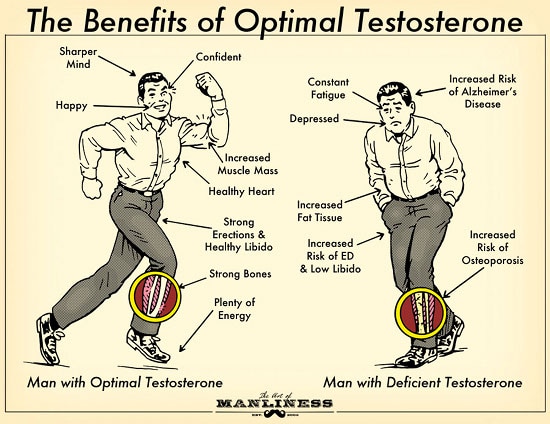
16 Effects of Testosterone on the Body


The graphic below was created by and medically reviewed by George Krucik, MD for Healthline. The graphic offers a basic Testosterone 101 reference for those who want to know how T functions in the (male) body.

I have included a more readable version of the references at the bottom of the post.

The Effects of Testosterone on the Body

Article Sources:

Friday, June 20, 2014

Fitness Friday - Fitness News and Information You Can Use


If it's Friday, it must be time for some fitness news and information. This week we have 40+ interval training, supplementing with oral ATP for recovery, maintaining 1RM in the deadlift, a whole lot of rep scheme variations, and a 4-week chest specialization program (because we all need pecs that look like Arnold's, above).

First up, from Runner's World, and argument in favor of interval training for us old people (40+).

Interval Training and Trolleyology

Is it safe for 40-year-olds to exercise hard?
By Alex Hutchinson


---

I couldn't help thinking of these dilemmas yesterday when a doctor friend asked about the message given to a group of GPs by a cardiologist at a continuing medical education course – that for people over 40, the risks of interval training outweigh the benefits. The common thread: while it may not seem rational, most humans seem to prefer taking a passive role in a greater harm than an active role in a lesser harm. 

The central trade-off here is the same one that applies to all exercise: you have a slightly increased risk of a cardiac event during exercise, and in exchange you get a slightly decreased risk of a cardiac event during all the hours you're not exercising. This is true for marathons, sprints, moderate continuous exercise, intense interval exercise, you name it. That's why doctors used to discourage heart-attack survivors from doing any exercise – until they realized that avoiding exercise ultimately made a recurrence more likely rather than less likely.

* * * * *

Next we have a research article from the Journal of the International Society of Sports Nutrition
on supplementing with oral ATP following exercise to increase blood flow to the muscles (which would then increase transport of protein and glucose to the muscle for recovery).

Oral adenosine-5'-triphosphate (ATP) administration increases blood flow following exercise in animals and humans


Ralf Jäger, Michael D Roberts, Ryan P Lowery, Jordan M Joy, Clayton L Cruthirds, Christopher M Lockwood, John A Rathmacher, Martin Purpura and Jacob M Wilson

Journal of the International Society of Sports Nutrition; 2014, June 13, 11:28. doi: 10.1186/1550-2783-11-28 


Abstract (provisional)

Introduction

Extracellular adenosine triphosphate (ATP) stimulates vasodilation by binding to endothelial ATP-selective P2Y2 receptors; a phenomenon, which is posited to be accelerated during exercise. Herein, we used a rat model to examine how different dosages of acute oral ATP administration affected the femoral blood flow response prior to, during, and after an exercise bout. In addition, we performed a single dose chronic administration pilot study in resistance trained athletes.
 

Methods

Animal study: Male Wistar rats were gavage-fed the body surface area, species adjusted human equivalent dose (HED) of either 100 mg (n=4), 400 mg (n=4), 1,000 mg (n=5) or 1,600 mg (n=5) of oral ATP as a disodium salt (Peak ATP(R), TSI, Missoula, MT). Rats that were not gavage-fed were used as controls (CTL, n=5). Blood flow was monitored continuously: a) 60 min prior to, b) during and c) 90 min following an electrically-evoked leg-kicking exercise. Human Study: In a pilot study, 12 college-aged resistance-trained subjects were given 400 mg of ATP (Peak ATP(R), TSI, Missoula, MT) daily for 12 weeks, and prior to an acute arm exercise bout at weeks 1, 4, 8, and 12. Ultrasonography-determined volumetric blood flow and vessel dilation in the brachial artery was measured at rest, at rest 30 minutes after supplementation, and then at 0, 3, and 6 minutes after the exercise.


Results

Animal Study: Rats fed 1,000 mg HED demonstrated significantly greater recovery blood flow (p < 0.01) and total blood flow AUC values (p < 0.05) compared to CTL rats. Specifically, blood flow was elevated in rats fed 1,000 mg HED versus CTL rats at 20 to 90 min post exercise when examining 10-min blood flow intervals (p < 0.05). When examining within-group differences relative to baseline values, rats fed the 1,000 mg and 1,600 mg HED exhibited the most robust increases in blood flow during exercise and into the recovery period. Human study: At weeks 1, 8, and 12, ATP supplementation significantly increased blood flow, along with significant elevations in brachial dilation.

Conclusions

Oral ATP administration can increase post-exercise blood flow, and may be particularly effective during exercise recovery. 
The complete article is available as a provisional PDF. The fully formatted PDF and HTML versions are in production.
* * * * *


This is a useful article from Tony Gentilcore on how to maintain deadlift strength during time we are not able to lift heavy or consistently. Turns out that, of the big three (squat, deadlift, bench) deadlift strength lasts the longest without consistent practice. This seems to explain how some lifters with HUGE deadlifts only train that lift once a month or so.

How to Maintain Deadlift Strength


I received an interesting question from a reader the other day on deadlifts, particularly 1RM (1 rep max) deadlifts. And since I get all giddy like a school girl at a One Direction concert whenever someone brings up the topic, I figured I’d share my answer here on my website since I’m sure it’s a question that others have wondered as well.

Q: My lifting consists mostly of deadlifts and chin-up/pull-ups with lots of auxiliary work. I also cycle a lot (100 miles per week in-season). But I am in the field for several months a year and it interrupts my lifting.

Last year I pulled 305 on my 60th birthday (at 182 pounds body weight). I got a late start this year and was not as systematic with the spin up. I did a 1RM test and only pulled 270 (at 190 pounds) on my 61st.


My question is:
I would have liked to maintain a 300 pound 1RM but was not systematic enough through the year. What do I do between programs to maintain a higher 1RM? (And continue to cycle and miss the occasional month in the deep field for work?).

A: Who are you? John Wayne? I love this! 

* * * * *

Two articles from T-Nation floated to the top this week.

22 Proven Rep Schemes 

by Christian Thibaudeau   
06/16/14


Here's what you need to know...

  • While there's no one best set/rep scheme, there are plenty of great ones to choose from, all time-tested and proven to work.
  • Methods like 10 x 1, 5 x 2, ramping up to a 3RM, 3/2/1 waves, and 1/3 ratchet loading, among others, work great for pure strength gains.
  • For gaining both size and strength, schemes like cluster 5's, 5 x 5, and 1/2/4/6 are extremely effective.
  • For pure hypertrophy, 4 x 8, 10/8/6/20, and Gironda's 6 x 6 have been around forever and continue to pack on muscle.
"How many sets and reps should I do to get the best results?"

I hear that question every day. People all want a cut and dried answer so all they'll have to do is follow it and make uninterrupted progress. Sadly, it's not as simple as that. There is no one "best" sets/reps scheme. And sometimes a little detail like doing one too many sets in a certain intensity range could absolutely kill your progress. However, while there are no best schemes, there are several great ones. Here are 22 of them. All of them will work if you respect the given guidelines and train hard.

* * * * *

4-Week Chest Specialization 

by Mike Samuels   
06/17/14


Here's what you need to know...

  • With a traditional bodybuilding split, you'll only train your chest once every five to seven days, meaning you're leaving a hell of a lot of elevated muscle protein synthesis potential on the metaphorical table. We should instead opt for a specialization approach.
  • While hammering the chest three times per week, all other muscle group will be put on maintenance mode.
  • Monday will be your power/activation workout, Wednesday is your strength session, and Friday is for hypertrophy work.
Despite the "chest and biceps only" guys at every gym and Monday being International Chest Day, an awesome set of pecs is a rarity. It's hardly surprising though. Browsing through websites and magazines, you'll find conflicting information on chest training. Half the coaches out there say the bench press is the best damn chest exercise there is. The other half say it wrecks your shoulders, hits your delts and triceps more than your chest, and doesn't deserve its place in the bodybuilding hierarchy.

Then you've got the incline vs. decline argument. Judging by how many people suffer from man-boob syndrome where the size of the lower and mid portion of the pecs far outweigh the musculature of the upper section, you'd be forgiven for thinking that incline work is what everyone needs to focus on. Then suddenly, some fancy new EMG study comes out and indicates that the best chest-developer is the decline bench, and how inclines are actually much more of a shoulder exercise.

Confused? Yep, me too. At least I was, until I realized how to structure a chest routine for optimal development.

Thursday, June 19, 2014

Male Survivors of Sexual Assault - Ft. Huachuca Presentation


I will be down in Sierra Vista (AZ) later today speaking at Ft. Huachuca (home of U.S. Army Intelligence Center [once known as the School of the Americas]) speaking on the topic of male survivors of sexual abuse (both childhood abuse and adult rape).

Presented below is the Powerpoint slide show that is the foundation for my talk. It contains a LOT of useful statistics on male survivors, so I thought it might be of interest here.