Tuesday, February 22, 2011

Lawrence Barraclough - One Man's Relationship with His Penis [NSFW]

http://www.tinyfotos.com/images/kx0hak8jwz0vtprrvra_thumb.jpg

How is that for a title sure to bring a lot of people here who have NO interest in gender and masculinity? Maybe if you found this blog for some other reason, you'll have a read and hang around a bit.

Male concern with penis size is so universal that it is the subject of jokes and, more importantly, the subject of shame. A lot of guys who are perfectly normal in penis size feel ashamed of what we tend to refer to as their "manhood."

And that is certainly a part of the problem - men can be so identified with penis size that not being "hung like a horse" is seen as a sign that he lacks virility or manliness. There seems to be some assumption (likely from watching porn) that the average male penis is at least 7 inches long erect. Not so much. According to Wikipedia:
Results vary, with studies that rely on self-measurement reporting a significantly higher average than those with staff measuring, but a mean erect human penis is approximately 12.9–15.0 cm (5.1–5.9 in) in length. Flaccid penis length is a poor estimate of erect length.
In the interest of full disclosure, I worried about this issue when I was a young man. My best friend in middle school/high school was well-hung (we all played sports growing up, so these things are obvious), and in comparison I thought that I must be abnormal. As I grew up, and had wonderful, enthusiastic sex with my various partners, I stopped worrying about it.

Perhaps all adolescent boys worry about this as they become more socially and sexually aware. That's my guess . . . but as the film points out, men can talk about almost everything, but NOT their penises.

Lawrence Barraclough - My Penis and I
This is a film I made (The Author) in 2005 for the BBC. “I guess this thing is about having a small dick, and it’s horrible saying that because it’s true…. And why is it such a problem? This is what this film is about”. My Penis and I follows my two-year journey to discover if size matters. It charts the effect my penis has had on my life, my family and my relationship with my girlfriend Nicola. The film is now out of BBC licensing and I am free to distribute it non-commercially.

My Penis and I from Lawrence Barraclough on Vimeo.


Monday, February 21, 2011

The Art of Manliness Podcast #34: The Attributes of a Hero With Dr. Frank Farley

I'm not sure how I feel about the hero mentality. My suspicion is that it is an immature form of masculinity - high on testosterone and lower on wisdom. I think that the hero energy/archetype tends to decrease in middle age, when the body is no longer capable of being the warrior-hero, but at the same time there is life experience to become the elder/mentor.

Or not - just thinking out loud. Maybe my middle-aged body/mind is making excuses.

Welcome back to another episode of The Art of Manliness podcast! Well, we went on a little hiatus with the podcast. I’ve received several emails and tweets asking what happened to it. With Gus being born and work on the second book, I put the podcast on the backburner. I just didn’t have enough time for it. But now that Gus is on a regular schedule and the book manuscript has been turned in, we’ll be returning to our regular bi-weekly podcast schedule.

In this week’s episode I talk to Dr. Frank Farley, a professor of psychology at the University of Temple. For the past twenty years, Dr. Farley has researched heroism and the psychological attributes of heroes. In our interview, we discuss some of these attributes, why society needs heroes, and what we can do as men to be heroes for our children.

Listen to the Podcast!

Other ways to listen to the Art of Manliness Podcast:

Listen to the Art of Manliness Podcast on a separate page.

Subscribe via iTunes

Subscribe to the podcast in the media player of your choic


Sunday, February 20, 2011

Male Fertility Is in the Bones: First Evidence That Skeleton Plays a Role in Reproduction

Interesting finding - osteocalcin, also known as bone gamma-carboxyglutamic acid-containing protein, is a noncollagenous protein found in bone and dentin - and now it seems that osteocalcin is implicated in testosterone production (thus the link to fertility). They mention that other studies have shown that it helps control insulin secretion, glucose metabolism, and body weight.

Male Fertility Is in the Bones: First Evidence That Skeleton Plays a Role in Reproduction

ScienceDaily (Feb. 18, 2011) — Researchers at Columbia University Medical Center have discovered that the skeleton acts as a regulator of fertility in male mice through a hormone released by bone, known as osteocalcin.

The research, led by Gerard Karsenty, M.D., Ph.D., chair of the Department of Genetics and Development at Columbia University Medical Center, is slated to appear online on February 17 in Cell, ahead of the journal's print edition, scheduled for March 4.

Until now, interactions between bone and the reproductive system have focused only on the influence of gonads on the build-up of bone mass.

"Since communication between two organs in the body is rarely one-way, the fact that the gonads regulate bone really begs the question: Does bone regulate the gonads?" said Dr. Karsenty.

Dr. Karsenty and his team found their first clue to an answer in the reproductive success of their lab mice. Previously, the researchers had observed that males whose skeletons did not secrete a hormone called osteocalcin were poor breeders.

The investigators then did several experiments that show that osteocalcin enhances the production of testosterone, a sex steroid hormone controlling male fertility. As they added osteocalcin to cells that, when in our body produce testosterone, its synthesis increased. Similarly, when they injected osteocalcin into male mice, circulating levels of testosterone also went up.

Conversely, when osteocalcin is not present, testosterone levels drop, which causes a decline in sperm count, the researchers found. When osteocalcin-deficient male mice were bred with normal female mice, the pairs only produced half the number of litters as did pairs with normal males, along with a decrease in the number of pups per litter.

Though the findings have not yet been confirmed in humans, Dr. Karsenty expects to find similar characteristics in humans, based on other similarities between mouse and human hormones.

If osteocalcin also promotes testosterone production in men, low osteocalcin levels may be the reason why some infertile men have unexplained low levels of testosterone.

Skeleton Regulates Male Fertility, But Not Female

Remarkably, although the new findings stemmed from an observation about estrogen and bone mass, the researchers could not find any evidence that the skeleton influences female reproduction.

Estrogen is considered one of the most powerful hormones that control bone; when ovaries stop producing estrogen in women after menopause, bone mass rapidly declines and can lead to osteoporosis.

Sex hormones, namely estrogen in women and testosterone in men, have been known to affect skeletal growth, but until now, studies of the interaction between bone and the reproductive system have focused only on how sex hormones affect the skeleton.

"We do not know why the skeleton regulates male fertility, and not female. However, if you want to propagate the species, it's probably easier to do this by facilitating the reproductive ability of males," said Dr. Karsenty. "This is the only rationale I can think of to explain why osteocalcin regulates reproduction in male and not in female mice."

Other Novel Functions of Osteocalcin Reported Earlier

The unexpected connection between the skeleton and male fertility is one of a string of surprising findings in the past few years regarding the skeleton. In previous papers, Dr. Karsenty has found that osteocalcin helps control insulin secretion, glucose metabolism and body weight.

"What this work shows is that we know so little physiology, that by asking apparently naïve questions, we can make important discoveries," Dr. Karsenty says. "It also shows that bone exerts an important array of functions all affected during the aging process. As such, these findings suggest that bone is not just a victim of the aging process, but that it may be an active determinant of aging as well."

Next Steps and Potential Drug Development

Next, the researchers plan to determine the signaling pathways used by osteocalcin to enhance testosterone production.

And as for potential drug development, since the researchers have also identified a receptor of osteocalcin, more flexibility in designing a drug that mimics the effect of osteocalcin is expected.

Whether it's for glucose metabolism or fertility, says Dr. Karsenty, knowing the receptor will make it easier for chemists to develop a compound that will bind to it.

"This study expands the physiological repertoire of osteocalcin, and provides the first evidence that the skeleton is a regulator of reproduction," said Dr. Karsenty.

Authors of the Cell study are: Franck Oury, Ph.D. (CUMC); Grzegorz Sumara, Ph.D. (CUMC); Olga Sumara, Ph.D. (CUMC); Mathieu Ferron, Ph.D. (CUMC); Haixin Chang, Ph.D. (Cornell University); Charles E. Smith, Ph.D. (McGill University); Louis Hermo, Ph.D. (McGill University); Susan Suarez, Ph.D. (Cornell University); Bryan L Roth, Ph.D.(UNC-Chapel Hill); Patricia Ducy, Ph.D. (CUMC); and Gerard Karsenty, M.D., Ph.D. (CUMC).

This study was supported in part by the National Institute of Child Health Research (NICHR) and the National Institutes of Health (NIH).

Reference:

Franck Oury, Grzegorz Sumara, Olga Sumara, Mathieu Ferron, Haixin Chang, Charles E. Smith, Louis Hermo, Susan Suarez, Bryan L. Roth, Patricia Ducy et al. Endocrine Regulation of Male Fertility by the Skeleton. Cell, 17 February 2011 DOI: 10.1016/j.cell.2011.02.004

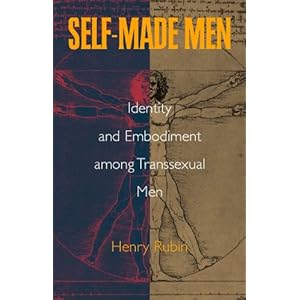
Self-Made Men - FTM Identity and the Body

Henry Rubin's book, Self Made Men, is an excellent overview of the perspective and experience of Transmen - based on his qualitative interviews and an excellent background history of how our understanding of the transgender/transsexual person.

These are some long excerpts from a single chapter on the body and how it can feel completely alien to one's sense of identity.

This poses some serious issues to concepts of embodied consciousness (here, embodied, literally "in the body," includes the brain) - it is assumed by many philosophers and neuroscientists in the "embodiment" camp that much of who and what we understand ourselves to be is shaped by our embodied experience. The experience of transgendered people counters this position bhy demonstrating that it is entirely possible to have a sense of self and identity that is exactly opposite of the body in which one is born.

So unless we one day find a genetic component to identity, separate from body, we have to accept one of two options: (1) transgenderism is a mental illness of some type (which I do NOT believe is true), or (2) our current models of embodiment and socially constructed gender identity are inadequate or incomplete.

There is still so much we do not understand about who we are as human beings - but a book like this goes a long way toward helping us sort out parts of the mystery.

Self Made Men: Identity, Embodiment, and Recognition Among Transsexual Men, by Henry Rubin.
Chapter 3: Betrayed by Bodies
• Ed: There's the difference—there's tons of butch dykes who could so far tell you almost the exact same story. I finally decided what it is. Its that butch dykes are comfortable enough with female parts and FTMs cannot have that. They would rather die or do something drastic or get help.
In these comments, Ed makes a distinction between himself and butch women based on the specific discomfort he experiences with his female body. Like other FTMs in this study, Ed explains that there are real and empirical differences between FTMs and lesbians—these differences are historically constant and positive. From their perspective, the experiences of comfort or discomfort with one's body, especially one's gendered parts, differentiate these identities.

Ed assumes that even very butch women are more comfortable in their bodies than he is in his. Some butches, especially those who came out before the lesbian-feminist revolution, contest this assumption. Anthropologists like Gayle Rubin and Esther Newton suggest that butches share many predilections and dilemmas with FTMs, including a preference for male names, pronouns, and clothes including undergarments; great discomfort with their bodies; and related difficulties
in their sexual lives.' These scholars theorize a continuum between FTMs and butches. In this usage, "butch" is a noun.

Against this continuum thesis, most of the FTMs in this study see themselves as distinctly different from butches. They signify this by calling lesbians "butch women." In their lexicon, "butch" is an adjective that modifies the noun "woman." Ed hesitates when telling me that he "finally decided what it is" that distinguishes him from butch women. It has taken him some time to come up with something that he feels answers the question with certainty. Ed's criterion is the one most FTMs in this study prefer: the tension he felt between his body image and his material body. His male body image came into conflict with his anatomy and with how others interacted with him It is not enough for him to pass as a man in the world or be able to do the things that men do. Ed locates the difference between himself and other females, especially butch women, in his body.

FTM difference claims are unsurprising if we consider them in light of the history of chapters one and two. By articulating a difference between themselves and lesbians, these FTMs are drawing on a discourse that has successfully obtained desired medical procedures in the past. FTMs today make these same claims though it is less difficult to convince physicians to treat them. These claims about their bodies are, therefore, not just means for dealing with physicians; they also provide meaning to their enigmatic lives. Each FTM in this study felt a need to construct a biography that legitimates his seemingly strange life choice. That choice has to make sense to him as the only rational thing to do in such circumstances.

The history of becoming treatable bodies is echoed in the words of the FTMs who speak here about their bodies during childhood and adolescence. Their comments reveal their experiences of betrayal by their bodies. They also demonstrate how their perception of difference from lesbian women establishes them as treatable subjects. FTMs frame adolescence as a persistent conflict between their male body images and their feminizing material bodies. This tension between body image and material body points to the general importance of bodies to a sense of self.

FTMs describe adolescence as an extraordinarily difficult time of life when they risked and often lost their senses of themselves. They divide their lives into two halves: a "before" and "after" puberty. After puberty, as the process of sexual development took over their bodies, they felt simultaneously disembodied and acutely aware of their bodies. They become, in the words of one FTM, "social zeros."

In adolescence, these men used their experiences of disembodied awareness to reinforce their sense of difference from others with female bodies. This difference helped them consolidate their identities as (transsexual) men. They claim that their experiences of puberty were uniquely different, either quantitatively more painful or qualitatively different in kind, than that of most other adolescents. By positing that difference in their changing bodies, they provide a logical reason for modifying those bodies.

Although some may suggest that such difference claims are not empirically valid and that all teens experience this kind of distress, the experience and the claims of such difference are what is important here. Whether this difference can be proven empirically is less important in this context. The experience of difference is one way that these men determined the direction, and interpret the meaning, of their lives. By anchoring this difference in their bodies, as Ed does in the quote that opened this chapter, they could legitimate their transitions from female to male.

Body and Self
Jake: After I got [breasts], and in order to fight off the glances of the boys, I made myself as invisible as I could, which is why I never made friends in school. I totally became a nothing almost. It really angered me if the boys gave attention to me because I know they weren't giving it to me.

Henry: What were they giving it to?

Jake: The breasts. [laughs] Or some illusion or this new outfit. A physical outfit. This thing that glued on me. It was no longer me the way I liked it and it's not the way I wanted it.
All of the confusion, fear, and wonderment of puberty was complicated for Jake, as it was for other FTMs, by the secret knowledge that he was not a girl or a woman Jake, a gay man who has always been attracted to males, characterized his adolescence as lonely, mostly due to his lack of place within the gendered world of junior high and high school. He became a "nothing." Jake looks back on the new sexual attention he received from his pals with frustration, not pleasure, because the boys no longer recognized him as one of them. As his body developed the cultural signs of womanhood, he became increasingly aware that he identified as a boy on the verge of manhood. He was not the only female-bodied person to grow uncomfortable with the sexual attention given to breasts, but Jake found this attention difficult to receive because it meant that he was no longer able to socialize with others on his own terms. The problem, he says, was not exactly that he was treated as a sex object by his neighborhood chums. Instead, it was his sense of complete misrecognition based on physical cues that are culturally identified with womanhood.

For Jake and for most of the guys in this study, puberty marked the first significant "before" and "after" of their young lives. Before puberty, while their bodies still cooperated with their identities, they were able to convince themselves and others that they were, or at least were like, boys. As their bodies began to look significantly different from other boys, they had more and more difficulty being recognized for their true male selves. It became increasingly difficult to sustain a male identity as their bodies began to resemble the bodies of adult women. Breasts made it impossible to deny that they were female-bodied.

Before puberty, when their bodies were unencumbered with breasts, they were able to ignore, hide, or minimize the few physical signs, like genitalia, that marked them as female. Relative to adolescent bodies, the bodies of children are less identifiably sexed. Girls' and boys' bodies are more similar than the pubescent or fully developed bodies of women and men. This is especially true with regard to breasts, which are the most visibly gendered features of the mature human body. This relative lack of sex markings on the bodies of children made it possible for the FTMs to see themselves as boys.

Many of the participants say that before puberty they simply knew that they were boys. Others remember only a persistent sense of difference that had no name. While the former group was clearly beyond the borders of normal female-bodied subjectivity, this latter group remained just on the border of the socially prescribed roles for girls in Western culture. As youths, many of them inhabited the ambivalent position of tomboys? Texas Tomboy appropriated that moniker when he got older, but it had always been a part of who he was.
I liked being referred to as a tomboy growing up. But I always played with the boys and rode BMX and built ramps and I was the only girl in my neighborhood that liked to play like that. I remember wishing I could wear boy's underwear. I would be really persistent. I don't know what my arguments at seven years old were, but I got my way.
Texas is still persistent. He is a video artist, a part-time hustler, and a short guy who "always exceeded people's expectations ... with strength and intelligence." Texas's attitude represents one FTM's response to being called a tomboy. For him and those who responded similarly to the term, "tomboy" was an adequate label for who they were and what they liked to do in their childhood. For a short time, it gave them a place in the social order. They were different from most girls, but their sense of that difference could be explained in the deviant identity of the tomboy.

The tomboy identity comes with an implicit normative expectations that the child will grow out of it. Tomboys who do not grow out of their tomboy preferences are stigmatized. Many female-bodied individuals do grow out of their tomboy stages and become unproblematically identified as feminine women. In addition, women athletes are more acceptable today, so even very athletic females are tolerated. Other tomboys grow up to identify as gay women or lesbians. Some FTMs called themselves tomboys until it became apparent that they were expected to grow out of it.

Other men in this study immediately grasped the normative assumptions behind the minimal tolerance granted to tomboys, knew that their experiences were more than a phase, and felt patronized by the tomboy label. They understood that a tomboy is a girl who is like a boy, whereas they knew themselves to be boys. Jack and Wolfie both express their dissatisfaction with the tomboy label. They each feel that the tomboy label undermined their sense of difference from girls and trivialized their sense of themselves.
Jack: I wasn't a tomboy. I was a boy. I would rather just be called a girl than to be called a tomboy. Because that's totally dismissing. That's acknowledging what I'm doing, but saying it's a phase and I'm going to grow out of it.

Wolfie: I was very conscious of patronizing attitudes towards children and that was one part of it. A tomboy is like a "boyette."
These men were more isolated almost from the beginning of their lives. Their way of being in the world was completely unrecognizable to others. They resisted the tomboy label because they did not want to be mistaken for girls, but by refusing this label, they completely cut themselves off from the social order.

The non-tomboy FTMs classify FTM tomboys as "secondary transsexuals," whereas they see themselves as "primary transsexuals." For this group, the early recognition that they were not girls of any sort is an unequivocal sign of transsexual identification. (Likewise, the FTMs who never had lesbian careers think of themselves as "primary" and those with lesbian careers as "secondary" transsexuals.) The nontomboys express an absolute discomfort with their female bodies. The tomboys struggle longer to become certain that they are men. Another small group in this study was not tomboy-identified and was more comfortable doing activities that the culture associates with girls, such as doll play and house play. Looking back, these men identify with other "sissy boys" and feel sure that many of their childhood and adolescent boyfriends and pals turned out to be gay men like themselves.

Under the cover of heterosexual normativity, their behavior as "sissy boys" looked like normal femininity to others. This "normal" female behavior did not mean, however, that they were girls, at least not in their own minds. They report that they felt like they were boys growing up, but they were not interested in culturally hegemonic activities of "normal" boys.

Before puberty, the guys had disregarded or actively ignored what few markings indicated the sex of their bodies and identified themselves in one of three ways: (1) they were boys (with bodies that approximated the bodies of other boys) who liked to do typically boy activities, (2) they were tomboys who felt a distinct, yet not quite definable, difference from others with female bodies, or (3) they were boys who, because of their preference for activities associated with girls, evoked little suspicion from others although they knew themselves to be different from girls. The first group was more stigmatized than the other two and suffered deeper social consequences for their refusal to conform to the identities their bodies were assigning them. The second group had a temporary place in the cultural landscape of childhood, but it was a place that eventually evaporated as they matured. Finally, a twist of cultural logic gave the men in the third group a hiding place that aroused few suspicions, but made their path after puberty particularly misunderstood by others—if "she" liked doing "girly" activities and preferred men as sexual partners, why change "her" sex?

Once their bodies developed female features, all of them were forced to realize that they were unlike the boys they had considered their natural cohorts. The bodies they inhabited disfigured their essential male selves.' They were faced with a choice of maintaining their male identities at great risk of social stigma or "going underground" and playing the role dictated by their female bodies. After puberty, the social difficulties they had experienced increased exponentially as their bodies changed from relatively ungendered and asexual into female bodies. Three things—menarche, breast development, and hair growth—made them physically uncomfortable and socially alienated.
For most - if not all - of these men, the onset on menses (menarche) was one of the most disturbing and traumatic experiences of their young lives. Their once simple and mostly androgynous bodies (of which they experienced very limited awareness) suddenly betrayed them and revealed its dissonance with who they experienced as their self.

Often for the first time, they knew without doubt (and this generally coincides with the emergence of breasts) that they had the wrong body - that they were boys in a girl's body and it felt horribly wrong.
Menarche

Most female-bodied people can point to the onset of menses as a physical threshold that marks one as a grown woman. The capacity to fulfill the childbearing role remains the physical and hegemonic criterion for adult womanhood. For FTMs like Ed, this benchmark of adult female status was greeted with gritted teeth.
I remember the next day going to school and telling someone and this girl was like, "Isn't it great?" and I'm worried about it and I felt very ashamed that I was not happy at all.
Ed wants to distinguish himself from the typical transsexual portrayed on television talk shows, describing himself as "any other long-haired, some facial hair, black T-shirt guy." In the story that he tells of his first menstruation, he emphasizes the difference between his female friend's response and his own. This difference is one piece of evidence that Ed assembles to legitimate his male identity.

Shadow was born in South Dakota, which is the home of the Santee Sioux and the Lakota Sioux Native American tribes. He was given his name in a ritual by a Native American man, an older friend, because it captured the sense that he was a part of both the light and the dark. As he grew up and assumed this name, he began to frame his shadowy existence as a conflict between his body image and his material body.
My belief about my process growing up is that what I was going through during puberty was estrogen poisoning. I will swear by that now that I've started the testosterone. The way I functioned in life was taken from a point of anger. In my early twenties the violent rages were frequent. I'd say like once a month. Imagine that. [laughs]
This is an emphatic statement of the difference between a young girl who is approaching maturity with ordinary discomfort and a transsexual man as he endures his menstrual cycle.

Like several of the guys in this study, Shadow ties his body alienation to his angry and violent youth. For him, the body became his "first clue" in his search for a way to make sense of his dilemma Most of the other men understand this kind of anger as a social reaction to a difficult situation, but Shadow believes that estrogen poisoning caused his violent outbursts. Shadow's story of estrogen poisoning counters to the hegemonic cultural belief that testosterone is the likeliest cause of male rage. He does not claim that estrogens, in and of themselves, are poisonous. Rather, he explains his rage as an incompatibility between his body image and his female endocrinology. Shadow recalls visiting doctors and becoming frustrated with their inability to fix the problem.
Going to different doctors and [hearing], "Sorry dear, you're a healthy, young female. Just growing up. This'll pass. It's just what women have to go through." Bullshit! I don't care what you say, this is not normal. Then my other female friends are going through this. I knew there was something different going on.
Like the others, Shadow also used the experiences of the girls around him to sharpen his own self-understanding. These guys went through the normal body changes that are part of female adolescence.(4) However, they insist that their responses went far beyond ordinary teenage angst from the rapid and uncontrollable physical changes Texas describes it as "a tragedy." James recalls becoming embarrassed of the body he had previously loved because "it could do great things." Francis remembers a loss of self-confidence, crying a lot, and becoming acutely self-conscious. Dani calls it "a shocking experience ... mind-boggling." For many of the FTMs in this study, the experience of starting to menstruate brought on intense shame and embarrassment. Several of them, like Julian, say that their shame resulted in an extended silence that isolated them.
It felt like something so private and so humiliating and so shameful and I already was very private and secretive. Not for a second did it occur to me to go tell the gym teacher, certainly not my mother, certainly not a peer ... I don't even know if I could've said the word at that time. I don't know if I could've even said "period."
Not telling anyone about their first periods and not using sex-specific language to refer to themselves were last-ditch attempts to maintain their bodies as they were "before." By choosing to conceal the start of menses, these female-bodied people willfully refused to situate themselves linguistically as women. Partly as a reaction of disgust and shame, partly as a strategy of resignifying the material body, these men took care not to acknowledge their material bodies.

Their unwillingness to use language that refers to female bodies and female processes demonstrates the extent of their discomfort. One important strategy they deploy for preserving their sense of self is the use of euphemistic and indeterminate language to specify body parts that are abhorrent to them. They almost always use articles, rather than possessive pronouns, to refer to their female body parts. These body parts have become independent agents acting in defiance of the disembodied self. Such threats are linguistically neutralized and effaced via grammar.
There are many more stories in the book about how "The initial arrival of that "dreaded visitor" made other guys aware, sometimes for the first time in their lives, that they were not the boys they thought they were" (p. 102). The experience was sometimes overwhelming:
If menstruation stands out as the mark of womanhood, then it comes as no surprise that these men regarded it with suspicion, hostility, anxiety, and frustration. Some stubbornly refused to allow the material body to define them. For many others, this foreign body convinced them to try to live for a time as women. Those who attempted to do so claim that they were unable to perform femininity adequately and suffered through long periods of depression. Some report an inability to recall whole segments of their lives, suggesting that they withdrew from the world in order to preserve their identities. Several say that they chose to isolate themselves from others as a way of asserting themselves and preventing others from treating them in ways that offended their sense of self.
The arrival of breasts, being a visible marker of their alien bodies, posed its own set of difficulties, shame, and fear - some refer to their "treacherous bodies."
Breasts
James: I was embarrassed by my breasts. I tried to cover them up a lot. My posture was bad as a result. It was just difficult sometimes to acknowledge my body.
A writer and an executive, James tells me that he transitioned so that he could finally grow up. James's anguish came from the difficulty he had seeing himself in a body with breasts. Some FTMs on the brink of transition prioritize their breasts as the most important aspect of their appearance that they would change The chest is the body part most likely to block them from living full lives. It inhibits them from living full-time as men and causes the most discomfort when they look in the mirror Some start binding breasts from their first appearance and others take up the practice as they age and become more distraught. The men bind the breasts down using everything from control-top nylons with the legs cut out to ace bandages, even duct tape and specially made jerseys. A few choose not to bind because it is too ungainly or too hard to breathe. Another strategy for minimizing the conflict between the body image and the material body is to wear two or more shirts, even on the hottest of days.

By some accounts, breast size could be a relevant factor in determining who can live with their female parts and who cannot. Others said that site made little difference to them. The simple fact of the existence of the breasts was unbearable to most of the men in this study. During adolescence, Texas recalls, he had such a strong antipathy to the mere idea of the breasts that he believes he influenced his development.
My mom told me because she had really huge breasts in high school that I would, too. I really feel like I willed them away. I really didn't want that. I don't know, it was really hard. I really didn't like going through puberty at all. [close to tears]
Others, like Francis, who never developed or who developed later, report wanting breasts and being envious of the larger girls around them. Their typical explanation for this contradictory desire was a wish to be "normal." Having breasts would confirm their femaleness and magically eliminate those "abnormal" thoughts about being a guy. These guys seem to feel that their wishes backfired, and at least one man suggests that all that wishing got stored up in his body, eventually producing large breasts. These wishful refusals provided the strength to sustain a transsexual man's sense of his essential self while his body was betraying him As with menstruation, the FTMs felt that their responses to the development of breasts were anomalous compared to the experiences of the young women who were assumed to be their cohorts.

This perceived difference contributed to their isolation. Jack recalls the feeling of not being accepted for who he was.
They loved to have someone to pick on and I happened to be that person. Thank God for my mother. Every once in awhile I'd go, "I just don't want to go to school today." "Okay." It was so horrible. You act like a boy, you isolate yourself from the whole world. Boys don't accept you and girls don't accept you. They'd often walk by in theirgroups and yell stuff. A lot of things were, "You're so ugly" and being picked last at gym. Or nobody would call me. That's just the worst feeling in the whole world.
By falling in line, these guys could reduce the stigma that they faced, though at a huge cost to their subjective sense of self. Wolfie, like many in this study, expresses the feeling that he was faced with a choice between staying committed to his body image and subjectivity but being alone, or capitulating to social pressures and the materialist compulsion to become the woman that his body dictated he should be.
Either you have a chance at a relationship with somebody and go along with whatever the prevailing dress and behavioral ideal is or you don't. Sort of a choice between being uncomfortable in yourself or having other people make you feel uncomfortable.
Either way, they feel that adolescence brought on these choices because of the changes in their material bodies that failed to represent their subjectivity adequately.

Several men tell stories that narrate their resistance to their treacherous bodies or the social conventions associated with those bodies. John recalls:
My mom went into the section, I kept wandering off. She kept dragging me back there. The saleslady comes up and she's like, "Raise your arms up." I said "no" three times; finally I did 'cause I decided I'd let mom buy it and I'd never wear it. I actually wore it to school the day of the test and watched all the other girls take their shirts off and took a good look [laughs] and then refused. I never got the scoliosis test. I got in trouble. That's the only time that thing ever touched my body. Ever.
John refuses even now to concede that he went into a lingerie department. He will say "the section," but a heterosexual man in his social location would not say he had been in a store looking at women's underwear with his mother. He refused the saleswoman's attempts to put the garment on his body three times. Conceding to take it home was a passive move that allowed him to defer wearing it. The single time that he wore a bra became an adolescent locker-room escapade, a covert kind of panty-raid that allowed John to exercise his heterosexual, masculine desires for the girls in his cohort. Instead of a story of joy at this event, or even a certain modest embarrassment that a non-transsexual child might express, John's tells of maintaining his male gender identity despite outside attempts to discipline his body. In fact, the heterosexual masculinity of this story helps him to consolidate his gender identity.
Here is one final passage from what was one of the most illuminating chapters in the book. So much or our sense of identity is embodied - when the body does not match our perception of who we are, the psychological dissonance can be frustrating, uncomfortable, and cause terrible suffering.
These experiences confirm the idea that we have a body image, an embodied sense of our selves that may not coincide with the material body itself. "Agnosia" is the term used by phenomenologist Merleau-Ponty to designate the condition of a reverse "phantom limb." Agnosia is "the nonrecognition of a body part that should occupy a position within the body image" (Grosz 1994, 89). FTMs become disembodied selves who refuse to recognize their breasts. Transsexual men perpetually monitor their breasts because their flesh does not coincide with their body image Agnosia, in this sense, is an assertion of a self rather than a delusional condition.

After having had their chests reconstructed, many of the guys report that they could not remember what their bodies looked or felt like before the procedure. They say that this effect occurs within weeks of the surgery. This observation shows that their bodies now conform to their body image and their sense of self.' No longer agnosic, FTMs in this study feel as if they are now "tuned into one station." The alignment of body image and material body restores, to some degree, the carefree embodiment that characterized their youth.

A few of the guys noted that their disembodied awareness shifted after chest reconstruction to other, less obviously gendered body parts like hips and buttocks, as they began to be able to inhabit the upper halves of their bodies. Some report an increased desire for penis reconstruction after their chest surgeries, or increased frustration with the limitations of phalloplasty and other surgeries for penis reconstruction. These desires and frustrations indicate that the physical body remains, to some degree, out of sync with the body image and that a disembodied awareness may continue to structure their lives.
I highly recommend this book.


Saturday, February 19, 2011

The Friend We Want To Be - Evaluating Our Relationships

http://bishoysblog.com/wp-content/uploads/2010/04/friendship21.jpg

This Daily Om from a couple of days ago is a good meditation on how to be a good friend. Men have some issues in this area in my experience. We tend to sexualize friendships with women and have shallow friendships with other men. Neither is terrible healthy.

Sometimes we need to reevaluate our friends. Are they healthy for us? Do they support us to be our better selves? Can we be ourselves with them?

Likewise, we need to consider the friend we are to others. If we are not offering good friendship, the kind of friendship we want in return, we are not likely to feel safe and supported in our friendships.

The Friend We Want To Be
Evaluating Our Relationships

It is important to look at ourselves and notice what kind of friend we are to the people in our lives

There comes a time in all our lives when we may need to evaluate our relationships, making sure that they are having a positive effect on us, rather than dragging us down. Without realizing it, we may be spending precious time and energy engaging in friendships that let us down, rather than cultivating ones that support and nourish us along our path. Life, with its many twists, turns, and challenges, is difficult enough without us entertaining people in our inner circle who drain our energy. We can do so much more in this world when we are surrounded by people who understand what we’re trying to do and who positively support our efforts to walk our path.

We can begin this evaluation process by simply noticing how we feel in the context of each one of our close relationships. We may begin to see that an old friend is still carrying negative attitudes or ideas that we ourselves need to let go of in order to move forward. Or we may find that we have a long-term relationship with someone who has a habit of letting us down, or not showing up for us when we need support. There are many ways to go about changing the status quo in situations like this, having a heart to heart with our friend showing through example. This process isn’t so much about abandoning old friends as it is about shifting our relationships so that they support us on our journey rather than holding us back.

An important part of this process is looking at ourselves and noticing what kind of friend we are to the people in our lives. We might find that as we adjust our own approach to a relationship, challenging ourselves to be more supportive and positive, our friends make adjustments as well and the whole world benefits.


New Issue - Journal of Men, Masculinities and Spirituality


A new issue of Journal of Men, Masculinities and Spirituality is online now - check it out.

Volume 5, Number 1: Table of Contents

Editorial:
Joseph Gelfer, Sex and Gender in Jung’s The Red Book (pp. 1-3)

Article:
Birthe Loa Knizek, Eugene Kinyanda, Vicki Owens and Heidi Hjelmeland, Ugandan Men’s Perceptions of What Causes and What Prevents Suicide (pp. 4-21)

Reviews:
Philip Culbertson, Review of Jack Malebranche, Androphilia: Rejecting the Gay Identity, Reclaiming Masculinity (pp. 22-23)

Philip Culbertson, Review of Tammi Vacha-Haase, Stephen R. Wester, and Heidi Fowell Christianson, Psychotherapy with Older Men (pp. 24-25)

Sarah Heinz, Review of Andrea Ochsner, Lad Trouble: Masculinity and Identity in the British Male Confessional Novel of the 1990s (pp. 26-28)

Edward C. Dodge, Review of Gordon J. Hilsman, Intimate Spirituality: The Catholic Way of Love & Sex (pp. 29-31)

Joshua Fleer, Review of Elaine Frantz Parsons, Manhood Lost: Fallen Drunkards and Redeeming Women in the Nineteenth-Century United States (pp. 32-34)

Bob Batchelor, Review of Lynne Luciano, Looking Good: Male Body Image in Modern America and John Pettigrew, Brutes in Suits: Male Sensibility in America, 1890-1920 (pp. 35-37)


Friday, February 18, 2011

CBS - Sen. Scott Brown: Writing about Childhood Abuse was Cathartic

When Scott Brown became the darling of the Tea Party crowd after winning Ted Kennedy's Senate seat, I figured he was just another partisan conservative - having not heard much of his philosophy and only seeing the occasional soundbite, I wasn't impressed.

And then there was the whole beefcake . . . Cosmo . . . or whatever.

But then he started casting his vote as a Senator. He is a conservative on all fiscal and foreign policy issues, no doubt about it, but he supported lifting the ban on Don't-Ask-Don't-Tell, he opposes a Constitutional amendment to ban gay marriage at the federal level, and he feels that Roe v. Wade is settled law (although he supports some conservative issues in this realm, such as parental notification).

He is more independent than I gave him credit for - and now that he has come forward about being sexually abused as a child, I admire his courage as a man to address this issue. Too few men are willing to come forward about this because of the shame that is directed at them by other men (often covertly) and by their own sense that they should have done something to stop it.

So, props to Brown for going on 60 Minutes to talk about the material that is coming out in his book, Against All Odds: My Life of Hardship, Fast Breaks, and Second Chances.

Sen. Scott Brown speaks out on childhood abuse

Tells "60 Minutes" writing about abuse was an act of catharsis for him

(CBSNews)

Sen. Scott Brown reveals he was sexually abused as a child several times by a camp counselor in a "60 Minutes" interview with Lesley Stahl. The Massachusetts Republican also talks to Stahl about physical abuse suffered at the hands of stepfathers, in one case saying he would like to have purchased the house where it occurred just so he could "burn it down.'

The interview will be broadcast this Sunday, Feb. 20 at 7 p.m. ET/PT.

Brown says even his mother doesn't know about the sexual abuse. "That's what happens when you're a victim. You're embarrassed. You're hurt," he tells Stahl. Brown spoke of being touched and forced to touch the counselor. "Fortunately, nothing was ever fully consummated, so to speak, but it was certainly, back then, very traumatic."

The counselor, he says, came for him more than once. "As predators do," says Brown. "He said 'If you tell anybody...I'll kill you. I will make sure that nobody believes you.'" Being physically abused at home and the victim of seven broken homes made Brown even more susceptible to such a predator. "When people find people like me at that young vulnerable age, who are basically lost, the thing that they have over you is, they make you believe that no one will believe you."

Brown, who came to national prominence by winning the Democratic seat held by Ted Kennedy in a watershed political moment, details these abuses and other childhood traumas in an upcoming book, Against All Odds. Some of the abuse detailed in the book will be revelations to his wife and mother. The senator says writing was an act of catharsis for him. He tells Stahl of another cathartic act he wished he could have done in Wakefield, Mass., when a house he lived in with an abusive stepfather came up for sale.

"I actually called the realtor and went in and took the tour and relived kind of where everything was...to make sure I wasn't ...dreaming. As I left, I said, 'Man, I wish I had the money. I'd just buy this thing and burn it down.'"

Such a childhood, he says, prepared him well for the bare-knuckle politics he is encountering in Washington. "When I'm getting the crap beat out of me outside, in the political spectrum," he tells Stahl, "I'm like, 'Psst. This is nothing. Bring it on. Let's go. Next!"

Produced by Karen Sughrue


Thursday, February 17, 2011

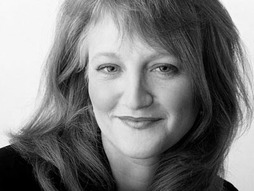
TED Talks - Krista Tippett: Reconnecting with Compassion

Nice talk and a great message. Via TED: The term "compassion" -- typically reserved for the saintly or the sappy -- has fallen out of touch with reality. At a special TEDPrize@UN, journalist Krista Tippett deconstructs the meaning of compassion through several moving stories, and proposes a new, more attainable definition for the word.

Why you should listen to her:

Krista Tippett grew up in Oklahoma, the granddaughter of a Southern Baptist preacher. She studied history at Brown University and went to Bonn, West Germany in 1983 on a Fulbright Scholarship to study politics in Cold War Europe. In her 20s, she ended up in divided Berlin for most of the 1980s, first as The New York Times stringer and a freelance correspondent for Newsweek, The International Herald Tribune, the BBC, and Die Zeit. She later became a special assistant to the U.S. Ambassador to West Germany.

When Tippett graduated with a M.Div. from Yale, she saw a black hole where intelligent coverage of religion should be. As she conducted a far-flung oral history project for the Benedictines of St. John's Abbey, she began to imagine radio conversations about the spiritual and intellectual content of faith that could open minds and enrich public life. These imagined conversations became reality when she created "Speaking of Faith" (now "Being"), which is broadcast on over 200 US pubic radio stations and globally by NPR. From ecology to autism to torture, Tippett and her guests reach beyond the headlines to explore meaning, faith and ethics amidst the political, economic, cultural and technological shifts that define 21st century life. Tippett is the author of "Speaking of Faith" and "Einstein's God."


Poem: John Lane - The Truth About the Present

http://fineartamerica.com/images-medium/prayers-to-the-ganges-river-art-nomad-sandra-hansen.jpg


The Truth About the Present
by John Lane

after Bei Dao

when rivers are intoxicated
with dioxide you gather lotus shoots
to pick their pockets is
the clock of the age

when the last songbird
shivers with undue cold like wires overhead
to handle harsh metals is
the clock of the age

when your keyboard dissolves
in the pit of nations
to write in echoes is
the clock of the age

when you forge transparencies
in the foundries upstream
the bridges are blocked by karaoke
their digital sand is
the clock of the age

the cell phone's face is always
time-dependent on fingers somewhere
today opens to the nearby delta
and tomorrow
is the clock of the age


~ from Abandoned Quarry: New and Selected Poems


Wednesday, February 16, 2011

Overly Medicated Soldiers (Mostly Men) Dying Far Too Often

FINAL HOLIDAY Senior Airman Anthony Mena with his mother, Pat, on Christmas Day in 2008. He was found dead in his apartment in Albuquerque in July 2009.

This is disturbing, but it's not new information. As many as 300,000 soldiers, mostly men, are returning from Iraq and Afghanistan with PTSD, traumatic brain injury, depression, or some combination of those. While there has been a recent move to provide quality therapy, there are not enough therapists (the inclusion of counselors, rather than only social workers, has never really materialized), most are still prescribed a cocktail of medications that have nasty side effects - like death.

And a lot of them are self-medicating (five times as many troops claiming to abuse prescription drugs than illegal ones) so that they do not have mental illness on their record, which might get them sent home. For many of these guys, going home is when the suffering really begins.

For Some Troops, Powerful Drug Cocktails Have Deadly Results

PAIN AND DEPRESSION Senior Airman Anthony Mena in Baghdad in 2007.
After his death in 2009, a toxicologist found eight prescription medications in his blood.

This article was reported by James Dao, Benedict Carey and Dan Frosch and written by Mr. Dao.

In his last months alive, Senior Airman Anthony Mena rarely left home without a backpack filled with medications.

He returned from his second deployment to Iraq complaining of back pain, insomnia, anxiety and nightmares. Doctors diagnosed post-traumatic stress disorder and prescribed powerful cocktails of psychiatric drugs and narcotics.

Yet his pain only deepened, as did his depression. “I have almost given up hope,” he told a doctor in 2008, medical records show. “I should have died in Iraq.”

Airman Mena died instead in his Albuquerque apartment, on July 21, 2009, five months after leaving the Air Force on a medical discharge. A toxicologist found eight prescription medications in his blood, including three antidepressants, a sedative, a sleeping pill and two potent painkillers.

Yet his death was no suicide, the medical examiner concluded. What killed Airman Mena was not an overdose of any one drug, but the interaction of many. He was 23.

After a decade of treating thousands of wounded troops, the military’s medical system is awash in prescription drugs — and the results have sometimes been deadly.

By some estimates, well over 300,000 troops have returned from Iraq or Afghanistan with P.T.S.D., depression, traumatic brain injury or some combination of those. The Pentagon has looked to pharmacology to treat those complex problems, following the lead of civilian medicine. As a result, psychiatric drugs have been used more widely across the military than in any previous war.

But those medications, along with narcotic painkillers, are being increasingly linked to a rising tide of other problems, among them drug dependency, suicide and fatal accidents — sometimes from the interaction of the drugs themselves. An Army report on suicide released last year documented the problem, saying one-third of the force was on at least one prescription medication.

“Prescription drug use is on the rise,” the report said, noting that medications were involved in one-third of the record 162 suicides by active-duty soldiers in 2009. An additional 101 soldiers died accidentally from the toxic mixing of prescription drugs from 2006 to 2009.

“I’m not a doctor, but there is something inside that tells me the fewer of these things we prescribe, the better off we’ll be,” Gen. Peter W. Chiarelli, the vice chief of staff of the Army who has led efforts on suicide, said in an interview.

Growing awareness of the dangers of overmedicated troops has prompted the Defense Department to improve the monitoring of prescription medications and restrict their use.

In November, the Army issued a new policy on the use of multiple medications that calls for increased training for clinicians, 30-day limits on new prescriptions and comprehensive reviews of cases where patients are receiving four or more drugs.

The Pentagon is also promoting measures to prevent troops from stockpiling medications, a common source of overdoses. For instance, the Navy, which provides medical care for Marines, has begun pill “give back” days on certain bases. At Camp Lejeune, N.C., 22,000 expired pills were returned in December.

The Army and the Navy are also offering more treatments without drugs, including acupuncture and yoga. And they have tried to expand talk therapy programs — one of which, exposure therapy, is considered by some experts to be the only proven treatment for P.T.S.D. But shortages of mental health professionals have hampered those efforts.

Still, given the depth of the medical problems facing combat veterans, as well as the medical system’s heavy reliance on drugs, few experts expect the widespread use of multiple medications to decline significantly anytime soon.

The New York Times reviewed in detail the cases of three service members who died from what coroners said were toxic interactions of prescription drugs. All were classified accidents, not suicides.

Airman Mena was part of a military police unit that conducted combat patrols alongside Army units in downtown Baghdad. He cleaned up the remains of suicide bombing victims and was nearly killed by a bomb himself, his records show.

Gunnery Sgt. Christopher Bachus had spent virtually his entire adult life in the Marine Corps, deploying to the Middle East in 1991, Iraq during the invasion of 2003 and, for a short tour, Afghanistan in 2005. He suffered from what doctors called survivor’s guilt and came back “like a ghost,” said his brother, Jerry, of Westerville, Ohio.

Cpl. Nicholas Endicott joined the Marines in 2003 after working as a coal miner in West Virginia. He deployed twice to Iraq and once to Afghanistan, where he saw heavy combat. On one mission, Corporal Endicott was blown more than eight feet in the air by a roadside bomb, medical records show. He came home plagued by nightmares and flashbacks and rarely left the house.

Given the complexity of drug interactions, it is difficult to know precisely what killed the three men, and the Pentagon declined to discuss their cases, citing confidentiality. But there were important similarities to their stories.

All the men had been deployed multiple times and eventually received diagnoses of P.T.S.D. All had five or more medications in their systems when they died, including opiate painkillers and mood-altering psychiatric drugs, but not alcohol. All had switched drugs repeatedly, hoping for better results that never arrived.

All died in their sleep.

Read the whole disturbing article.

OK, I had to include this story - from everything I have heard, it is not the exception, but the rule. Too many drugs, too little monitoring, and men who served their country are dying from the aftermath of that service.

Psychiatrists still do not have good medications for the social withdrawal, nightmares and irritability that often accompany post-traumatic stress, so they mix and match drugs, trying to relieve symptoms.

“These decisions about medication are difficult enough in civilian psychiatry, but unfortunately in this very-high-stress population, there is almost no data to guide you,” said Dr. Ranga R. Krishnan, a psychiatrist at Duke University. “The psychiatrist is trying everything and to some extent is flying blind.”

Thousands of troops struggle with insomnia, anxiety and chronic pain — a combination that is particularly treacherous to treat with medications. Pairing a pain medication like oxycodone, a narcotic, with an anti-anxiety drug like Xanax, a so-called benzodiazepine, amplifies the tranquilizing effects of both, doctors say.

Similarly, antidepressants like Prozac or Celexa block liver enzymes that help break down narcotics and anxiety drugs, extending their effects.

“The sedation is not necessarily two plus two is four,” said Cmdr. Rosemary Malone, a Navy forensic psychiatrist. “It could be synergistic. So two plus two could be five.”

Commander Malone and other military doctors said the key to the safe use of multiple prescriptions was careful monitoring: each time clinicians prescribe drugs, they must review a patient’s records and adjust dosages to reduce the risk of harmful interactions. “The goal is to use the least amount of medication at the lowest doses possible to help that patient,” she said.

But there are limits to the monitoring. Troops who see private clinicians — commonly done to avoid the stigma of seeking mental health care on a base — may receive medications that are not recorded in their official military health records.

In the case of Sergeant Bachus of the Marines, it is far from clear that he received the least amount of medication possible.

He saw combat in Iraq, his brother said, and struggled with alcoholism, anxiety, flashbacks, irritability and what doctors called survivor’s guilt after returning home.

“He could make himself the life of the party,” Jerry Bachus recalled. “But he came back a shell, like a ghost.”

Sergeant Bachus received a diagnosis of P.T.S.D., and starting in 2005, doctors put him on a regimen that included Celexa for depression, Klonopin for anxiety and Risperdal, an antipsychotic. In 2006, after a period of stability, a military doctor discontinued his medications. But six months later, Sergeant Bachus asked to be put on them again.

According to a detailed autopsy report, his depression and anxiety worsened in late 2006. Yet for unexplained reasons, he was allowed to deploy to Iraq for a second time in early 2007. But when his commanders discovered that he was on psychiatric medications, he was sent home after just a few months, records show.

Frustrated and ashamed that he could not be in a front-line unit and unwilling to work behind a desk, he applied in late 2007 for a medical retirement, a lengthy and often stressful process that seemed to darken his mood.

In early March 2008, a military doctor began giving him an opiate painkiller for his back. A few days later, Sergeant Bachus, 38, called his wife, who was living in Ohio. He sounded delusional, she told investigators later, but not suicidal.

“You know, babe, I am really tired, and I don’t think I’ll have any problems falling asleep tonight,” he told her. He was found dead in his on-base quarters in North Carolina nearly three days later.

According to the autopsy report, Sergeant Bachus had in his system two antidepressants, the opiates oxymorphone and oxycodone, and Ativan for anxiety. The delirium he experienced in his final days was “most likely due to the interaction of his medications,” the report said.

Nearly 30 prescription pill bottles were found at the scene, most of them recently prescribed, according to the report.

There's still more - read the whole article.