Tuesday, July 22, 2014

The 3 Scariest Words A Boy Can Hear

So what are those three scariest words? "Be a man."

This wisdom comes from Joe Ehrmann, a former NFL defensive lineman and now a pastor. He was interviewed recently for NPR's Utah Public Radio, and the transcript is below. This story is part of All Things Considered's "Men in America" series.

Interesting quote:
CORNISH: For you, what is masculinity? What does it mean to be a man?
EHRMANN: I think it could be only defined by two things. One, it's your capacity to love and to be loved. Masculinity ought to be defined in terms of relationships. Second thing, it ought to be defined by commitment to a cause - that all of us have a responsibility to give back - to make the world more fair, more just, more hospitable for every human being. So I think it's about relationships and commitment to a cause. That's the underlying of all humanity - men and women.
Cool interview.

The 3 Scariest Words A Boy Can Hear

By NPR Staff
Originally published on Mon July 14, 2014 

Listen  - 7:25
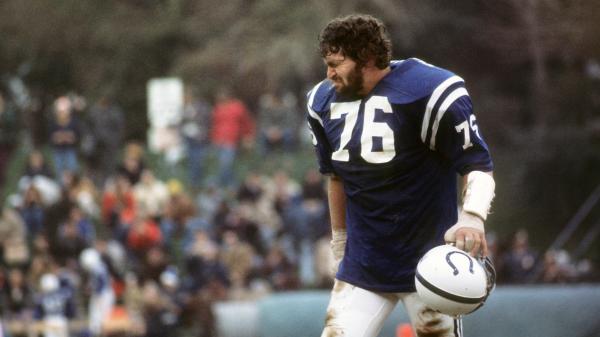

Joe Ehrmann, shown in 1975, was a defensive lineman with the Baltimore Colts for much of the '70s. He says that as a child, he was taught that being a man meant dominating people and circumstances — a lesson that served him well on the football field, but less so in real life.   Neil Leifer Sports Illustrated/Getty Images
This story is part of All Things Considered's "Men in America" series.

It's rare that a man makes it through life without being told, at least once, "Be a man." To Joe Ehrmann, a former NFL defensive lineman and now a pastor, those are the three scariest words that a boy can hear.

Ehrmann — who played with the Baltimore Colts for much of the 1970s and was a lineman at Syracuse University before that — confronted many models of masculinity in his life. But, as with many boys, his first instructor on manhood was his father, who was an amateur boxer.

Ehrmann says of his father: "I think his definition, which was very old in this country, was: Men don't need. Men don't want. Men don't touch. Men don't feel. If you're going to be a man in this world, you better learn how to dominate and control people and circumstances."

On the football field, those lessons served Ehrmann well. But, as he tells NPR's Audie Cornish, it was not the same case in the pediatric oncology ward. In 1978, Ehrmann's teenage brother was diagnosed with cancer. However tough Joe was on the field, he did not feel equipped to help his brother or himself.

Interview Highlights


On how his brother's death affected him

When he died, that was devastating to me. And I started to ask all the questions about what is the role, the meaning, the purpose of life. I was 29 years old, I was six years into my NFL career, and I had no concept — no concept what life was about, and no concept what I was about. And on this journey, I ended up asking the question: What does it mean to be a man? ...

I recognized that everything I had invested my life in — all my accomplishments, my achievements, the stuff I had accumulated — I recognized at that moment they offered no hope or help to my 19-year-old brother — 18-year-old brother — lying on his deathbed. ...

All I had was these old "man up" kind of things — "suck it up, we'll get through this together" — when he really needed the emotional, the nurturing, the love. And I had to really struggle to pull that out of my heart.

On the roles a coach can play in his players' lives

There's two kinds of coaches in America: You're either transactional or you're transformational. Transactional coaches basically use young people for their own identity, their own validation, their own ends. It's always about them — the team first, players' needs down the road.

And then you have transformational coaches. They understand the power, the platform, the position they have in the lives of young people, and they're going to use that to change the arc of every young person's life. I think football is an ideal place — sports in general — team sports are an ideal place to help boys become men. And the great myth in America today is that sports builds character. That's not true in a win-at-all-costs culture. Sports doesn't build character unless the coach models it, nurtures it and teaches it.

On what those philosophies look like on the field

I think there's a lot of screamers, there's a lot of shouters, there's a lot of shamers. My approach is this: Boy, you're in the middle of the game, and some kid's having a tough time. They get beat. ... I tell all my players, "Come on over to me during the game and I'll give you a hug." And you think about the power of a hug versus swearing, shouting, shaming at some kid.

When I played football, I hated [when] some kid would get a knee injury, your teammate would go down and that coach would say move the practice down 20 yards and leave that kid laying there. ... As coaches, we can kneel down next to that kid, you affirm the tears, the pain, the emotions, and you bring all the team around to say, "How can we help Bobby? He's one of us; he's done so much. He had so many dreams." So, you teach them how to build authentic community as men caring for and loving each other.

On the changes he's seen in ideas of masculinity

I think those three lies of masculinity — athletic ability, sexual conquest, economic success — in many ways, those things have been heightened. You have this increase in social media. You have young boys coming into this world, and they are hit 24/7. They're given all kinds of negative messages about their masculinity. They've been conditioned, and they have way more messaging out of this culture than I ever had as a young boy. I think in many respects, it's more difficult. There's more negative messaging out there and less positive.

On what it means to be a man

It think it can only be defined by two things: One, it's your capacity to love and to be loved. Masculinity ought to be defined in terms of relationships. Second thing, it ought to be defined by commitment to a cause. All of us have a responsibility to give back, to make the world more fair, more just, more hospitable for every human being. So I think it's about relationships and commitments to a cause. That's the underline of all humanity — men and women.

Copyright 2014 NPR. To see more, visit http://www.npr.org/.

Transcript


ROBERT SIEGEL, HOST:

This is ALL THINGS CONSIDERED from NPR News. I'm Robert Siegel.

AUDIE CORNISH, HOST:

And I'm Audie Cornish. We've been hearing about men this summer - how their roles have changed, what their lives are like. And one thing most men are told at some point in their early lives is this - be a man.

JOE EHRMANN: Yeah, I think every boy at a very early age is given this mandate to be a man. They're actually the three scariest words every boy receives.

CORNISH: That's former NFL defenseman Joe Ehrmann. He played in the 1970s, mostly for the Baltimore Colts. As with many boys, his first instructor on manhood was his father.

EHRMANN: I think in many ways my father gave me all the wrong concepts about being a man. I think his definition, which was very old-school in this country, was men don't need. Men don't want. Men don't touch. Men don't feel. If you're going to be a man in this world, you better learn how to dominate and control people and circumstances.

CORNISH: And, of course, men don't cry. On the football field, those lessons served Joe Ehrmann well, but not in the pediatric oncology ward. In 1978 Ehrmann's teenage brother was diagnosed with cancer, and however tough Joe Ehrmann was on the field, he did not feel equipped to help his dying brother or himself.

EHRMANN: When he died, that was devastating to me. And I started to ask all the questions about what is the role, the meaning, the purpose of life. I was 29 years old. I was six years in my NFL career, and I had no concept - no concept what life was about and no concept what I was about. And on this journey I ended up asking the question what does it mean to be a man?

CORNISH: Why that question for this particular really very emotionally wrenching part of life?

EHRMANN: Well, 'cause I think I recognized that when my brother was diagnosed and began his dying process - I recognized that everything I had invested my life in - all my accomplishments, my achievements, stuff I had accumulated - I recognized at that moment they offered no hope or help to my 19-year-old brother - 18-year-old brother lying on his deathbed. I was a socialized male that had separated my heart from my head, trying to live life from the neck up.

CORNISH: You were saying all you had were the locker room speeches basically.

EHRMANN: Yeah. All I had was these old man up kind of things. Suck it up. We'll get through this thing together. When he really needed the emotional - the nurturing, the love. Boy, and I had to really struggle to pull that of my heart.

CORNISH: You went on to seminary and to become a pastor. And you also went on to coach high school football. Now, can you talk about what it is in particular you think coaches can do to shift this ideology and whether you really have encountered coaches who are interested in doing that?

EHRMANN: Well, there's two kinds of coaches in America. You're either transactional or you're transformational. Transactional coaches basically use young people for their own identity, their own validation, their own ends. It's always about them - the team first, players' needs down the road. And then you have transformational coaches. They understand the power, the platform, the position they have in the lives of young people, and they're going to use that to change the arc of every young person's life. I think football is an ideal place - sports in general - team sports are an ideal place to help boys become men. And the great myth in America today is that sports builds character. That's not true in a win-at-all-costs culture. Sports doesn't build character unless a coach models it, nurtures it and teaches it.

CORNISH: You mentioned that coaches are either transactional - what can you do for me - or transformational. On the field, how does that play out? Are you basically talking about the screamers here?

EHRMANN: The screamers, yeah. I think there's a lot of screamers. There's a lot of shouters. There's a lot of shamers. My approach is this - boy, you're in the middle of the game and some kid's having a tough time. They get beat. I tell all my players, come on over to me during the game and I'll give you a hug. And you think about the power of a hug versus swearing, shouting, shaming at some kid. Boy, you know, when I played ball I hated - some kid would get a knee injury. Your teammate would go down and that coach would say move the practice down 20 yards and leave that kid laying there. Boy, as coaches, we get kneeled down next to the kid. You affirm the tears, the pain, the emotions, and then you bring all the team around to say how can we help Bobby? He's one of us. He's done so much. He had so many dreams. So you teach them how to build authentic community as men caring and loving for each other.

CORNISH: I'm speaking with Joe Ehrmann. He's founder of Coach for America. And so you've actually been doing this work for decades. And has the average boy changed in some way or are there changes you've seen in how they approach masculinity than when you were growing up?

EHRMANN: Not too much. Boy, I think there's different nuances and stuff, but we have a real crisis when it comes to what it means to be a man.

CORNISH: Not too much, really?

EHRMANN: I don't think so. I think those three lies of masculinity - athletic ability, sexual conquest, economic success. In many ways those things have been heightened. You have this increase in social media. You have young boys coming into this world and they are - 24/7 they're given all kinds of negative messages about their masculinity. They've been conditioned, and they have way more messaging out of this culture than I ever had as a young boy. So I think in many respects it's more difficult. There's more negative messaging out there and less positive.

CORNISH: Can you talk about a particular incident that really drives that home for you?

EHRMANN: Well, I think the Steubenville, Ohio, rape case - two high school boys - 16-year-old girl - drunk, passed out - hundreds of pictures taken - tweets. And that one person had the moral clarity or moral courage to intervene in the midst of that. Two boys sentenced to prison - had no idea about consent. They weren't taught this stuff. A community tried to cover it up. Boy, I think that thing is played out and could play out at any high school. Boys have to be taught about - they have to have the moral clarity and the moral courage to speak up. That's not going to end. Women can't end it. It's not going to end until we raise up a generation of men that have the courage to call out other men on behalf of women in this country.

CORNISH: For you, what is masculinity? What does it mean to be a man?

EHRMANN: I think it could be only defined by two things. One, it's your capacity to love and to be loved. Masculinity ought to be defined in terms of relationships. Second thing, it ought to be defined by commitment to a cause - that all of us have a responsibility to give back - to make the world more fair, more just, more hospitable for every human being. So I think it's about relationships and commitment to a cause. That's the underlying of all humanity - men and women.

CORNISH: Joe Ehrmann - he's founder of Coach for America. Thank you so much for speaking with us. EHRMANN: Great to be with you, Audie. Thank you.

Transcript provided by NPR, Copyright NPR.

Monday, July 21, 2014

Peg Streep - What Porn Does to Intimacy

http://www.epiclol.com/cdn/pictures/2012/01/pornography-logistic_1326452670_epiclolcom.jpg

Disclaimer - Not all porn is evil, but frequent use of porn can pose serious issues.

This post from Peg Streep's Psychology Today blog, Tech Support, looks at three recent studies on how pornography impacts intimacy in relationships.

What Porn Does to Intimacy

3 studies find that explicit material can do more harm than most people think.

Published on July 16, 2014 by Peg Streep in Tech Support
The rapid proliferation of pornography is one of the digital age’s legacies; some 40 million people in the United States visit porn websites regularly, many of them emerging or young adults. Popular media have capitalized on cautionary tales about porn addiction and stories of boyfriends objectifying their girlfriends and wanting them to behave like porn stars. But studies confirm that the preponderance of young men—and slightly less than half of women—thinks that watching sexually explicit material is okay.


That’s what Spencer B. Olmstead and his colleagues found when they asked college students about the use of pornography in future romantic relationships: 70.8 percent of men and 45.5 percent of women thought they would watch. In contrast, only 22.3 percent of men and 26.3 percent of women thought pornography had no role in a romantic partnership. Men and women tend to disagree on two issues: How porn is watched (alone, in groups, with a sexual partner); and how often it is watched. As Michael Kimmel reported in his 2008 book Guyland, young men often watch porn with their peers and for different reasons than older men. Kimmel writes that “guys tend to like the extreme stuff, the double penetrations and humiliating scenes. They watch it together with guys and they make fun of the women in the scene.” In contrast, older men with more experience either watch by themselves or with a partner, and with what Kimmel calls “wistfulness” about their younger selves; they tend to prefer material “where the women look like they are filled with desire and experience pleasure.”

The Olmstead study found that women’s concerns had more to do with whether consumption of porn was limited than whom it was watched with. Men tend to think that watching porn has only positive consequences.

As reported by Nathaniel Lambert and others in a review of studies, women whose partners watched porn regularly thought less of those partners and saw porn as more of a threat to the stability of their relationship. On the other hand, other studies have shown that young men and women alike think that sexually explicit material can help them explore their sexuality and adds “spice” to what they do in bed.

Is watching pornography really as benign as people think? The following three studies reveal that it has a greater effect on relationships than those we usually discuss.

1. Porn-free relationships are stronger, with a lower rate of infidelity.

That’s what Amanda Maddox and her colleagues found in a study of men and women, ages 18 to 34, who were in romantic relationships. The researchers measured the levels of negative communication, relationship adjustment, dedication or interpersonal commitment, sexual satisfaction, and infidelity. In their study, 76.8 percent of men and 34.6 percent of women looked at sexually explicit material alone; 44.8 percent reported viewing it with partners. They found that people who didn’t view any porn had lower levels of negative communication, were more committed to the relationship, and had higher sexual satisfaction and relationship adjustment. Their rate of infidelity was at least half of those who had watched sexual material alone and with their partners. But people who only watched porn with their partners were more dedicated to the relationship and more sexually satisfied than those who watched alone.

2. Watching porn diminishes relationship commitment.

What these researchers discovered is that watching porn reminds you of all the potential sexual partners out there, which in turn lowers your dedication to the person you’re actually involved with. It also leads you to swap out the person who’s actually lying in bed with you for some fantasy person you’ve never met (and probably never will).

Does that sound healthy?

Nathaniel Lambert, Sesen Negash and others conducted five separate experiments to find out. In the first, they asked participants, age 17 to 26, who were in relationships (as long as three years and as brief as two months) about their porn consumption and measured levels of commitment. They found that porn consumption lowered commitment in both men and women, but with a stronger effect on men.

In their second study, they had independent observers watch videos of couples performing an interactive task—one partner was blind-folded and had to draw something while the other gave instructions. Among the observers, lower commitment was observed among porn users.

The third study only tested participants who had consumed porn. They had half the group give up porn for three weeks. The other half was asked to give up their favorite food, but were allowed to watch porn. The result? Those who had abstained from sexually explicit material showed increased commitment to the relationship at the end of the three weeks.

The last two studies focused on the effect of greater attentiveness to alternatives on potential infidelity and infidelity itself. And yes, people who watched porn were more likely to engage in flirting (and more) outside their relationships in one experiment; and more likely to cheat and hook-up in the other.

3. The fantasy alternative leads to real-world cheating.

In another study, Andrea Mariea Gwinn, Nathaniel Lambert, and others further explored the nature of the other alternatives imaginatively offered up by pornography. They suggested two possibilities: First, that seeing physically attractive and sexually available partners on screen may heighten a person’s perceptions of his own possible partners. And second, that porn may make the idea of multiple sexual partners more appealing—another wound to a committed relationship.

And that’s exactly what they found.

In one study, the researchers found that people who thought about porn they’d watched reported having better alternatives to their current relationship than those who didn’t. A second study showed that, over time, exposure to porn was a robust predictor of infidelity.

More strikingly, the team found that both thinking about possible partners and acting on the impulse to find those alternatives operated separately from dissatisfaction with one's current relationship and partner. In other words, even though one's own pasture may be plenty green enough, just the thought of a greener one can be enough to send one roving.

You might want to keep that in mind if you’ve been watching the hard stuff or if you've become inured to seeing your partner just flip open his laptop "just for fun.”

Pornography is not as benign as you think, especially when it comes to romantic relationships.

1. Olmstead,Spenser B., Sesen N Negash, Kay Pasley, and Frank D. Fincham, “Emerging Adults’ Expectations for Pornography Use in the Context of Future Committed Relationships: A Qualitative Study,” Archives of Sexual Behavior (2013), 42, 625-635.
2. Kimmel, Michael. Guyland: The Perilous World Where Boys Become Men. New York: HarperCollins Publishers, 2008.
3. Maddox, Amanda, Galena K, Rhoades, and Howard J.Markman,” Viewing Sexually-Explicit Materials Alone and Together: Associations with Relationship Quality,” Archives of Sexual Behavior (April 2011), 40, no. 2, 441-448.
4. Lambert, Nathaniel M. and Sesen Negash, Tyler F.Stillman, Spencer B. Olmstead, and Frank M. Fincham, “A Love That Doesn’t Last: Pornography Consumption and Weakened Commitment to One’s Romantic Partner,” Journal of Social and Clinical Psychology (2012), vol.31, no.4, 410-438.
5. Gwinn, Andrea Mariea, Nathaniel M. Lambert, Frank D. Fincham, and Jon K,Maner, “Pornography, Relationship Alternatives, and Intimate Extradyadic Behavior,” Social Psychological and Personality Science, (2013), vol.4, no. 6, 699-704.
Copyright© Peg Streep 2014
VISIT ME ON FACEBOOK: www.Facebook.com/PegStreepAuthor
READ MY NEW BOOK: Mastering the Art of Quitting: Why It Matters in Life, Love, and Work
READ Mean Mothers: Overcoming the Legacy of Hurt

Sunday, July 20, 2014

Men, Power, Money, and Sex - An Interview with Warren Farrell, Men's Rights Advocate


Marty Nemko is a life coach, author, and he blogs at his self-named site. He often blogs on topics related to men and boys, so it seems appropriate that he interview men's rights activist Warren Farrel for his Psychology Today blog, How to Do Life. Yes, I wrote activist and not advocate - he is the former, not the later.

First, my disclaimer: I do not like Farrell. His claims on the frequency of false rape accusations are totally ignorant of the reality "on the ground." For example, he claims below that we need to do away with the guilty/not-guilty binary because sexual encounters are far too nuanced for such a binary (this has been Marc Gafni's defense of his sexual predation on students, on whose board of directors Farrell sits). And besides, he adds, sometimes there are false reports, so we should never assume guilt.

WRONG - 92% (at least) to 98% of rape claims or true, and this doesn't even acknowledge the true claims that are not investigated by police.

Farrell has repeated made insanely stupid comments on date rape. Like this one:
We have forgotten that before we began calling this date rape and date fraud, we called it exciting. (Myth of Male Power, p. 314-15)
Or this one:
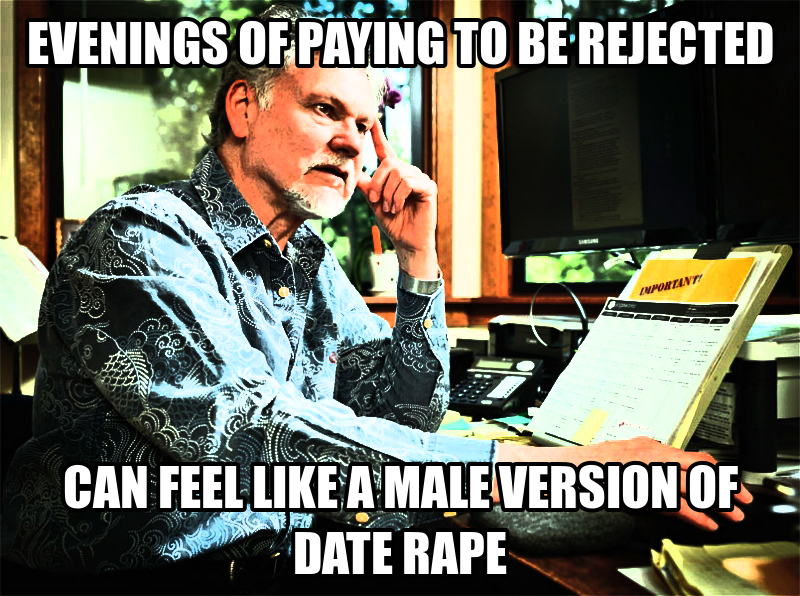
Evenings of paying to be rejected can feel like a male version of date rape. (MoMP, p. 314)
Really? Paying for dinner and not getting laid is the same as date rape? So the price of sex with a woman is dinner? Are we talking a nice restaurant here, or will Taco Bell due? Isn't that prostitution?

Oh, and by the way, have you been raped, Warren? Do you know how it feels to have your autonomy and physical body, not to mention your psychological self, sexually violated by another person? To have your trust in other human beings destroyed? To believe, despite the evidence, that somehow it was your fault? To have the nightmares, the hypervigilance, the self-loathing that comes with rape? Yeah, thought not.

Or this:
Almost all single women acknowledge they have agreed to go back to a guy’s place “just to talk” but were nevertheless responsive to his first kiss. Almost all acknowledge they’ve recently said something like “That’s far enough for now,” even as her lips are still kissing and her tongue is still touching his. (MoMP, p. 314)
Okay, so if you kiss somebody, that is tacit consent to sex? Wrong again, Warren.

And he always goes back to his straw man about false reports. Most studies put the false report rate at 2%. Even the FBI (1996), only put it at 8%:
As with all other Crime Index offenses, complaints of forcible rape made to law enforcement agencies are sometimes found to be false or baseless. In such cases, law enforcement agencies “unfound” the offenses and exclude them from crime counts. The “unfounded” rate, or percentage of complaints determined through investigation to be false, is higher for forcible rape than for any other Index crime. Eight percent of forcible rape complaints in 1996 were “unfounded,” while the average for all Index crimes was 2 percent.
What that section fails to mention, however, and Farrell has never acknowledged, is that local law enforcement will often decide a case is unfounded when drugs or alcohol are involved, or when there is previous sexual activity between the rapist and the victim.

Roughly a third to a full half of the clients I see have reported their rapist and the police/sheriff decided not to file charges or even pursue an investigation. This is seldom acknowledged aside from claims that reported rapes are far less than total rapes.

* * * *

One place Farrell is right is that this needs to be something we talk about with kids long before college or when they become sexual (high school, in general). Education is always the best prevention.

Where Farrell tends to be most relevant is in his discussions of the disposable nature of men in most societies. However, the answer is not to put more women in those jobs to make the risk more equal - it's to remove that safety issues that make those jobs so deadly (mining, oil fields, etc, where the corporations repeatedly avoid, undermine, or lobby against safety regulations). And the exception here is combat - let women be in combat military roles if they can do it.

Anyway, here is the brief interview.

Men, Power, Money, and Sex

An interview with men's advocate, Warren Farrell

Published on July 17, 2014 by Marty Nemko, Ph.D. in How To Do Life


Warren Farrell is a leading expert on men’s issues. He is the author of seven books and chair of the Commission to Create a White House Council on Boys and Men. He served on the board of the National Organization for Women (NOW) in New York City and is an advocate for both sexes having the full range of options, professionally and personally. 

I interviewed him about gender roles, power, why men earn more, and campus rape.

Marty Nemko: You're most well-known for your book The Myth of Male Power, just out in a new e-book edition. Many people think men have the power: Look at the Senate and CEO rosters. How would you respond?

Warren Farrell: A small percentage of men have major institutional power but across the full population, real power is about having choices. The women’s movement has made it socially acceptable for a mom to work full-time, stay home with the child full-time, or work part-time. That’s as it should be. Alas, it’s not as acceptable for a man to work part-time, let alone be a full-time parent. Mr. Mom is still a term of derision.

Marty Nemko: But men earn more. Isn’t that power?

Warren Farrell: Many men still buy into a false definition of power: feeling obligated to earn money that someone else spends while we die sooner—5.2 years sooner. That’s not power. That’s being a prisoner of the need for love and approval.

Marty Nemko: In your book, Why Men Earn More, you report that the statistic that women earn 77 cents for each dollar a man earns for the same work is very misleading. Can you give an example as to why? 

Warren Farrell: Women who have never been married and never had children earn 17% more than never-married men that have never had children, even when education and years worked are equal. Men don’t earn more than women. Dads earn more than moms. Why? When a child is born, a mom is more likely to divide her labor between work and home, earning less at work. A dad is more likely to increase his hours at work—or work two jobs—often taking jobs he likes less that pay more. 

Marty Nemko: In Why Men Earn More, you write, “The road to high pay is a toll road.” Are you suggesting that high pay and power can be inversely correlated?

Warren Farrell: Yes. For many dads, the road to high pay is not about power; it’s about his hope to make his children’s life better than his. It’s about giving his wife a better life. And to get that higher pay, he often has to forgo work he'd rather do. For example, he might prefer to be a teacher or a creative but to better support his family, he accepts a long-hours, high-stress, technical, travel-intensive, often soulless management position.

Marty Nemko: In your recent Reddit Highlighted Conversation, you cite statistics so startling that some would question their veracity. Would you provide the source for:
  • This is the first time in U.S. history that our sons will have less education than their dads.
  • Boys' suicide rate goes from equal to girls at age 9 to five times(!) girls' in their twenties.
  • More U.S. male military were killed by suicide in one year than were killed in the wars in Iraq and Afghanistan in all years combined.
Warren Farrell: Yes. Boys having less education than their dads is from the OECD (Organization for Economic Co-operation and Development), “Education at a Glance,” 2010, Table A1.3a

The boy-girl suicide rate is from the Centers for Disease Control and Prevention, Morbidity and Mortality Weekly Report, 58,1, 2009, and Web-based Injury Statistics Query and Reporting System (WISQARS), 2010.

The U.S. military suicide rate data is from the DOD, uncovered by CBS, in Armen Keteyian, “Suicide Epidemic Among Veterans.” CBS News, November 13, 2007. http://www.cbsnews.com/stories/2007/11/13/cbsnews_investigates/main3496471.shtml.

Marty Nemko: The subtitle of your book The Myth of Male Power is: Why Men are the Disposable Sex. How are men the disposable sex?

Warren Farrell: Virtually all societies that survived did so based on their ability to train their sons to be disposable—disposable in war, disposable at work.

Marty Nemko: That’s a strong statement. What’s your evidence?

Warren Farrell: The evidence is ubiquitous. 92 percent of workplace deaths occur to men, jobs few women would take: oil rig workers, long-haul truckers, roofers, coal miners. Yet there isn't the political will to create regulations that would afford them more protection for these workers. Meanwhile, when women have a less life-threatening deficit, for example, underrepresentation of women in engineering, there's massive expenditure to redress. Although male-only draft registration is a violation of both the 14th Amendment’s equal-protection clause and the 5th Amendment’s due process clause, it is so unconsciously accepted it isn’t even questioned. Only men can serve in direct combat so 98 percent of Iraq and Afghanistan deaths were men.

Marty Nemko: Is the fact that men die 5.2 years younger than women another example of male disposability?

Warren Farrell: It is the combination of facts like men dying 5.2 years younger than women—or men dying sooner from all ten of the ten leading causes of death, plus the fact that we nevertheless have seven federal offices of women’s health and none of men’s health that together reflect the psychology of indifference toward male disposability. Similarly, men over the age of 85 commit suicide 1350 percent as frequently as women over 85. Virtually no one knows this. If women over 85 committed suicide 1350 percent as often than men, it would be used as the quintessential example of our undervaluing of women. We seem to care more about saving whales than saving males.

Marty Nemko: You said men are indirectly disposable as dads. How do you mean?

Warren Farrell: In a divorce, if the mother doesn’t want the father to be equally involved, the apriori assumption is that she's right. Men have to fight in court for that right, and that's expensive.Unless he’s rich, he’s disposable. 

Marty Nemko: What are your thoughts about the current focus on campus rape?

Warren Farrell: The issue first should be addressed before kids get to college. For example, we may need to encourage our daughters to take the initiative when they do want physical intimacy, not just to say when they don’t. Our society strives for equality but few experts are asking women to share the responsibility for taking the initiative in sex, thereby risking rejection. During adolescence, women are the more mature sex. It’s unfair to expect guys to assume 90 percent of the burden of sexual rejection.

Marty Nemko: What should happen at college?

Warren Farrell: First, make the law the last resort. The law is binary: guilty/not guilty. Sex is nuanced and more nonverbal than verbal. Those nuances have evolved over millennia. A slight change in eye contact means everything in a male-female encounter but would be laughed at in court. And if a grievance is filed, we should not presume guilt. Alas, some accusations are false.

Marty Nemko: What about workshops at college?

Warren Farrell: Yes but both sexes should be walking a mile in each other’s moccasins.

Marty Nemko: You’ve done such trainings, right?

Warren Farrell: Yes. I used to tell college audiences, “Every woman is in a beauty contest every day of her life.” I then invited all the guys on stage to experience that. I had those guys wear bathing suits and had the women be the judges. The guys were stunned at being unseen for their integrity, intelligence, or values. They felt objectified.

Marty Nemko: What did you do to help the young women walk a mile in the guys’ moccasins?

Warren Farrell: I had the women “ask-out” the guys they were most attracted to on a 20-minute “date.” Some did what they criticize men for, for example, lying to get an attractive guy to go out with them. Others went after a less attractive guy to reduce the chance of getting rejected. The guys totally identified with that.

Marty Nemko: What was the outcome of those workshops?

Warren Farrell: Greater compassion for the other sex’s vulnerability, and I formed hundreds of men and women’s groups so they would continue to deepen their compassion after I left campus. 

Marty Nemko: Was there any concrete evidence it reduced campus rape?

Warren Farrell: I asked campus sponsors to let me know if any of the workshop participants later were involved in a date rape accusation. Although I had worked with 20,000 students in hundreds of colleges, not one incident was reported.

Marty Nemko: Do you still do those workshops?

Warren Farrell: As political correctness set into the colleges’ psyches, college programs shifted to emphasizing only men understanding women. It would be wiser for programs to help both sexes better understand each other. We don’t need a women’s movement blaming men, nor a men’s movement blaming women. We need a gender liberation movement. We need both sexes walking a mile in each other’s moccasins.

Friday, July 18, 2014

Fitness Friday - Fitness News and Information You Can Use

Welcome to another Fitness Friday. I was on vacation last week and did not post the usual Fitness Friday link collection, so this week there is some catching up to do.

That noted, we begin today with two posts from the last two days at T-Nation, the first being a general article by Charles Staley on how to be sure your training program is organized correctly, and the second being a specific style of training (total-reps) by Kyle Arsenault. For what it's worth, Charles knows his stuff (he trains my girlfriend), so give it a good read. 

I am also a fan of the training style Arsenault outlines in his article. By using his technique, you assured of getting enough reps in to build muscle, but because you are using a weight that is essentially 5-6 rep max, you will also be building strength.

10 Principles For Better Programming

by Charles Staley   
7.18.2014


Here's what you need to know...
  • There are thousands of training programs out there, but the most effective ones share similar principles.
  • Check out the list below and make sure your training program puts most of these principles into action.
There are as many theories about programming as there are coaches who apply them. But in my 30-plus years in the field I've found that all successful training programs have common themes. Here are the top 10 most important principles for creating programs that work.
* * * * *

Total-Rep Training

by Kyle Arsenault   
7.17.2014


Here's what you need to know...
  • This method uses high intensities, greater volume, and involves working close to muscular failure.
  • Determine your 5-6RM for one of the big lifts. Then do as many sets as necessary for you to hit a total of 25 reps. In addition to allowing you to work close to failure on each set, the system allows for auto-regulation.
  • Once the total amount of reps is completed, you'll do a drop set where you immediately drop the resistance by 5-10% and complete one more set close to failure.
When it comes to making strength and size gains, a training program that utilizes higher intensities (percent of RM), a greater overall volume, and a closer proximity to muscular failure produces superior results. The issue with this approach is the increased risk of injury and burnout, as well as the consistent mental toughness and discipline it takes to continuously complete these sessions. Over time, crushing 8-10 sets of singles or triples or consistently smashing through a 5x5 routine will take its toll.

While de-load weeks have their place, I'm suggesting we find a way to complete the bulk of our training using a system that not only uses a higher intensity and volume, but also matches our physical and mental preparedness for that day. That's where this new method comes in.
* * * * *

From Jason Ferruggia's blog, a guest post by Yuri Elkaim.

Why Dudes Should Do Yoga

Guest Post By Yuri Elkaim
July 15th, 2014


Think Downward Dog and Cat Pose is stuff for sissies? Think again. You may be hitting the gym hard, spending hours on the court, but skimp on the stretching and you’ll never reach your A-game.

Yoga hasn’t been used for thousands of years by women only. It’s not just for old people that live in Asia. It’s actually a tool that’s helped millions of men, monks, and—yes—even elite athletes find their focus, get strong, and discover their ultimate ability.

Tap into the age-old wisdom of yoga, and you’ll find a whole new level of strength, conditioning, and power that you didn’t know you had. Here are five reasons to give yoga a try. Once you add it to your weekly workouts, you’ll discover a dozen other benefits.
* * * * *

From Eric Cressey's blog:

My Top 5 Powerlifting Mistakes

Written on July 15, 2014, by Eric Cressey

SSG

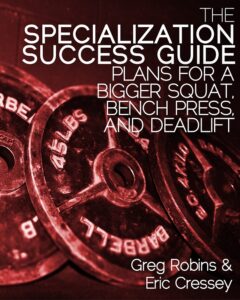
With this week's release of Greg Robins and my new resource, The Specialization Success Guide, I got to thinking about some of my biggest mistakes with respect to developing the Big 3 (squat, bench press, and deadlift). Here are the top five mistakes I made in my powerlifting career....

* * * * *

From Brett Contreras' blog:

A Simple System for Progression: 3 Set Total Reps

We all want to be making progress in the gym, but unfortunately, many lifters remain stagnant. In general, you want to make sure you’re getting stronger over time. Getting stronger means using more load or achieving more repetitions with the same weight. This is the essence of progressive overload, which I discussed in great detail HERE. While there are a million ways to progressively overload, I’m going to outline a very simple system I use in my own training and with my clients.


3 Set Total Reps


When I prescribe an exercise, quite often I will use the same load with all 3 sets, and I’ll simply note the total number of reps they achieve (this is in contrast to pyramids, which I wrote about HERE). Once they reach a particular total, I’ll increase the load. I first learned about this method from a Joe DeFranco DVD that I purchased many years ago, and it’s something that I’ve consistently sprinkled into my training since then.
* * * * *

And back to T-Nation for some heresy from TC, as well as other good stuff.

8 Reasons You're Still Weak or Fat

by TC   
07/14/14


Here's what you need to know...
  • If after several years of training you're still weak, there's a good chance you need to rethink your ideas about squats and deadlifts; that you've got no love for the upper body squat; that steroids misled you about a basic training principle; and that you work muscles instead of movements.
  • If after several years of training you're still fat, there's a good chance you need to rethink your ideas about eating 6 meals a day and doing fasted cardio.
  • If you're still skinny, there's a good chance your ideas about post-workout nutrition are 10 years old and your definition of recovery days needs an adjustment.
Convention dictates that I write an intro to this article, but this article is about defenestrating convention and tweaking your strength-building or fat-burning or bodybuilding perspective a little to the left or to the right, so screw a drawn-out intro. The title says it all.
* * * * *

Break 3 Rules, Build More Muscle

by Christian Thibaudeau   
07/07/14


Here's what you need to know...
  • For hypertrophy, it doesn't really matter what the exercise looks like as long as it puts the muscle under an optimal load/tension. Accordingly, some of the biggest bodybuilders on the planet rely heavily on partial reps.
  • If you can't feel a muscle working in an exercise, you can't stimulate it or grow it optimally. Isolation work will fix this problem and even improve your compound lifts.
  • You can build muscle with almost any kind of rep range. If you train consistently and try to gradually become stronger in the rep ranges you're doing, you'll grow muscle with 3 reps or 20 reps.
Despite my focus on performance, I also want to look muscular and lean, as do my clients. I've even competed in bodybuilding myself to see what it was like and to understand it better. I also had the opportunity to work with a lot of great bodybuilders, amateurs and pros. I worked with Amit Sapir for a few years, starting when he was an amateur and up to when he won his pro card. I also was involved in the Darryl Gee project that was documented on T Nation. Currently, I'm training Patrick Bernard, a new IFBB pro in the 212-pound class, as well as a young woman who won her class in figure at a recent contest. I've definitely learned a thing or two in the process.

You can learn from anyone who's training hard and making progress - bodybuilders, powerlifters, athletes, CrossFitters, Olympic lifters, etc. Close your mind to any of these training modalities because of pre-conceived ideas and you'll miss out on a lot. That said, here are three things I learned from working with bodybuilders.
* * * * *

How to Increase Your Pull-Up Power

by Dan John   
07/09/14


Here's what you need to know...

  • The pull-up has been beaten to death by lifters and athletes who try at all costs to get their rep total higher and higher. They should be adding load instead.
  • Simply hanging from the bar is an important form of loading. If you want to do 25 strict pull-ups, can you even hang from the bar long enough to do them?
  • The ab wheel mimics many of the keys to proper pull-ups.
  • Pavel's Russian Fighter Pull-up Program allows you to "sneak up" on a higher number of reps.
I pity the pull-up. In the past decade, this wonderful movement has been trashed and beaten by enthusiasts who try at all costs to up their rep total higher and higher. Sure, high reps have their place, but many of us need a smarter, more rational approach.

After a certain age, pull-ups start "bugging" people. For most of us, there's a pain in the elbow that only goes away when we avoid pull-ups. A few weeks or months later, it seems to cure itself and the only way we reinjure it is by doing more high-rep pull-ups and... we succeed! We have a name for this in my gym. We call it Middle Age Pull-Up Syndrome, or MAPS. "You too can help us cure this disease. Please send money now to..."

Improving your pull-up numbers, either with more reps or more load - which I tend to recommend over more reps - is going to be a study in balance. If you force the reps up with more and more volume, you might eventually hit your new personal record in the movement but never again throw a ball or comb your hair. You could keep your hair really short, or you could train the pull-up using a few contrarian ideas.

Big Think - The Power of Vulnerability

Vulnerability is one of those things men tend to struggle with in relationships, primarily because so many of us were raised never to show vulnerability. I suspect women also deal with this issue, but it's often men who get the bad rap for it.

In this article from Big Think, the author offers some short but useful insights on the necessity of vulnerability in healthy relationships.

The Power of Vulnerability


July 17, 2014
Shutterstock_166308674

Years ago I read an article by Harvard business professor Chris Argyris whose message stuck with me. “Good Communication that Blocks Learning” was about the mental models we develop early in life for dealing with emotional and threatening issues. These “defensive routines,” as Argyris termed them, exist to prevent human beings from experiencing embarrassment or threat. At the same time, however, they prevent examination of the nature and causes of both. In short, they prevent learning and thereby perpetuate bad choices.

Breaking free of defensive communication routines requires a willingness to be vulnerable. Only while bringing down our guard are we able to effectively examine why certain unsavory situations occur repeatedly in our lives. Ironically, this kind of vulnerability requires courage.

Doing the unexpected, as hard as it may be, often brings rewards. We know that apologizing, when defensiveness or retaliation is expected, can lead to calmer communication. The unexpected causes most of us to reflect. Indeed, it is often how young children learn new things.

Moreover, the rule of reciprocity in human interaction calls for a civil response to a civil offering. Ignoring this rule has its consequences, but here again breaking free of defensive routines can enable us to change the communication options of others. If we move beyond defensiveness, the rule of reciprocity encourages others to do so as well.

It would be naïve to suggest that antagonistic relationships around the world would disappear were the key players to reflect more on their defensive routines. But it wouldn’t hurt, either.

To the extent we stick with routines, we cease to learn other communication options. Perhaps worse, we become predictable -- and thereby manageable -- by others, many of whom we’d prefer not to give such power if we had our wits about us. They are able to provoke us to and corner us within our own defensiveness because it’s so easy to do.

Unblocking defensive communication routines starts with recognizing their existence and realizing what can be said in their place. “This is where I usually become defensive...” or “Rather than escalate this into an argument neither of us wants, let me suggest...” are two phrases that may prove useful the next time you feel yourself becoming defensive, and there are many others. Their use opens us up to learning, and so makes us more skillful at communication.

Sure, there is risk in relinquishing defensiveness. The greater risk, though, is that of becoming stuck in routines that repeatedly take us to the same unhappy and unproductive place.


photo: PathDoc/Shutterstock.com


by Kathleen Kelley Reardon

Thursday, July 17, 2014

Michael Sam's Powerful, Show-Stopping Speech at the ESPYs


Michael Sam was given the Arthur Ashe Courage Award at the 2014 ESPYs on Wednesday night. His acceptance speech was incredibly powerful. Enjoy!

Michael Sam's Powerful, Show-Stopping Speech at the ESPYs

By Scott Gleeson

LOS ANGELES — Michael Sam delivered an incredibly powerful speech after accepting the Arthur Ashe Courage Award at the 2014 ESPYs on Wednesday night.

There weren’t many dry eyes in the room following the words of Sam, who was honored for his decision to publicly come out and become the first openly gay player drafted into the NFL.

Sam emotionally quoted Ashe’s words of wisdom, that included: Start Where You Are, Use What You Have and Do What You Can.

“Those were words to live by,” Sam said. “Whether you’re white or black. Young or old. Straight or gay.”

Sam fought back tears on stage, and he ended his speech by telling the story of a gay woman who told him she never again consider committing suicide after he came out as gay.

Sam’s powerful message: “To anyone out there, especially young people feeling like you don’t fit in, or are not accepted, great things can happen when you have the courage to be yourself.”

Sam brought boyfriend Vito Cammisano on the red carpet and specifically thanked him.

Dwayne “The Rock” Johnson presented the award. Jason Collins, the first openly gay athlete in the NBA, was shown cheering in the audience.

Wednesday, July 16, 2014

More Teen Boys Look for Relationships, Not Flings

PsychCentral reports on a new study from the American Journal of Men’s Health that reveals teenage boys are changing in ways most would never have predicted - they are choosing more secure and honest relationships. But to keep things within the realm of the familiar, they want these relationships within a sexual relationship. Hormones and heart - a big step forward for teen boys.

More Teen Boys Look for Relationships, Not Flings

By Rick Nauert PhD Senior News Editor
Reviewed by John M. Grohol, Psy.D. on July 16, 2014


A new study determines teenage boy’s desire intimacy and sex in the context of a meaningful relationship and value trust in their partnerships.

The finding may be a surprise to those who view teenage males as testosterone-laden aggressors.

Investigators from Columbia University’s Mailman School of Public Health believe the study provides insights into the development of masculine values in adolescence, an area that has been understudied.

The researchers have published their findings online in the American Journal of Men’s Health.

For the study, researchers studied 33 males who ranged from 14 to 16 years of age to learn more about how their romantic and sexual relationships developed, progressed, and ended. The participants were recruited during routine medical visits at a community adolescent clinic that serves low-income, predominately African-American adolescents.

The group’s sexual history began earlier than the national average, putting them at increased risk for sexually transmitted diseases.

Participants were asked open-ended questions about relationships and sex, such as desirable partner characteristics, intimacy, closeness, and trust.

“Prevailing values in our culture suggest adolescent males want sex, not relationships. However, values and behaviors related to sex and relationships are likely more complex than typically portrayed,” said first author David Bell, M.D., M.P.H.

“In fact, very few of the participants described sex as the main goal of opposite-sex interactions and relationships.”

The study advances an understanding of adolescent males’ early relationships in two significant ways.

First, close relationships were important to the participants. Second, they desired intimate and caring relationships, expressed vulnerability and dependence, and placed great importance on trust in relationships.

Few participants described trying to trick or talk a partner into having sex, and few evidenced pride and boastfulness about numbers of sexual conquests. An area of vulnerability expressed by the males was the lack of knowledge about sex and concerns about their own capacity to sexually perform.

These findings starkly contrast with descriptions of older, sexually experienced adolescent males, according to Bell, in which older adolescents consistently endorse the belief that relationships should be focused around sex, an avoidance of intimacy, and the treatment of females as sex objects.

“Our sample was primarily lower-income African-American adolescent males and the results, while not generalizable, are transferrable to similar populations of adolescent males,” noted Bell, who is also medical director of New York-Presbyterian Hospital’s Family Planning Clinic/Young Men’s Clinic.

Investigators will now study the method by which early adolescent masculine beliefs evolve over time toward more predominant masculine beliefs.

These findings can assist clinicians to better address young men’s sexual health needs and incorporate an understanding of adolescents’ developing masculinity into health promotion.

* Source: Columbia University’s Mailman School of Public Health
* Happy teenage couple photo by shutterstock.

Tuesday, July 15, 2014

The Body Learns - How We've Gotten Education Wrong

I was wondering how long it would take for education science to catch up with cognitive science, particularly with embodied cognition. The use of embodied cognition in education theory is changing everything we thought we knew about how learning occurs.

Most importantly, especially for boys, we are learning that the body is an integral part of the learning process. Better late than never, I guess.

The Body Learns

For years we’ve been telling kids to sit still and pay attention. That’s all wrong.

By Annie Murphy Paul | July 10, 2014

Sam Herman, 7, draws on the SMART Board 885, an interactive whiteboard system that uses multitouch technology, at the Macworld 2011 showroom in San Francisco on Jan. 29, 2011. Incorporating bodily movements—even subtle ones—can improve learning. | Photo by Ryan Anson/AFP/Getty Images
Today’s educational technology often presents itself as a radical departure from the tired practices of traditional instruction. But in one way, at least, it faithfully follows the conventions of the chalk-and-blackboard era: EdTech addresses only the student’s head, leaving the rest of the body out.

Treating mind and body as separate is an old and powerful idea in Western culture. But this venerable trope is facing down a challenge from a generation of researchers—in cognitive science, psychology, neuroscience, even philosophy—who claim that we think with and through our bodies. Even the most abstract mathematical or literary concepts, these researchers maintain, are understood in terms of the experience of our senses and of moving ourselves through space.

This perspective, known as “embodied cognition,” is now becoming a lens through which to look at educational technology. Work in the field shows promising signs that incorporating bodily movements—even subtle ones—can improve the learning that’s done on computers.

For example, Margaret Chan and John Black of Teachers College of Columbia University have shown that physically manipulating an animation of a roller coaster—by sliding the cars up and down the tracks and watching the resulting changes in kinetic and potential energy, as shown in a bar graph—helps students understand the workings of gravity and energy better than static on-screen images and text. This embodied approach to instruction, the authors found, is especially helpful to younger students and to those working on more difficult problems. In counterintuitive domains like physics, bodily rooted learning allows the learner to develop a “feel” for the concept being described, a physical sense that is more comprehensible and compelling than a concept that remains an abstract mental entity.

In similar experiments, led by Insook Han of Hanyang Cyber University in South Korea, students learn about the concept of force by using a joystick to move two gears shown on a computer screen. Han’s studies show that allowing users to physically manipulate the gears in this way improves their memory and problem-solving performance on force-related questions. The richer the perceptual experience provided by the computer program, the greater the students’ understanding and retention of the material.

One reason involving the body improves learning is that bodily movements provide the memory with additional cues with which to represent and retrieve the knowledge learned. Taking action in response to information, in addition to simply seeing or hearing it, creates a richer memory trace and supplies alternative avenues for recalling the memory later on. Movement may also allow users to shed some of their “cognitive load”—the burden imposed by the need to keep track of information. Instead of trying to imagine what the gears would do if moved, a mentally taxing activity, learners can allow their hands to do it and see what happens, freeing up mental resources to think more deeply about what’s happening. This is pretty much how we all learned to drive.

From an evolutionary perspective, our brains developed to help us solve problems in the real world, moving through space and manipulating actual objects. More abstract forms of thought, such as mathematics and written language, came later, and they repurposed older regions of the brain originally dedicated to processing input from the senses and from the motor system.

This repurposing is apparent in the frequency with which we use physically grounded metaphors to express abstract ideas: counting is like moving through space (“the countdown is approaching zero”); accommodating two different principles is like “balancing” them on a scale. Bringing the body back into the equation can provide learners with a useful way station between concrete referents and all-out abstraction. Physically acting out knowledge to be learned or problems to be solved makes the conceptual metaphors employed by our brains a literal reality.

We can see this principle at work in the research of Arthur Glenberg of Arizona State University. In a series of experiments carried out more than a decade ago, Glenberg found that children’s reading comprehension improved when they acted out a written text, using a set of representational toys (a miniature barn and horse, for example, accompanied a story about a farm). Glenberg then demonstrated that the same procedure could work on a digital platform: In a 2011 experiment, he showed that having first- and second-grade students manipulate images of toys on a computer screen after reading a story benefits their comprehension as much as physical manipulation of the toys.

Mina Johnson Glenberg (who is married to Arthur Glenberg and also works at Arizona State, as director of the university’s Embodied Games for Learning lab) is taking the embodied approach even further, designing educational games that engage learners’ entire bodies.

A program called the Alien Health Game, for example, presents students with this scenario: “You have just woken up to find an alien under your bed. It is hungry and it is your job to figure out what makes it healthy.” From an array of foods, users learn to choose the ones that are most nutritious, and then must dance, jump, and exercise to help the alien digest his meal. (A bonus: The game is so physically active that it measurably elevates users’ heart rates.)

In other work, Johnson Glenberg employs Xbox Kinect–like technology to capture students’ movements as they interact with images projected onto a whiteboard. The interface can be used to teach subjects like physics, chemistry, and geology; in the geology module, for example, students use the movements of their bodies to deposit sediment layers, insert a fossil layer, and generate earthquakes in a virtual environment. The technology is being used in a half dozen American schools, including Quest to Learn in New York City and ChicagoQuest.

It’s early days for these real-world applications. But the research behind them can help teachers, parents and students better evaluate and use educational technology products that are already widely available. An awareness of embodied cognition, for example, might lead users to prefer touch-sensitive devices like the iPad, which respond directly to the movement of users’ fingers on the screen, over computers that interpose a keyboard between screen and user. According to John Black of Teachers College, technology that evokes movements that complement the concepts to be learned is also likely to be effective from an embodied point of view: For example, an application in which counting is expressed by tapping on a mouse (discrete movements that complement the discrete nature of counting) will better promote learning than a program that asks users to make a sliding movement as they count (a continuous action at odds with the discrete nature of counting).

Parents and educators can also treat the virtual “movements” involved in many educational programs and games as preparation for more traditional learning. For example, John Black and Jessica Hammer, also of Teachers College, showed that moving through the virtual spaces of the history game Civilization made players much better at learning history from a conventional textbook than players of the game The Sims. Even though Civilization players possessed no greater knowledge of history when they opened the textbook, their virtually embodied experience of grappling with the issues raised by historical simulations made them better prepared to absorb the lessons of the text.

Educators and parents can also help students incorporate bodily movements of their own into the use of educational technology, an approach that Black has applied to the teaching the programming language Scratch. Asking students to act out the motions they intend for the program’s virtual “agent” using their own bodies, and then programming the agents to make the same moves, has shown itself to be “a particularly effective learning approach,” Black writes. Even when they’re learning on computers, it’s wise to remember that students are more than mental machines.


* This story was produced by The Hechinger Report, a nonprofit, nonpartisan education-news outlet affiliated with Teachers College, Columbia University.
* Annie Murphy Paul is a fellow at the New America Foundation and the author of the forthcoming book Brilliant: The Science of How We Get Smarter.

Monday, July 14, 2014

Denise Cummins - Why Some People Seem to Lack Empathy

https://blogger.googleusercontent.com/img/b/R29vZ2xl/AVvXsEj6q0ntngPzy2AAcGTGIg8TPvJ613e9BbatSBtHZPrbwBlH-YNVgTMAjmXBfCVuIYfnr96fgcWz9G3w2t44UUPtMe3bjbpiy1RpXZx-F0Aj_-5XlPQqoEo_dsC-Daua2vs5HLA3WOqygaVY/s400/Empathy.png

Between men and women, men usually get the bad rap for not being very good about expressing empathy, unfairly I would suggest.

This post from Psychology Today's Good Thinking blog, by Denise Cummins, Ph.D., offers some insight into people (not just men) seem to lack empathy - and it's a study of women only (no men).


Why friends sometimes shun each other when they should be there instead.

Published on June 23, 2014 by Denise Cummins, Ph.D. in Good Thinking

"You OK? You seem distracted", asks Alice's coworker.


"Yes, I'm OK", Alice responds. "It's just that my mother is in the hospital again, and I'm not sure she's going to make it this time." Alice's voice cracks, and she reaches for a tissue to wipe her tears. When she looks up, she is surprised to find her coworker has vanished.

To make matters worse, her coworker avoids her for the rest of the day. He is even hostile when Alice asks for information she needs to complete a report.

Later that evening, her coworker sends her an email that simply says, "Sorry. Couldn't take it."

Most of us have had interactions like this that leave us scratching our heads. We can reverse the sexes in the above scenario, or have both parties be the same sex. It doesn't matter. It still surprises and chagrins us when people we consider friends—decent, kind people—seem to abandon us when we most need emotional support. They are clearly not sadists who delight in the suffering of others or psychopaths who are indifferent to it. So their behavior is perplexing.

This kind of interaction can lead to anger, judgment, and recriminations—the "you don't care about me" outrage response. But here is the problem: Both parties feel their feelings have been trampled.


The Empathy Response Can Lead to Emotional Overwhelm

Consider what happens inside us when we view the suffering of others. When we experience physical pain or emotional distress ourselves, a neural circuit becomes activated (anterior cingulate cortex—or ACC--and insula).  Neuroscientific research shows this same circuit gets activated when we see others suffer pain or emotional distress. So seeing the suffering of others causes us to suffer as well.
Although this response is crucial for social interaction, it is indeed unpleasant. If that circuit is hit too frequently (excessive sharing of others' negative experiences), it can lead to emotional burnout.

And so people develop strategies for protecting themselves. Some do what Alice's coworker did—put physical and emotional distance between themselves and the suffering person. Some stay present but emotionally dissociate, which the sufferer usually experiences as emotional abandonment.

Coping with the Emotional Overwhelm of Empathy

A crucial part of socialization is learning how to protect oneself from being overwhelmed by the suffering of others while still giving them the support they need and deserve.

Research suggests that the answer to this dilemma may be compassion training. Compassion is defined as a feeling of concern for the suffering of others (rather than experiencing distress in the face of the suffering of others.) Programs aimed at training compassion have been found to foster prosocial (helping) behavior while evoking a feeling of emotional well-being.

Recent research led by Max Planck scientist Olga Klimicki showed that compassion training actually affects which neural circuits are activated when viewing the suffering of others. 

This was the basic design of the experiment:


Compassion study design
The design of an fMRI study on compassion training

The affect group viewed three blocks of video clips that consisted of a high-emotion and a low-emotion video clip (10-18 seconds long). The clips were taken from newscasts or documentaries. The high-emotion video showed people suffering physical or emotional distress. The low-emotion vides showed everyday scenes that did not include suffering. fMRI brain scans were taken while the women viewed the videos. After each video, the women rated how much empathy, positive feelings and negative feeling they had experienced while seeing the video. They were told that "empathy" meant how much they shared the emotion of the persons in the video clips.

The first session was the baseline—the women simply viewed the videos and their natural responses were recorded. Following this pre-training viewing session, the women received "empathy training" to enhance their empathetic responses. This training consisted of instructing them to focus on resonating with the suffering they were viewing. The second viewing session followed this training. Following this, they received "compassion training" which consisted of a meditation for directing love and compassion toward themselves and others. They then viewed the third and final set of videos. (A control group completed a memory task that consisted of learning lists of neutral words.)

The results were quite striking: As expected, the women showed more distress to the high-emotion clips than the low-emotion ones, both in their fMRI scans and their own ratings. The scans showed activation of the "empathy circuit" (ACC and insula). Their distress was enhanced following empathy training—greater activation in their empathy circuitry, higher negative emotion ratings, and lower positive emotion ratings.

But importantly, compassion training reversed these effects: Negative emotion ratings returned to baseline levels, positive emotion ratings surpassed baseline levels, and a brain circuit associated with reward and affiliation became activated (medial orbitofrontal cortex and striatum).

The researchers concluded that compassion can be trained as a coping strategy to overcome empathic distress and strengthen resilience. Rather than feeling overwhelmed by the suffering of others, those trained in compassion can offer help while simultaneously deriving peace and satisfaction from reducing the suffering of others.

Final note: You may be wondering why only women served as participants in the study. The answer can be found here.

Copyright June 23, 2014 Denise Cummins, PhD

Dr. Cummins is a research psychologist, a Fellow of the Association for Psychological Science, and the author of Good Thinking: Seven Powerful Ideas That Influence the Way We Think.

More information about me can be found on my homepage
And my author page.
Follow me on Twitter.
And on Google+.